Why Do I Love Rabbit Hunting?

Cold, clear, crisp mornings this time of year always reminds me of rabbit hunting. One of my good friends in high school had a pack of beagles, and we would load them up almost every Saturday during season and head to the woods. January and February were prime times to hunt rabbits.

My family had an old VW bus that we had taken the seats out of so we could haul eggs in it. It was our hunting vehicle, but it rally stunk after putting 10 or 12 beagles in it and driving 20 to 30 miles. And the ride home in the afternoon was just as bad. I don’t know how we stood it!

That VW bus had high ground clearance and a low gear ratio. We thought it would go anywhere, and usually proved it would. Mud holes and slick logging roads were no problem. The only time we got it stuck, we went down a long hill and parked at the bottom. The lower part of the hill was soft sand, and when we tried to leave the tires just bogged down in it.

After a couple of hours of working to get out, we walked the two miles to the nearest house and the farmer took us back on his tractor. It easily pulled the bug bus up the hill to solid ground. He charged us $2 as I remember, not a bad price for what he did, even back in 1966!

I have many great memories of listening to the beagles “sing” as they ran rabbits and we scrambled to get in a position to shoot them when the dogs brought them around. After a few trips I learned to anticipate where the rabbit would run as it made its circle back toward its starting point.

Rabbits almost always run in circles when chased, trying to stay in familiar territory, I guess. The only exception was when we jumped a “swamp rabbit,” a bigger, darker version of the cottontails we usually found. Those rabbits were faster and would run longer before heading back. They were much harder to kill.

The first time I went rabbit hunting with my friend I carried a .22 rifle, thinking I would be sporting and give them a chance. The next time I went I had my .410 shotgun. The .22 gave them way too much of a chance. After shooting at some rabbits with the .410 I switched to a 12 gauge shotgun and finally started hitting them!

One January Saturday we had some snow on the ground. It was solid white in our yards and along the highway. We decided to leave the dogs at home and hunt without them since we thought the snow would be a problem for them. It turned out to be my best day, I killed six rabbits.

The snow in the woods was not a solid blanket, but the scattering of white made the rabbits show up much better. We went to an area where timber had been cut the year before and there were big piles of limbs along the edge of the cleared area. We would kick the brush and a rabbit would run out!

I will never forget that day. There were three of us hunting, and two would go to one side of the brushpile while the third kicked at it on the other side. When a rabbit ran out the one closest to it got the shot. We would take turns doing the dirty work of kicking, because the rabbit usually came out on the other side and the kicker seldom got a shot.

The three of us killed almost 20 rabbits that day. I don’t think we ever killed nearly that many with dogs, since finding one, letting the dogs run it and then getting it often took an hour. Without the dogs we kicked a lot of brush and shot the rabbit as soon as we saw it.

We ate a lot of fried rabbit back in those days. Cleaning the game we killed was always a part of every hunt, and we would often have the rabbits that night for supper, if we got home in time. Nothing was ever wasted, and we would not have considered hunting anything we did not plan to eat.

Rabbits are not as plentiful as they once were. I would love to hear the pack of beagles chasing them again, and feel the excitement of trying to be in the right spot to shoot. I will cherish memories of my growing up wild in Georgia for as long as I live.

What Is Casting for Crappie?

Casting for Crappie
from The Fishing Wire

Casting for crappie

Casting for crappie

When it comes to catching crappie, spider rigging is popular along with long lining. However, just casting for crappie is the number one tactic for many crappie anglers.

As with all fishing, catching crappie by casting requires that you put yourself where the fish are, whether you’re in a $40,000 boat or walking the bank.

For crappie anglers in most areas, the best time to cast for crappie is in the springtime when the fish are up shallow spawning. Crappie will get up on the bank searching for spawning areas and make nests around cover or structure. Making target specific casts to cover and structure is the best way to catch these crappie.

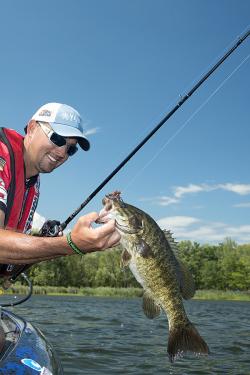
“Casting is a great way to get the bait or lure in front of the fish without spooking them when they’re up shallow,” says B’nM’ crappie pro staffer Brad Taylor.

It’s not just Brad Taylor using a spinning rod and reel when casting for crappie. His daughter, Allie Bre, one of his favorite fishing partners, also loves to cast and catch crappie. “It’s a great time to take out your children and let them cast a live minnow or lure by themselves without having to help them and they can honestly catch a fish by themselves,” said Taylor.

One of Taylor’s favorite crappie fishing spots is the renowned Grenada Lake in Mississippi. “Early in the year, I like to fish the grass on Grenada Lake since there is no structure to speak of here. I usually fish with a live minnow or Southern Pro Lit’l Hustler 1 ½-inch tube rigged on a 1/32- or 1/16-ounce jig head,” said Taylor.

For live minnows, Taylor uses a #2 Eagle Claw 214EL light wire hook and #4 split shot. “Since the water is muddy on Grenada Lake, I can rig up with 8 pound test line when fishing with live minnows or even tubes,” said Taylor.

Crappie caught by casting

Crappie caught by casting

Taylor likes to rig with a cork and keep the tube lure just above where the crappie are located.

“Most the time on Grenada, I’m in about three feet of water catching them,” said Taylor.

Casting light offerings can be challenging for the novice angler. However, a spinning reel can help eliminate some of the problems associated with casting especially live minnows or lightweight lures. Spinning reels have a fixed spool that doesn’t rotate. Instead the fishing line flows off the spool by being pulled from the weight of the lure.

One reel especially effective for this duty is the WaveSpin spinning reel (www.wavespinreel.com) with a unique star-shaped spool lip that the company says is much less likely to cause tangles than conventional designs. Reportedly the design can also increase casting distances due to reduced line drag. The revolutionary spool features a row of teeth all slanted in one direction with gaps between the teeth reducing friction at the same time eliminating tangles. The reels have aluminum spools, all metal gears, over-sized line roller, infinite anti-reverse and an exclusive 10 disc drag system.

Two anglers that don’t have any problems casting spinning rods and reels are B’n’M’s pro staff manager Kent Driscoll and B’n’M’ pro staffer/Grenada Lake fishing guide John Harrison (www.crappie101.com) who fish together in crappie tournaments. Both like to cast spinning rods and reels especially to stake beds. Stake beds are man-made structure commonly constructed from wood or PVC pipe to attract crappie.

“When fishing stake beds, we approach them going into the wind because we can control the boat better and that lets us keep our distanced from the stake bed,” said Harrison.

“We use live minnows, live minnows rigged on a jig with a soft plastic body or a 1/16-ounce jig. Normally, we will just cast past the stake bed and twitch it, pause, twitch, pause retrieve back through the stake bed,” said Driscoll.

Rod and reel for casting for crappie

Rod and reel for casting for crappie

When it comes to crappie rods Taylor, Driscoll, and Harrison like using the B’n’M’ Poles Sam’s Super-Sensitive 7-Foot Crappie Rod (www.bnmpoles.com) or Buck’s Graphite Crappie Spinning rod. Both are lightweight graphite rods design just for casting live minnows or casting lures.

Spinning reels and rods make casting live minnows and lures so easy any angler can do it. Then it’s a matter of cleaning the fish and heating up the cooking oil.

Does the Ohio River Have Trophy Catfish?

Catfish from the Ohio River

Catfish from the Ohio River

New Study Launched to Track Trophy Catfish in the Ohio River

Ohio Division of Wildlife
from The Fishing Wire

The popularity of catfish angling has increased tremendously in recent years and the large sizes that catfishes can attain make them especially popular with anglers seeking trophy-sized fish. Trophy-sized catfishes can be found in many lakes, rivers, and reservoirs throughout Ohio, as evidenced by the state records for flathead catfish (76.5 pounds from, Clendening Lake) and channel catfish (37.6lbs from LaDue Reservoir). However, the Ohio River is the premier destination for Buckeye State catfish anglers pursuing some of Ohio’s biggest fish. The state record blue catfish (92lbs) was caught in the Markland Pool of the Ohio River in 2009. In recent years, however, anglers have reported decreasing catches of large flathead and blue catfishes in the Ohio River, particularly in the Markland and Meldahl pools.

Large Ohio River catfishes present some unique challenges for state agencies responsible for managing the fishery (Pennsylvania, Ohio, West Virginia, Kentucky, Indiana, and Illinois). The Ohio River is a massive system, spanning 981 miles and having 19 lock and dam complexes from its origin in Pittsburgh, Pennsylvania to the confluence with the Mississippi River at Cairo, Illinois. The size and complexity of the Ohio River makes it difficult for biologists to estimate how many large catfish are present and the sizes available for anglers. Also, fishing regulations vary among some Ohio River states for anglers and commercial fishers. In fact, Kentucky, Indiana, and Illinois permit the commercial harvest of Ohio River catfishes, but Ohio, West Virginia, and Pennsylvania do not. In addition, little is known about how commonly large catfishes move between Ohio River pools and between state jurisdictions and move into, or out of, the commercial harvest zone.

In 2014 the Ohio Division of Wildlife initiated a 5-year study with the goal of learning about the movements of large (>25″) catfishes in the Ohio River. Specifically, the study aims to determine how much these large fish travel between pools and how widely they wander within the river and its tributaries. Information for this study will be collected through angler reports and through the use of specialized telemetry equipment and results will help agencies along the river better manage the catfish fishery.

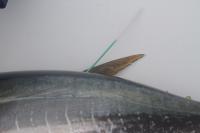
Large flathead and blue catfish will be marked with an external tag inserted near the dorsal spine and released back into the Ohio River. Each of these tags will be imprinted with a toll-free “1-800” number that anglers can call to report catching one of these fish. Catch reports should provide a location of where the fish was caught and the unique identification number on the tag. Anglers that report catching one of these fish will receive a reward (valued at $10-100 and will be entered into a drawing for a $1,000 cash prize at the end of the study. This information will be used to estimate the catch and harvest of large flathead and blue catfish by anglers and commercial fishers.

A subset of these tagged fish will also be implanted with a transmitter (picture) that emits an ultrasonic signal that can only be detected by specialized equipment, called hydrophones. Hydrophones are underwater microphones specifically designed to “listen” for these tags. Each time a hydrophone detects a signal from one of these transmitters, it records the date, time, and the identification number of the tag. So each time a fish with a transmitter swims by one of these hydrophones, we will know when that particular fish was in the vicinity of that hydrophone. Biologists will use the detection history for each fish to track the movements of these large catfish over the next few years. For example, when the same fish is repeatedly detected by a single receiver, we will know that it remained in that area over that time. Conversely, if the same fish is subsequently detected by a receiver in another area of the river, we will know that the fish was moving upstream or downstream at that time.

The Ohio Division of Wildlife, Kentucky Department of Fish and Wildlife Resources (KDFWR), West Virginia Division of Wildlife (WVDNR) and the United States Fish and Wildlife Service (USFWS) have been working together over the last year to deploy dozens of these hydrophones throughout the Ohio River and the primary tributaries to study movements of invasive Asian carp. This hydrophone “array” will also benefit this catfish research as well.

In addition to identifying the areas most frequently used by large catfishes and measuring their movements throughout the Ohio River, this study is anticipated to provide information on catch and harvest rates for these fish. This information will help biologist better understand the dynamics of large flathead and blue catfishes in the Ohio River and potentially identify the need for new strategies to more effectively manage these fishes.

It was the best of times, it was the worst of times for me in my Top Six tournament

“It was the best of times, it was the worst of times.” That quote from ‘Tale of Two Cities” pretty well sums up my fishing at the Georgia Bass Nation Top Six tournament at Lake Eufaula last Friday and Saturday.

I went to Eufaula Wednesday morning, registered the Flint River Bass Club team, got a campsite, and put my boat in the water to look for something that would work in the tournament. The first place I stopped I quickly caught a two pound largemouth and a 13 inch spot on a ledge, so I felt I at least had something to rely on.

After about six more hours of riding ledges watching my depth finders looking for fish, I had found a couple more places that looked good. That night I tried to think of what to do the next day, the last day of practice, and in the tournament.

Niles Murray and Jennifer Spell, the other two team members, met me the next morning at the boat ramp and we headed out just as the sun came up. We tried some shallow lily pad fields and a couple more places and Niles caught one fish. Then we went into a small creek. Niles and I cast at about the same time to a rocky bank with overhanging bushes and we all three saw a nice bass come up and eat Niles’s Trick worm.

He landed a four pound bass and when I picked up my rod I had a nice keeper on the jig and pig I was fishing. I told them I knew where I would start the next day. They were both co-anglers, fishing with someone else in the tournament from their partners boat. I would be fishing from mine.

We then fished a brush pile and I caught a five pounder on a jig and pig. A little later Jennifer caught a good keeper off some riprap, then added a 2.5 pound fish from the edge of some lily pads in a cove. After looking at a ledge in the area that was covered with fish we could not get to bite we went in for the drawing.

I was boat 20 so there were only 19 boats ahead of me the next morning at blast off, but after running five miles to the small creek there was already a boat fishing there. So I went to the brush pile where I had caught the five pounder the day before. That fish hit at noon, with the sun high. The sun was just coming up when we stopped.

Neither my partner nor I caught a fish from the brush, so we went to the riprap. I quickly caught two solid 15 inch keepers on a Bitsy Bug jig and pig. Then we fished the lily pads and a 3.5 pound bass hit my topwater frog. I felt pretty good with three keepers at 9:00.

After fishing the pads we went to the ledge where we had seen the fish and I caught a 14 inch keeper. At 10:00 I went back to the brush pile and within a few minutes I landed two bass just under three pounds each on a Rattleback jig with a Zoom Fat Albert trailer. That culled my smallest fish so I told my partner he could have control of the boat the rest of the day since I had a pretty good catch.
He wanted to run up a creek and fish a frog in the lily pads, so we did that the rest of the day. I missed two good bass on the frog and he caught three, and missed about ten hits. It is often hard to hook a bass on a frog in lily pads.

Just as time ran out my trolling motor batteries went dead. It was not a problem since we had to go in, anyway, and we had been churning through lily pads for four hours, rough on any motor. I had fished at Lake Martin for ten hours on Saturday and seven more on Sunday a couple of weeks earlier with no battery problems, so I was not worried.

At weigh-in I had just over 12 pounds and felt good about my catch when I headed to the campground, hooked up the battery chargers, cooked and ate dinner and went to bed.

I was asleep by 8:00 since I had to get up at 4:00. A little after 9:00 my microwave beeped when the power went out and woke me a little. The wind had gotten bad and I was so groggy from sleep my only thought was that I hoped the power would come back on so I could have coffee in the morning.

Just after 3:00 the microwave woke me again when the power came back on. I had enough sleep that I woke well enough to think about my battery chargers. They don’t work very well with no power. I got up and checked and they were back on, too.

When I got up an hour later my batteries were still charging so I left them on until the last minute when I had to leave to pick up my partner for the day. When I met him he said he had checked and I was in fifth place out of 98 people.

We ran to the brush pile as soon as we started and the wind was so high it was hard to fish. Nothing hit but I was not worried, the sun was not bright yet. We tried to fish the riprap and lily pads but the high wind kept the fish from biting. At 10:00 I went back to the brush pile and found out my batteries were already so drained I could not control the boat in the wind.

For the next five hours we had to find a bluff bank where the wind was not so bad and drifted and fished. I never caught a fish and dropped to 24th place!

I have two new batteries in my boat for the Flint River tournament at Lanier today!

Humminbird® Pros Win Inshore Redfish Tour (IFA) 2014 Championship

Captains Rick Murphy and Geoff Page commit to insanely long runs, take top honors

HOUMA, LA. – Captains Rick Murphy and Geoff Page are no strangers to top IFA Redfish rankings. In 2004 and 2010 the duo won IFA Team of the Year. In 2011 and 2013, they won qualifying IFA events, but until now, never an IFA Championship.

“We would have been proud as pumpkins with 5th or 6th place,” says Sarasota, Florida-based Captain Geoff Page. “After the first day we were in 11th place and we didn’t think we could win it. Our goal was just to get a Top 10. The win never crossed our mind. And then it just fell in our laps.”

Still, the win is the result of an ambitious plan-one that required a 108-mile run each way from Houma, Louisiana, to Venice. The trip was 200 miles plus round trip!

Murphy started scouting the Houma area a week prior to the tournament while Page fished around Venice, marking waypoints on his Humminbird 798ci HD SI.

“Here I am scouting in Venice and Rick is eliminating any potential waters near Houma. And not once did I have to consider how to get to Venice – that was all Rick’s inherent skill, Humminbird GPS and Yamaha Fuel Management Gauge,” says Page.

Wasn’t long into practice that the two realized Venice would be the place to be come tournament time. Because Venice extends so far into the Gulf, it serves as a natural stopping point for baitfish moving from west to east or east to west in fall and winter.

“We knew that 26- to 27-inch reds near Venice would weigh more than anywhere else. Pogies are plentiful there and they pack a ton of protein. All we had to do was figure out how to get there,” says Homestead, Florida’s Captain Rick Murphy.

Skeptical that the run could even be made without diverting far into the Gulf, the duo sought the advice of locals familiar with labyrinthine canals, marshes and bays.

Page laughs: “Homeboys told us, ‘A little crazy, but you can do it!'”

“I marked all the waypoints on my 798ci HD SI unit. When we decided to use Murphy’s Pathfinder to make the 200+ round trip journey, I simply saved all my waypoints onto an SD card and plugged them straight into Murphy’s 1199. It worked flawlessly and took just a few seconds! I’ve always said fishing a Humminbird is easy, but that wins the prize – literally!”

So, using the GPS on his Humminbird 1199ci HD SI Combo, Murphy was able to map a quick route to their preferred redfish waters.

“I ran the Intracoastal Waterway and Houma Canal down past Cocodrie Bayou and headed east through marshes, using the Humminbird GPS to navigate old oil landcuts, coming out about 16 miles northwest of Grand Isle. From there I continued using the GPS, following the barrier islands in the Gulf to Venice.”

Murphy says the key was dropping waypoints during the entire route to aid in navigation.

“All I had to do was go from one waypoint, push exit, and go to the cursor for the next waypoint. That kept me on the right path, rather than hitting ‘Go To,’ which might divert me around an island. I ran the 1199 in split-screen with mapping and satellite overlay: 1-mile scale on the left and ¼- or ½-mile scale on the right side. I set the cursor 16 miles away; made it real simple.”
Following Murphy’s mapping run the Tuesday prior to the tournament, the team felt confident in their plan.

“We transferred all my waypoints from Venice to Rick’s 1199 and we were ready to go,” says Page.

Pushing Pogies, Boxing Reds

“On Day One we did the route in I hour 45 minutes, fished for 3.5 hours and then ran back to Grand Isle, got fuel, and ran home for weigh-in,” says Murphy.

What they found were “millions and millions” of pogies and some fat reds, including the second and third biggest fish of the tournament, including a 9.67-pound fish on Day One that measured a mere 1/32-inch from the 27-inch cut off.

The duo’s program involved Murphy using a Yeti cooler as a platform on the bow of his Pathfinder 2300 HPS for added elevation to spot active reds.

“I’d stand at the cockpit and help Rick spot fish, which he’d get first crack at. Thing is, he’s probably one of the best sight fishermen in the world. If he saw a fish he’d press stop on his iPilot remote and take the shot. If there was another fish in the boil, I’d cast,” says Page.

“I ran the Minn Kota iPilot remote in my left hand and a baitcaster in my right. It was all about spinnerbaits. Vibration was key – big blade and the thump of a Bass Assassin paddletail on the back,” says Murphy.

Moving the boat slowly ahead with the Minn Kota iPilot remote, Murphy would literally part massive schools of pogies with the boat, pushing them toward shore.

“The redfish went nuts as soon as the pogies hit the grass. You’d have about three to five seconds to throw to a redfish boil and intercept them. It was pretty intense sight fishing,” says Murphy.

“It was a cool deal. We worked island after island without ever cranking up the big Yamaha. Just point the iPilot toward the next island, hit the due north button and get ready for the next throw down. You might see three fish, you might see 13 … and they’re Louisiana fish, which don’t spook like Florida reds. You’d throw a spinnerbait at ’em and they’d run it down and eat it,” says Page.

After Day One the team was in 11th place with 16.85 pounds. On Day two they started in the first
flight of boats and shaved 15 minutes off their morning run, reaching Venice in 90 minutes.

“On Day Two we had a 9.77 and a high 8 for a two-day total of 35.29,” says Murphy. “It was a really great surprise. Definitely made the running worth it!”

Page says the Championship win demonstrates just how important the right equipment can be.

“Sure, we found the right fish, but we never would have been able to reach them without stuff that works. Humminbird and Minn Kota were a big part of it, as well as the reliability and speed of our Pathfinder boat and Yamaha motor. Keep in mind it was pretty dark when they cut us loose in the morning. But we had good waypoints so we could get there safe and sound, even at some pretty high speeds.”

Although humble, Page says the bragging rights will be used.

“We’re in our early 50s now. Sure, we can go hard all day long on the water, but do you think we could stay awake through the ninth inning of the World Series games? We’re like the old men of IFA Redfish, but this win proves we can still hang with the young bucks!”

Murphy and Page also earned $44,990 in cash and prizes.

For more information visit humminbird.com, contact Humminbird, 678 Humminbird Lane, Eufaula, AL 36027, or call 800-633-1468.

Why I Love Lake Martin

As usual, the three bass clubs in Griffin had a great trip to Martin for our annual tournament last weekend. The weather was great, except for a bad thunderstorm that hit Sunday morning a little over an hour before daylight and delayed our blast off for 30 minutes.

Some members of the clubs went to Martin a week early and spent five or six days trying to come up with a good pattern for the two day tournament. Many of us camp at Wind Creek State Park, others stayed in cabins there, and some got motel rooms in Alexander City. I love camping at Wind Creek, it is a beautiful place and the weather is usually great.

I did my usual, leaving Wednesday afternoon and getting to Wind Creek in time to put my boat in at the ramp, go around to my campsite and leave it then walk back to the ramp for my van. It was so nice I didn’t even mind the walk. Also, I was not worn out from fishing all day.

Thursday morning I got up before daylight and went looking for places to catch fish. I landed four nice keepers on a crankbait before it even got light enough to see. As the sky got gray I picked up a topwater plug and caught nine keepers and several throwbacks before 9:00.

After riding around some looking at different spots I went in and took a nap in my van. Then I went back out and caught several more bass after lunch. Two of them hit a top water plug at 2:00 in the bright sun, and they were the two biggest fish I caught all day. I was sure I had found something good.
After eating dinner at the campsite I got in bed early. Since I thought I had figured out what I needed for the tournament I slept in Friday morning. But when I went out at 7:30 and tried topwater in some new places I didn’t have much luck. I did catch a nice three pound largemouth on a worm in a brush pile, another good keeper from under a dock and two or three drop shoting deep points. So I had a plan “A,” “B,” and “C.”

Good plans often are great until the fishing starts. Saturday morning I had a limit of fish within 30 minutes, but they were all small. By 10:00 I lost count of the keepers I had caught when I went over 18, but only one was close to two pounds. So I took off up the river.

That worked. I caught a three pound bass and others that culled every keeper I had in my live well from that morning except one.

Sunday was completely different. At 10:00 I had caught a lot of short fish but only two little keepers. So I went out on a point to drop shot, and fish came up schooling. I caught two drop shoting and two on top so I did get my limit. Then I went to the brush pile where I had caught the three pounder Thursday and quickly caught two decent spots from it.

In the tournament 23 fishermen brought in 166 keepers weighing about 223 pounds in 17 hours of fishing. There were no fishermen with no bass and we had 33 five-fish limits. On Saturday only two fishermen didn’t weigh in limits, but there were only 12 with limits on Sunday.

In this tournament we fish it like two one day tournaments. On Saturday Bobby Ferris won with 9.84 pounds, I was second with 9.82 pounds, James Beasley had 9.52 pounds for third and Raymond English was fourth with 9.14 pounds. Robert Proctor had big fish with a 3.67 pound largemouth. My 3.05 pounder was second biggest.

Sunday was much tougher. Lee Hancock won with five at 8.26 and had a 2.95 pounder for big fish, Kwong Yu was second with five at 8.22, Billy Roberts placed third with five at 7.51 and Raymond English was fourth again with five at 7.41.

The thunderstorm that delayed us broke my heart. A guide I know fished a pot tournament Saturday and he and his brother had seven fish that weighed 21 pounds. He told me they caught four spotted bass over three pounds each the first 30 minutes they fished, but it got tough after that.

The place he told me they caught them was a point the had shown me about five years ago, and I won that year with fish I caught there before the sun got over the trees. The sun hitting the water there is like a light switch being turned off – they just stop biting.

I was going to make the 20 plus mile run to that point Sunday morning, but the thunderstorm delay meant I could not get to it before the sun got up. As I said, the best laid plans last until the tournament starts!

I can’t wait to get back to Lake Martin!

What Are Some Tricks To Catch Late Season Crappie?

Surefire tricks for late-season crappies

Scott Glorvigan – sglorvigen@wired2fish.com
from The Fishing Wire

For anglers across the Ice Belt, November’s arrival spurs thoughts of the hardwater season ahead. But plenty of fine open-water fishing remains for the faithful who see the season through to the end.

Take crappies, for example. One of the year’s best bites is still firing on all cylinders, and promises stellar slabbin’ right through freeze-up. “It’s undoubtedly worth getting your boat out a few more times to enjoy the late-fall crappie bite,” says veteran guide and noted fishing authority Scott Glorvigen. “The fish are ganged up in predictable places, and ready to hit baits with a vengeance.”

Here’s the deal. As autumn wanes and water temperatures fall into the 40s, crappies abandon withering weedbeds and shift away from near-shore structure. “The fish head for their winter haunts, which are typically deep, mid-lake basin holes,” Glorvigen explains.

Here, large schools of hulking, hump-backed slabs roam the abyss in search of sustenance. Much of the feeding focuses on zooplankton and other pint-sized prey, but crappies eagerly snap up larger meals such as minnows and other baitfish.

Glorvigen leans on cutting-edge electronics such as Lowrance’s Elite-5 CHIRP Gold sonar-chartplotter to pinpoint pods of wayward panfish. “The fish are constantly moving around, which makes sonar a must,” he notes. “Lowrance’s new CHIRP units give you incredible target resolution, so you can verify the fish you’re marking are crappies, and even pick out individual fish within a school.”

A plotter primed with detailed mapping is another key component. “This allows you to identify likely areas and then search them effectively,” he says. “Plus, if you lay down a trail of waypoints while following the fish, you can often predict where they’re headed next. For example, if you know a school of slabs is moving in a counter-clockwise rotation around a deep hole, it’s much easier to follow the herd.”

In search mode, Glorvigen scans potential hotspots, which include depths of 50 feet or more. “Don’t assume there are limits on how deep the fish will go,” he cautions. “Many anglers mentally set a boundary of 25 to 30 feet, but crappies often suspend much deeper.”

Once a school is spotted, Glorvigen takes an unusual tack for tricking the fish. “One of the hottest tactics for tapping the late-fall bite is hovering swimming jigs such as Rapala Jigging Raps and Northland Puppet Minnows within the school,” he says.

“Horizontal jigs tipped with flavored softbaits such as Berkley PowerBait and Gulp! bodies also work well. “You can use spoons, too, but vertical baits aren’t nearly as effective this time of year.”

While many anglers wield tiny tackle for crappies, Glorvigen favors swimming lures in the 2- to 2¾-inch class, along with 1/8-ounce jigheads. Colors aren’t as key as the bait’s water displacement when fishing deep water, he notes, though he has seen higher catch rates on UV patterns compared to standard color schemes.

Gearing up, Glorvigen spools a light-action Lew’s multi-species spinning rod with 10-pound Northland Bionic Braid mainline. The rod’s quick tip engenders strike detection and solid hooksets, while the superbraid boosts sensitivity, which is a huge asset when fishing deep water. He ties a small swivel on the end of the line, to limit twist, and adds a 12- to 18-inch leader of low-vis 6-pound fluorocarbon.

Unlike traditional snap-fall tactics used for walleyes and other larger predators, Glorvigen applies a slower hand for suspended cool-water crappies. “It’s not a standard jigging presentation where you’re really working the bait,” he says. “This situation calls for deadsticking. When the crappies see the lure’s profile, they think it’s a minnow mixed in with the zooplankton, and boy, do they smack it.”

Thanks to his CHIRP sonar’s target resolution, Glorvigen can watch his jig even as it descends into a crappie wolfpack. “This is really a breakthrough,” he says. “It’s not uncommon to run across massive schools 15 feet thick. With traditional sonar, there’s no seeing into a tight school. Once the bait gets into the fish, it’s off the radar. But with CHIRP, I can tell where my lure is and how fish react to it.”

He cautions that once you find a school, it’s important to keep moving to stay on top of it. By shadowing a deep-running gang of slabs, it’s possible to pluck multiple fish from a single group. “Keep in mind that when you pull crappies out of extreme depths, the fish are likely unreleasable,” he warns. “Plan on keeping what you catch for a late-fall fish fry. And if you get on a school of fish too small to keep, move along until you find larger ones.”

Depending on the individual lake, your latitude, and what kind of weather Mother Nature dishes out in the weeks ahead, you might have a month or more of crappie action before winter draws the curtain on open water. “Good news is, as soon as safe ice arrives, the same areas are still going to produce fish,” Glorvigen adds. Which is all the more reason to hit the water now to unlock the locational secrets of late-fall crappies on your favorite fisheries.

Sitting In A Tree

Sitting in a tree for several hours at a time, waiting on a deer to come within range, gives you a lot of time to think. When you first settle down in the dark, watching the sky slowly lighten, all your thoughts are on deer. But when it gets light enough that you stop seeing antlers on every stump, your mind may wander a little.

For a few seconds it may linger on the problems of the world. Ebola, IRS scandals, Russia invading Ukraine, terrorists attacks on our embassies, terrorists killing people in the US and Canada and all the other top news items don’t hold your thoughts long. You may clench your teeth when you think about how hard you work to be able to hunt a day or two while the government takes chunks of your money to give to folks that don’t work, but your natural surroundings make those things pass quickly.

Your main concentration is on trying to do everything right so you don’t spook a deer, and watching for any tell-tale movement that indicates one is nearby, but you do notice many other things. You do see movement and every flicker draws hard examination, but it is almost always a squirrel or bird. Why are they called gray squirrels when they have only brown, black and white hairs? But they do look gray. Those are the kinds of thoughts that pass through your mind.

Even the trees and bushes seem sharper as the sun comes up. You can identify almost all of them from the bark, leaves and shape. That comes from years of study looking for food sources. And a falling leaf is interesting in the way it changes direction. They all have their own paths, some falling straight down, some spiraling, some fluttering like a wounded dove.

A thunking sound makes you smile. You know it is a big white oak acorn hitting a limb then the ground as it falls. After all, that is why you are set up here. White oaks dropping their acorns all around will definitely attract whitetails.

A distant train wails and you know why so many books and poems claim this is one of the most forlorn sounds. It reminds you of passing time, leaving a place you love and someone leaving you. Then a murder of crows go wild and their cawing calls bring you back to the reality of the woods.

You watch your breath in the cold morning air, noting the way it moves, knowing any scent you have that will spook a deer will go the same way. A squirrel comes out of its nests in a nearby tree, stretches and scratches, then starts barking at you. No matter how well you are camouflaged he sees you. But this is his home. He notices a new lump in a tree just like you would notice, as you came out of your bedroom, someone sitting on your couch.

And you can only hope you are high enough and well hidden enough so a deer doesn’t spot you before you can get a shot. That is why you are 50 yards from the trail you are watching. You only have a few narrow shooting lanes to it and that helps you hide, but you know you will not have long to get off an accurate shot through one of them.

And if you notice little flickers of movement from squirrels, birds and falling leaves you just know a deer will see you raise your hand to scratch your nose or if you move your head scanning around. So you make all movements very slowly, even if your nose is about to drive you crazy. Movement definitely draws the attention of a deer. Maybe that is why they seem to bed down and not feed when it is windy. There is just too much movement. And scents get blown around and are not reliable.

The sun makes interesting, changing patterns as it filters through the trees and leaves. You have set up so you won’t be looking through your scope directly into it, knowing a stray ray can blind you, and you hope you are at the right angle so it doesn’t interfere with any shot you get.

A crunch in the leaves makes you turn your head slowly to check it out, but you know before looking it has to be a squirrel. Deer can walk through the woods without making a sound. You can be looking at a spot, glance away and when you look back a deer will be standing there. It did not make a sound, it is like it popped out of the ground right there.

All these things and many more are the reasons you hunt. You can’t ever become “one with nature,” but this gets you as close as possible. Even if you don’t see a deer the time flies by and, as you climb down to the ground, you can’t wait till the next time you are up in a tree, thinking.

Should Anglers Keep Some of the Fish They Catch?

Encouraging anglers to keep fish

Editor’s Note: In many states, it’s been a long, uphill battle to convince anglers to release fish so that more can reach larger sizes. But in certain types of habitat-smaller waters with average low temperatures and minimal food production-the only way to get more big fish is to harvest lots of small fish, thus leaving more food for the survivors. Utah is currently working towards this type of a solution for many of their waters. Here’s the story, from the UDWR.

——-

Wildlife Board approves rule changes for 2015

SALT LAKE CITY – Biologists hope rule changes approved by the Utah Wildlife Board will encourage anglers to keep more fish in Utah.

you should keep fish in some cases

you should keep fish in some cases

Keeping the fish you catch – up to your legal limit – is the key to providing fish with the food they need to grow.
Photo by Richard Hepworth

“A chance to catch a larger fish is the number one thing active Utah anglers have told us they want,” says Drew Cushing, warm water sport fisheries coordinator for the Division of Wildlife Resources. “Unfortunately, at many of the state’s waters, anglers are releasing too many fish. If they’ll start keeping fish, up to their legal limit, the growth rate of the remaining fish should improve.”

Cushing says when a water has too many fish in it, the fish run out of food. And that limits how big each fish can grow. “In addition to helping the fish population,” Cushing says, “keeping fish will add something to your diet that’s extremely healthy and good to eat.”

To encourage anglers to keep more fish, the Wildlife Board recently approved several rule changes for the 2015 season. The changes take effect Jan. 1, 2015.

You can see all of the changes the board approved in the 2015 Utah Fishing Guidebook. The free guidebook should be available online by early November.

No home possession limit

Members of the board hope eliminating the ‘home’ possession limit-the number of fish an angler can have in his or her freezer at home-will help anglers develop a new ‘mindset’ that encourages them to keep more fish.

DWR biologists originally recommended that the possession limit be eliminated for every fish in Utah except salmonoids-trout, kokanee salmon, whitefish and grayling. The board, however, eliminated the home possession limit for every fish species in the state.

A creel survey, which measures the number of fish anglers keep, was completed at Willard Bay Reservoir in 2011. A similar survey will wrap up at Starvation Reservoir this fall. The DWR will conduct creel surveys at both waters in 2015. Results of the earlier surveys will then be compared with results of the 2015 surveys to see if eliminating the possession limit made a difference in the number of fish anglers kept.

No yellow perch limit at Fish Lake

The board also approved a DWR recommendation to eliminate the daily yellow perch limit at Fish Lake.

“In surveys,” Cushing says, “anglers have indicated that the number one reason they go to Fish Lake is to catch big lake trout. Right now, the yellow perch population in the lake is so large that trying to introduce a species for lake trout to feed on isn’t going to work.”

Cushing says reducing the number of yellow perch will increase the amount of zooplankton available for other species to eat, including kokanee salmon that biologists want to introduce to the lake. A self-sustaining population of kokanee salmon would provide an excellent food source for lake trout in the lake.

The idea to eliminate the yellow perch limit originated with an advisory group of anglers assembled by the DWR.

Brook trout limit increased at Boulder Mountain reservoir

The board also approved a recommendation to increase the daily brook trout limit at Oak Creek Reservoir, one of 80 lakes and reservoirs on the Boulder Mountains in southern Utah.

Starting Jan. 1, the limit at Oak Creek will increase from four brook trout a day to 16 brook trout a day.

“The reservoir has an increasing population of brook trout, and fish are growing much slower,” Cushing says. “The fish are not getting as big. When the limit increases on Jan. 1, we hope anglers will take advantage of the increased limit and remove some additional fish. If they don’t remove enough fish, we’ll have to chemically treat the reservoir and then restock it with sterile brook trout that can’t reproduce.”

Another change on the Boulder Mountains involves placing limits on each of the mountain’s 80 lakes and reservoirs. Currently, lakes and reservoirs are grouped together, based on where on the mountain they’re located. Then, a limit is applied to every lake or reservoir in the group.

“Listing each water that has a limit that’s different from the general statewide limit, and what the limit is for that specific water, will eliminate a lot of confusion among anglers regarding what the limit is at each water,” Cushing says.

An advisory group of anglers who enjoy fishing on the Boulder Mountains helped the DWR draft the proposal the board approved.

Why Am I A One Issue Voter?

I admit it. I am a one-issue voter. I will never vote for any politician that thinks making it harder for law-abiding citizens like me to get a gun or ammo will do anything to stop gun crime. And as a bonus, I usually find the candidates that oppose gun control also agree with my feelings on most other issues, too.

Gun control is one of those issues that pits individual liberties and responsibility of the individual against those that think government can solve all problems. Supporters of gun control want to pass even more laws that have no effect on people that use a gun for crime. How can any rational person, politician or anybody else, think someone willing to commit murder will be affected in any way by laws restricting the availability of guns?

Blaming the gun for crimes and trying to control access to them is like blaming the drugs for addiction and trying to control access to them. It simply does not work. If it did there would be no illegal drug use. It is also like blaming the match for arson. Guns don’t go out and shoot someone by themselves any more than a match goes out and lights a fire without someone striking it.

Some may think eliminating guns will keep criminals from getting them. If there are no legal guns, like there is no legal heroin or cocaine, they somehow think gun crime will be eliminated. Heroin and cocaine prove the illogic of that position.

Recent events in the US and Canada have drawn the usual whines for even more gun control. In Canada a terrorists used a 30-30 lever action rifle to kill a soldier and shoot up the parliament building. I just kept waiting for someone to call the rifle that has been around for over 100 years a “semiautomatic assault style weapon.”

In the US, police were attacked by a terrorists using a hatchet. Wonder if it was semiautomatic? In a school shooting a student brought a handgun to school and killed two of his classmates and shot others, The big question has been “where did he get the gun.” As Hillary would say, “What difference does it make?”

Why did he do it? Would he have done something similar, or worse, for example some kind of bomb, if he had not gotten a gun? Immediately the Brady Bunch, who used to be called Handgun Control, Inc and now renamed the Brady Center to Prevent Handgun Violence, sent out fund raising letters and emails. They want to somehow stop kids with mental problems from getting their parents guns. How? By eliminating all guns?

There are insane people in our world and there are mean, evil people, too. They will find some kind of weapon to do violence on those that abhor it. If no one had a gun, what would they use? And in the two above cases, a good guy with a gun shot and stopped the terrorists.

If guns caused problems there would be a high murder rate in deer camps, where every fall folks sit around for days within easy reach of high powered rifles, often the dreaded semiautomatic weapon type. Yet you never hear of a shooting in a deer camp.

If guns caused problems it would be unsafe to walk into a store selling guns. From Walmart to Berrys Sporting Goods, racks of guns sit calmly and don’t shoot anyone. In fact, there are a bunch of guns in my house, all loaded and ready to shoot, but they have never shot anyone.

Gun safety is important. If there were young kids in my house I would teach them to leave guns alone unless an adult was present, but I would store guns and ammo separately and lock them up. Kids will be kids and accidents will happen, but teaching safety will go a long way to preventing them.

I got my first .22 when I was eight years old, and had been shooting a BB gun for about three years before I got it. Gun safety was instilled in me from the time I was old enough to understand danger and guns were part of my life every day. All my friends had guns and from the time we were about ten years old we were allowed to hunt together, since our parents knew they had taught us well. And we never had an accident or intentionally shot another person.

Guns are inanimate objects. They have no will of their own. Only people have the ability to do harm with them. Getting rid of guns or making it difficult for careful, law-abiding folks will do nothing to stop those with a will to do harm.

Be wary of politicians supporting gun control. They don’t trust you and guns are not the only one of your liberties they want to control.