Tough June Tournament At West Point Lake

At West Point on Sunday 16 members of the Sportsman Club fished our June tournament from 6:00 AM until 2:00 PM. We landed 29 keeper bass weighing about 47 pounds. There was only one five-fish limit and three fishermen didn’t catch a keeper.

Kwong Yu won with three largemouth weighing 7.80 pounds. My four bass weighing 7.56 pounds was second, third was Raymond English with five at 6.83 pounds, Javin English was fourth with four at 5.89 pounds and Chris Davies won big fish with a 3.93 pound largemouth.

I was surprised at the number of largemouth weighed in. West Point is full of spotted bass and they are usually fairly easy to catch, but not Sunday! There were 12 largemouth brought in and four of them weighed over three pounds each.

Jordan McDonald fished with me and I had a very frustrating start. Nothing hit any of our baits at daylight the first place we stopped, a hump where I can usually catch a lot of spots as it gets light. The second place we tried Jordan got a nice largemouth but that was the only fish we caught on that rocky bank and point, another place where we usually catch a bunch of spots.

At 9:00 we were headed to the fifth place we wanted to fish when I noticed current moving at the bridge we went under. Current usually makes the fish bite, like it did at Bartletts Ferry last month, so I pulled in to a nearby point. Although we could see a big school of baitfish with bigger fish under them down 16 to 18 feet deep on the point they would not hit anything we tried.

After 30 minutes of trying to make them hit crankbaits, worms and topwater I got out my dropshot rig. That rig is a four inch worm on a small hook about 12 inches above a one-eighth ounce sinker tied on eight pound test line. You drop the rig to the bottom straight under the boat, keep the lead on the bottom, raise your rod tip to make the worm suspend and jiggle it slightly. Bass will often hit it when they won’t hit anything else.

I felt a slight weight as I jiggled the worm and set the hook, and yelled for the net. I could tell it was a good fish. I usually catch smaller fish on that rig but this turned out to be a 3.56 pound largemouth. We stayed there and thirty minutes later I got another hit and landed a two pound largemouth.

After another hour on that point without any more bites we tried another point. I missed a bite on a jig head worm then caught a keeper spot. Some fish were hitting on top out over deep water and I thought they were hybrids, but Jordan cast a jerk bait to one of them and landed a keeper spot.

After fishing that place and getting no more keepers we went to another point. As we fished it I saw more baitfish with fish under them, again down about 15 feet, and let my dropshot worm down to them and caught my fourth keeper, another largemouth.

That was it for the day. We tried several more places, including going back to the place I caught the first two, and the fish were still there but still would not hit.

Fishing can be tough right now and it is hot, but I would rather be fishing than anything else I could do!

How Does Florida Manage Barracuda?

Florida Barracuda one step closer to better management

Today’s feature comes to us courtesy the Snook & Gamefish Foundation—read more about this conservation group at www.snookfoundation.org.

Florida barracuda

Florida barracuda

By Mike Hodge
from The Fishing Wire

The barracuda is considered among the fiercest predators on the flats, yet the feisty fish has had little protection when it comes to bag limits in the state of Florida. That may change thanks to the Snook & Gamefish Foundation and other conservation organizations.

The Florida Fish and Wildlife Conservation Commission (FWC) took a big step last week toward establishing regulations to protect barracuda when it announced a proposal restricting recreational and commercial harvests of the fish.

During a public hearing in Sarasota, the FWC staff presented a draft rule to the commissioners, who will formally vote on the measure this fall.

The rule will create:

· a recreational and commercial slot limit of 15 to 36 inches

· a recreational daily bag limit of two fish per person

· a commercial vessel limit of 20 fish

SGF members and staff applauded the recent developments.

“These proposed regulations by the FWC show a deep commitment to protecting and ensuring the sustainability of a species that many people simply overlook, or call a ‘trash fish,’ ” said Mike Readling, chairman of the SGF’s Board of Directors. “As we know, every species is critical to the fine balance of our marine ecosystems, including the toothy ones with poor reputations. These new limits will go a long way toward curbing massive, unnecessary harvests of barracuda, and the Snook and Gamefish Foundation is proud and excited that our iAngler app was singled out by the FWC as one of the avenues to a scientific-based solution for the documentation of this species.”

The FWC, which has not done a formal stock assessment for barracuda, has encouraged fishermen to use the SGF’s Angler Action Program (AAP), an electronic logbook, to help monitor the population.

Photo: dan Decibel”Florida anglers are really lucky to have this commission and science staff,” said SGF Executive Director Brett Fitzgerald, who is particularly satisfied with Florida’s continued willingness to stretch the boundaries of conventional fishery management. “FWC has allowed FWRI to be very progressive, and they are willing to look into new solutions to old fishing problems. In this case, using recreational angler data from the AAP represents a huge shift in the culture of fishery science. Anglers truly are plugged in — directly — to the system. Now every fishing trip that is logged counts towards a brighter fishing future.

“What’s cool is, we didn’t set the system up to help specifically with ‘cudas. But here we are, contributing meaningful info for the protection of that species. And you can bet many more species will follow. The power to improve fishing is truly in our own hands. It’s an opportunity that is unprecedented and well earned by the anglers who have been faithfully logging in the AAP.

“We at SGF can’t say enough good things about the FWRI staff, from top to bottom. Their guidance throughout the AAP development process has been continuous and critical. It’s really an honor to share ideas with them and see the ideas come to fruition.”

Florida barracuda are fun to catch

Florida barracuda are fun to catch

Anglers in South Florida, the Keys in particular, have complained that barracuda numbers have declined in recent years, which prodded the Lower Keys Guides Association (LKGA) to launch the Save the Barracuda Campaign.

It took nearly two years, but the LKGA concerns have been addressed.

“Barracuda are amazing sport fish, and intricate part to the nearshore flats fishery of the lower Keys and Key West,” LKGA President Luke Kelly said. “When winter weather proves tough for other gamefish, barracuda fill the gaps providing great action on the shallows for the many travelers who find themselves south during winter. We at the LKGA are very happy to see the action taken by the FWC on this important issue.”

No one knows for sure why the South Florida barracuda population has appeared to be dwindling, but commercial harvests could be part of the issue. According to the FWC, commercial harvest of Keys barracuda has increased dramatically the past few years, from 10,000 pounds in 2011 to 50,000 in 2013.

Barracuda is considered an unregulated species commercially, meaning commercial fishermen can harvest as much as they want. Recreational anglers are limited two Cuda or 100 pounds, whichever is greater.

New regulations, if approved, should help, but Fitzgerald warned against complacency.

“We aren’t done yet,” he said. “This is a case where there is power in numbers. We anglers need to continue logging, continue recruiting new anglers into the Angler Action Program’s system. If we were to let this privilege slip by because we decided not to log, we’d really be doing ourselves a disservice.”

The final hearing on barracuda regulations will be held at the FWC Commission meeting in Weston (Sept. 2-3).

*photo credit: Image with ‘cuda and fly reel courtesy of Dan Decibel.

What Are the Top Midwest Walleyes Lakes

Top Midwest Walleyes Lakes

By Vexilar Pro Jason Mitchell
from The Fishing Wire

Big walleye caught in a  Midwest lake

Big walleye caught in a Midwest lake

The Midwest is ground zero for walleye fishing popularity. Midwesterners love their fish with the white tipped tails and luckily, there are several great walleye fishing destinations across the northern tier of the United States. Of course we couldn’t put every great walleye fishery on this list and the list is in no particular order. This list is nothing more than some top-notch fisheries that are fishing extremely well right now. Healthy fish populations, trophy fish potential and catch ability all factor into some of the best walleye water we have seen in our travels that in our opinion offer some of the best walleye fishing in the region.

Leech Lake, Minnesota
This massive natural lake in northern Minnesota has gotten a lot of attention in recent years for great walleye fishing but this lake just seems to get more solid each year. There are a lot of walleye in this lake with opportunities for both eater size fish and big fish. What is neat about this big lake is that you can fish so many different ways. From classic rigging and jigging presentations to lead core and swim baits, there is so much variety in this ecosystem that there are usually several solid patterns happing at once.

Lake Winnibigoshish, Minnesota
Another of the big natural lakes in northern Minnesota, Winnie has quietly developed into one of Minnesota’s best walleye lakes. Perhaps at the expense of the Lake’s renowned perch population, the walleye population is healthy and thriving. Fun shallow weed patterns occur through the summer as well as classic structure fishing over deep gravel bars.

Devils Lake, North Dakota
This now massive natural lake is now nearly 200,000 acres of water when you look at the entire lake basin and include Stump Lake. With high water and a decade and a half of incredible recruitment, this lake continues to live up to its stellar reputation as a top tier walleye fishery. Several shallow patterns emerge that are fun for anglers. Top tactics include pitching crank baits and soft plastic swim baits into shallow water along with classic bottom bouncer and spinner presentations along weed bed edges.

Bitter Lake, South Dakota
The Glacial Lakes Region of South Dakota is very similar to Devils Lake in terms of history and high water creating new fishing opportunities. Bitter Lake is now the largest lake in the region and offers tremendous fishing. Anglers enjoy casting jigs and crank baits along weed bed edges or run the contours with bottom bouncer and spinners. Within sixty miles of Bitter Lake however are countless small lakes that also offer tremendous fishing and some of the lakes no doubt offer as good of fishing as your going to find anywhere particular for numbers of fish.

Green Bay, Wisconsin
Probably the best fishery on the list for consistently producing trophy caliber fish. While some fisheries like the Western Basin of Lake Erie, Columbia River, Lake Winnipeg and Tobin Lake get a lot of attention for producing big fish. Green Bay often gets overlooked. Classic Great Lakes harness and board fishing tactics often shine through the summer with many small boat fishing opportunities on the right days.

Lake Sakakawea, North Dakota
This reservoir on the Missouri River in western North Dakota has been on the upswing in recent years and has several good year classes of fish. Extremely high amounts of forage have actually slowed fishing down over the past few years but there are a lot of walleyes in this lake and they have been well fed. This is more of an anticipatory pick as this cyclic lake by nature is due to really turn on and the stars are lining up. Anglers often focus on classic reservoir structure with live bait rigs, jigs and bottom bouncer and spinner presentations along with trolling crankbaits.

Kabetogama Lake, Minnesota
A classic Minnesota north woods fishing experience. With much of the lake located within Voyageurs National Forest, this mostly undeveloped lake offers that cool wilderness experience. Classic deep structure jigging and rigging tactics shine on this lake. Much like a Canadian Shield fishing experience, this lake is full of sixteen to twenty four inch walleye.

Lake Winnebago, Wisconsin
Really some of Wisconsin’s best inland walleye water. Great early season opportunities exist on the Wolf River but as the season progresses, much of the attention shifts back to the basin of Winnebago. Another lake with so many different patterns, walleyes can be found in shallow reeds and rocks or suspended out over the deeper basins.

Mississippi River Pool Four, Minnesota
We would rate this fishery right behind Green Bay for big fish potential on this list. Probably one of the best places in Minnesota for consistently finding fish over twenty-nine inches. A variety of fun patterns emerge including wing dams, trolling lead core and blade baits.

Lake of the Woods/ Rainy River, Minnesota
A very big lake with a huge population of walleyes. The Rainy River spring walleye run is one of the best fishing opportunities there is but what surprises some people are just how good the small boat opportunities are on the Rainy long after the crowds have left. Out on the big water, there are some phenomenal trolling bites that more recreational anglers are discovering with snap weights and lead core.

Missouri River, North Dakota
While the overall size of the fish has dropped off in recent years, the spring run up the Missouri River near Bismarck, North Dakota is still a walleye slug fest where anglers can sometimes score some big catches of walleyes with many fifteen to nineteen inch fish. Pitch jigs along shallow wood and sand bar current seams, slip jigs in faster water or pull crankbaits upstream.

All of these notable fisheries are top tier destinations that attract legions of anglers each season. A sampling of some of the Midwest’s top walleye fisheries but in no way is this a complete list of every great fishing opportunity. There are several smaller and more obscure fishing opportunities that fly under the radar and remember that a great day on a mediocre fishery is much better than a poor day on a great fishery. Is there a fishery we left off this list? Let us know what you think on the Jason Mitchell Outdoors Facebook Page, www.facebook.com/JasonMitchellOutdoors

Also don’t forget to check out the new and improved Vexilar website!! Visit www.Vexilar.com for more info and to learn/see all the great products!!

Good luck out there and be safe!!

How Can I Catch Five Pound Bass at Lake Seminole?

Laura Ann Foshee with Two Five Pound Lake Seminole Bass

Laura Ann Foshee with Two Five Pound Lake Seminole Bass

How early are you willing to get up in the morning to do something you love and how far are you willing to drive to do it? Sometimes I think nothing is better than the “job” of fishing and writing about it, but sometimes it wears me out.

Sunday I got up at 3:00 AM for the Spalding County Sportsman Club tournament at West Point and drove the 65 miles to the lake. After fishing eight hours, I got home at 4:00 PM, ate dinner, took a shower and was asleep by 6:00 PM since I had to get up at 1:00 AM Monday for a Georgia Outdoor News article at Lake Seminole.

After a four hour, 210 mile drive I got to Wingates Lunker Lodge and met Laura Ann Foshee, the young fishermen highlighted in the article. We fished until 2:00 PM then I drove the four hours home. I was worn out after those two trips!

Both trips were fun though. Laura Ann lives near Birmingham, Alabama and fishes for her high school bass team. She is one of only 12 high school anglers nationwide to be named to the Bass Anglers Sportsman Society 2015 High School All American Team. And she is the only female angler on it.

Laura Ann gets her love of fishing from her uncle, Scott Montgomery, owner of Big Bite Bait Company in Georgetown, Georgia. Big Bite is one of the biggest plastic bait companies in the US. So she has a lot of contacts with good fishermen, especially members of the Big Bite Pro Staff.

One of those Pro Staff Members took us out for the day on Seminole. Matt Baty lives in Bainbridge and fishes Seminole a lot, and does well in tournaments. We had a good day, landing two bass over five pounds each and several more keepers. And they hit in shallow grass beds. Laura Ann caught one of the five pounders on a topwater popping frog and that was very exciting! The other one hit a paddle tail worm swam over another grass bed. Both hit not far from Wingates in the Flint River and will be marked in the article.

She marked ten of her favorite spots to catch August bass on Seminole and explained how to fish them. That information will be in a Map of the Month article that will run in the August issue of both Georgia and Alabama Outdoor News magazines.

Are Big Baits Better for Big Bass?

Lunker Baits for Lunker Bass

By Frank Sargeant
from The Fishing Wire

There’s something that just doesn’t compute for me when it comes to tying a $50 bill on the end of my line and throwing it out there for the Fates to intervene.

But for a growing number of bass anglers, the opportunity of hooking a lunker largemouth is worth the risk: lures that cost $50 and even more are now available, and a fair number of anglers are catching fish on them.

Bucca Bull Shad Bait

Bucca Bull Shad Bait

One of the best is the big “Bull Shad”, a hand-carved lure produced by one Mike Bucca in his garage in North Georgia. The lure is pretty much a spitting image of a sizeable gizzard shad, and they do catch really big fish for anglers with the patience to throw them long and hard–they’re a favorite in the hard-fished clear water lakes of California, for example, where giant Florida-strain largemouths of 12 pounds and more are common.

At least one local guide has also discovered the magic of the Bull Shad. Captain Mike Carter, who fishes mostly from Goose Pond area up-river at Guntersville, has been putting some very large summertime bass in the boat in the last week on this lure.

Carter says his success on fish to 8 pounds has been primarily on grass edges and flats, not over the main channel where most bass anglers spend most of their time in the heat of summer. He says the first hour of daylight and the last after sundown are prime times, and even at that it takes lots of casting to find a bass big enough to eat the jumbo lure, but production has been impressive considering how difficult it usually is to catch big bass at this time of year. (You can learn more from Carter by visiting www.anglingadventures.info.)

The basic Bull Shad is a 5-incher that sells for $49.95 at Tackle Warehouse and other retailers. It’s available in a floater, a slow sinker or a deep diver. Bucca also makes larger–including much larger–models, up to 9 inches long. The big one weighs 5.5 ounces, about as much as a hand-sized bluegill, and it takes a man to throw it more than a few times–to say nothing of some man-sized tackle. The lure has a man-sized price, too, at $89.95!

The lures have four wobbling segments and a swimmer tail, and are so nicely carved that they look like someone has cut a live shad into four pieces and then stitched them back together. Bucca says the appearance, along with the action, does the job on big fish, which are very hard to fool on baits that are less lifelike because they’ve probably been caught many times over their life span.

Be that as it may, the idea of risking a lure that’s going to take a full day’s labor at minimum wage to purchase will give many anglers pause. Braided line testing 80 or 100 pounds should give some assurance, but when you hook up with a really big fish, anything can happen–failed knots or a knick in the line might bring on disaster.

The Bull Shad is not the only high-dollar lure on the market these days–many imported from Japan are in this price range, and like Bucca’s lure, they offer incredible realism and action, but at a price that will limit purchase only to the most avid anglers.

Some older anglers may remember a few decades back when the first fat lipped crankbait, the “Big O” came out and proved itself incredibly successful–the few who owned these lures sometimes rented them out for a day of tournament fishing. That may be no bad way to go when it comes to the new breed of high-dollar lures, for those unwilling to take the risk of amortizing a $50 lure.

Fishing Is Good At High Falls Lake

IMG_0750 If you like to fish you are missing out on a great place to go if you don’t try High Falls. The 660 acre lake is only a few miles from Griffin, Georgia boats are limited to 10 horsepower motors so you don’t have to worry about skidoos and skiers and the lake has great populations of bass, crappie, bream and catfish.

Peyton James knows how good it is and fishes it often. The last Friday in June he and his dad fished in the afternoon for bass and had an excellent catch, including one six pounder and several more big bass. Even better, Payton and his father caught them on topwater baits, the most exciting way to catch bass.

The fish hit near docks and blowdowns, making it even more exciting. On most big lakes this time of year you need to drag plastic baits in deeper water to get bit. Casting to visible targets, especially with topwater baits, is much more exciting!

You can catch all the bream you want fishing around shoreline cover with crickets or a flyrod and popping bug. Crappie will hit minnows or jigs trolled or fished around deeper wood cover. Catfish are a little tougher since they bite better at night and boat fishermen have to be off the lake by sundown. You can catch them from the bank if you have a place to fish after dark.

Nice High Falls Bass

Nice High Falls Bass

Try High Falls for some exciting fishing right now.

Reflection On Independence Day and the Future of Our Freedoms

Independence Day Reflection
Jim Shepherd
from The Fishing Wire

As we prepare to celebrate our national birthday, I’m reflecting proudly on our past, but as a gun owner and recreational shooter, I’m concerned for our future.

Last week, two Supreme Court opinions led one of their own members (more on that below) to accuse the Court of being “drunk on power.”

In a dissenting opinion on gay marriage, Justice Antonin Scalia broadened his dissent with an accusation that the Supreme Court was willingly undermining a fundamental principle of the American Revolution: “the (people’s) freedom to govern themselves”.

Scalia used a decision he described as “lacking even a thin veneer of law” to say the Court made “a naked judicial claim to legislative- indeed super legislative power; a claim fundamentally at odds with our system of government.”

Whatever your position on that issue, his words, which appeared very carefully chosen, should concern you.

He characterized the ruling as a “putsch”- a fighting word in most of the rest of the world. “Putsch” is the attempt to overthrow a government via suddenness and speed – a sneak attack.

Scalia and fellow dissenting Justice Clarence Thomas said the intent of the dissent was to “call attention to this Court’s threat to American democracy”.

For firearms owners, that’s warning of what is likely ahead. The landmark Heller opinion reaffirming our right to keep and bear arms was upheld by the narrowest of margins.

Today, that same court seems to be more likely to restrict gun owners than affirm their freedoms.

Before you write to indignantly remind me the 2A only recognizes a God-given right, realize this: today’s Washington is as fundamentally different from our founding fathers as the Houses of Parliament and monarchy from which they declared independence.

Justice Scalia says the Supreme Court has affirmed the right of the elite to decide what’s best for “the rest of us”. Last week it was health care and personal partners. Next time, it could be the right of firearms ownership.

The Court’s apparent willingness to decide law rather than follow it has many other smart people, principally those located outside Washington, equally concerned.

Today’s Supreme Court, as described by two of its own members, is highly unrepresentative of the people – and actively engaged in a “social transformation” of the country.

In fact, Scalia’s dissenting opinion characterized the entire Federal judiciary as “hardly a cross-section of America.”

Should enough of the “unrepresented America” decide enough is enough and act, Justices Scalia and Thomas may have unknowingly authored the catchphrase for yet another Declaration of Independence.

The first American revolution, Scalia wrote, represented the ultimate rejection of “taxation without representation”. He continued, saying “social transformation without representation” was equally intolerable.

That accurately describes the feeling of many across the nation as many elected officials, sworn to follow both the law and will of their constituents, do neither.

They’re joined at the hip with a mainstream media which agrees with their reshaping of America. With “the watchdog of liberty”- a free and unbiased media- transitioned to lap dog, news is no longer reported; it’s tailored to fit a particular narrative.

In short, our leaders no longer believe us smart enough to make our own decisions -so they’re making them for us.

That’s what makes Justice Scalia’s dissent both damning and frightening.

It’s damning in his enumeration of just how far government has distanced itself from the people.

It’s frightening because it indicates Washington no longer fears dissenters -even when they sit on our Supreme Court.

If you accept what Justice Scalia has written as accurate, many in government believe the rest of us to unwilling to suffer the discomfort associated with defending our core beliefs and national values. And they’ve suborned millions into agreeing with them by making it better to live on the dole than work.

Absent a dissenting Supreme Court and with the judicial branch already playing follow the leader, they really see nothing to rein in their remaking of our country as they think it should be.

A wealth of anti-gun legislation has already been introduced at the state and national levels this year.

It may look like more of the same knee-jerk legislation offered on the heels of other national tragedies.

But today’s legislative, executive and judicial branches are fundamentally different from those of only a few years ago.

As tens of thousands of New Yorkers have refused to comply with the mandated registration of their modern sporting rifles, legislators have seethed and are quietly looking for some way to compel their compliance.

With the non-compliance, these gun owners have essentially made themselves willing criminals. But the legislators appear uncertain as to how far they can push to enforce their legislation.That’s partially due to many law enforcement officials saying they won’t be part of some police action against otherwise law-abiding citizens.

Still, many of those elected officials would have no problem declaring firearms ownership as entirely illegal, or making gun ownership a disqualification for anything from holding a government job to opening a bank account or obtaining medical care.

We will still celebrate Independence Day 2015 at my home tomorrow, because we still have much to be thankful for.

But I hope you’ll take a few minutes to consider the thoughts I’ve been compelled- but uncomfortable-to write as a holiday message.

Examine your own family and your beliefs, then ask the same Creator whose guidance was petitioned by our founding fathers to give you a sign as to what each of us can – and should – do going forward.

God bless each of you – and, yes, God bless America.

As always, we’ll keep you posted.

I Love To Cook – and Eat!

I love to eat and love to cook, two things that go together well. This time of year we have a lot of fresh vegetables to eat or cook, making both even better. Squash are easy to grow and plentiful, and if you buy them the price is not bad right now.

Many years ago I had a lot of fresh yellow squash from my garden and wanted a different way to cook them. I like them sliced and fried or steamed with onions, and even fry the male blooms, but I had so many I need another way to cook and eat them.

This was before the internet where you can find millions of recipes fast, so I got out one of my favorite cookbooks, “Southern Country Cookbook” put out by Progressive Farmer magazine in 1972. I often refer to it and find recipes I like, even if I do change them some.

One recipe, “Skillet Dinner with Squash” caught my eye. It called for browning ground meat in bacon grease then adding chopped bell peppers, sliced squash, chopped tomatoes, salt and pepper and simmering for 40 minutes. I decided to brown the meat with chopped onions and used canned tomatoes with jalapeno peppers.

I was not sure how it would taste, but it was great! Of course I used ground venison, not beef, and increased the amount of bell peppers. I now cook it anytime I have some squash and it is great for lunch or even dinner. For dinner I eat it with a salad.

A couple of weeks ago when my wife was out of town I went to the freezer and found a package of sliced deer liver. Linda doesn’t like it so I usually cook it when she is out of town. I love it and was real disappointed that this was the last package I had.

I floured and sautéed the liver in bacon grease along with a bunch of sliced onions. When the liver and onions browned I added water and covered it to simmer for about a half hour. While it was simmering I sliced potatoes and more onions and browned them in more bacon grease.

I always have to have a green vegetable with my meals so I got out some frozen Brussel sprouts and thawed them in the microwave, then dribbled butter over them on a cookie sheet and put them in the oven under the broiler to brown almost to the point of being blackened.

I make sure I have enough gravy in the liver pan to smother the liver and potatoes on my plate. It is a greasy meal but it taste great and I had enough for two meals.

I had made a lot of gravy so I had about two cups left. So it would not go to waste I took a package of ground venison, about a pound, and made two big hamburger steaks. I first sautéed onions in more bacon grease and fried the hamburger steaks with them, then smothered all of it with the liver gravy and simmered for about 15 minutes. With French fries and cole slaw it was another great meal!

After the Sportsman Club Bartlett’s Ferry tournament last month I kept some spots to clean. I fried some of the filets but kept about a half dozen filets from one pound bass to make a casserole. It was simple, I sliced potatoes fairly thin and layered potatoes, filets and grated cheese in a big baking dish.

After adding a little milk I baked it until the potatoes were soft, the fish done and the cheese melted. All I needed with that casserole for a meal was a salad to go with it.

Writing this made me hungry. Time to go cook something!

What Are the Odds Of Getting Bitten By A Shark?

Sharks!

By Frank Sargeant, Editor
from The Fishing Wire

OK, folks, which part of this are we not getting?

There are a whole bunch of sharks right now on the beaches of the Carolinas, probably because of the annual baitfish run, which has brought a lot of small blues and other fish into the surf, which in turn has put feeding sharks very close to shore.

If you swim where there are a lot of feeding sharks, the odds that you will get bitten are not, as shark apologists keep telling us, much smaller than the chance you will get hit by lightening or the odds that you will get in an auto accident on the highway.

Sharks are common

Sharks are common

White sharks get most of the bad press when it comes to shark bite, but they’re actually rarely involved in incidents along East Coast beaches. (Florida FWC Photo)
They are relatively good. Or bad, actually, considering the result of even an “exploratory” bite by a shark of just about any size beyond a pup.

When the apologists, who want to let us all know that, hey, sharks wouldn’t really want to bite people, it’s all just a mistake, talk about shark bite odds, they conveniently ignore the fact that EVERYBODY is exposed to lightening anytime they’re outside anywhere across the nation. And that virtually everybody in America is also exposed, on a daily basis, to auto accidents.

That’s not the case with sharks–a relatively few people are fortunate enough to vacation on the beaches, and they are in the water for only a few hours a day. On the basis of exposure, shark bite is not so rare as some would have it seem.

A 17-year old was bitten Saturday at Cape Hatteras National Sea Shore, the second attack in two days, and the sixth along Carolina beaches in the last two weeks. It’s one of the more remarkable runs of attacks in any area of the U.S. coast in modern history.

Does this mean that sharks are actually vindictive creatures hungering for human flesh and patrolling swimming beaches with an eye out for tasty legs and feet?

Of course not.

What it means is that sharks are wild, predatory animals which feed opportunistically, like most predators–if they did not, they would not survive. Opportunistic feeding includes a willingness to take a bite now and then of unknown but potentially-edible food sources, including human appendages temptingly dangling where the shark is already in a feeding mood due to other food in the water–and where the visibility is not all that good to begin with.

Some are calling for an end to shark fishing off piers in the area, but sharks in the numbers that are showing up on the Carolina beaches do not appear magically when a couple of guys start tossing baits in the water. The sharks are there because of large natural food sources, and they will be there until that food moves on, which it surely will in short order–nothing stays put in the ocean except the reef species, and even they migrate seasonally.

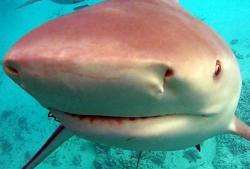
Bull Shark

Bull Shark

Bull sharks are the bad boys of nearshore waters, frequently prowling into the surf and sometimes traveling well up coastal rivers. They often feed in areas where beach-goers are present. (Frank Sargeant Photo)

Another strategy that won’t work is killing sharks in areas where the bites have occurred. The shark that bit a swimmer at Hatteras today may be 50 miles north or south by this time tomorrow. The fact that more bites occur in close proximity do not mean that a “rogue” shark is hunting humans, it simply means that there is a pretty dense population of sharks in the area.

Bottom line is that sharks must be treated like grizzly bears and African lions and other dangerous predators with the capability to prey on whatever wanders into their habitat.

Don’t swim where sharks are known to be concentrated, and particularly not where they are seen feeding–a shark close to the beach is almost always there because of a food source–otherwise, they want more water under their bellies.

Don’t swim where visibility is poor–any animate object that pops suddenly into a shark’s view at close range may draw a reflex bite.

Don’t swim in low light conditions–see above. Also, many sharks prefer to feed in low light, when their sense of smell and movement gives them an advantage over prey that needs sight to avoid them.

And don’t be misled into the idea that sharks are simply Bambi without the antlers, promoted to some extent by YouTube videos that show intrepid divers handling them. A shark not homed in on food and in crystal clear water is a whole lot less dangerous than one where there’s fish blood, wave action and clouded visibility.

Finessing Georgia Bass

So far this year fishing has been pretty good. The unsettled spring weather kept bass in the pre-spawn feeding spree and then you could catch bedding bass longer than usual. Post spawn bass bit good for several weeks. But now fishing can be tough.

The water is getting clearer as it gets hotter on most lakes and that usually means fewer bites. Bass are deeper and in tighter schools. Running the banks won’t produce bass like it did during the spring. When fishing gets tough you can probe the depths or you can go to lighter tackle and baits and still catch shallow bass.

Light line is often the key to getting bites from finicky shallow water bass. I like six and eight-pound fluorocarbon line and it works well with the smaller baits that will get a bass’s attention. Line lighter than six-pound test makes it very hard to land a bass since they like to head to cover when hooked, but four-pound test line would probably produce even more strikes.

A six foot light action spinning rod teamed with a quality reel with a good drag system works well for finesse fishing. I always turn off the anti-reverse on reels so I can back reel when fighting a strong bass. It takes some practice to get used to fishing with a reel that will turn backwards but it is a big help when you need it. A good drag is essential so you don’t break your light line on the hook set.

A fisherman once explained the importance of smaller baits this way. After a big meal when sitting watching TV and rubbing your stuffed belly you probably won’t grab a full size candy bar. But it is hard to pass up nibbling on a few chocolate-covered peanuts on the table in front of you.

Present a four inch worm or small spinner in front of a bass and it will hit it, even if the fish is not in a feeding mood. Tiny crankbaits also work well this time of year. Try a Texas rigged four inch curly tail worm on a 1/16 ounce sinker or put it on a slider type jig head the same weight. Tie on a small in-line spinner or tiny 1/16 ounce spinnerbait to get a bite. Crankbaits 1/8 to 1/16 ounce will also work.

Two things attract shallow water bass this time of year. Current and shade will both make the bass feed and if you can find a combination of the two your odds go way up. Bridges, docks and overhanging brush provide shade while normal current upstream or generated current on the lake give you the conditions to catch shallow bass.

Throw your small Texas rigged worm under shoreline brush even if the water is only a couple of feet deep. If there is some current moving under the bushes bass will hold there and feed better. Run up the river feeding the lake to find more overhanging cover that has current on weekends since power is usually not generated as much.

Bridges offer the best of both worlds. The bridge and pilings offer cover and shade and, since they are on the narrowest place on the lake, they concentrate current. Work a slider worm, small crankbait or spinner along the rocks in the shade or by the pilings. Try to cast up-stream and fish with the current since that is the way the bass will be facing.

The shade under docks holds bass and they are even better if there is some brush around them. Current moving under them helps, too. Cast a Texas rigged worm under them or swim a crankbait or small spinner along post and under floating docks. All will draw bites.

Go light this time of year for more action. You will get more bites and the fight will be better on the light tackle.