Scholarship Assists in Pinfish Research

Angler Action Foundation Scholarship Assists in Pinfish Research
Katie Ribble has always grown up around the water.
from The Fishing Wire

“We had a sailboat when I was growing up, and I remember visiting family along the coast in Maine. My first job was at a local aquarium up there,” Katie recalled. “I was always elbow-deep in the touch tank. The positive reaction from people there was always very rewarding to me when I shared my knowledge.”

That experience provided the foundation for a future career in marine and environmental sciences.

While working on her Master’s degree under Dr. Michael Parsons (director of Florida Gulf Coast University’s Coastal Watershed Institute and Vester Field Station), Katie’s efforts have landed her the first-ever John Cassani Fishery Research Scholarship from the Angler Action Foundation (AAF), a not-for-profit conservation group based in Florida.

“To kick off this memorial scholarship, we were looking for a student who demonstrates all of the characteristics Katie exhibits,” said Mike Readling, AAF Chairman. “Initiative, leadership, and an intrinsic understanding that the ‘in-the-mud’, down and dirty basic research can be extremely important and rewarding, even though it might not be as glamorous as something like tracking a famous white shark.”

Katie’s work certainly fits that bill. Among other things, she is delving deep into how pinfish feeding behaviors change in relation to factors such as water temperature.

Throughout their lifecycle, pinfish eat a good variety of things, from tiny zooplankton to other fish to shrimp. (Maybe you’ve encountered one or a thousand pinfish as you sought out seatrout, red drum or snook in the grass flats during your fishing career in Florida.) Pinfish are also grazers of grass and algae – and during certain periods of their lifecycle those can make up the bulk of their diet.

Serving as a primary forage species in Florida, pinfish are a critical part of the food web. Understanding more about their diet, and whether environmental factors such as water temperature trigger an increase in feeding activity, will help us better understand how pinfish fit into Florida’s complex marine systems. But Katie’s research goes even further.

Unknown to many, there is a lot more going on with the grass and algae that pinfish are eating.

Ever notice that fuzzy, sometimes sort of slimy, coating that adorns the seagrass or algae you are constantly plucking from your jig or lure that is weighted too heavy? Turns out, that slimy stuff has a very interesting and important story.

One of the dinoflagellates (in this case, a marine plankton) that is included in that community of microscopic plants and critters that make up the fuzzy slime is Gambierdiscus spp, which is the only known source of the toxin that causes Ciguatera fish poisoning.

If you’ve never heard of Ciguatera before, you aren’t alone. It is the most frequent seafood poisoning, yet we know relatively little about it. Katie explained that may be because people are unfamiliar with the symptoms and likely source/cause, they may just think they had ordinary food poisoning. Symptoms can include diarrhea, vomiting, numbness, itching, sensitivity to hot and cold, dizziness, and weakness – a list that certainly could be mistaken for any number of maladies.

“It is probably misdiagnosed a lot,” she said. “We’ve associated Gambierdiscus with reef fish in the past, now we are seeing it in other places.”

Which leads us back to pinfish, turtle grass, and the shallow blissful waters of the Florida Keys.

Katie noted that the presence of Gambierdiscus in our waters is nothing new, and this research is not intended to stir up a new scare. In fact, it is a global phenomenon and there are records from the Chinese T’ang Dynasty (618-920 AD). Just last month there was an international conference dedicated to the toxin in France.

If you have heard of Ciguatera, it is probably because you know someone who was diagnosed or maybe visited an area with a tropical reef associated with high concentrations. The point is Ciguatera was only a factor for those who risked eating fish from specific areas.

Barracuda is one of the fish associated with the toxin, as are some groupers, moray eels, and other reef fish.

Barracuda? Remember that time, in between picking fuzzy seagrass blades from your jig, a flash of silver streaked past and just like that your lure or bait was gone – line sliced so cleanly you never even felt a tug? Yep – that was probably a barracuda. Who eat pinfish. Who eat grass coated with yummy brown slime.

Already, Katie’s research has uncovered some interesting tidbits.

While establishing a baseline for her new pet pinfish feeding behaviors, Katie took some turtle grass and a species of Halimeda, a native calcarious green macroalgae from an area in the Keys known to have a particularly strong strain of Gambierdiscus. Part of the first step was to strip the grass and algae clean of all of the fuzzies to see how the pinfish grazed on the clean plants. What Katie found there surprised her.

“It seemed that the fish in my tank would rather starve themselves than eat the clean grass,” she said.

In other words, without the brown slimy stuff as dressing, turtle grass salad is not on the pinfish menu. Katie isn’t sure why that is.

“Maybe they can’t digest the plant without them,” she offered.

As she moves forward, she hopes to uncover other aspects that lead to increased pinfish feeding in the wild. Combined with simultaneous work in Dr. Parson’s lab at FGCU, where he is guiding other students to answer questions such as whether there are normal fluctuations of the Gambierdiscus blooms, and/or whether there are factors that might trigger an unnaturally large bloom. The information might help us understand how the toxin moves up the food chain and across a variety of habitats.

As Katie talked about her early findings, it became easy to see that she settled into the right career path. Her enthusiasm is contagious (Ciguatera is not, by the way), and it is very promising for all of us who are optimistic that we’ll become better stewards of our marine and fresh water habitats. Research like Katie’s points to just how completely all these habitats depend on each other, and that there is a lot of communication between them.

Katie hopes to use her AAF Don Cassani award of $1000 to help pay her way to conferences where she can share her findings.

“Helping these students share their findings is critical,” Readling said. “Putting Katie’s work in front of other scientists is one of the best ways to develop more research ideas. For us fishermen and women, it gives us hope that as a group, we can figure out how to best protect all facets of our environment, from one end of the system to the other.”

AAF encourages you to support the Cassani Scholarship Fund. Any donations made HERE will go directly to the fund and be excluded from all other AAF projects. If you have questions about the program or wish to nominate yourself or another graduate student for the 2019 award, please email Brett Fitzgerald (brett@angleraction.org).

In 2010 a memorial fund was created to commemorate the life and passion of Daniel J. Cassani, with the mission to support and promote marine fish research and conservation. All donations made to AAF in this link will go directly to this fund.

The Angler Action Foundation, based in Florida, is dedicated to conserving our fish, their habitats, and sensible recreational angler access. Angler Action is a 501c3, founded by William Mote. Our primary service project, iAngler, is the first and only database owned by fishermen that contributes directly to state-level stock assessments. Our mission is to continue to help improve fishery research, educate ourselves, other anglers and fishery managers, and continue with best conservation practices.

A COPY OF THE OFFICIAL REGISTRATION AND FINANCIAL INFORMATION MAY BE OBTAINED FROM THE DIVISION OF CONSUMER SERVICES BY CALLING TOLL-FREE 1-800-HELP-FLA OR ONLINE ATwww.FloridaConsumerHelp.com, REGISTRATION DOES NOT IMPLY ENDORSEMENT, APPROVAL, OR RECOMMENDATION BY THE STATE.” REGISTRATION #: CH11670

Sitting In the Woods

Have you ever gone out into the woods and just sat, watched and thought? Deer hunters spend many hours doing exactly that every year, but I am afraid that is changing. Seeing pictures, and even worse, videos, posted while hunters are sitting on a deer stand makes me think they are missing one of the most important parts of hunting.

What do they miss? That little flash of movement that would reveal a huge buck if they were not staring at their phone? How about a beautiful cardinal eating matching red dogwood berries? Do they notice the golden yellow sweetgum leaf gliding through the air, pausing briefly when it hangs on an undergrowth limb, then falling to the forest floor to start the never-ending nutrient cycle over?

There is something magical if you actually observe nature. A squirrel waking up to start its morning commute to work, stretching and scratching on a limb near a hollow tree trunk, then scurrying carefully down the tree to search for breakfast. Did it bury the acorn if finds, stashing it away for today?

Do you miss the gurgle of the water over a tree trunk in the creek and think about where it has been and where it is going? How many times has it fallen on a hillside much like the one you watch and trickled into a creek? It then flows to a bigger creek following it to a river.

That river dumps into the ocean, where the water evaporates into the air. Wind currents move the clouds it forms back to a hillside, where it falls to start its timeless journey again.

The ancient white oak on the top of the hill has seen many changes. It now overlooks you sitting in a red oak a little way down the hill. Your perch grows up through the rocks on an old terrace, so the white oak watched it grow. Was it there while a dirt farmer struggled to flatten a small place for his crop, tediously moving shovels of dirt, then the rocks, to the terrace?

The rocks at the base of your tree had sat on the hill for thousands of years, slowly being exposed by eroding soil, then moved to their current position by the farmer. What has passed over time on their hillside? What will pass before gravity and erosion rolls them down the hill to the creek, where water will wear them away.

If you have hunted this land long enough, you may remember the fall day when you sat near the big white oak and killed a limit of squirrels with your .22. Or the summer day when you tried to catch tiny bream in the creek, on flies you had tied in a not so successful effort. But the bluegill still tried to eat it.

If you are old enough, you remember the days before whitetail deer here, and watched as the herd grew. The first deer you shot, with an old Marlin 30-30, was a small basket eight-point buck. You know now it was no trophy, but it still remains one of the most exciting days in your life.

That patch of privet was the hiding place for your biggest deer, a true trophy. You still don’t know how you made a killing shot, your arms were trembling from holding your gun on the spot where you knew the buck would expose itself as it moved out of the privet as it fed along the trail, eating acorns.

Your whole body was shaking from excitement, and you remember trying to order yourself to calm down. The movement of the buck ruins all those efforts, but you remember making yourself breath out, then in and squeeze, not pull, the trigger when the crosshairs lined up. And you almost jumped the 20 feet to the ground to go get a close-up look at him. He did not disappoint.

You may remember the days before 4 wheelers, too. Even though your property covers over 50 acres, you would never use one until you have a deer on the ground. But you hear their irritating whine and growl on nearby property at daylight as late hunters lazily ride to their stand, spooking the deer they would have seen if in the woods and quiet early enough.

Strangely enough, you hear their noise again an hour later, just when you expect to see deer moving back to bedding areas. At least they are scaring the deer they might have seen with a little patience. And they might spook them toward your stand.

Shots from other properties make you wonder if that trophy buck you have been patterning for weeks just went down. You hope that if he did, he was killed by a hunter that put out as much effort as you, and not by a deer shooter that made no effort other than to put out corn.

If you kill a deer, you take a minute at the kill to think about the deer and thank it for its sacrifice, so you will have meat. You have respect for your quarry and take pleasure in a trophy or just a meat doe, but you respect both for the wildness in it, and in you.

If you don’t make a kill you still rejoice in the total experience of being part of a tradition and way of life that is changing all too much.

Merry Christmas

Cold Water Paddling & Fishing Safety

Cold Water Paddling & Fishing Safety Tips from Virginia DGIF

Life Jackets are important


Always wear a life jacket when afloat.
By Bruce Ingram
from The Fishing Wire
Photos by Bruce Ingram

The most dangerous incident of my paddling career occurred on the James River when a friend and I overturned in his canoe. Earlier, my water temperature gauge had registered 54 degrees and the air temperature 65 degrees. When I fell in, I felt as if a sledge hammer had struck my chest, and my buddy and I struggled to swim to shore – losing most of our gear.

That day, the air and water temperature combined measured 119 degrees – within the danger zone says Stacey Brown, boating safety program manager for the DGIF. She adds that although many variables exist concerning when the risk of hypothermia becomes more acute, generally if the air and water temperatures together are 120 degrees or below, wet suits are recommended for paddlers. Another major factor, continues Brown, has to do with the amount of time someone is subject to the cold water and air temperatures.

Boat with a buddy in cold weather


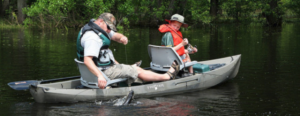
Especially in cold water conditions, like these two anglers on the New River, please consider going floating and/or fishing with a buddy.

Obviously, one of the most basic acts any paddler can accomplish is to always wear a life jacket. But in my many decades of floating and wade fishing Virginia’s rivers and streams, I would wager that most paddlers I have observed – whatever the season from the dog days of summer to the frigid waters of winter – were not wearing life jackets. Many, in fact, did not even have them in their craft or were just using them as seat cushions.

“Wearing a life jacket is the best way to ensure your trip doesn’t end in tragedy,” emphasizes Brown. “It would be nice that people think of their life jackets as gear, just like with other sports, rather than required equipment.”

Brown offers the following additional recommendations.

*Carry your whistle or other sound producing device in case you do need to summon help.

*Be proficient in re-boarding your canoe, kayak, raft or other craft – especially if you are in a lake or larger river where getting to the shore to re-board would be difficult. If you end up in the cold water – you start to loss dexterity of movement fairly quickly.

*Paddle with a buddy – not only for more fun – but just in case of emergency.

*Evenly pack your boat to have an even keel (so to speak) – and help mitigate the chances of overturning.

*Let someone on dry land know where you are going and when you plan to return – in other words, share your float plan.

*Check the weather before and during the trip. During the excursion, be aware of changing or increasing winds and/or cloud build up.

*Be honest about your skills – know your limitations. For example, planning a long trip of many miles or hours during unfavorable water temperatures or forecasts could be risky for many floaters.

In the angling realm, there’s nothing I would rather do than float and fish the Old Dominion’s many outstanding rivers, but I know that my continuing to enjoy this pastime involves making wise decisions. Please consider making these safety tips part of your game plan.

November West Point Tournament

The fist Sunday in November, only five members of the Flint River Bass Club showed up for our November tournament at West Point. We fished eight hours on a cold, windy day. At 3:30 we weighed in seven largemouth and ten spots weighing about 25 pounds. There was one limit and no zeros.

I got lucky landing a limit weighing 9.32 pounds to win and had big fish with a 3.11 pound largemouth. Doug Acre was second with four at 5.09 pounds, Jack Ridgeway was third with three at 4.14 pounds, fourth was Don Gober with three at 3.79 pounds and his grandson Alex Gober placed fifth with two at 2.79 pounds.

I thought it was going to be a good day, quickly catching a keeper spot on a crankbait back in a creek. But after three hours fishing in creeks, catching only throwbacks, I was getting disgusted. Something made me go to a hump at 11:00 where I had some brush marked in 22 feet of water. My first cast to it produced my second keeper.

The bite was strange, just a little mushy feeling on my shaky head worm. My next cast I didn’t feel anything but realized my line was moving. When I set the hook, I reeled in a jig and no worm. That made me pick up a Carolina rig and pulled it into the brush. I thought I was pulling the weight against the brush but felt a fish spit it out.

I put a worm on my shaky head and was ready. When it hit the brush and felt mushy, I set the hook and caught my third keeper. Although I cast to the brush until noon, I did not get another bite.

Hoping the pattern would hold, I went to more deep brush on the main lake. At the next one, the big largemouth took off with my shaky head as it sank, almost jerking the rod out of my hand. I definitely felt it! Luckily it hooked itself.

At the next brush pile a good keeper spot did the same thing. I now had four keepers and was feeling better. The next brush pile I was ready. I switched to a jig and pig and as it fell I watched may line. It twitched, and I set the hook on my biggest spot, giving me a limit.

The rest of the day I carefully fished brush and stayed ready to set the hook on any unusual feeling. I landed three more spots, culling my first three fish.
the last one hit on my last cast with just eight minutes to get in to weigh-in on time.

Today Potato Creek is fishing West Point. I’m sure all the rain has muddied up the water and dropped the temperature. But I will try my pattern again, anyway!

Bonefish Genetics Study

BTT’s Bonefish Genetics Study Reveals Connectivity Across the Caribbean

Bonefish

Photo: Nadine Slimak

BTT has completed its multi-year Bonefish Genetics Study, the results of which provide scientific evidence that the bonefish population across the Caribbean is closely connected. The study, which launched in 2014, involved the collection of genetic samples from bonefish (Albula vulpes) in multiple locations spanning the region. With the assistance of anglers, guides, and partners, BTT surpassed its initial target of collecting 5,000 samples, ultimately receiving 13,359 from a diversity of locations, including South Florida and the Keys, The Bahamas, Mexico, Belize, Cuba, Honduras, Nicaragua, the Cayman Islands, Puerto Rico, and elsewhere. The majority of samples were from Florida, Bahamas, Cuba, Mexico, and Belize. Given that the study’s primary inquiry concerned connections to Florida, the most intensive analyses addressed Belize, Mexico, Florida, Cuba, and The Bahamas.

The samples underwent a thorough analysis by BTT’s collaborating scientists at the Florida Fish and Wildlife Commission (FWC). Of the 13,359 total samples, 11,222 were used for analysis. 1,588 fish were identified as other species (remember that Albula vulpes supports the fishery), and 549 samples were too degraded for analysis and were discarded.

The analytical approach included several levels:

One level of analysis examined a couple of locations (alleles) on bonefish genes for all samples (adults, juveniles, and larvae) to determine how well bonefish throughout the region shared these alleles;
Another level of analysis compared specific sites on the DNA among individuals to determine their level of relatedness;
Another level of analysis examined genetic information between adults and larvae/juveniles to determine if parent-offspring relationships could be determined;
Another level of analysis looked for sibling relationships.
The Findings

Bonefish (Albula vulpes) throughout the Caribbean share genetic composition to a great extent, indicating that bonefish in all of the locations that were sampled are part of a single genetic population. However, it appears that the distance between locations influences the degree of relatedness. For example, although bonefish in the eastern Caribbean share genetic composition with bonefish in the western Caribbean and Florida, fish in these locations are unlikely to be directly related. In other words, there are probably many generations between eastern and western Caribbean bonefish. The larvae of a bonefish that spawns in Vieques may end up in Honduras. When those larvae become adult bonefish and spawn, some of their larvae end up in Mexico. And when those fish spawn, some of their larvae may end up in the Florida Keys.

At smaller geographic scales, the connections are more direct.

There appears to be reasonably high connectivity between Cuba and the Bahamas;
There appears to be reasonable high connectivity between Belize/Mexico and Cuba;
There appears to be high connectivity between Belize/Mexico and Florida;
There appears to be limited direct connectivity between Cuba and Florida.
But when Belize, Mexico, Cuba, and Florida samples are combined, they are deemed as highly connected. There is also a high level of connectivity among islands in The Bahamas.

The results of the Bonefish Genetics Study underscore the need for conservation and improved fishery management at local and regional scales that transcend international boundaries. BTT’s next steps will be to examine more closely the pathways of connection, which will bring into focus the areas that BTT and its partners need to prioritize for conservation.

Thanksgiving Traditions

Thanksgiving Day is all about tradition and giving thanks for what we have. In my family while I was growing up that tradition revolved around hunting and eating until I got the fishing bug bad. After college, for me it became a day to fish, and eat.

Before I went to college daddy had two pointers and we always hunted quail in the mornings while mama slaved in the kitchen, preparing delicious meals. We usually ate so much that daddy didn’t want to go back hunting that afternoon, but in my youth and energy I usually grabbed my .22 or .410 and went to the woods, looking for squirrels and rabbits.

After I got married and finished my undergraduate degree daddy had stopped hunting since quail had become so hard to find, and no longer had dogs. So I would go to our place at Clarks Hill and fish in the mornings, then get to town in time for a late lunch. That night I would head back to the lake by myself and fish the next three days before heading back to Griffin and work Monday morning.

One year mama decided to have our big Thanksgiving meal at the lake so I could fish more. She loved to fish as much as I did and understood my addiction.
When I got to the lake Wednesday afternoon after work mama was already preparing food for the next day. She told me several family members, my brother’s family and a couple of aunts and uncles, were coming to have dinner with us.

The next morning when I got up she warned me to be in for dinner. I told her I would even come in early enough to get cleaned up before eating. I caught a seven-pound bass on a Shadrap from a tree I had cut down into the water the year before.

After weighing it and releasing it, I looked at my watch. It was 12:01 and I thought how thankful I was that mama was having our big meal at dinner, not lunch. I went in about 4:00 to get cleaned up and could tell something was wrong. Mama, daddy and Linda were mad. All the family had been there for lunch, not dinner as I understood. They had all gone home by the time I came in.

The only thing colder than the looks from mama and Linda that afternoon and night was the cold turkey sandwich I had for Thanksgiving dinner. But they got over it soon and I had something more to be thankful for that year, they didn’t stay mad.

I am very tankful for the way I was raised by two loving, strong parents that were strict but forgiving. I wish everyone could have those memories and be raising their children that way.

If you have Thanksgiving memories and traditions, keep them going. If not, start them this year before its too late.

City or Country Life?

There are millions of people who love city life. Their natural environment is concrete, glass and steel, crowds of people and the mad rush of traffic. I will never understand them any more than they will understand my love of the solitude of being in the woods, fields and on waters.

In the early 1980s I was accepted at several colleges to start work on my first master’s degree. Georgia State was the shortest drive, in distance anyway, so I first went there to register for classes. After three hours of trying to find a place to park and wandering underground from office to office without seeing the sun, I left and headed to West Georgia College.

I parked right in front of the Administration building and walked across shaded sidewalks with grass on both sides to the admissions office. Within an hour I was registered for my first summer quarter classes. The drive home was about 20 miles longer than to Georgia State but took less time due to traffic. It was a much better fit for me.

I have always loved being outside. By the time I was eight years old I knew every foot of our 15-acre farm. But I was not allowed to cross a fence to adjoining properties. When I was eight, I decided to cross the back fence, feeling old enough to explore new worlds.

When I got down to Dearing Branch, the one that flowed under the nearby fence and then through our property too, I found a wonderland. I had the same feelings as Bilbo Baggins when he first went to Rivendell. The branch flowed through a gently sloping valley. There were a few big boulders on a hill on the other side of the branch. Water gurgled in the branch with a sound I like.

Most wonderous was a huge whiteoak tree on the slope. I managed to cross the branch without getting wet and walked to one of those boulders and sat down. The feeling of freedom and awe mixed to make it one of my favorite memories. And I did not get into trouble when I got back home and told my parents.

I still get that sense of freedom and awe when in the woods, and sometimes on the lake if the weather keeps other folks off the water. Heavy fog this time of year is a good time to be alone even on the most crowded lake.

In a December club tournament several years ago, Jackson Lake was extremely foggy. Visibility was about 50 feet. I was back in a cove and enjoying the quiet and solitude the fog emphasized. Then I smelled wood smoke. I love that smell on a cold day on the lake. It almost warms you up.

Although I love the quiet, a haunting jazz song playing at a cabin fit the mood just right. I almost forgot about fishing for a short time. That song, the fog and the wood smoke combined to make me feel that same freedom and wonder I felt as a child.

One sign that shows the difference between city folks and country folks. City folks admire nature but want it controlled. You can see window boxes with flowers and plants in most cities, and well-groomed parks attract many people on nice days.

Have you ever seen a window box in the country with little skyscrapers in it? Are there any parks in the country with small buildings and traffic, to remind us of what being in the city is like? I don’t think so.

The bad thing about city folks wanting to get “back to nature” is they move to the county and try to make it more like the city. Subdivisions of closely packed houses are popular, but they destroy the natural environment.

From 1981 to 1994 I was director of transportation for Pike County Schools, and rode every passable road in Pike County monthly, checking bus routes. The changes were scary

When first started learning the county, there were some small farms, as well as a few big ones, but most of the county was undeveloped. The small farms were mostly people with good jobs in Atlanta. I said every piolet and airline worker wanted 40 acres with a horse. They bought up old farms and lived there, enjoying the natural environment without changing it much.

In the 1980 the school system developed a very good reputation and more and more parents wanted to move to Pike County so their kids could go to good schools. But they brought city life with them. Subdivisions that were natural in no way sprang up, with houses stacked together.

Some bought a few acres and built a house, but quickly started changing nature. They wanted paved roads and cleared most of their property, planting grass and flowers to replace what was there. I can’t blame them for wanting to “prettify” their place, nature is untamed and disorganized.

I have to admit I bought a house with about four acres in a subdivision but left the trees and wild except for a small vegetable garden plot. There were only four houses in the 100-acre subdivision but now there are about 17. When I first moved here, I could zero in my deer rifle in my back yard but don’t do that any longer. There are just too many houses in range.

Even with the development, I can’t see any other houses when the leaves are on the trees. And after they fall the view from my back deck is still natural. And I do shoot squirrels in my yard but use a shotgun and am very carful where my shot will fall.

Enjoy nature, but please don’t try to make it more like a city.

Hurricane Impact on Fishing

Hurricane Impact on Estuary Gamefish

Though hurricanes can be hell for human residents of coastal areas, a new Texas study seems to indicate that they are not harmful to inshore fish, and may even be helpful.

By Evan Pettis | Biologist, Aransas Bay Marine Lab, Texas Parks & Wildlife
from The Fishing Wir

Figure 1. Catch rates of red drum and spotted seatrout in TPWD fall gill nets. Figure 2. Angler catch rates of red drum and spotted seatrout.

Catch rates of red drum and spotted seatrout


On August 25, 2017, Hurricane Harvey made landfall as a category four storm in the small fishing community of Rockport. Winds as high as 150 mph and a storm surge in excess of seven feet battered the town before the storm moved inland and unleashed record-breaking quantities of rain along the Texas coast. The economically important commercial and recreational fisheries were certainly not spared from the devastation left in the wake of this historic storm. A preliminary assessment conducted by Texas Parks and Wildlife Department (TPWD) and the National Oceanic and Atmospheric Administration (NOAA) estimated that damages to the state’s fishing operations and fishing-related businesses exceeds $58 million.

As a biologist working in “Hurricane Harvey ground-zero,” a common question I’ve fielded from concerned constituents is “What are the ecological impacts of the storm on the fisheries of the Coastal Bend?”

It’s well-documented that major storms like Harvey can have lasting effects on estuarine communities. The greatest threat to shallow-water species is the rapid disruption of normal salinity regimes via highly saline storm surges followed by excessive freshwater inflows. Paired with increased organic loading, these hydrological changes can result in low-oxygen conditions that trigger fish kills. Fortunately, for the Aransas Bay system, these changes were highly localized and relatively short-lasting.

Hurricanes also impact the habitats that marine species rely upon. In the Coastal Bend, many oyster reefs were broken up by intense wave action and, in some spots, buried under thick layers of silt and debris. Seagrass beds, mangroves, and salt marshes also suffered considerable losses due to high winds and powerful waves. It will be quite some time before we fully understand how the effects of this habitat degradation propagate up the food chain. Fortunately, data from TPWD monitoring programs indicate that the immediate impacts on popular bait species (i.e. blue crabs, shrimp, and Atlantic croaker) were minimal.

Currently, recreationally and commercially important finfish appear to have actually benefited from the storm. Relief for these species comes by means of reduced harvest pressure. Local anglers were preoccupied with recovery and repairs and faced numerous obstacles to wetting a line in the wake of the storm. Public access to the bays was limited as boat ramps and fishing piers were damaged, and losses to private and for-hire vessels was extensive. Significant damage to bait stands and commercial shrimp boats also made bait difficult to procure. Lastly, visiting anglers struggled to find hotel accommodations in the months following Harvey.

To monitor fishing pressure and total landings, TPWD routinely conducts angler surveys and trailer counts at boat ramps. In September 2017, we documented an 85% decline in boating activity in the Aransas Bay system compared to 2016.We intercepted an average of only two fishing trip interviews per survey, down from 16 the previous year. In fact, more than half of September’s angler surveys had no fishing trip interviews. Fishing activity bounced back over the next few months, but still remains below average.

So what impact did reduced angler pressure have on our local fish populations?

To answer that question, we looked at data collected during TPWD’s biannual gill net sampling program. For our two most popular game fish, spotted seatrout and red drum, the results were extremely promising (Figure 1).

In the months following the storm, red drum were caught in the nets at a rate of 0.81 fish/hr, up from 0.67 fish/hr in 2016 and close to the 10-year average. Spotted seatrout were caught at a rate of 0.41 fish/hr, a huge improvement over 2016 (0.22 fish/hr) and the 10-year average (0.29 fish/hr). This data implies that these species are actually more abundant in Aransas Bay following Hurricane Harvey.

Moreover, data collected at angler surveys indicates that the higher abundances track well with higher catch-rates for sports fishermen (Figure 2).

Anglers were landing red drum at higher rates in September 2017 compared to the previous year, and at much higher rates than the 10-year average in October and November. Spotted seatrout were being caught at roughly twice the rate as the previous year and the 10-year average from September through November. Though still too early to say conclusively, it appears as though these trends have continued into the spring.

To better understand the long-term effects of Hurricane Harvey, TPWD will continue to closely monitor our fisheries in the coming months and years. Though we usually perceive hurricanes as purely destructive, it’s important to note that they are a recurring natural force acting along the Gulf of Mexico. Our ecological communities, including our highly-prized finfish, have evolved and adapted in response to these large storm systems and, as our data shows, can actually benefit from the occasional disturbance.

Recovery efforts in Rockport and the surrounding areas are making daily progress, and the local fishing community is gradually returning to normalcy. Boat ramps, marinas, bait stands, and fishing guides are rapidly getting back to business, partly due to funding set aside for Federal Fisheries Disaster relief. So if you find yourself with that burning desire to bend a rod, grab your fishing license and head down to the Coastal Bend. Aransas Bay is open for business and the bite is on!

Four Fishing Trips In A Week – Different Weather for Each

Four trips in the past week were fun but the weather was very different on each. I’m glad I now have suitable clothes for all kinds of weather. At Lake Martin in Alabama last week, it was very cold and the wind howled all day. But Anthony Vintson, an Auburn Bass Team fisherman, showed me how to catch a lot of bass there for a January Alabama Outdoor News Map of the Month article.

On Friday Tucker Sweat, a Georgia College Bass Team fisherman, showed me how he catches bass on Sinclair in January for my Georgia Outdoor News Map of the Month article. It was a beautiful day, warm, sunny and calm. Very different from the Tuesday three days earlier.

On Saturday the Potato Creek Bass Masters fished our December tournament at Jackson, the last one this year. It poured rain all day and was cold. Then on Sunday the Flint River Bass Club and the Spalding County Sportsman Club fished a two-club tournament at Jackson for our last tournament this year in those clubs. It was warm all day and sunny after about 10:00 AM. That is four totally different weather conditions on the lake in just six days!

In the Potato Creek tournament, after eight wet hours of casting, 17 competitors brought in 43 keeper bass weighing 80 pounds. WE don’t keep up with numbers of spots but almost all I saw were spotted bass.

Niles Murray came back strong from his medical leave to win with five wedging 12.14 pounds, Doug Acree placed second with five at 9.96 and had big fish with a 4.69 pounder, Tom Tanner was third with five weighing 9.75 pounds and Buddy Laster came in fourth with four weighing 9.12 pounds.

Everything I did was apparently wrong. I caught a keeper spot on a crankbait 15 minutes after blast off and thought I was on something, but two hours later I had not had another bite. I went back to the truck to try to find some dry matches and went back to where I started.

I caught a keeper largemouth beside the same rock where the spot had hit over two hours earlier. It hit a shaky head worm. Although I didn’t ride around a lot in the rain, I fished a variety of places with different baits but never caught another fish.

On Saturday, 16 members of the combined clubs fished for eight hours to land 37 keepers weighing about 56 pounds. There were only 12 largemouth weighed in. Four people had five-fish limits and there were five zeros.

Raymond English won with five at 10.49 pounds and had one of the biggest spots I have seen from Jackson, a 4.23 pounder, for big fish. Billy Roberts placed second with five at 7.92 pounds and Jay Gerson placed third with five at 5.70 pounds. Thanks to a tip on Saturday to use a smaller crankbait, I had five weighing 5.28 for fourth. Of course, Billy said he beat me with a very big crankbait.

Both days the water was stained a little and in the low 50s. That is usually a good combination this time of year, but fishing was tougher than hoped, as always.

How Spotted Bass Ruin A Lake

Growing up in the 1950s and 60s, fishing was a warm weather sport. We fished from March through August and hunted September through February. I never knew bass would bite in the winter until I joined the Spalding County Sportsman Club in 1974 and fished an October tournament that year and a January tournament the next year.

If memory serves me right, we caught a lot of bass at Sinclair. But that was not really a surprise since the weather was still warm. But the January tournament was a big surprise. On a freezing day with sleet, my partner landed a six-pound bass at Jackson, one of six over six pounds weighed in that day.

I landed one small keeper largemouth on a chrome Hellbender, one of the few crankbaits we had back then. There were only largemouth in the lake.
The days of consistently catching quality largemouth at Jackson are long gone, as tournament results show. In the late 1980s sewage from Atlanta that used to flow into the lake down the South River, keeping it fertilized like a farm pond, was diverted.

Even worse, well-intentioned but clueless fishermen midnight stocked spotted bass in the lake. Now they dominate the bass population. Spots grow more slowly than largemouth, don’t get as big, and dominate the habitat since they are more aggressive.

Some examples of the changes over the years. I landed my first two eight pounders in January tournaments at Jackson in the 1970s, and the second one was third biggest fish that day. I landed my biggest bass ever, a 9.4 pounder, in a February tournament there.

In a March tournament I had fourth biggest fish with a 7.4 pounder. There was one just over eight pounds and a 9.1 pounder. But big fish was a 9.2 pounder. In a tournament with Larry Stubbs, I netted a 7.4 pounder for him then he netted a 7.5 pounder for me! There are many more examples like that.

I landed an 8.8 pounder in 2001 in a January tournament, but that is the last fish I can remember over six pounds, and there had been none I can remember for several years before it. If we didn’t have at least one six pounder back then it was a bad day.

Spots are fun to catch but totally change a lake. There is no size limit on them anywhere in the state except Lanier, and biologists encourage fishermen to keep a ten fish limit every time they can to eat.

I brought home as many as I could after our last tournament. The small ones are easy to filet and taste great. It is unusual to catch one over three pounds and removing as many as possible may help the lake a little.