Category Archives: Tournament Fishing

Why I Love Lake Martin

As usual, the three bass clubs in Griffin had a great trip to Martin for our annual tournament last weekend. The weather was great, except for a bad thunderstorm that hit Sunday morning a little over an hour before daylight and delayed our blast off for 30 minutes.

Some members of the clubs went to Martin a week early and spent five or six days trying to come up with a good pattern for the two day tournament. Many of us camp at Wind Creek State Park, others stayed in cabins there, and some got motel rooms in Alexander City. I love camping at Wind Creek, it is a beautiful place and the weather is usually great.

I did my usual, leaving Wednesday afternoon and getting to Wind Creek in time to put my boat in at the ramp, go around to my campsite and leave it then walk back to the ramp for my van. It was so nice I didn’t even mind the walk. Also, I was not worn out from fishing all day.

Thursday morning I got up before daylight and went looking for places to catch fish. I landed four nice keepers on a crankbait before it even got light enough to see. As the sky got gray I picked up a topwater plug and caught nine keepers and several throwbacks before 9:00.

After riding around some looking at different spots I went in and took a nap in my van. Then I went back out and caught several more bass after lunch. Two of them hit a top water plug at 2:00 in the bright sun, and they were the two biggest fish I caught all day. I was sure I had found something good.
After eating dinner at the campsite I got in bed early. Since I thought I had figured out what I needed for the tournament I slept in Friday morning. But when I went out at 7:30 and tried topwater in some new places I didn’t have much luck. I did catch a nice three pound largemouth on a worm in a brush pile, another good keeper from under a dock and two or three drop shoting deep points. So I had a plan “A,” “B,” and “C.”

Good plans often are great until the fishing starts. Saturday morning I had a limit of fish within 30 minutes, but they were all small. By 10:00 I lost count of the keepers I had caught when I went over 18, but only one was close to two pounds. So I took off up the river.

That worked. I caught a three pound bass and others that culled every keeper I had in my live well from that morning except one.

Sunday was completely different. At 10:00 I had caught a lot of short fish but only two little keepers. So I went out on a point to drop shot, and fish came up schooling. I caught two drop shoting and two on top so I did get my limit. Then I went to the brush pile where I had caught the three pounder Thursday and quickly caught two decent spots from it.

In the tournament 23 fishermen brought in 166 keepers weighing about 223 pounds in 17 hours of fishing. There were no fishermen with no bass and we had 33 five-fish limits. On Saturday only two fishermen didn’t weigh in limits, but there were only 12 with limits on Sunday.

In this tournament we fish it like two one day tournaments. On Saturday Bobby Ferris won with 9.84 pounds, I was second with 9.82 pounds, James Beasley had 9.52 pounds for third and Raymond English was fourth with 9.14 pounds. Robert Proctor had big fish with a 3.67 pound largemouth. My 3.05 pounder was second biggest.

Sunday was much tougher. Lee Hancock won with five at 8.26 and had a 2.95 pounder for big fish, Kwong Yu was second with five at 8.22, Billy Roberts placed third with five at 7.51 and Raymond English was fourth again with five at 7.41.

The thunderstorm that delayed us broke my heart. A guide I know fished a pot tournament Saturday and he and his brother had seven fish that weighed 21 pounds. He told me they caught four spotted bass over three pounds each the first 30 minutes they fished, but it got tough after that.

The place he told me they caught them was a point the had shown me about five years ago, and I won that year with fish I caught there before the sun got over the trees. The sun hitting the water there is like a light switch being turned off – they just stop biting.

I was going to make the 20 plus mile run to that point Sunday morning, but the thunderstorm delay meant I could not get to it before the sun got up. As I said, the best laid plans last until the tournament starts!

I can’t wait to get back to Lake Martin!

Where Do Tournament Caught Bass Go When Released?

After Lake Champlain Fish Tournaments: Study Finds Where the Fish Go
from The Fishing Wire

Today’s feature, an interesting study on where bass go after being released at weigh-ins, comes to us from Lake Champlain International; www.mychamplain.net.

By Daniel Kelly

The Crew

The Crew

The Lake Champlain bass dispersal project crew (Credit: Lake Champlain Research Institute, SUNY Plattsburgh)

Lake Champlain has been a popular bass fishing spot for some time, made so by its size, surrounding scenery and abundant fish habitat, especially in its northern end. The lake’s expansive tributaries also draw in anglers who like to rev up their fishing boats and make waves.

But with prized bass there getting more and more attention, scientists with the Lake Champlain Sea Grant wanted to know what impacts all the activity was having on the fishery.

“There are probably 75 tournaments on this lake each year,” said Mark Malchoff, aquatic resources specialist with the Sea Grant. “And about four to six of them are big ones with sometimes 100 boats.”

Malchoff, along with investigators from the Lake Champlain Research Institute at the State University of New York – Plattsburgh, wanted to quantify the impacts of catch-and-release policies at the competitions and how bass disperse after they’ve been released back into the water.

Their study began with tagging fish. Some were fitted with radio transmitters, but a vast majority were tagged with T-bars: tiny tags inserted between spines in dorsal fins. All of those had Malchoff’s phone number and email address on them.

“You sort of release them and hope someone finds one, but there’s no guarantee,” said Malchoff. “It’s a classic letter in a bottle.”

Inserting Tracklng Device

Inserting Tracklng Device

Surgery underway on a Lake Champlain bass (Credit: D. Garneau, SUNY Plattsburgh)

The approach was useful because two tag methods allowed researchers to find if one was more reliable for tracking and if there were any effects caused by the tags themselves. Malchoff says there was good agreement between the two, with both helping researchers track bass movement through Lake Champlain during and after tournaments.

Largemouth bass, researchers found, are especially affected during tournament time. They experience more stress than smallmouth, as judged by a series of indicators including bloody fins, hook wounds or fin damage. A lot of the stress comes from being housed in livewells, which takes its toll. They may also be targeted more as competition labors on.

“With tournaments – the big ones at least – by day three, only the Top 10 to 20 anglers are still fishing,” said Malchoff. “At that point, they’re targeting the biggest fish they can find.” And with live fish valued more at weigh-in time, fishermen try to keep fish swimming. “But the farther you move them (in livewells), the more likely it is they’ll get beat up,” said Malchoff.

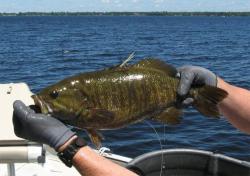
A post-op tagged smallmouth (Credit: Lake Champlain Research Institute, SUNY Plattsburgh)

Released Smallmouth

Released Smallmouth


Smallmouth bass also exhibited signs of stress, but not as much as largemouths. Both bass types appeared more prone to bloody fins as water temperatures increased. And after they had been released back into Lake Champlain, researchers found that bass swam toward the north side. There is plenty of high-quality habitat on that end, says Malchoff, and going north saves a trip over deep-water areas to reach the southern end.

All the findings boil down to a few things fishermen and tournament organizers can do to protect and conserve bass in Champlain. “Don’t transport them as far (in livewells), and lake temperature – in a lot of places, waters are warmest in late July or early August – avoid scheduling tournaments at those times if at all possible,” said Malchoff.

Researchers also provided evidence against a commonly held notion that many types of fish stress could be attributed to barotrauma, or damage caused to them by sudden pressure changes. Fish that don’t maintain equilibrium don’t always need to have their air bladders deflated, Malchoff says, something that tournament anglers often do.

“My real interest is looking at tournaments as a sustainable resource,” said Malchoff. “And like a lot of things, there’s always room for improvement.”

A Saturday Kids-Buddy Tournament and A Sunday Club Tournament At Bartletts Ferry

There is nothing quite like seeing the excitement on a kid’s face when they catch a fish. They light up and almost vibrate they are so happy. Last Saturday at the Spalding County Sportsman Club Youth/Buddy tournament at Bartletts Ferry three kids showed us that joy.

We were disappointed there were only three youth in the tournament, but it was well worth the effort to put on the tournament. Raymond English brought his grandson Preston and he won the youth side with three keepers weighing 3.39 pounds. Russell Prevatt’s grandson Bryson had two weighing 1.52 pounds for second and Zane Fleck’s grandson Dakota had three weighing 1.22 pounds for third.

I am glad they all caught fish. The fishing was tough but they worked hard for seven hours to land fish on a tough day. I will long remember watching Bryson, the youngest angler in the tournament at seven years old, bring a bag of fish up to the scales.

The weigh-in bag looked almost as big as he is and with water and fish in it, it was very heavy. Although he struggled with it, he wanted no help! He was so excited he couldn’t stop talking. It was great.

Kids win prizes rather than money and I was disappointed I didn’t have the tackle bags ready. I am trying to get some donations and will present the prizes at the next club meeting. Unfortunately, I have used up all the tackle I had collected for prizes.

In the Buddy side of the tournament Raymond and Preston won with five fish weighing 9.63 pounds. The way the tournament works is kids weigh in the fish, up to five 12 inch largemouth and any size spots since there is no legal limit on them, and the adult and kid combine their best five for the team weight. Spots have to be 12 inches long in the buddy tournament due to club rules.

A father and son were supposed to fish with me but due to a last minute problem they couldn’t make it, so I fished as a “team” by myself. I had three keepers weighing 6.49 pounds for second and my 3.70 pound largemouth was good for big fish. Russell and Bryson had four weighing 3.13 for third and Zane and Dakota had four weighing 2.25 for fourth.

Fish hit a little bit of everything, from Trick worms to spinner baits. I caught one at daylight on a spinner bait, one at 11:00 on a Texas rigged Mag 2 worm and the big fish hit a jig head worm at noon. The fish were scattered on the cloudy, cool day and there was not much of a pattern. I caught fish from one foot deep to 22 feet deep.

During the buddy tournament I decided to look for new places to fish and it worked. The first two hit on places I had never fished before, and the third one hit on a point that has always looked great but I have never caught a fish before, so I had quit fishing it years ago.

On Sunday ten members of the Sportsman Club fished our September tournament on Bartletts. After eight hours of casting we brought in 26 keepers weighing about 33 pounds. There were three five-fish limits and two people didn’t catch a keeper. We had six largemouth, 18 spots and two shoal bass weighed in.

I won with five weighing 6.98 pounds and had a 3.16 pound largemouth for big fish. Sam Smith had four weighing 5.41 pounds for second, Niles Murray had a limit weighing 4.87 pounds for third and his partner Raymond English had five weighing 4.57 pounds for fourth.

I started out where I had caught my first fish the day before but got no bites. Then I ran to where I caught my second fish and again got no bites. By 7:45 I was where I had landed the big one the day before and quickly caught a barely 12 inch long spot, then a largemouth the same size.

At noon I had fished a lot of places and still had just two keepers. In desperation I went out on a point and saw fish near the bottom, and used a drop shot worm to catch three keeper spots and several throwbacks. That gave me my limit with an hour left to fish, but they were all small.

For the last hour I decided to go to the point where I had never fished before Saturday but had caught a keeper that day. There were fish on the bottom and I missed some bites on the drop shot worm, and thought they must be bream. Then, with five minutes left to fish, the big fish hit. I didn’t think I would ever land it but managed to net it after a long fight.

This is my favorite time of year to fish. The weather is beautiful and fish tend to bite better. And boat traffic is supposed to be lower, since Labor Day is supposed to be the end of boating season, but it was not that way Sunday. The beautiful weather had a lot of pleasure boaters on the lake and I rocked and I rocked and rolled all day from their wakes.

Catching Spotted Bass On Lake Lanier In November

Lake Lanier was the site for the November Spalding County Sportsman Club tournament a few years ago. Nine of us fished for eight hours and caught 19 bass weighing 31 pounds,15 ounces. That is a good average size for any lake and it is even better if you know most of the bass we caught were spotted bass. They tend to be smaller and lighter than largemouth.

James Pilgrim, Jr. had a limit of 5 keepers that weighed 9-2 for first. He had one of the prettiest spots I have ever seen, a 4 pound, 4 ounce fish that took big fish honors. Kwong Yu also had a limit and his 7-7 weight was good for second place. David Pilgrim had 4 keepers weighing 6-0 for third.

I caught only two spots but they weighed 5-8 and that was good for fourth place. I caught one on a jig and pig at 8:00 am and the other on the same bait at 2:00 pm. Both were on rocky points. My big one weighing 3-8 was the biggest spotted bass I have ever caught, but it wasn’t quite big enough!

James, David and Kwong said they caught their fish on worms in fairly deep water. They were fishing brush piles 20 to 30 feet deep. I am always amazed how deep the fish hold at Lanier. The shad I saw on my depthfinder were all 35 to 40 feet deep and other fish were holding under them. I caught a couple of little hybrids jigging a spoon in 40 feet of water.

I never fish that deep on other lakes. I guess it is the clear water at Lanier. If you try Lanier anytime soon, plan of fishing deep water. Jigging spoons are a good way to fish that deep.

The pro fishermen found similar conditions at Lake Russell that year. They also caught fish deep. The winner jigged spoons and slow rolled a spinnerbait through standing timber in 30 feet of water. Russell also has very clear water. Remember, the clearer the water, the deeper the bass will usually hold.

Can I Catch Bass On An Ice Fishing Jig In the Summer?

Ice-Fishing Bait Helps Palaniuk To Top-10 Finish In Bassmaster Tourney
from The Fishing Wire

Brandon Palaniuk

Brandon Palaniuk

After grabbing an early lead in a Bassmaster tournament last month, Brandon Palaniuk told the media he was keeping details of his tackle and tactics “locked down for now.” It’s time to bust out the key and set his secret free. In the heat of the summer he caught ’em on an ice-fishing bait – a Rapala Jigging Rap®.

“It’s a little trick up my sleeve that I’ve kept secret for a long time,” says Palaniuk, the only Bassmaster Elite Series pro from Idaho. “Before I made the Elites, I had thrown them a little at home. I’ve caught open-water fish on them all the way down to 70, 80 feet.”

When fished through the ice as they were designed for, Jigging Raps work best with a vertical pump-and-swim action. A successful open-water presentation, however, requires aggressive rod snaps throughout a horizontal retrieve.

“When you snap the rod, it will dart a foot or two off to the right, and then it falls super fast,” Palaniuk explains. “And then you snap it again and it might dart two feet back over to the left – or forwards, or backwards. It’s a constant change of direction.”

After weighing a 20-pound-plus five-fish limit to lead the first day of the Bassmaster Elite Series tournament on New York’s Lake Cayuga in late August, Palaniuk told Bassmaster.com he was fishing a pattern he had all to himself. It’s likely those Empire State bass hadn’t seen anything like a Jigging Rap before – at least not in the summer.

Lead weighted and balanced to perfection, Jigging Raps inimitably simulate the erratic characteristics of a wounded baitfish. “The big thing is how erratic it is,” Palaniuk says. “For fish that are in a negative, inactive mood, it triggers a feeding response.”

The Jigging Rap’s unmistakable minnow profile features single reversed hooks on the nose and rear – so regardless of how a fish attacks, it’s running smack-dab into a hook. A center treble hook – hung from a belly eyelet – further increases your hook-up ratio.

Fishing much deeper than most other competitors on Cayuga, Palaniuk saw only one other angler during the tournament. Targeting smallmouth, he ended up catching both brown and green bass off of two small rock piles in about 25 feet of water. A shell bed extended from the rock pile area down to about 40 feet. “The fish would stay anywhere from that 25-foot to that 40-foot zone,” he says.

Palaniuk found fish in those spots in the two-and-a-half days of practice before the four-day tournament began. Despite being able to see them clearly on his depthfinder, however, he couldn’t get them to bite at first.

“There were schools of these fish, so I’d drop on them with a drop shot and they’d follow it down,” he recalls. “But I wouldn’t be able to get them to eat.”

But on the last day of practice, inspiration struck.

“I pulled out the Jigging Rap to try to get a reaction strike,” he says. “The first drop with it, I had one eat it.”

It was a No. 7 size Jigging Rap in the Glow color pattern – white with a chartreuse head. He threw it on a 7-foot, medium-action spinning rod spooled up with 8-pound-test braided line attached to an 8-foot, 8-pound-test fluorocarbon leader.

“That first drop of the Jigging Rap, a couple followed it down, and the first few snaps of the rod, I got one to eat it,” Palaniuk says. “So then I kind of got excited. I was like, ‘Man, I’ve got something figured out that they’re going to eat!”

After dropping the Jigging Rap a few more times and shaking off a few more bites, he determined he’d found a school of 4-pounders.

“So, I just always had one tied up and on the deck throughout the tournament,” he says. “And when I would see fish on my electronics I would drop on them. If there were two or more fish, I’d drop on them like that and see if I could get bit.”

Ultimately, the Jigging Rap bite did not yield enough big fish for Palaniuk to win the tournament – he ended up placing eighth – but it did account for several of the fish he weighed and helped clue him into a couple other ways to get bites. Based on the way bass had been biting the Jigging Rap in practice, Palaniuk decided on the first day of the tournament to stroke a 1-ounce Terminator Football Jig, rather than crawl it across the bottom, a more traditional presentation. That decision led to a 20-pound, 1-ounce limit and the Day 1 lead.

“The reason I started stroking it was because of the fact that I got on the Jigging Rap bite,” he explains. “I just started ripping it off the bottom, like you would a Jigging Rap, and that’s pretty much how I caught 20 pounds pretty quick.”

Most of the bass Palaniuk caught on the Terminator Football Jig hit on the fall immediately after a vertical stroke. “You’d rip it up and I think you’d catch their attention, and they’d follow it up, and then instantly, if you’d let off at all, they ate it,” Palaniuk explains. “It’s almost like you’re fishing a spoon. Once you rip it up off the bottom, they eat it as soon as it changes direction – starts to fall.”

Although many believed, going into the tournament, that shallow-grass largemouth would be the ticket to success on Cayuga, Palaniuk – true to form – opted to target deep-weedline smallies.

“I always like doing something different,” he explains. “I feel like that’s how you put yourself in contention to win and how you can separate yourself from everyone else – if you can find the quality fish doing something different, that not every else is doing. The reason I found those fish is because I was looking for smallmouth.”

As it turned out, however, he caught both smallmouth and largemouth from his deep spots. Brown and green bass were “pretty evenly mixed in the school,” he says.

Lightning and Fishing

I admit it, I am scared to death of lightening. When I was about eight years old some friends and I were “camping out” on the screened in back porch of my house. A bad thunderstorm hit in the middle of the night and I just knew I would be hit by a bolt of electricity. Since that night I get nervous when I hear thunder, even if far away.

Over the years I have had many bad experiences with thunderstorms while I was fishing. Once summer while fishing way up the river at Bartletts Ferry a powerful storm suddenly popped over the surrounding hills. The rain was torrential and lightening started cracking all around us.

There was little cover so I pulled the boat into a small creek where the overhanging trees should give me some protection. I sat there in the boat, using the trolling motor to keep the wind from blowing me back out in open water. After a few minutes I realized the boat was not being affected by the wind. The heavy rain had put so much water in the boat it was sitting on the bottom.

That storm lasted over two hours. When it finally stopped it took a long time for the bilge pump to get enough water out of the boat to make it float again.

One August I was at Jackson Lake practicing for a night tournament. The afternoon had been very hot and muggy, with thick clouds overhead but no thunder, rain or wind. Just as it got dark I was fishing beside the dam when suddenly wind started gusting over the dam and a crack of lightening direct overhead was the first sign of a storm.

Back then there was no barrel line at the dam so I pulled my boat up against the solid concrete wall. There was a metal rail on top of the dam, about 20 feet over my head, so I felt I had a lightening rod protecting me.

For over an hour I sat in the drivers seat of the boat with my head on my arms. The lightening flashes were so bright I could see the light even though my eyes were tightly shut and my arms covered them. My dog Merlin got under the console of the boat hiding from the downpour and loud cracks of lightening.

Those experiences and others make me now head for some kind of cover if the thunder is anywhere near me. And I have an app on my phone that shows weather radar, giving me a good idea how close the storm is to me.

Last Sunday at a tournament at Oconee thunder made me head for cover. I left a place in open water where I had just seen on my depth finder a brush pile covered with fish. I would not stop and fish it, it was way too far from cover.

In the Flint River Bass Club tournament last Sunday at Oconee, 13 members and guests fished our September tournament from 6:00 AM to 3:00 PM. We brought in 16 bass over the 14 inch size limit weighing about 29 pounds. There were no limits and six people didn’t have a keeper after nine hours of casting.

Niles Murray won with four bass weighing 7.66 pounds, Chuck Croft was second with three at 6.08 pounds and his 3.38 pounder was big fish, Mindy Burns had three weighing 5.19 for third and my three weighing 4.62 gave me fourth place.

I knew fishing would be tough, but not that tough. I started fishing a spinner bait on seawalls, usually a good pattern before it gets very light this time of year, and caught a three pound channel cat at about 6:15. It gave me a good fight but it was not what I was hoping for.

At 6:30 I switched to a crankbait and caught a keeper bass off a seawall. That fired me up but after almost an hour of trying the crankbait, spinner bait, buzz bait and Pop-R I had not gotten another bite. Then I got an explosive hit on the Pop-R right on the seawall. The fish fought like a big one but it was another 15 inch largemouth. Two in the live well at 7:30.

From then to noon I tried everything I could think to fish. I kept throwing the topowater baits until the sun got on the water but never got another bite. Crankbaits and spinner baits didn’t work either, and the only hit I got on worms was a ten inch bass by a dock.

At noon thunder started rumbling off in the distance so I got nervous and kept looking at the clouds. At 1:00 I was fishing a point and the thunder was getting closer, so I decided to head near the ramp so I could get to the van quickly. As I left the point I saw a GPS waypoint way off the bank on the point and rode over it. That is when I saw the brush with fish on it but I would not stay out there and fish in the open water.

At 2:00 the thunder was still distant so I went back to the brush pile I had seen and quickly caught my biggest keeper at 2:15. Although I fished the brush until I had to go in that was it for me.

Fishing A Tough August Night Tournament At West Point Lake

Last Saturday, night time was not necessarily the right time to catch bass at West Point. In the August Spalding County Sportsman Club tournament eight members fished for eight hours to land 14 bass weighing about 22 pounds. There were no five fish limits and two people didn’t catch a keeper.

Kwong Yu won with two bass weighing 6.55 pounds and his 3.51 pound largemouth was big fish. I was second with four spotted bass weighing 5.33 pounds, Raymond English had three at 3.76 pounds for third and Harvey Pilkenton had two weighing 2.67 for fourth,.

Kwong said just after dark, around 9:30 PM, he pulled up on a brush pile and caught his two fish on back to back casts. Both were nice largemouth, the only two weighed in. Fishing was that tough.

I started on a rock pile in about 12 feet of water where I have caught fish this summer and after about an hour I caught a barely 12 inch long spot and two short fish. I stayed there for another hour but got no more keepers.

I went and fished a couple more places without getting a bite then went back to the rock pile at dark and caught one more barely 12 inch keeper spot. After over an hour of fruitless casting I decided to head back closer to the ramp and stopped on a long point.

One of my first casts to it produced a skinny spot about 14 inches long. Then a little later I felt a tap, set the hook and a fish took off stripping drag. It rolled on the surface in the dark and from the sound I was sure I had a ten pounder, especially when it took of stripping more drag.

When I got it to the boat I was shocked to net a 2.57 pound spot. I just knew it was much bigger. All my fish hit a Mag 2 worm Texas rigged. Kwong said his two hit a jig and pig.

At least it was a little cooler when the sun set, so night time was the right time to be fishing, even if it was not necessarily the right time to be catching.
——-

Clarks Hill August Bass Tournament

I love Clarks Hill but it surely has not been very nice to me this year in tournaments. I grew up fishing the lake and still have a place there at Raysville Boat Club and thought I knew the lake well. Now I am not so sure.

Last April I struggled to catch fish in a Spalding County Sportsman Club tournament. This past week I spent four days there, going over on Wednesday to practice two days to try to figure out something for a two day Flint River Club tournament over the weekend.

Fishing is always tough in August, and I much prefer to fish at night for bass, but the tournament was during the hot, miserable days. Our tournament was originally scheduled for Lake Russell, where spotted bass and different kinds of cover and structure make it a better choice in August. But since some of the club members couldn’t find a place to stay that they liked it was changed to Clarks Hill.
To make matters worse we put in at Soap Creek Marina up the Savannah River arm of the lake. Although it is only 17 miles from my trailer at Raysville to Soap Creek Marina by road, it is a 40 mile boat ride, one way, by water. Almost all my fishing at Clarks Hill has been up the Little River arm near Raysville and I did not want to make the long run in the tournament.

On Thursday I put in at Soap Creek and fished a little and looked at a lot of places on my deptfinder. It was too hot to sit still very long but I hoped to find something that would give me confidence for the tournament. I didn’t. I never caught a fish, and the places I checked just didn’t look good.

The only thing I found at all was schools of bait and fish under the two bridges in Soap Creek. I like fishing bridges and riprap and that is often a good pattern this time of year, especially since you can sit in the shade and fish! But I didn’t get a bite the little time I spent trying them.

On Friday I decided to check some of my better places near the boat club. Although I tried deep brush piles and similar places where I have caught August bass in years past, the only fish I was able to catch was around the pilings on the bridge near my trailer. So I knew I would not make the long run.

In the tournament, 11 members fished 18 hours in two days to land 53 keepers weighing about 85 pounds. There were four five-fish limits during the two days and two fishermen didn’t land a keeper either day. It was as tough as I expected.

Chuck Croft had gone over on Thursday and fished with two local fishermen before the tournament, and he found a pattern that paid off. He was the only one to have a limit both days and he won with 15.14 pounds. His partner JJ Polak came in second with six bass weighing 14.84 pounds. Niles Murray found a big fish and came in third with six bass weighing 13.20 pounds and his 5.97 pounder was by far the biggest fish. My eight keepers in two days weighed 9.24 pounds for fourth.

Chuck and JJ caught their fish on topwater plugs in very shallow water, and they said that pattern worked all day, a big surprise to me. I never really checked shallow water after the sun got up, just knowing the fish would be deep. Shows how much I know.

I fished a couple of deep points but I spent most of both days around the two bridges. I went to the first one at 7:30 Saturday morning and landed three keepers on a topwater popper by 8:30. Then it got tough. I checked some other places but was back at the bridge by 1:30 and landed my fourth keeper. Then, with just an hour left to fish, I caught my two biggest fish. All the last three hit worms.

Sunday I went straight to the bridges and caught two before the sun got up. With about 30 minutes left to fish, around 1:30, I got my third keeper. I tried a lot of things around the bridges but most of them just didn’t work.

Saturday morning there was fisherman fishing live minnows under the first bridge I went to. I talked to him and he said he had caught a lot of fish during the night but they had quit biting when it got light. It was discouraging when he told me he had caught crappie, hybrids, catfish and gar, but no bass, even on live bait.

If you go to Clarks Hill right now take live minnows and fish under bridges at night if you want to catch something.

What Is Your Summer Go-To Bait?

Pros Throw Go-To Baits All Summer
from The Fishing Wire

If you could only fish a handful of baits this summer, what would they be? We asked Bassmaster pro Ott Defoe and walleye guide Tom Neustrom, neither of whom hesitated before rattling off a short list of go-to lures.

Rapala and VMC Lures make many go-to baits

Rapala and VMC Lures make many go-to baits

Rapala and VMC offer an assortment of lures ideal for probing the depths during the heat of summer

A Freshwater Hall of Fame Legendary Guide, Neustrom primarily targets walleyes in Minnesota. His top summer baits are the Rapala Scatter Rap, Rapala Husky Jerk, VMC Moon Eye Jig and Rapala Glass Shad Rap.

The 2011 Bassmaster Rookie of the Year, DeFoe hails from rural Knoxville, Tennessee. As a Bassmaster Elite Series and Bassmaster Open tournament competitor, he targets bass all across the country. His top summer baits are a Rapala DT-10, Rapala DT-16, Terminator Pro Series Jig and a VMC Shaky Head Jig.

“With those four baits, man, you should be able to catch a fish anywhere you go,” DeFoe says.

Scatter Rap

Several baits in the Scatter Rap family are in Neustrom’s regular rotation. Built on classic Rapala balsa body shapes, Scatter Raps derive their name and signature sweeping action from an innovative, patent-pending, curved Scatter Lip™.

“I love the Scatter Rap,” Neustrom says. “It’s a great bait with great action, especially when you change the cadence on your retrieve, which changes the action of the bait.”

A Scatter Rap is often a go-to bait

A Scatter Rap is often a go-to bait

The Scatter Rap Shad has a unique, erratic action, and dives 5 to 8 feet.

Featuring what’s best described as evasive action, baits in the Scatter Rap family perfectly mimic a spooked baitfish fleeing attack, moving from one side to the next, triggering reactive bites.

When Neustrom wants to get Scatter action deeper than a Scatter Rap Shad’s 5- to 8-foot diving depth, he’ll cast a Scatter Rap Countdown, which will sink to whatever depth he wants to fish it. To get it to depth, he simply counts it down, “just like the names says.”

“I like to count ‘one-thousand-one, one-thousand-two,’ and when it do that, I usually get about two- to two-and-a-half feet per ‘one-thousand,'” Neustrom explains. “If you get to ‘five-one-thousand,’ you’re usually down ten feet.”

Once he gets the Scatter Rap Countdown to the strike zone, he slow rolls it back to the boat. “Just lift your rod and reel, pull it back, lift it again, pull it back,” Neustrom explains. “That gives you that erratic action in deeper water.”

Husky Jerk

Neustrom is “really partial to Husky Jerks,” he says. “I’ve caught a lot of smallmouths and walleyes on that bait.”

A natural-looking minnow profile and neutral buoyancy make the Husky Jerk practically irresistible to gamefish. Intermittently pausing the bait on the retrieve is key.

“You just stop reeling that bait and just let it sit there for a couple seconds and then start to reel again,” Neustrom explains. “It’s a great triggering action.”

VMC Moon Eye Jig

When he’s vertical jigging or pitching for walleyes with live minnows, Neustrom will often thread them on a VMC Moon Eye Jig, which features a very effective bait-keeper. “That bait keeper will keep even live bait on the hook, even better than just a straight hook.”

Glass Shad Rap

When trolling for walleyes, Neustrom favors Shad Raps, Scatter Rap Shads and Glass Shad Raps. He ties on the latter in clear water and when he’s needs a little extra running depth.

“I seem to get a little bit better depth with the Glass Rap than a regular Shad Rap,” he says.

His go-to size is a No. 5, which will run 12 1/2 to 14 feet at 2 to 2.5 mph, with 105 feet of Sufix 832 Advanced Superline braid out. His favorite colors are Glass Blue Shad and Glass Perch.

“They just work really, really good in these northern-tier lakes,” he says. “They outproduce a lot of other baits.”

DT-10 and DT-16

Throughout the summer, you’ll find both Rapala DT-10’s and DT-16’s tied on rods on DeFoe’s boat deck.

“Any time the fish are out offshore on deeper structure, as they often are in the summer months, one of those two baits is going to reach the range those fish are in,” he says.

Terminator Pro Series Jig

Not all summer bass live deep. “There’s always fish that live shallow in the summer time,” DeFoe says. “Even when it’s very, very hot.”

Ott Defoe's go-to bait

Ott Defoe’s go-to bait

Elite Pro Ott DeFoe relies on a variety of lures to score despite hot weather.

Flipping a Terminator Pro Series Jig in shallow water is among DeFoe’s favorite ways to catch summer bass. “Those fish, when they want to bite something, a lot of times, they want a big meal,” he explains. “You can put a big trailer on the back of that jig to give you a large profile.”

Featuring a unique head design, the Terminator Pro Series Jig is much more versatile than most jigs – it’s not just for shallow presentations. “You can cast that jig deep too,” Defoe explains. “You can basically do anything you want to do with it.”

Custom jig-skirt colors, color-matched brush guards, a single rattle and a heavy VMC® Black Nickel hook further differentiate the Terminator Pro Series Jig from other cookie-cutter jigs that all pretty much look the same.

VMC Shaky Head

When the going gets tough, DeFoe’s going to break out the spinning tackle and toss a green-pumpkin finesse worm on a VMC Shaky Head Jig.

“When times are tough and you need to get a bite, you can tie on that combination and catch one,” he advises.

Bass Fishing Tournament Payback Increasing

Payback Plus-The Next Generation of Tournament Fishing?

Tournament promises maximized winnings for competitors.

By Frank Sargeant, Editor
from The Fishing Wire

In the early days of bass fishing tournaments, it was common for the tournament director to keep a healthy portion of the entry fees for himself to pay for his investment of time and energy, dividing up what was left with the competitors. Understandably, in the case of a few more tight-fisted promoters, this resulted in some pretty scant purses for the anglers.

Tournament blast off

Tournament blast off

Big money events can lure hundreds of anglers to compete in bass tournaments these days, and for those who come out on top, the rewards can be substantial. (Frank Sargeant photo)

Those days are for the most part long gone thanks to the amazing choice of tournaments anglers have these days; 100 percent payback has become common in well-run major events, and good anglers get a strong return on their entry fees.

But Morris Sheehan, head honcho of the American Bass Anglers headquartered in Athens, Alabama, goes these events one better with his new 100% Plus Team Tour, slated for the lakes of North Alabama as well as Tennessee and Kentucky in 2015.

“We’re actually making a total payout greater than the sum of the entry fees in each of these events thanks to our sponsoring participants,” says Sheehan. “The top team is going to take home a $20,000 Triton/Mercury/Motor Guide bassing rig, and since these are what we call “contingency” tournaments, those who fish with late model rigs from Triton and Mercury, T-H Marine, The Boat House in Athens (Morris Sheehan’s boat dealership) and two dealerhships in Tennessee can earn big bonus money from the companies on top of that–the total for the winning team could run as high as $32,000 for each event.”

Sheehan said there will be a North Alabama division with four events on Lake Guntersville and one on Lake Wheeler, and a Tennessee/Kentucky division with four events on Kentucky Lake, one on Old Hickory.

“The tournaments are slated on alternating weekends so a team could fish both divisions if they want to,” says Sheehan. “About 20 percent of the field at each event will get a check so it’s a really good payback.”

The first tournaments of the season are March 14 at Guntersville for the North Alabama division, March 28 at Kentucky Lake for the Tennessee/Kentucky division.

Top five teams in each division will not only go home with the prizes and bonuses, they’ll also earn a no-fee entry into the Ray Scott Championship at a location to be announced during the season. (This year’s championship will be Nov. 12-15 on Lake Wheeler.) Top boater in that draw team event will take home $100,000 in cash, top co-boater $50,000.

Entry into the tournaments is $250 per event, and anglers can fish as many or as few as they want–though having a shot at the Ray Scott event will require fishing at least one division fully. A $100 optional bonus pot entry will also be available, with top rods splitting the entry fees.

The schedule for the North Division is:
Guntersville Lake 3/14/2015
Wheeler Lake 4/18/2015
Guntersville Lake 6/20/2015
Guntersville Lake 7/18/2015
Guntersville Lake 8/29/2015

The schedule for the Tennessee/Kentucky Division is:
Kentucky Lake 3/28/2015
Old Hickory Lake 4/25/2015
Kentucky Lake 6/27/2015
Kentucky Lake 7/25/2015
Kentucky Lake 8/22/2015

For details on the ABA 100% Plus Team Tournament, visit http://www.americanbassanglers.com/ABANews.php?Newsid=1163 or call 256-232-0406.