Category Archives: Saltwater Fishing

Everything saltwater fishing

Cod

A coffin for cod? The downward spiral of the fish that built New England

While we don’t always see eye-to-eye with the Pew Foundation on fishery management, particularly where reef species or marine refuges are concerned, this column on the decline of New England cod is well worth reading. Editor
from The Fishing Wire

by Lee Crockett of The Pew Charitable Trusts

Landing a Cod

Landing a Cod

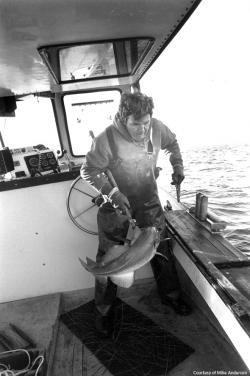
Mike Anderson lands a cod he caught in the early 1990s using hand-line gear in the nearshore waters off Cape Cod, Massachusetts.

When Mike Anderson arrived in Cape Cod in the 1960s as a young man with dreams of adventures at sea, many people shared the same warning: “You won’t get rich in the fishing business; it’s just a way of life.”

But Anderson, undeterred, embraced that lifestyle, fishing his way through decades of long, sometimes treacherous days at sea in the sun, wind, fog, and ice. His hands toughened like leather as he baited hooks late into the night in anticipation of the next day’s bounty. He relished the challenge of each day, the camaraderie among tough-as-nails fishermen, and the exhilarating adventure of it all.

Anderson, now 72, was part of the glory days of thriving New England fishing towns, when fishermen followed their fathers into the business and old-timers spoke, only half-jokingly, of cod so plentiful one could practically walk across the water on their backs. Back then, despite early signs of decline, people still thought the fish were limitless. Most people, that is, except for Anderson.

He believed trawlers that dragged nets along the ocean bottom, scooping up vast amounts of cod, were capturing too many fish and damaging the seafloor. He stubbornly stuck to hook-and-line fishing, even as nets started sweeping up cod in numbers he’d never seen before. In due time, his two-man crew—which once pulled in thousands of pounds of cod a day and regularly caught fish weighing 40 to 50 pounds—began to see both its catch and the size of the fish decline. By the 1990s, the cod were so sparse and small that Anderson gave up and moved on to other species.

Anderson feels he witnessed the decimation of one of the greatest concentrations of marine life on Earth.

Drying Cod

Drying Cod

A historic photo, likely from the early 1900s, shows cod laid out to dry—a once common sight in New England when the fish were more plentiful.

“The fish never really had a chance,” says Anderson, who still fishes every day, both for the joy of it and to make ends meet. “It was greed, shortsightedness, and naiveté. People misunderstood how many fish there were. The world is finite, and we haven’t got the right to diminish the world.”

A recent study determined that the 2014 cod population on Georges Bank, located off Cape Cod in the easternmost side of the Gulf of Maine, was the lowest ever recorded—roughly 1 percent of what scientists would consider a healthy population. That’s down from the 7 percent reported for 2011. In other waters off Cape Cod, the species is also in dire straits. For the fish that built New England, it’s been a long downward spiral.

Because other species in the region also are in decline, the U.S. Department of Commerce declared a fishery disaster in New England in September 2012, the second such declaration for the region in 20 years. As fish populations have plummeted, fishery managers have shown a consistent pattern of failing to heed warnings from scientists, sufficiently limit catch, promptly pursue corrective actions, and otherwise do what’s needed to help fish populations recover, including protecting the habitat and bait fish that cod rely upon.

It’s high time to finally get it right. We at Pew are urging the New England Fishery Management Council—which sets fishing policies in federal waters (from three to 200 miles offshore), from Maine to Connecticut—to address these critical issues:

First, the council must enact and enforce realistic science-based catch levels. Current methods of setting catch amounts are too permissive. It’s wrong to let people keep fishing for the average amounts they’ve caught in the past when fish numbers are dropping and other environmental factors, such as warming waters, may be putting the fish populations at risk of extinction.

School of Cod

School of Cod

The 2014 cod population on Georges Bank, located off Cape Cod in the easternmost side of the Gulf of Maine, was the lowest ever recorded—roughly 1 percent of what scientists say would be a healthy population.

Second, many cod die because they are caught incidentally as fishermen target other species. Fishery managers still don’t have a good handle on the extent of the problem. It’s hard to set safe catch amounts when it’s unclear how many fish are being taken from the water. Add to that the issues created when some fishermen misreport the areas from which they are taking fish or the size of the fish they take, or underreport their catch, and it’s nearly impossible to see the big picture. Fishery managers have been too slow to ramp up their force of at-sea observers and dockside inspectors to better monitor and resolve these problems.

Third, it’s unproductive for the council to consider lifting protections for important cod habitat when the fish need them most. Decades ago, in response to the fisheries crisis of the early 1990s, the federal government curtailed fishing in 8,887 square miles of New England waters where fish live and spawn, including 26 percent of Georges Bank.

But now, fishery managers propose reducing the protected areas substantially, including a drastic rollback of 81 percent of the protected parts of Georges Bank. Cod used to be spread throughout the Cape; but as the fish grew more scarce, scientists believed they took refuge in limited prime habitat areas within their former range. Fishermen in the past knew these spots and targeted them, further decimating the species. Why would anyone let that happen again?

Mike Anderson

Mike Anderson

Mike Anderson, seen here on the Chatham Fish Pier in 2014, helps educate the public about fishing and related issues as part of the Pier Program, run by the Cape Cod Commercial Fishermen’s Alliance. Millions of pounds of seafood are landed at the pier annually. (Photo via www.fishypictures.com)

Lastly, researchers know cod and other fish are much smaller today than they were decades ago. Although the cause is uncertain, scientists theorize that overfishing and warming waters are playing a role. Researchers are also baffled about what is happening to young fish. Experts know that eggs are hatching and fish are growing for several years, but then they are disappearing. These mysteries are worrisome and deserve more study.

This uncertainty makes it all the more urgent for officials to take a comprehensive view of the ecosystem when setting fishing policies—for example, by weighing habitat, food sources, warming waters, and other factors when making decisions about how to manage a species. Pew is advocating that this approach, called ecosystem-based fisheries management, be incorporated into federal law as Congress renews the Magnuson-Stevens Fishery Conservation and Management Act. You can read more about it in our blog series here.

As for Anderson, he isn’t involved or weighing in on these current-day debates. Rather, the philosopher’s son and English major is penning stories about his life at sea and telling cautionary tales on the fishing docks as part of efforts by the Cape Cod Commercial Fishermen’s Alliance to educate the public about the history and future of the Cape’s small boat fishing industry.

He wants current and future generations to learn from past mistakes. And he hopes New England’s legendary fishing towns can spawn new stories of adventure and plentiful catch, instead of just relying on the memories the old-timers leave behind.

What Is In Chesapeake Bay Predators’ Diets?

Little things turn out to be big deals in Chesapeake Bay predators’ diets

Today’s feature comes to us from Karl Blankenship, long-time editor of Bay Journal, detailing a topic that is beginning to be understood as critical to gamefish populations everywhere—the forage the fish eat.

Analysis finds invertebrates, tiny anchovies are critical in Chesapeake food web

By Karl Blankenship, Editor
Bay Journal; www.bayjournal.com.

Menhaden are caught in a purse seine net

Menhaden are caught in a purse seine net

Menhaden are caught in a purse seine net. An analysis of the diets of five major Bay predators found that menhaden was important for only one, striped bass, and even for them, the bay anchovy was more important. (Dave Harp)
t-studied estuary in the world, but a group of scientists attending a recent workshop were surprised about how little they knew about what predatory fish eat.

After all, menhaden — dubbed by some as the “most important fish in the sea” would also be the “most important” fish in the Bay, right?

Apparently not. That honor, were one species to be singled out, might belong to the tiny bay anchovy — a fish that rarely grows more than 3–4 inches in length and typically doesn’t live longer than a year.

“They’re the most abundant fish in the Bay,” said Ed Houde, a fisheries scientist with the University of Maryland Center for Environmental Science, who helped organize the workshop. “They’re really important in the Bay’s food web.”

An analysis of 12 years of Baywide diet information for five major predators prepared for the workshop found that bay anchovy was a significant portion of the diet for four of those species. Menhaden was important for only one, striped bass, and even for them, bay anchovy were more important.

“Menhaden came out not as high on the list as people thought it was going to be,” Houde said. “It was an important prey, but it certainly wasn’t in the top three or four.”

Even more significantly, the analysis showed that the Bay’s food web is less of a fish-eat-fish world than popularly thought, even among many scientists. A host of unheralded species, from worms to clams to crustaceans, are major food sources for the Chesapeake’s predatory fish.

Those were some of the findings that came out of the workshop conducted by the Bay Program’s Scientific and Technical Advisory Committee late last year. The workshop focused on the question of whether the Bay produces enough food, or “forage,” to adequately support its predator population. The workshop stemmed from a commitment in the 2014 Chesapeake Bay Watershed Agreement that called for assessing the “forage fish base.”

It’s a question conservation groups, scientists and fishery managers are increasingly asking for oceans and coastal areas around the globe: Are there enough herring, anchovies, menhaden and similar species to feed predatory fish, marine mammals, fish-eating birds and, in many cases, to support major fisheries?

It was once thought those small schooling fish were so abundant that they could not be overfished. Around the world, they account for about a third of all fish harvested, after which they are processed for oils, fish meal, livestock feed and other products. A 2012 report by the Lenfest Forage Fish Task Force, prepared by scientists around the world, including Houde, called for global harvests to be cut in half to protect both forage species and the many predators that depend upon them.

Similar questions about the forage base have been raised around the Bay. Anglers have complained for years that striped bass were underfed because of a lack of menhaden, and watermen have contended that large numbers of striped bass and other fish looking for food ate too many blue crabs.

Fishery management over the years has sought to maximize the production of predators like striped bass. Other predators have been introduced, sometimes accidentally, such as snakeheads, at other times deliberately, to give anglers new pursuits, such as blue catfish and flathead catfish.

Populations of many fish-eating birds, including bald eagles, osprey, great blue herons and cormorants are at or near record highs, at least compared with recent decades. Meanwhile, some prey thought to have been important historically, such as river herrings and American shad, are at historic lows.

Invertebrates ‘key’ food source

The forage workshop, which followed the new Bay agreement commitment by a few months, was aimed at reviewing what data were available about forage in the Bay and identifying new information that might be needed to guide future forage fish management — and to ensure high and sustainable production of their predators.

But along the way, workshop organizers began to realize that in the Chesapeake, the emphasis just on “forage fish” might be less important than it is for some other areas.

That stemmed from an analysis done for the workshop that examined the diets of five predators thought to be good indicators of predator food demand in different areas around the Bay. The predators in the analysis included striped bass, summer flounder, Atlantic croaker, clearnose skate and white perch.

The analysis drew on 12 years of data from the Chesapeake Bay Multispecies Monitoring and Assessment Program (ChesMMAP), conducted by the Virginia Institute of Marine Science, which collects fish at locations from the mouth of the Bay to near Baltimore five times a year.

Since 2002, the survey has captured 391,000 fish, and measured 285,000. Biologists have examined the stomach contents of more than 35,000 fish, representing 94 species, to determine what the fish had been eating.

A type of forage was considered “important” if it accounted for more than 5 percent of the food in any predator species in at least one survey. It was “key” if it accounted for 5 percent in more than one predator.

More than half of the 20 forage groups identified as “key” or “important” turned out to be invertebrates such as mollusks, worms and crustaceans.

For instance, mysids, a small shrimp-like crustacean, was the most common food consumed by summer flounder, measured by weight, the second most common consumed by striped bass, and the third most common prey of Atlantic croaker. Polychaete worms were the most common prey of Atlantic croaker and white perch, and the third most important for striped bass.

In other coastal areas, “the invertebrates are not the big issue — it is the small schooling herring and anchovies or what have you,” said Tom Ihde, an ecosystem modeler with the National Oceanic and Atmospheric Administration Chesapeake Bay Office, who helped organize the workshop.

Forage fish vs. forage base

Bay Anchovy

Bay Anchovy

In real life, the bay anchovy behind Ed Houde, a fisheries scientist with the University of Maryland Center for Environmental Science, only grows to be 3–4 inches long. (Dave Harp)

Ihde and Houde said much of the previous work concerning forage has focused on predators in ocean fisheries. Those fish are often larger, and primarily consume small fish. Also, much of that focus has been in places such as the West Coast, which lack large estuarine feeding grounds like the Chesapeake Bay.

In the Chesapeake, the predators are often smaller — the largest striped bass generally are here only a few weeks of the year to spawn — and much of the food of the smaller, resident striped bass consists of a variety of bottom-dwelling organisms. As a result, what started out as a discussion aimed at addressing forage fish turned into one focused on the entire forage base.

In fact, the importance of soft-bodied organisms like worms is likely understated when fish stomach contents are examined, Ihde said. “Some of these invertebrates are digested quickly and are probably even more important than our analysis would show because they very quickly turn into unidentifiable goo,” he said.

That said, workshop participants said in their recently released report that menhaden should still be considered a key forage species because the species is important to large striped bass for whom the Bay is a critical spawning area, even if they are only here part of the year. Menhaden are also considered important prey for larger individuals of other large predatory fish such as weakfish and bluefish. And menhaden are likely important for other species, such as fish-eating birds, workshop participants said.

“There’s a general perception that it is all about menhaden,” Ihde said. “They are important. But we can’t forget about all these other things that in some cases are more important to our current system.”

And those other things add to the complexity of understanding, and ultimately trying to manage, the Bay’s food web.

Some organisms not typically thought of as forage turned out to be important in the Bay, such as the young of croaker, weakfish and spot — adults of which are generally considered predators.

“It was a big surprise to me to see something like young-of-the-year weakfish show up as one of the more important prey in the diets of predators,” said Houde, who has participated in several forage fish studies in recent years.

Scant data for tributaries

But the total picture is far from complete. The ChesMMAP surveys only cover the mainstem of the Chesapeake. There is little information available about tidal tributaries.

Those areas are important nurseries for many fish — and are also home to a rapidly growing population of predatory blue catfish. Although some studies are under way to better understand the diet of blue catfish, much less is known about the forage base and food demand by predators in those areas.

Because of those limitations, workshop participants suggested the data from ChesMMAP may under-represent the importance of some forage species such as American shad, river herrings, mummichog, killifishes, gizzard shad, silversides and some small bivalves, which tend to be found in low-salinity areas.

Even less is known about shallow water of less than 2 meters, especially in habitats such as underwater grass beds and marshes, which biologists think may be particularly important for forage production, and where survey boats have a hard time operating.

And the ChesMMAP data have their own limitations. It is a trawl survey, so it collects fish mainly from the bottom, and collections from its gear under-represents both the largest and smallest fish.

The survey is being modified in coming years to collect more samples from higher in the water column and from the benthic invertebrate communities at its collection sites.

While that should refine its information, it is not likely to dramatically change overall conclusions, as other — albeit smaller — surveys examined in the workshop analysis found similar results.

“Our hope is it will lead to a much better understanding of the ecosystem,” said Chris Bonzek, the VIMS scientist who oversees the ChesMMAP survey and who prepared the forage analysis for the workshop. “But we are not going to all of a sudden see that bluefin tuna are the most important predator in the Bay.”

A more complete picture

Because predators are eating so many types of prey — many of which are poorly studied — it’s difficult to characterize the current status of the Bay’s forage base. But, with support from the Bay Program’s Sustainable Fisheries Goal Implementation Team, Houde and several colleagues are reviewing existing information to start piecing together a more complete picture of forage abundance and predator demand.

With information gleaned from the ChesMMAP analysis and other sources, they are assessing the relative abundance of different forage groups in regions of the Bay to see if there are trends in the overall amount and availability of prey, or in the relative abundance of the different types of forage.

In addition, they are looking at stomach content data from major predator fish species to begin to estimate the amount and kinds of forage they are consuming.

That information will start addressing the fundamental questions of how much forage is consumed by predators, what type of forage is most important in different regions of the Bay and how much change has taken place over the years. Ultimately, it will help answer the question of how much food is needed to support the Bay’s predators, both now, and in the future.

“While we are not close to getting that answer, it is the direction we are heading in,” Houde said. “Providing estimates of consumption and forage demand is something we would like to be able to deliver to managers in the next decade.”

A ‘balanced’ ecosystem

Figuring out how to use that information to maintain a “balanced” ecosystem will be a challenge for managers as populations of many forage species vary widely. For instance, the numbers of bay anchovy can fluctuate tenfold from year-to-year — they can live up to three years, but most are eaten by predators within a year — so the relative success of annual reproduction drives their overall abundance. Likewise, the numbers of young croaker, weakfish and spot available to be eaten depend on year-to-year reproduction success.

When the issue moves beyond fish to the broader forage base, the level of complexity increases. Many bottom-dwelling species can be sensitive to extended periods of low oxygen, so a large seasonal “dead zone” can reduce overall abundance, and even eliminate species, from some areas. “If it is a bad hypoxia year, the benthic invertebrates cannot get up and swim away like the fishes,” Ihde said.

The loss of underwater grass beds, coastal marshes and oyster reefs have reduced the amount of habitat available for many forage species. The hardening of shorelines, development of land adjacent to the Bay and its tributaries, sea-level rise and climate change will likely cause continued habitat losses, the workshop report said.

At the same time, predator populations are constantly changing — and not just the fish.

Around the Bay, the populations of fish-eating birds such as eagles, osprey and blue herons are large — and growing. The Bay’s population of double-crested cormorants, which was almost nonexistent four decades ago, is nearly 5,000 today. That’s enough cormorants to consume 300 tons of fish annually, according to the workshop report.

Overall, the fish demand of birds around the Bay is largely unknown, Houde said. Birds, though, could be one of the first indicators of stress if there were a problem with the Bay’s forage base. Houde noted that research in other areas has shown that when forage fish populations decline by a third of unfished levels, the populations of fish-eating birds may drop precipitously.

Protecting forage fish

Other than menhaden, most of the forage species in the Bay are not actively managed fishery species. Menhaden have been increasingly regulated in recent years by the Atlantic States Marine Fisheries Commission, which manages migratory fish along the coast. The commission is working to establish new harvest goals in the next several years that recognize the role of menhaden as prey for predators.

The abundance of other forage can be influenced by a range of actions aimed at improving environmental conditions and protecting habitat, the workshop report said.

For instance, reducing nutrient pollution could reduce the size and duration of dead zones — Bay water quality standards were written to promote a greater diversity of benthic creatures as well as larger, longer-lived species.

Other actions can help protect habitat important for forage species, the report said, such as limiting the use of bulkheads and other hardened shorelines that degrade local habitats, and controlling development near the shore, which is increasingly linked to the lost or reduced production of benthic species.

Forage could also be protected by reducing some predator fish populations, such as snakeheads or blue catfish, but managers have little control over other predators, such as birds.

But the emerging information could offer other opportunities for management. The recognition that the little bay anchovy plays a relatively big role in the Bay food chain could promote efforts to better understand it, Houde said.

“The anchovy is so tiny that most people have discounted it as the target of a directed fishery,” he said, “but there have been proposals for bay anchovy fisheries in other areas along the Atlantic coast.”

Although he said such a proposal is unlikely for the Bay, fishery managers might want to consider policies to prohibit a future fishery in recognition of the bay anchovy’s importance to other species.

“Sometimes,” he said, “in the case of a forage fish, it is easier to develop and implement management policies before there is a fishery.”

The workshop report, “Assessing the Chesapeake Bay Forage Base: Existing Data and Research Priorities,” is found at the Scientific and Technical Advisory Committee website, chesapeake.org/stac/; click on “publications.”

The Bay Program’s management strategy for its forage fish outcome is found at chesapeakebay.net/chesapeakebaywatershedagreement/goal/sustainable_fisheries.

What’s on the menu for Bay’s predators

Drawing on information from the Scientific and Technical Advisory Committee’s workshop report, the Management Strategy for the Chesapeake Bay Watershed Agreement’s Forage Fish outcome preliminarily identified these as the Bay’s key forage species and groups for a wide variety of predators:

Bay Anchovy
Polychaetes
Mysids
Amphipods
Isopods
Mantis Shrimp
Young Spot
Young Weakfish
Sand Shrimp
Young Atlantic Croaker
Razor Clams
Atlantic Menhaden

These species were recognized as potentially important forage groups or species, but were not identified as the top contributors to the diets of predatory fish by information presented at the workshop:

American Shad
River Herring
Atlantic Rock Crab
Atlantic Silverside
Blackcheek Tonguefish
Blue Crab
Flounders
Gizzard Shad
Kingfish
Lady Crab
Macoma Clams
Mud Crab
Mummichog
Killifishes
Small Bivalves

Carl Blankenship

Carl Blankenship

About Karl Blankenship
Karl Blankenship is editor of the Bay Journal and Executive Director of Chesapeake Media Service. He has served as editor of the Bay Journal since its inception in 1991.

Read more about Chesapeake Bay at www.bayjournal.com.
What Are Giant Grouper?

Times Changing for Giant Grouper

By Rodney Smith, www.rodneysmithmedia.com.

Landing a giant grouper

Landing a giant grouper

Handling Giant Grouper Carefully is a Mighty Task

It might as well have been the Loch Ness monster I stood over, except there was nothing either anecdotal or mystical about this giant sea monster; it was real! The rotting carcass of what was then called a jewfish, estimated to weigh over six-hundred pounds, lay before me in the wet Gulf of Mexico sands near the base of the Pier Kahiki, which was part of a Hawaiian-themed complex at Indian Rocks Beach. The high tide had dumped the decaying beast there after fishermen had caught it using a hand gaff-sized steel hook baited with a football-sized black drum. The hook was attached to a short 3/8″ steel chain, which was tied to a sturdy hemp rope they had secured to the pier’s railing.

Once I was up and on the pier’s deck, I overheard the crusty dock manager, Joe, chuckling and talking through the cigar permanently clenched in his broad, crooked mouth to a couple of tourists. “It took six of them men to pull it to shore” he was telling them. Later, when I asked Joe why they wasted such a giant fish, he followed his normal method of operation, spitting his words in my direction. “Boy, them big fish ain’t any good; anyway, they took the cheek meat with’em.”

It was the late Sixties, a time of ignorant bliss, well before most fishermen understood our oceans’ bounties were not finite. Less than a decade later, I believe it was the summer of 1975, during one of my first surfing trips to Sebastian Inlet State Park, I saw three Volkswagen Bug- sized grouper swimming along the bottom of the inlet’s main channel. Their size was amazing and unbelievable. This was the last time I saw any truly giant jewfish.

Looking back at how drastically fisheries management has changed, it might as well have been a hundred years ago. Today jewfish have been officially renamed goliath grouper. Since 1990, these remarkable fish have been fully protected in the U.S.A as a “no take” fish, and their numbers continue to grow. In fact, goliath grouper have rebounded to the point that segments of the angler population find them to be quite the nuisance.

Acting like protected California seals, goliath grouper hang out at places where they know they can steal angler’s catches. Their thieving habits alone have partially fueled a push to remove a couple of layers of Federal and State regulations protecting these endangered fish. Less restrictive rules could give fisheries managers several keen opportunities to raise research money and fisheries datum, or find ways to better protect habitat and build artificial reefs.

States like Florida could sell goliath grouper kill-tags, much like special hunting permits. They could open up a couple of goliath grouper short seasons and help the recreational sports fishing industry raise revenue. This strategy could pump major bucks into coastal fishing communities around the Sunshine State and help researchers and scientist collect valuable data. It could be a “win/win” for everybody!

However, there are serious obstacles standing in the way of this idea. Fisheries biologists understand the complexities of protecting the sustainability of these potentially huge, but slow- growing fish better than most of us. They will tell you we must protect the biggest goliath groupers or they will never return to their historical size and range.

There are two things I’ve learned about fisheries management as a member of the South Atlantic Fishery Management Council’s Snapper/Grouper Advisory Panel. Management of our fisheries and other marine resources is most often driven by money and greed, and secondly, I now understand why the following statement is true. Fisheries management isn’t rocket science, it’s worse!

To read more like this, visit www.rodneysmithmedia.com.

Why Pass the Gulf States Plan?

“The Five Best Reasons To Pass The Gulf States Plan”

by Jeff Angers
from The Fishing Wire

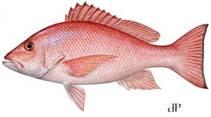
Red Snapper

Red Snapper

There are plenty of good arguments why Washington ought to let the Gulf of Mexico states assume management of the red snapper fishery beyond their own state waters. Yet five of the most persuasive reasons seem to have been missed in all the testimony and written comment about the proposal.

I’m speaking of the five fish and wildlife management agencies of the Gulf states. I’ve spent the last 20-plus years working with the individuals who lead and work in these departments, and I have found them all to be impressively competent professionals — serious and passionate about sustaining the stocks of fish and game under their management.

In my own state of Louisiana, we are justly proud of our Department of Wildlife and Fisheries, which has developed a state-of-the-art creel survey for offshore anglers (“LA Creel”).

Now in its third year, the innovative LA Creel survey is providing pinpoint-precise, real-time estimates of fisheries populations and harvest levels.

This is exactly the kind of data that fisheries managers need to protect red snapper — but only if they have the authority to act.

Once Washington gets out of the way, the five state fisheries managers can respond with flexible approaches that reflect the real state of affairs in the Gulf; they will be able to preserve the species for the enjoyment of all sectors, with no group excluded. Today, federal fisheries managers are left to guess — and to play favorites.

It was this kind of advanced knowledge that led Louisiana’s DWF to realize that the recreational red snapper catch during the regular season was short of its quota by at least 88,823 pounds, making possible an extended season that just began November 20. (The extended season will be subject to a daily bag limit of two snapper per person of 16-inch minimum length; Louisiana’s regular state-waters red snapper season ended September 8).

LA Creel is featured in a new video that also introduces us to representatives from all five Gulf state fishery management agencies. It ought to be “Exhibit A” in the case for adopting the five Gulf States’ plan. I urge recreational fishing advocates to watch the video and share it widely on social media.

Louisiana isn’t alone: each of the five Gulf States has been at the forefront of advanced fisheries science.

It was their devotion to the sustainability of the red snapper that drove the five states’ fisheries directors to put aside regional, political and personal differences and take the historic step of coming together to develop the five states’ plan.

They were doing what we ask all leaders to do: when confronted with a serious problem like federal mismanagement of the red snapper fishery, real leaders set aside distractions, utilize the most advanced scientific tools and information at their disposal and then act in the best interests of future generations.

It wasn’t just a matter of joining together to fill the vacuum left by the federal government’s mismanagement. The five directors then went further, each of them becoming personally involved in advocating for the plan, both in their own state capitals and in the halls of Congress.

Over the last year, testimony advocating state management from Nick Wiley, the executive director of the Florida Fish and Wildlife Conservation Commission; Chris Blankenship, the director of the Marine Resources Division of the Alabama Department of Conservation and Natural Resources, and Robert Barham, Secretary of the Louisiana Department of Wildlife and Fisheries, before the U.S. House of Representatives has been especially compelling and persuasive.

The state directors traveled to Washington to move the ball forward on their historic agreement. Once H.R.3094 is enacted, their words will be remembered as watershed moments in saving the fish and the fishery.

As those of us who live here know, the Gulf is a very special place, unique in every way. These are the men and women who know it better than anyone else — certainly better than a distant bureaucrat in Washington, D.C., however well intentioned.

Can and Should the Gulf Stream Be Used To Generate Power

Plugging Into the Gulf Stream?
Can the Gulf Stream be used to generate power? Should it?

by Kip Tabb, Coastal Review
www.coastalreview.org
from The Fishing Wire

MANTEO — The Gulf Stream passes at times just 12 miles from Cape Hatteras. The amount of water it carries past our coast is massive. In fact, if it were a river, the Gulf Stream would be the greatest river that ever existed on this planet.

“”By the time the Gulf Stream gets off Cape Hatteras (it’s greater than) the flow of all the rivers of earth . . . 45 times greater the entire flow of every river on earth (at flood stage) is what we have off Cape Hatteras,” Mike Muglia of the Coastal Studies Institute said.

A team of researchers and scientists from the institute, N.C. State University and the Institute of Marine Sciences in Morehead City has been studying for the last two years whether all that water could be put to use to create electricity.

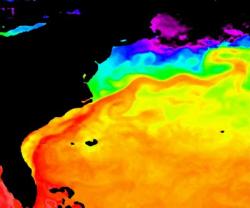
 Gulf Stream hugging the Southeast coast

Gulf Stream hugging the Southeast coast

This infrared image shows the warm waters of the Gulf Stream hugging the Southeast coast, moving millions of gallons of water per second. Photo: NASA
“Is there a resource there and is it enormous? Absolutely,” Muglia said, then asks the important question. “Is it a viable resource?”

It is still too early to tell, but there are characteristics of the Gulf Stream as it passes the Outer Banks that may make better suited for energy production. As it flows north past the Outer Banks, the Gulf Stream is constrained from changing position by the edge of the continental shelf on its west side, Muglia explained. It veers east into deeper water at The Point, an undersea geologic structure about 40 miles off Hatteras Island, and its course can meander.

“The key point is that off of Hatteras, the variability in available energy at a specific location is due primarily to the variability in the Gulf Stream location,” he said.

The Gulf Stream gains three times the amount of flow as it moves north up the Southeast coast. Its flow is measured in svedrups, or Sv — named for the late Harald Sverdrup, a pioneering oceanographer and an early director of the Scripps Institution of Oceanography in California. Off the south Florida coast, the stream’s flow is 33 Sv, or 33 million cubic meters per second; by the time the current reaches Cape Hatteras it’s flow has increased to 90 Sv.

However, with no banks to constrain its flow, the location of the Gulf Stream is not a constant, nor is the force of the current the same at all times. Because it varies in place and flow as much as it does, if the Gulf Stream is to be developed as an energy resource accurate predictions of its fluctuations will be needed, the researchers noted.

Ruoying He, an oceanographer at N.C. State, develops models of coastal circulation currents. It is the modeling that his group has created that is being used to predict where the Gulf Stream will be and the force of the current as it moves past the Outer Banks.

“I got involved in this project because my team at NC State develops a high resolution computer model to predict ocean circulation off the East Coast of U.S.,” He wrote in an email in response to a question. “Similar to the weather forecast, our model provides time and space continuous ocean state . . . predictions. They are quite useful to fill observational gaps and help understand Gulf Stream variability measured by (the) limited suite of observational assets we deployed . . .”

The models He’s team have developed have been remarkably accurate, according to Muglia. “We’ve compared (our) measurements to the model and the model does an extremely good job of capturing the average speed over a long time period,” he said.

He notes there is more work to be done. The model has done a good job of predicting the amount of flow in the Gulf Stream and giving a good idea how it fluctuates. However, if the resource is going to be developed, better information is needed.

“A major research area in my team is to further improve the accuracy of our ocean prediction model,” He wrote. “The model is doing a decent job in predicting the Gulf Stream variability. We hope, through further model refinements and data assimilation, we can perform accurate real-time . . . forecasts of the Gulf Stream to support (and) optimize offshore surveys and energy harvesting efforts.”

Whether the Gulf Stream can be utilized as an energy resource is still very much up in the air. Muglia notes there are a number of hurdles that must be crossed before energy will surge from the waters of the Atlantic Ocean.

“Is it a viable resource in terms of permitting? Is it a viable resource in terms of economics? Engineering?” he asked.

Those questions, especially the topic of engineering, are being addressed by John Bane at the Institute of Marine Sciences. He points out that the studies that are being done are comparable to almost any study looking at a potential energy resource. “The observations that Mike has made shows very clearly that it (the Gulf Stream) fluctuates. It’s very similar to studies of wind energy,” he said.

Expanding on that, Bane talked about other energy resources. “If you were out in West Texas and wanted to drill for oil, you would examine and explore where oil might most likely be. This is a resource assessment. That’s what we’re doing.”

The assessments are ongoing and expanding. Initially the instruments used to measure what was happening with the currents were coastal radars, ongoing measurements taken from instrument in the sea and onsite observations. Instrumentation is being increased to look at a broader cross section of the Gulf Stream, giving the scientists a better picture of the energy closer to shore where it may be more accessible and farther out to sea where there may be more potential energy but the cost of engineering would become higher.

The first biological assessments are also being done. The role of the bottom arrays that are used to assess current and flow is being expanded.

“These now have hydrophones on them. We’re passively listening and seeing what kind of critters we have out there,” Muglia said. “We’ve certainly observed clicks and marine animals. Some of them seem pretty curious. We have one where it sounds like he comes right up to the instrument.”

A place of verdant sea life, the Gulf Stream has been a remarkable asset for the Outer Banks for as long as the islands have been populated. Whether it will be a part of the energy assets of North Carolina is still an unanswered question.

“We really are just trying to understand what the resource is and whether it’s a viable resource,” Muglia said.

How Can I Catch More Tautog?

Yamaha Fishing Tip of the Week: Be Anchor Savvy to Catch More Tautog
from The Fishing Wire

Use two anchors to get on the structure and stay there!

Tautog

Tautog

Even though the hot days of summer fishing are a memory and fall is starting its march toward winter, mid-Atlantic anglers shouldn’t have to take their boats out of the water just yet. The best fishing of the year for blackfish, aka tautog or tog, is just getting started, and the season is open through January in most states along the mid-Atlantic and New England coasts. Open seasons, size and bag limits vary from one jurisdiction to another, so be sure to check your state’s marine fish regulations so you don’t run afoul of the law.

Tog are bottom fish that live and feed in and around structure. Likely places include mussel beds, wrecks and rocky outcroppings – pretty much any form of what is classed as “hard” structure. Regardless of whether it’s naturally occurring or manmade, if it’s been on the bottom in 25 to 100 feet of water long enough to be encrusted with mussels and other anchoring life forms and invaded by crustaceans like crabs, tog will inhabit it at some time during the year. The most productive depths to fish will change with the seasons and water temperature because tog will generally move from shallower to deeper environs as temperatures drop. In late fall and early winter, concentrate your efforts on hard structure in 40 to 70 feet. When ocean temps get down into the 40s, shift to even deeper spots. There are many artificial reefs found off states such as New York, New Jersey, Delaware and Maryland that provide prime tog habitat; further north your focus will be on naturally-occurring hard structure.

Fishing for tog requires a higher level of boat handling expertise and an understanding of how to use your depth finder, chart plotter and anchor(s) to position your boat. Your depth finder and chart plotter are the keys to finding and saving good structure spots to fish, but they will also be critical in helping you anchor directly over those spots to cash in on the tog they are holding. Private boaters will learn that some of the most productive pieces of structure consist of smaller wrecks and rock piles that are overlooked by larger head boats and charter boats. But to get on them you have to be able to anchor with pinpoint accuracy, and that’s an art form that requires a little practice.

Most serious tog fishermen keep two complete sets of ground tackle (anchor, chain and rode) aboard their boats and with good reason. One is typically kept in the boat’s bow anchor compartment, the second in a tub so it can be stowed when not in use. There are a number of anchor designs, but a Danforth-style is the most widely accepted for recreational fishing boats and works well for both sets of ground gear. When choosing an anchor, start by referring to the manufacturer’s application chart for the weight generally recommended for your size boat, but for fishing purposes go up one additional size. This will let you anchor more quickly and with less line between the boat and anchor, which makes deploying and retrieving less work. For a typical 20- to 27-foot boat, each set of ground tackle should consist of an anchor, 12 feet of 1/4-inch chain attached to the anchor with a shackle, and one cable length (600 feet) of 3/8-inch braided nylon line, which is called the “rode.”

Catch Tautog

Catch Tautog

If you’re new to this, you’ll probably want to have a marker buoy or two rigged and ready to drop on the structure as the boat passes over it. A buoy will provide you with a visible reference point when trying to get the boat settled over a spot. If you are well practiced with your GPS, you can forego the buoy and use the saved structure waypoints on the plotter screen for your anchoring reference point. Buoys can be purchased at marine specialty stores or websites, or you can make your own out of brightly colored commercial pot marker buoys wrapped with 150 feet of 1/8-inch nylon twine, marked every 50 feet with a permanent marker with a sash weight attached to the opposite end. Use stainless steel screws to attach a Velcro strap from the top to the bottom of the marker buoy, and use it to control how much line will pay off the buoy when it hits the water. If the water is 75 feet deep, release about 85 feet of twine before dropping the buoy to keep it above your spot, with enough extra line to keep the weight from being bounced off the bottom by waves.

One anchor might be sufficient for most boating needs, but for serious tog fishing two anchors spread approximately 90 degrees apart allow you to adjust the boat’s position by lengthening or shortening the rode for each anchor. By double anchoring, you can hit your mark quickly with some wiggle room to spare for adjusting position if the wind or current changes after you’re anchored. Nothing is more frustrating than getting on a spot and building a good bite only to have the wind change a few degrees and blow you off the spot.

Here’s how to do it. Once you mark a spot, either on your chart plotter or using a marker buoy as a visual reference, you have to determine how the wind and current are going to affect the way the boat will lay at anchor. To do this put the boat in neutral, and let it drift for a few minutes with your plotter scaled down to a very tight range setting (200-500 feet works fine for this phase) with the plot trail feature activated to record the direction of the drift on screen. That trail will be your guide to approximate how the boat will settle back on the anchor lines. The other thing you have to determine is how much rode you’ll have to let out for the anchors to set and hold the boat, because that will tell you how far away from the structure point you have to drop them. To get that number, simply multiply the depth of the water by five. For example, if the structure is in 70 feet of water, you’ll want to drop each anchor about 350 feet away from the mark. Don’t worry about being off by as much as 50 feet one way or another – that’s why you’re using an anchor one size larger than recommended.

Anchors

Anchors

Now that you’ve determined the direction the boat should rest at anchor and how far away the anchors should be dropped from the mark, get your anchors ready for deployment at the bow of the boat, and then slowly run the boat directly down current of the buoy or the waypoint marker on your plotter. Turn so it parallels the drift trail you just created, passing directly alongside the buoy or over the mark on the plotter screen. As soon as the boat reaches the mark, turn the boat at least 45 degrees to port of the drift line, and proceed at a slow speed until you are about 350 feet from the mark and drop the first anchor. Once it strikes bottom, carefully power backwards toward the buoy in reverse letting line out until you get close to the mark. Then hold the anchor line tight until the anchor sets in the bottom and pulls the line through your hand. Take a wrap on a bow cleat, let the boat settle back on the rode to be sure the anchor is firmly set, then loosen that line and repeat the procedure, but this time running the boat from the mark at least 45 degrees to starboard of your drift line. When you’re done you will have two anchors set 350 feet out from the mark, spread approximately 90 degrees apart.

Drop back both lines until you get close to your mark, and wrap them around a bow cleat and let the boat settle in. If the boat is positioned too far forward, drop back by letting out more rode from both lines to put it on the mark. If it’s behind the mark, pull up on both lines. If it is laying to the right, let out a little line on the starboard anchor and pull in some line on the port. Do the opposite if the boat is laying too
far to the left. It’s that simple.

If you want to move the boat while you’re fishing to cover more of the structure, you’ll find that adjusting the anchor lines will give you quite a bit of latitude to do so. This is important because you will encounter structure where you will only catch tog on specific areas and not on the whole piece. Sometimes bigger tog will show a preference for a specific portion of a larger piece of structure. For example, there are wrecks where they feed on the up-current side so anchoring over the up-current portion of the wreck will catch a lot of fish, while being off that spot might only produce a few bites or small fish.

Remember that anchoring accurately is an art that takes into consideration some scientific observations on your part and the smart use of the tools you have on your boat. It takes practice to gain an understanding of how sea and wind conditions affect your boat under different anchoring scenarios. Just remember that tog fishing is all about location, so with some good structure numbers, a compliment of well set-up ground gear and these techniques, you can get on even the smallest piece accurately and hold the boat there while you limit out. If conditions change during the day, you might have to reposition one or both anchors, but that’s the price you pay for great fishing. Anchoring might be the least fun part of the trip, but nine times out of ten it’s the most important.

What Is the Real Alabama Red Snapper Tally?

Alabama Red Snapper Tally 56 Percent less than Feds Report

EDITOR’s NOTE: Today’s feature, written by Alabama Department of Conservation and Natural Resources’ David Rainer, is yet another example of the continuing conflict between the five states that comprise the shores of the Gulf of Mexico and federal authorities when it comes to managing the Gulf’s fisheries. As you’ll read, the results don’t seem to surprise anyone- but the fight continues.
from The Fishing Wire

As many Alabama offshore anglers will attest, the results from the red snapper catch data is the same old song, second verse.

When the mandatory Red Snapper Reporting System was implemented for the 2014 season, the Alabama Marine Resources Division had a pretty good idea that the catch numbers compiled by the NOAA Fisheries was significantly inflated. The catch data for the 9-day 2014 season reported through Alabama’s “Snapper Check” was 455,522 pounds, while the feds estimated the catch at a whopping 1,227,469 pounds.

The discrepancy between the Alabama red snapper catch data and the federal catch data was recently confirmed with the 2015 numbers.

Keep in mind the 2015 season was different because of sector separation. The private recreational anglers had a 10-day season. The charter boats with a federal reef fish permit were allowed to fish 44 days.

Still, the discrepancy was significant. The federal catch estimate was 2,355,481 pounds. Marine Resources estimated the catch off Alabama at 56 percent less than the federal estimate at 1,045,042. The average-size red snapper landed was more than 8 pounds.

“We continued the Red Snapper Reporting Program for a second year to compare it to the federal MRIP (Marine Recreational Information Program),” said Chris Blankenship, Director of the Alabama Marine Resources Division. “Last year, the results showed that Alabama caught about two-and-a-half times less red snapper than the federal government estimated we caught.

“Where that’s important is the quota is set before the season, and that’s how they determine the number of days for the season. If they are overestimating what’s been landed, our snapper season potentially could have been two-and-a-half times longer if they had used Alabama’s information.”

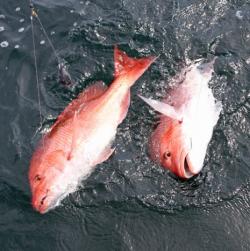
Red Snapper

Red Snapper

Anglers who pursue red snapper off the Alabama Gulf Coast have had no problem at all landing nice red snapper during the short seasons (above). Ongoing research on the red snapper population off of Alabama indicates a healthy, vibrant stock (Below). Photos by David Rainer, with permission.
Red Snapper Research

Red Snapper Research


Blankenship said even though the parameters changed because of the sector separation, Marine Resources was interested to see if that discrepancy between Alabama numbers and federal numbers would be similar for 2015.

“This year, the federal program estimated there was more than twice the number of red snapper landed than what the Alabama program estimated,” he said.

The reason Blankenship is confident in the Alabama numbers is because of the collection of data through the mandatory Red Snapper Reporting Program and the deployment of Marine Resources personnel to conduct checks at the public boat ramps and marinas, as well as on-the-water checks by enforcement personnel.

“We end up with a correction factor for the ones that were not reported,” he said. “We use that to come up with the final numbers. It’s a much less complicated system than what the federal government uses, and we feel ours is much more accurate.

“We have cameras at the public boat launches; we do vessel counts on how many boats launched during red snapper season. We do this to compare the numbers used by the Alabama reporting program or the MRIP data. What we found was the number of vessels launched very closely corresponds with what the Alabama red snapper program reported. We think that is important validation for our program.”

Blankenship also said the MRIP system is still using a telephone survey of coastal households and extrapolating the data.

“It’s obvious to us when we look at the results from that telephone survey that they are overestimating the amount of effort, the number of fishing trips for the state of Alabama,” Blankenship said. “We are attempting to work with the MRIP team to see what’s causing the difference in data.

“They have been very anxious to see how we have calculated our results from the Alabama Snapper Check, but they have not been as open to show how they come up with their numbers. We’re trying to work through those difficulties. We don’t have anything to hide. We are glad to show how our system works and how we came up with our numbers. It’s not complicated, and we feel it’s very accurate. We want to be able to look under the hood of the MRIP program, and we think it will help them develop a more accurate estimate of the catch, not only in Alabama but nationwide.”

Blankenship said one example of MRIP data that cannot be accurate came from Mississippi.

“When you look at the landings on the NOAA MRIP website for the private recreational season in Mississippi and the federal estimate of their catch, for the 10-day red snapper season in June, the federal MRIP system estimated there was not a single red snapper landed in the state of Mississippi,” Blankenship said. “So in Alabama, the feds estimated we caught more than 2 million pounds of red snapper, and in Mississippi, they estimated they caught zero red snapper during the same time period. This just shows the MRIP system obviously has some flaws.

“That’s why we feel it is so important for the feds to use numbers from Alabama Snapper Check because our numbers are much more accurate.”

The current federal quota for the recreational sector has a 20-percent buffer built in to account for overages. Blankenship said the best way to get rid of that ridiculously large buffer is to have more accurate catch data.

“The best way to get that 20-percent buffer back is to have regional management for either a portion of the quota or true management of red snapper where we do the stock assessment and set the quota,” he said. “We feel like with regional management we can get more days for the private recreational anglers and more days for the charter boats.”

The Gulf of Mexico Fishery Management Council is considering Amendment 39 that would give the five Gulf States regional management of the red snapper fishery.

A public hearing on the amendment was held in Mobile Tuesday night. The full Gulf Council will consider Amendment 39 at its next meeting, which is scheduled for January 25-29, 2016, at Perdido Beach Resort in Orange Beach, Ala.

“The reason Amendment 39 is important is evident in our red snapper reporting numbers,” said Blankenship. “Alabama currently supports Amendment 39 because we feel like we can do a much better job managing this red snapper fishery than is currently being done by the federal government and get our anglers more days to fish.”

Blankenship said Marine Resources is in the process of doing a stock assessment off the coast of Alabama and will hopefully have the results by the end of the year. The early numbers look good.

“The snapper stock seems to be very healthy even after the season,” he said. “Whether we caught a million pounds as Alabama estimates or 2.3 million pounds as the federal government estimates, we’ve been out there doing research since the season ended.

“I can say there is no shortage of legal-size red snapper off the coast of Alabama.”

—DAVID RAINER, Alabama Department of Conservation and Natural Resources

Fish on Mobile Bay and Mississippi Sound

“Bugging” the Fish on Mobile Bay and Mississippi Sound

Today’s feature comes to us from David Rainer of the Alabama Department of Conservation and Natural Resources
from The Fishing Wire

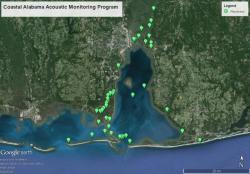
Hydrophone locations in Alabama

Hydrophone locations in Alabama

Mobile Bay and the Mississippi Sound are bugged, but the listening devices aren’t snooping to hear the inshore anglers’ big-fish tales or locate their favorite fishing holes.

The microphones, known as hydrophones, are strategically positioned around the Bay and Sound to listen for the fish themselves – a select group of fish.

In a study sanctioned by the Alabama Marine Resources Division (MRD), several inshore fish are being fitted with sonic devices that will be picked up by the hydrophones to get a better idea of where and how much they travel during the year.

Chris Blankenship, MRD Director, said the project is in collaboration with the Mississippi Department of Marine Resources, which has hydrophone stations on the west side of Mississippi Sound.

“This should give us a better picture of the movement of those inshore fish,” Blankenship said. “It started as a tarpon project because that’s Alabama’s state saltwater fish, but we had very little information about the movement of tarpon in our area. Once the hydrophones were out, we had the opportunity to include other species, so we added red drum (redfish) and spotted seatrout (speckled trout) to learn about those fish movements at the same time.

“The interesting thing is that for any fish with an acoustic tag that we pick up, we share that information. Like sturgeon. The U.S. Fish and Wildlife Service has tagged some sturgeon in some of the creeks and rivers in Florida. Occasionally, we’ll pick up some of those fish in our array, and we’ll share that with the people who are gathering data on those fish.”

Dr. Sean Powers and the University of South Alabama Marine Sciences Department are conducting the study, which has been dubbed CAAMP, the Coastal Alabama Acoustic Monitoring Program. There is an array of 40 listening stations with hydrophones strategically placed around Mobile Bay and Mississippi Sound.

“The hydrophones were placed around the bay to cover the entry and exit points of fish, and in this instance, we’re talking about a red drum or speckled trout,” Powers said. “We have all the rivers covered in the (Mobile/Tensaw) Delta. We have a string of them along the Causeway, at Fowl River and Dog River. We also have them in Mississippi Sound.

“Our colleagues in Mississippi and Florida are using same type hydrophones, and we share data. So although we only cover Alabama with our 40 hydrophones, we have partnerships that cover the Gulf from Louisiana to Tampa.”

The hydrophones are designed to pick up acoustic signals with unique codes that identify individual fish. The acoustic tag sends a series of sound pulses in a few seconds. The hydrophone interprets that signal and identifies the fish. If it was a fish from Alabama, the identification of the fish gives researchers data on where the fish was tagged and where it was located when the signal was picked up at different times. If the hydrophone identifies an unknown code, the other states involved in the program are notified.

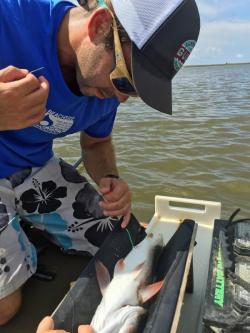
Inserting probe into fish

Inserting probe into fish

Each fish in the study is caught by researchers or other anglers and the small tag is attached.

“We do a little surgery on the fish,” Powers said. “We insert a little tag. It’s about half the size of a AAA battery. Sound travels really well in saltwater, so we don’t need that big of an amplifier. A little tag can do a whole lot. It sends that pulse out every minute. The tags will last a year. When it swims within 500 meters of a hydrophone, the signal is picked up and will tell us the fish was alive in that location. With our array of hydrophones and collaboration with the other states, we get good information on movement of fish, the seasonal movement of fish.”

The Mobile/Tensaw Delta and its role in the movement of inshore species is of particular interest to the researchers. Typically, the inshore species follow the migration of shrimp and other food sources into the rivers and creeks in the fall, depending somewhat on water salinity and flow.

“One thing we’re really interested in is how the saltwater fish use that Delta – when, and potentially why, they use that Delta area,” Powers said. “Although we have hydrophones all around the Bay, it’s a little more weighted toward the Delta, Fowl River and Dog River.”

The acoustic study is being done in stages, according to species. The first year is red drum. Powers said about 100 redfish have already been tagged.

Bugged fish released

Bugged fish released

“That was the fun part,” he said. “We went out and tagged them all around the Bay, some in the Delta and some off Fairhope, some off Bon Secour and some off Dauphin Island.

“What we will get is very important information on movement, and we’ll get important information on survivorship. We know how many fished we tagged. We have rewards so fishermen can call the information in to us if they catch one. That way we’ll be able to tell how many survived.”

That rate of survival, or escapement, plays a crucial role in the management of red drum, Powers said. Current management models are based on 30-percent escapement.

“What that means is 30 percent survive to go offshore and spawn,” he said. “The fish we tagged are within the state slot limit of 16 to 26 inches. What we would like to see is verification that at least 30 percent of those survive.”

The red drum study will be expanded next year with different parameters. Half the fish tagged will be wild fish, and half will be fished raised at the Marine Resources Division’s Claude Peteet Mariculture Center in Gulf Shores.

“We’re really interested to see if there is a difference in movement in wild red drum versus hatchery-raised red drum,” Blankenship said.

Speckled trout will be added to the study in year three; however, several speckled trout that were part of the live weigh-in for the Alabama Deep Sea Fishing Rodeo were tagged and released as well. Powers said the species for years four and five are undecided but could include flounder and/or sheepshead.

Before CAAMP came into existence, Powers said a tarpon study had been underway for a couple of years.

“We worked with fishermen on the tarpon, because you’ve got to be pretty good to catch a tarpon,” he said. “We tagged about a dozen tarpon, and we’ve also got satellite tags on a couple of fish that will pop off and float. We also have one receiver off Gulf State Park Pier, so we expect to hear a few tarpon ticking off Gulf State Pier.”

Powers said the information from the hydrophones is downloaded about every six months.

“Sometime next year we should have some good information,” he said. “We know that we’ve already heard from some of the tarpon and some of the red drum. The good thing about the red drum tags is some of the freshwater folks have receivers out to listen for sturgeon, and they’ve already heard some of our redfish up in the rivers.”

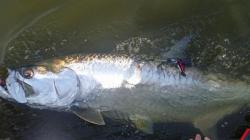
PHOTOS: (Crystal Hightower, tarpon by Andrea Kroetz) As part of the CAAMP array, hydrophones are stationed in Alabama coastal waters to pick up the signals from the tagged fish to study seasonal movements and escapement rates. A small acoustic device is inserted by Reid Nelson into the body cavity of the red drum in the study. Larger tags are attached near the dorsal fin on tarpon.

What Are Albies?

Yamaha Fishing Feature: Fall Light-Tackle Brawl
from The Fishing Wire

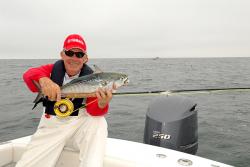
Albies are false albacore tuna

Albies are false albacore tuna

It’s That Time of Year When Albies Are Back in Town. So what are Albies?

Inshore anglers along the East Coast, from Florida to New England, look forward to fall for a lot of reasons. But those among us who enjoy a really good fight on very light tackle tend to rejoice more than our brethren. That’s because fall is when one of our favorite adversaries moves inshore, often right along the beach fronts, offering us some fast-and-furious, run-and-gun fishing with the lightest of tackle. It’s albie time!

False albacore, also called little tunny, albies or bonito in southern waters, are one of the smallest of the true tunas. While most encountered inshore are in the three-to-10 pound range, they can grow to weights in excess of 30 pounds. The world record, according to the International Game Fish Association, was caught on the edge of the Continental Shelf in the Washington Canyon, 80 miles off southern Maryland, and tipped the scales at a remarkable 36 pounds! They are relatives of the yellowfin, bigeye and bluefin tuna and when you hook one, you’ll realize they possess the same strength and fighting spirit as their much larger cousins, just on a scaled down level. So the trick to getting the most out of fishing for them is to scale down your tackle, hang on and enjoy the ride.

Albies, fishery biologists tell us, are the most abundant tuna species in the Atlantic where they range throughout temperate and subtropical waters, but if you chase them on a regular basis, you might sometimes question that statistic. At times, they appear to be everywhere at once crashing bait on the surface and at others, they can be almost impossible to find. In U.S. waters, they range as far north as Maine and as far south as the Florida Keys and throughout the Gulf of Mexico. We’ve personally caught them from Narragansett Bay to the Marquesas to the Mississippi Delta, and pretty much everywhere in between!

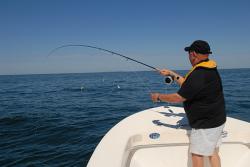
Fighting  an Albie

Fighting an Albie

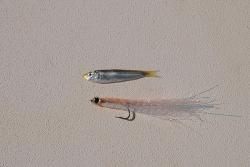
Albies feed on a wide range of small schooling baitfish including silversides, bay anchovies, sardines, small menhaden and herring. Anything shiny and moving fast with lots of company is a target for these speedy predators. When they key in on large schools of small baitfish they usually travel in wolf packs, so if you find one, you’ve found a lot. How long they stay in one place is always a contributing factor to how many you’ll catch because they tend to move quickly from one school of bait to the next, popping up in a confusion of surface splashes only to disappear almost as quickly as they surfaced. Albies are aggressive when feeding and quick to hit artificial lures, particularly small, shiny metal jigs and flies. What makes them so much fun to catch is their speed and stamina.

If fall is albie time in southern New England and the Mid-Atlantic states, then you might guess that they are migratory and you would be correct, although their migratory habits can be difficult to predict from year to year. They tend to spend much of the winter in their southern haunts, and then begin a northward migration that takes them up the Eastern Seaboard where they provide loads of fishing fun for anglers in Northern Florida, Georgia and the Carolinas. But as they move further north, they tend to push well offshore. It is also thought that large schools transit the North Atlantic, but little research has been done to test that theory. By late summer, they will start to move inshore off Massachusetts and Rhode Island where they will hunt bait schools in bays and sounds, around inlets and areas where currents collide. As they begin the fall run southward, they tend to stay closer to shore moving into the Long Island Sound, where they take advantage of massive schools of small baitfish moving out of the many estuaries into the Sound proper.

October, along the eastern end of Long Island, offers some of the best albie fishing to be found anywhere, as millions of bay anchovies in massive schools make their way around the Point at Montauk right into the path and hungry mouths of thousands of albies and small striped bass. They are so close to the beach surf fishermen catch their share standing on the rocks, but boat fishermen really cash in on the fast-paced action.

A little later in October, albies show en mass along the south shore of Long Island and the Jersey Coast. The fishing is different, but can be just as frenetic when a school of albacore finds a school of small baitfish, and there are plenty of those exiting the estuaries in both locales. The parade just keeps happening slowly, moving to the south. At the same time this is all going on, albies show up off Harkers Island, North Carolina, where they do a repeat of performance similar to that in Montauk. By this time, the action takes place around Cape Lookout National Seashore around the southern-most barrier island, Shackleford Banks, and around the inner waters of the island itself. The key to their presence is always the same—massive schools of small baitfish.

Most anglers fish for them with light spinning tackle. A seven-foot light-action spinning rod loaded with six- to 12-pound test line does the trick and makes the fight loads of fun. Hook a big one and you just might find yourself cranking up the outboard to chase it, and to keep from running out of line on the reel. Albies are the ideal inshore fish for challenging with fly tackle. A nice eight- or 10-weight rod matched with a quality reel with a super smooth drag that holds at least 300 hundred yards of backing is a must. Floating lines are best for casting to surface-feeding fish, and small flies that match the baitfish will get you plenty of bites.

Fall albacore action usually takes place around a boat. The fish move fast when feeding, popping up close to the boat, then a hundred yards away a couple minutes later, so you have to have someone at the helm ready to crank up and move to stay on the fish. This is called run-and-gun fishing, using the boat to get you to where the fish are busting quickly so you can drop in a few well-placed casts and hook up. Small outboard-powered boats are at a great advantage because of their speed and maneuverability, so if you’ve got one, make the best of it.

If there are albies around, but not surface feeding, you can try chumming. This technique seems to produce best results around nearshore structure such as lumps and ridges. Anchor and cut up handfuls of whatever small baitfish you can acquire. Then start tossing a few pieces at a time into the water to create a slick scented trail for the fish to follow to your boat. Don’t chum heavily because the fish will hang back and just eat the freebies. Pin a small, light wire hook in a whole baitfish and float it back with a few pieces of chum. You usually don’t have to wait very long for the fish to find you. If you don’t get a bite, try adding a small split shot to the line a couple feet up from the hook to get your bait a little deeper.

Bait for Albies

Bait for Albies

False albacore have very keen eyesight and they use it to distinguish and track prey when in hot pursuit, so keep your terminal tackle sparse and small, including your hooks and lures. Don’t use snaps and swivels. Tie your leader directly to your running line, and your lures or hooks directly to the leader. Always use a light fluorocarbon leader, 15-pound test or lighter, which is far less visible underwater than regular monofilament. If you use braided line on your reel, use at least 10 feet of flourocarbon leader between the end of the braid and the hook or lure. And be sure to check your leader after each fish because they do have teeth and they will scuff or nick the line. Change your leader as soon as you see any damage, or you can be sure you’ll lose a fish or two as a result of not paying attention to details.

Albies are the fun fish of fall for millions of saltwater anglers. If you haven’t chanced them before, you’re in for a treat. If you have, I’m sure we’ll be seeing you on the grounds again this fall to get in on the action.

Would A Hammerhead Shark Travel Widely?

Would a Tagged Hammerhead Shark Travel Widely”
from The Fishing Wire

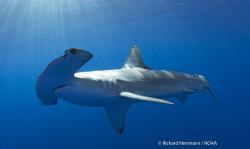
Smooth Hammerhead Shark

Smooth Hammerhead Shark

Smooth Hammerhead Shark (Sphyrna zygaena), Nine Mile Bank, San Diego, California.
Credit: Richard Herrmann/NOAA
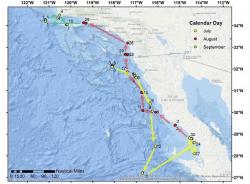
The first hammerhead shark fitted with a satellite tracking tag off Southern California has traveled more than 1,000 miles to Mexico and back again since NOAA Fisheries researchers tagged it near San Clemente Island about two months ago.

The shark, which is now off Ventura, California, is providing new insight into the great distance hammerheads may cover in search of food, mainly fish and squid. Unusually warm ocean temperatures in the Southern California Bight since last summer has drawn hammerheads north, making them more visible off Southern California.

“The surprising thing we’ve learned from this is just how much they move around within a season,” said Russ Vetter, Senior Scientist at NOAA Fisheries’ Southwest Fisheries Science Center in La Jolla, Calif. “This one went way down to central Baja and then shot back up here again just to find food, and that is a lot of territory for an animal to cover.”

Hammerheads have been sighted off Southern California more frequently in recent weeks, including one case last weekend where a hammerhead on a fishing line bit the foot of a kayaker reeling it in. While hammerheads are not usually aggressive, scientists warn that caution is warranted around sharks since they can act unpredictably.

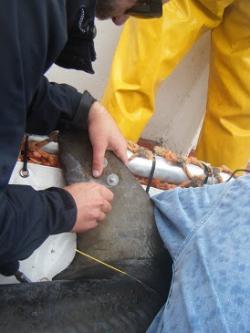
Researchers on an annual NOAA shark survey caught the tagged female hammerhead June 30 off San Clemente Island and attached the satellite tag to its distinctive dorsal fin. The satellite position only, or SPOT, tag relays high resolution location data as the animal travels. The shark is known as a smooth hammerhead, one of three types of hammerheads that occur in California waters and also include bonnethead and scalloped hammerheads.

attached a satellite tag to a hammerhead shark

attached a satellite tag to a hammerhead shark

Researchers attached a satellite tag to a hammerhead shark captured in a regular offshore survey June 30. The tag should last two to three years.
Credit: NOAA Fisheries/SWFSC

The smooth hammerhead shark traveled more than 1,000 miles to Mexico and back after it was tagged near San Clemente Island June 30.
Credit: NOAA Fisheries/SWFSC
The tagged shark measured more than seven feet long from its head to the fork of its tail. NOAA Fisheries scientists tagged a smooth hammerhead in the same area in 2008 with a different kind of tag that stores data for a few months and then detaches from the animal.

The shark tagging was conducted in collaboration with the Tagging of Pelagic Predators program.

Hammerhead habits are poorly known and researchers took advantage of the animal’s catch to learn more about its movements ahead of an approaching El Niño climate pattern, which typically boosts water temperatures along the West Coast. Patches of unusually warm water known collectively as “the warm blob” had raised temperatures off Southern California last year prior to El Niño, initially attracting warmer water species such as hammerheads.

 shark traveled more than 1,000 miles

shark traveled more than 1,000 miles

The new satellite tag shows that the hammerhead swam more than 400 miles south after its capture to an area off the central Baja Peninsula known for its production of sardines and anchovy, Vetter said. The shark then returned north to an area off Ventura this week.

The sharks’ distinctive hammer-shaped heads carry special sensory features and widely spaced eyes that may help them see and detect prey. The tagged hammerhead mostly hugged the continental shelf along the Pacific Coast but in one case made an open-ocean foray of a few hundred miles off of the Baja Peninsula. Vetter hopes the satellite tag will remain active for two to three years, providing a long-term record of the shark’s movements.

“It’s very interesting to us to see the neighborhoods this shark frequents,” he said. “For an animal to swim all the way to Baja just to see if there’s food suggests its food supply is not super abundant, which tells us something about conditions out there.”

The opportunity to track the shark during a warm El Niño year may provide clues about how hammerhead habitats may shift during gradual warming expected with climate change.

“It’s certainly possible they may spend more time farther north,” Vetter said. “We’ll be very curious to watch how far north this shark goes, which could give us an idea what to expect in the future.”