PUBLIC’S HELP NEEDED IN REPORTING WINTER MONARCH SIGHTINGS
SOCIAL CIRCLE, Ga. (Nov. 18, 2021) – We asked and, thankfully, you delivered.
Now we need your help again.
Last winter, volunteers from across the Southeast and Gulf states provided more than 5,800 observations of monarch butterflies. This winter, the partnership of universities, agencies and other organizations called Monarchs Overwintering in Southeastern States is requesting the public’s continued involvement in reporting sightings.
Sonia Altizer, a University of Georgia ecology professor and director of Project Monarch Health, said the information can help scientists determine if these iconic but declining butterflies “can overwinter as non-breeding adults in the southern U.S. and how this might affect future population numbers.” The monitoring will also help document how winter-breeding activity might be affecting the annual migration to Mexico.
Understanding migration and overwintering behavior is crucial to conserving monarchs, a candidate for listing under the Endangered Species Act.
Thousands of monarchs stream across the South each fall on their way to wintering grounds in central Mexico. In the spring, this eastern population of the butterfly returns to the U.S. and Canada to breed.
But not all monarchs migrate to Mexico. Volunteer observations over the past two decades have helped scientists better understand how and why some monarchs breed throughout the winter in the southern U.S. Scattered reports also suggest that some monarchs can overwinter in coastal regions in a non-breeding state, similar to their wintering behavior in Mexico.
The goal this winter is to collect more data for a growing partnership that has expanded to include organizations such as Florida Natural Areas Inventory and the North Carolina Natural Heritage Program.
Gabriela Garrison of the North Carolina Wildlife Resources Commission said the monarch is a species of greatest conservation need in North Carolina’s Wildlife Action Plan, as in the action plans of many other states. “So monitoring overwintering populations and learning more about their behavior is critical.”
The public is encouraged to report monarch sightings from Dec. 1-March 1 in North Carolina, South Carolina, Georgia, Florida, Alabama, Mississippi, Louisiana and Texas.
Observations are entered in Journey North’s online data portal, where they are transformed into real-time mapping visualizations of monarch migration and breeding. Journey North is an organization designed to engage people across North America in tracking wildlife migration and seasonal change.
Program coordinator Nancy Sheehan said the public has a long history of being a part of scientific discoveries. “Journey North is excited to provide a platform for engaging citizen scientists in this targeted monitoring effort.”
Susan Meyers, cochair of Monarchs Across Georgia agreed. “Volunteers are vital to this effort. If you enjoy being outdoors and exploring your local ecosystem, this is an easy activity that can be done alone or with your family.”
Wildlife biologist Anna Yellin of the Georgia Department of Natural Resources said project partners are grateful to all who reported sightings last winter. “When we come together as a community as we have with this effort, we stand a better chance of protecting the monarch butterfly for future generations.”
HOW TO TAKE PART
Step 1: Create a free account at journeynorth.org/reg.
Step 2: Learn how to report monarch sightings at journeynorth.org/monarchs.
Step 3: From Dec. 1-March 1, submit monarch observations at journeynorth.org/sightings.
Classic Lake Restoration Efforts In Arkansas
A $3.2 million restoration promises great results for anglers a few years from now as fish take advantage of new habitat.
HARRISBURG — As trucks unload large gray riprap and spray improved shorelines with grass seeds and fertilizer around Lake Poinsett in Poinsett County, Brett Timmons and his natural resources program technician, Tristan Bulice from Arkansas State University, continue to drag artificial habitat structures to the bed of the lake, nearing the end of a three-year marathon. The 471-acre lake has been dry since 2017 to complete a massive renovation involving many moving parts.
Originally constructed in 1961, Poinsett has held a healthy reputation in Northeast Arkansas as a great destination for crappie, redear and catfish. But managing a fishery is a constant battle against the elements to prevent erosion and deterioration of the lake’s infrastructure while maintaining the habitat under the surface. Timmons, regional fisheries supervisor for the AGFC in Jonesboro, has been hard at work in that battle since he joined the AGFC in 2012.
“I’ve heard Commissioners comment in the past about the challenge we have in fisheries management,” Timmons said. “Most of the work and the outcome is hidden from the naked eye under water, so it’s a difficult thing to measure against results of work that’s more easily seen.”flexamat reinforcements combine with riprap to prevent future erosion
That under-the-surface nature of lake management was illustrated in 2017, when after nearly 60 years, the infrastructure of Poinsett began to fail.
“Materials and construction techniques used at the time of Poinsett’s construction typically have a 50-year lifespan,” said Ben Batten, chief of the AGFC’s Fisheries Division. “At nearly 60 years old, the infrastructure of Poinsett had reached a point that repairs would be needed for the lake to continue providing the quality of fishing anglers had enjoyed for the last six decades.”
Work of this magnitude is much more than pushing some dirt with a bulldozer. Construction was complicated with the primary soil type surrounding the lake being loess soil and the area along Crowley’s Ridge in Arkansas being in an earthquake zone. Engineering, construction and ultimately the success of the project hinges on many factors like soil type, topography of the entire watershed that flows into and out of the system, and current condition. The repair work done at Lake Poinsett is one of the most expensive lake renovations undertaken by the AGFC to date. Including the extensive shoreline stabilization project, complete removal and replacement of the water-control tower and retrofitting of the outflow pipe and renovation of the auxiliary spillway, the cost of the completed renovation will exceed $3.2 million.
“Last year, only four major construction projects were underway by the agency, and Poinsett was one of them,” Batten said. “We currently have 15 other dams that are in need of some repair work, and we anticipate more work like this in the future simply because of the age of most of the infrastructure. But the benefits after these renovations make them worthwhile”
Slow Drain
Problems with the lake began to surface when shoreline erosion was documented a little over 10 years ago. This erosion became larger over the years and a plan to stabilize the shore was developed by the AGFC’s Arkansas Stream Teams program. But in 2016, a significant failure to the water-control structure rendered it inoperable. The following spring, officials at Lake Poinsett State Park noted that the lake level was dropping significantly. Contractors with the AGFC determined that the housing where the outflow pipe attached to the water-control structure had given way, allowing water to escape the lake with no control.
“The water-control structure needed to be replaced, and to do that you have to drain the lake completely,” Batten said.
Timmons said the work to complete the water-control structure was impressive.
“They drove steel beams 50 feet into the ground to provide a solid footing, then built up from there,” Timmons said. “Luckily, the dam was sound and the outflow pipe was still in good enough shape that they were able to repair and reinforce the pipe through an injection process instead of having to dig or auger a channel for a new pipe entirely. The finished product will likely last at least as long as the previous materials.”
Construction companies have also been hard at work placing riprap and erosion-control materials called “Flexamat” to replace eroded shorelines and prevent further damage.
“The riprap will block erosion, and the Flexamat will allow grass and other vegetation to grow within it to help stabilize slopes,” Timmons said. “Thousands of feet of shoreline have been repaired during the renovation.”
Angling Improvements
The renovation should be an exciting time for anglers, as Timmons expects good things from the dry period between the time the lake was drained and its expected refilling at the end of this year.
“Any time you draw down a lake and allow that lakebed soil to dry out and crack, you’re releasing nutrients back into that system when it refills,” Timmons said. “And the brush and grasses that have been allowed to grow during the construction time will add instant habitat for baitfish when we begin to restock. The breakdown of that vegetation also will add nutrients to the lake, promoting a boom of growth similar to what you see when a lake is first constructed.”
Timmons says anglers should see excellent rewards for their patience in the project, with good fishing only a few years after the lake is filled.
“We’ll stock catchable-size channel catfish as soon as we think the lake can support them for some instant gratification, and we’ll stock forage species in 2021 to let them get a good head start on the game fish to give the lake a good foundation,” Timmons said. “In 2022, we plan to stock bass and crappie. If all goes as planned, anglers should see some excellent fishing within four years or so.” Pallets, concrete and PVC pipes combine for beneficial habitat
Pallet Palace
Timmons isn’t leaving the habitat solely up to Mother Nature. He and many other AGFC staff have been hard at work adding extra bits of cover to increase the habitat throughout the lake.
“We added more than 4,000 pallets to the lakebed in July alone as fish habitat,” Timmons said. “I’d say we have somewhere between 7,000 and 8,000 pallets in fish attractors throughout the lake at this point, and we get more on a weekly basis.”
The pallets have been placed in different stacks and shapes in areas that were historically good for fishing and in new areas biologists determined would be likely hot spots when the lake refilled. Instead of weighing them down with concrete blocks, like they would do if the lake were full, Timmons and his team are able to strap the pallets down to the lakebed with steel cable and anchors driven into the ground.
“I’ve sunk a lot of cover for fish in my lifetime, and this is one of the most efficient ways to make sure it stays in place,” Timmons said. “But you have to have a renovation like this where the lakebed is dried out to do it.”Timmons with hundreds of spider buckets destined for the lakebed.
Along Came a Spider
In addition to the thousands of wooden pallet structures, AGFC staff have been building PVC fish attractors called “spider buckets” since the project began and is placing those in key areas of the lake. Fishing piers and areas near banks where anglers can access them easily will be crawling with spider buckets when the lake is allowed to fill.
“I’ve had extra help and interns building these using 5-gallon buckets, some concrete and PVC pipe that was given to us by Crittco Cable and Fiber, NEA Construction and Craighead Electric,” Timmons said. “They use the pipe to shield underground cables, but they always have some odd lengths at the end of the spool that can’t be used. They have given us miles of this odd-sized pipe that would have otherwise been headed to a landfill. Now it’s going to be great attractors for baitfish and sunfish.”
concrete culverts offer excellent cover for catfish and bass Lunker Bunkers
Pallets and spider buckets aren’t the only pieces of cover being added to the lake while it’s dry. Concrete culverts weighing more than 2,000 pounds apiece also have been placed along portions of the lake. These concrete tubes not only offer hard surfaces that attract fish, they make ideal ambush cover for larger fish.
“Catfish and bass really like these sorts of features on the bottom,” Timmons said. “It offers a different, larger space that they prefer, and we have tried to place them in groups to increase the attractiveness of the site for some of these bigger fish.”
Partnerships Provide
Timmons credits much of the success with the habitat work done so far to amazing partnerships from local construction companies and a nearby steel mill.
“We have had some great support throughout the entire project,” Timmons said. “From the local school who worked with us on habitat projects through their EAST program, to companies providing the thousands of wooden pallets and other materials we’ve used, I can’t say enough about the help we’ve received. This lake truly is a part of this community, and we really saw the community step up to help out wherever they could.”
Timmons says the contractors also have been exceptional throughout the project.
“There are plenty of habitat components the contractor did while he was working that were just above and beyond his quoted job,” Timmons said. “He would drag concrete tiles out and set up extra habitat sites while he was on his way back and forth to do other work in the lake, and just was always happy to help even without us asking.”
MANSFIELD, Ga. (Sept. 17, 2021) – Ladies, have you ever wanted to head out to go backpacking or fishing or shooting, but not sure where to start? The Georgia Department of Natural Resources’ Wildlife Resources Division can help! The Becoming an Outdoors-Woman (BOW) Workshop, scheduled for Nov. 5-7 at the Charlie Elliott Wildlife Center, provides a practical introduction to a wide variety of outdoor recreational skills and activities.
“BOW workshops focus on learning outdoor skills in a safe and structured environment, giving women from all backgrounds the chance to learn outdoor skills in a positive, non-competitive atmosphere where they can feel confident and have fun,” said Melissa Paduani, BOW coordinator. “Available class activities will include shooting, fishing, camping, photography, wilderness survival and more!”
BOW is an educational program offering hands-on workshops to women (18 or older) of all physical ability levels and aims to break down barriers to female participation in outdoor activities by providing a safe and supportive learning environment.
Weekend workshops begin on Friday morning and end on Sunday. Between meals and special presentations and events, participants can choose from about 20 professionally-led classes, ranging from such topics as firearms, outdoor preparedness, fishing, preparing and cooking game, foraging, geocaching, nature photography, medicinal plants and hunting. Sessions range in intensity from leisurely to rugged (strenuous).
“Although classes are designed with beginners and those with little to no experience in mind, more seasoned participants will benefit from the opportunity to hone their existing skills and try out new activities,” says Paduani. “All participants will receive enough instruction to pursue their outdoor interests further when the workshop is complete.”
Registration for BOW is now open. Participants can choose to bring their own tents and gear, stay off-site or stay at the lodge at Charlie Elliott, (part of a popular complex including a wildlife management and public fishing area). Cost per person, which includes food and programming, ranges from $245-290 (dependent on lodging choice).
For more information, including registration details, online registration and a complete listing of classes, visit www.georgiawildlife.com/BOW or call (770) 784-3059.
Steelhead Survival of Catch and Release Angling
Written by Will Lubenau, University of Idaho
from The Fishing Wire
Safely release steelhead
The second field season for the steelhead tagging study being conducted in Idaho has officially started. Tagging at Lower Granite Dam on the Snake River began on July 2, 2020. As of July 19th, 205 steelhead have already been tagged and released as part of this research to evaluate how many wild and hatchery steelhead are caught by anglers, and how often each year.
For the second field season, the goal is to tag a total of 2,000 steelhead; 1,000 adipose-intact fish and 1,000 adipose-clipped fish so obviously we are just getting started with our second season. Anglers will be asked to examine all fish caught for a tag that is located near the dorsal fin. To report a tagged fish, please go to https://idfg.idaho.gov/fish/tag/add. Those who return a tag to Idaho DFG get a reward.
Researchers at the University of Idaho have been taking our first look at the data from the first season of the steelhead study and are learning some interesting things. For additional information on preliminary study results, you can read an article recently published in the Lewiston Tribune.
There are two primary objectives to this study., 1) estimate how many wild steelhead are caught in Idaho’s steelhead fisheries and 2) take a closer look at how well steelhead survive being caught and released. These are important to understand for Idaho’s steelhead fisheries since we manage for both hatchery fish harvest opportunity and wild fish recovery as part of the fishery structure.
Currently, IDFG uses hatchery fish to estimate how many wild fish are caught in the state. IDFG assumes hatchery and wild fish are encountered by anglers at an equal rate. For example, if based on IDFG surveys it is estimated that 40% of hatchery fish were encountered by anglers, then it is assumed that 40% of our wild fish were also encountered by anglers. This study was set up to test if that assumption was accurate.
We tagged 878 wild steelhead at Lower Granite Dam last year. Of the 878 fish, 200 were caught and reported by anglers. However, we recognize that some tags are caught and not reported so it is important to account for non-reporting in our estimates. Since some of the tags had rewards associated with them, we can use that to estimate how many tags were caught and not reported. By combining the tag reports with an estimate of how many tags were caught and not reported, we get an idea of how many wild fish were encountered.
The main findings so far.
In the first year of the study, the encounter rate for Idaho’s wild fish was about 35% while the hatchery fish encounter rate was about 40% to 45%. With wild steelhead conservation being a primary concern for IDFG, this is good news because it means the wild steelhead encounter rate estimated in the past may have been conservative.
To estimate survival of caught-and-released wild fish, we used detections from PIT tag arrays (click here to learn more), fish weirs (click here to learn more), and hatcheries to document survival of our study fish. About 65% of the wild fish reported as caught were detected after capture and known to have survived while about 62% of fish not reported as caught were detected and known to have survived. Preliminarily, the nearly equal rates of detection for fish reported as caught and fish not reported as caught suggest that catch-and-release angling has little influence on steelhead survival.
For more information on Wild salmon and steelhead click here.
The Strategy and Science Behind Fish Stocking
Why fisheries experts stock certain species and sizes of fish in public water.
Stocking Trout
By Chris Penne, Utah DWR
from The Fishing Wire
“Why did you stock that species of fish in that water?” is one of the most common questions I get as a fisheries professional. That question is usually followed by “And, why did you stock the fish at that size?”
While the answer to each of these questions can be tied to specific situations, there are some general reasons why biologists choose to stock certain species and sizes of fish.
Providing fish and fun
Rainbow trout are a favorite catch for many anglers. We stock them in Utah’s community ponds in the spring and fall.
The most common reason to stock a fish in a river, lake or reservoir is to provide anglers with a recreational fishing opportunity.
Stocking rainbow trout in waters across Utah is a good example of recreational fish stocking. Rainbow trout are stocked solely to provide a great fishing experience for anglers.
Rainbow trout are very adaptable. They can be stocked everywhere from high-mountain lakes and streams to valley reservoirs — and even into the fisheries in our towns and cities. Other fish stocked for recreational reasons include brook trout, Arctic grayling, walleye and channel catfish.
Munching other fish
Our biologists are always happy to find chunky wipers during survey work — it means they’ve been eating the prey fish we’re trying to control.
In addition to providing a recreational opportunity, some fish are stocked for more scientific reasons — to serve as management tools. This means the stocked fish have a job to do. Often, that job is to consume (and thereby manage) overabundant forage fish, such as Utah chub or golden shiner.
Bear Lake cutthroat trout are a great example of a predator fish. We’ve stocked them in Strawberry, Scofield and Lost Creek reservoirs to feast on populations of Utah chub, a fish species that would get out of control without a predator to keep them in check.
Wipers — a hybrid cross between a striped bass and a white bass — are another predator we often use to control prey fish. Wipers prevent the overpopulation of prey species in Minersville, Newcastle and Scofield reservoirs.
In each case, these fish have a job to do first, but there’s a major upside to having them in these waters: they reach large sizes, providing anglers with a chance to catch a trophy fish.
Helping fish in need
There are other species of fish in Utah, particularly fish that are native to the state (i.e., in Utah when European settlers arrived), which need stocking to boost or maintain their populations until conditions improve.
In most cases, populations of these fish have decreased as a result of changes humans have made to the fish’s environment. Stocking them helps maintain or enhance populations while biologists work with partners to find and address the factors leading to the population decline.
This can be a slow process, but there are recent indications it’s working. For example, in recent years, the U.S. Fish and Wildlife Service has recommended that two fish — June sucker in Utah Lake and razorback sucker in the Colorado River — be downlisted from endangered to threatened on the federal Endangered Species list.
This move to downlist is only possible because populations of both species are improving. More work still needs to be done, but raising and stocking these fish is one of the key factors in the progress they’re making toward recovery.
Stocking fish at the right size
The fish that fisheries managers stock typically fall into one of three categories: fry, fingerlings or catchables.
Supplemental stocking has helped Utah’s razorback sucker population.
Fry are newly hatched fish that are just a few days old. Fingerlings are months older than fry, and — just like the name implies — are about the size of your finger, typically 3 to 6 inches long.
Catchables are even bigger. They get their name because they’ve already reached a size anglers want to catch.
Choosing which size to stock often comes down to giving anglers the most bang for their buck.
It takes personnel time and money to raise fish. In fact, because fish put on more weight for every inch they grow, every additional inch a fish grows makes it more expensive to raise.
Stocking fish at the smallest size necessary to achieve management goals saves a lot of money. With that in mind, fisheries managers frequently conduct comparisons of different sizes of fish to see which size provides anglers with the greatest return.
These tiger muskie fingerlings were stocked in Scofield Reservoir in 2017. Today, any surviving adult fish could be more than 3 feet long!
Being cost conscious allows us to stretch our funding farther and maximize the number and variety of fish we can stock for anglers.
Using research to improve efficiency
Most of the rainbow trout stocked in Utah enter the water as either large fingerlings or catchables. If we stocked rainbows at a smaller size, we could put even more into Utah’s waters, but the vast majority of these smaller rainbows wouldn’t survive.
We’ve learned through studies that for every dollar spent to raise them in a hatchery, anglers catch larger rainbow trout, at a higher rate, than they would if we stocked the fish at a smaller size. Therefore, it’s more cost effective to raise rainbow trout to a larger size before stocking them.
In contrast, other species — such as kokanee salmon, splake, tiger trout, wiper and tiger muskie — perform well when stocked as small fingerlings. Stocking them at a smaller size saves money that would otherwise be spent feeding and maintaining hatchery space for the fish as they continued growing.
Some fish, such as walleye, are stocked as fry. We stock these fish by the thousands — and even the millions. Despite being about the length of your fingernail and the width of a pinhead, walleye stocked as fry are a major contributor to some of Utah’s fisheries. Willard Bay Reservoir is a good example.
A study conducted at Willard Bay found stocking only 500,000 walleye fry each year created measurable increases in the already existing walleye population in the reservoir. In fact, during two years of the three-year study, walleye stocked in the reservoir as fry made up a larger portion of each new year class of fish than those produced by natural reproduction.
Stocking walleye fry may not be successful in every water, but you can bet fisheries managers will try stocking fry first before considering stocking larger walleye, simply because anglers are receiving more for their money by stocking smaller fish.
Understanding the strategy
So, there you have it. The next time you’re looking at fish stocking reports or reading a news story about a fish that’s been stocked somewhere in Utah — or reeling in a stocked fish — you’ll have a better idea why that fish was stocked in a particular location, at a particular size.
Chris Penne
Chris Penne is the regional aquatic manager in the DWR’s Ogden office. As a self-described fish-head, he loves managing fish on the job and then catching them in his spare time.
NOAA’s Deepwater Horizon restoration partners at the Gulf States Marine Fisheries Commission selected three new partners to conduct studies on reef fish restoration in the Gulf of Mexico. They were chosen through a competitive process, and the awards total approximately $690,000.
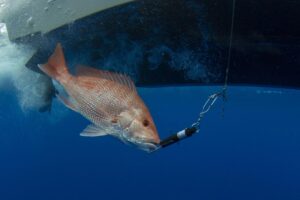
These studies are contributing to a $30 million project to encourage anglers to use fish descending devices. These devices increase survival of reef fish experiencing barotrauma in the Gulf’s recreational fisheries approved by the Deepwater Horizon Open Ocean Trustees.
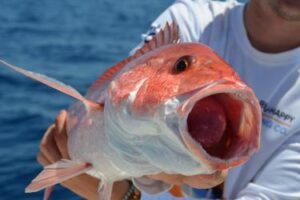
Barotrauma is damage caused by the rapid expansion of gases in fish that are caught in deeper water and quickly brought up to the surface. As the gases expand, they can damage the eyes, stomach, and other parts of the fish. This makes it difficult for them to swim back down and survive once released. Descending devices help fish by quickly releasing them at their normal depth, reducing the number of reef fish that die from catch and release fishing.
Coming to a Charter Boat (or Inbox) Near You
Decender Device on Charter Boat
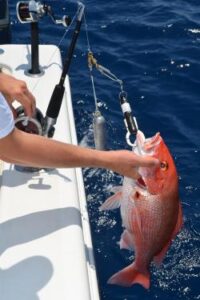
An angler holds a red fish with a fish descender device, about to release it back into the water.
Fish descender devices come in multiple forms, this one is pressure activated, releasing the fish at a specific depth automatically. Credit: NOAA Fisheries, Florida Sea Grant
All three studies will focus on the use of descending devices to help fish return to their underwater habitats, away from predators. Anglers can help restore fish populations impacted by the Deepwater Horizon oil spill by using these devices.
The first two studies will be conducted offshore, working with close to 40 recreational charter boat captains. Captains will:
Recapture fish previously tagged and released using descending devices, to increase understanding of survival rates
Deploy underwater cameras to shed light on whether predators, like sharks, are targeting fish when they are released with descender devices
Receive training on best practices while using descending devices
Gulf reef fish anglers should also be on the lookout for mail and email surveys from partners at Southwick Associates. These surveys will help the project team understand barriers to using descending devices. By participating in the studies, anglers will help inform future angler outreach and education methods.
Study Descriptions
Results from the three studies will contribute to restoration efforts that increase the health of reef fisheries impacted by the Deepwater Horizon oil spill, while improving angler experiences. The work will be carried out through 2025.
Determination of Predation Mortality, Barotrauma Survival, and Emigration Patterns for Catch-and-Released Red Snapper
Partner: Dr. Stephen Szedlmayer, Auburn University School of Fisheries, Aquaculture, and Aquatic Sciences
Award: $250,750
Timeline: 20-month project, ends December 2022
A team from Auburn University will collaborate with eight charter vessel operators to better understand the survival rates of red snapper released with descending devices. The team will tag and release red snapper across a range of locations and depths off the coast of Alabama and Mississippi. Participating captains will return to the tagging sites within 2 to 4 weeks to recapture as many tagged fish as possible. A combination of different tagging methods will provide a robust evaluation of descending methods and their effect on red snapper survival.
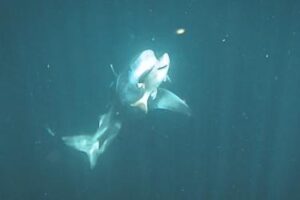
Barotrama make fish easy meals
A shark opens its mouth for a struggling fish underwater.
This fish was an easy lunch for a bull shark after being released without help from a descending device. Credit: NOAA Fisheries, Florida Sea Grant
Do Descender Devices Increase Opportunities for Depredation? A Gulf-wide Examination of Descender Device Depredation Rates and Depredating Species
Partner: Dr. Marcus Drymon, Mississippi State University Coastal Research and Extension Center
Award: $238,981
Timeline: 32-month project, ends December 2023
Working with 30 charter boat captains, this study will document whether hooked reef fish are eaten by predators and which species are responsible. This team from Mississippi State University will train and incentivize captains across the Gulf of Mexico to use descending devices and film fish releases with cameras. The team will then analyze the video footage, and results will be used to inform best release practices and address depredation concerns with descended fish. The project team will make short videos to train captains on data collection processes and share project results with stakeholders.
Measuring Changes in Angler Awareness and Use of Fish Descending Devices
Partner: Southwick Associates
Award: $200,000
Timeline: Baseline study in 2021, follow-up study in 2025.
Southwick Associates will assess recreational reef fish anglers’ current knowledge of fish descending devices. The goal is to establish an understanding of anglers’ perceptions about releasing reef fish and identify barriers to using descending gear. Understanding barriers will inform future education and outreach, and help anglers learn the advantages of best release practices. In 2025, the team will measure the change in anglers’ awareness and adoption of descending gear over time.
Improving Recreational Fish Survival is One Project Among Many Restoring Marine Resources After Deepwater Horizon
Fish showing barotrama damage
An angler holds a fish, its mouth open and air bladder inflated from barotrauma.
Barotrauma expands gasses in a fish causing the air bladder and other organs to expand as well, making it difficult for fish to swim after release. Credit: NOAA Fisheries, Florida Sea Grant
These studies are one part of a comprehensive $30 million project reducing barotrauma injuries and deaths in reef fish. The project also aims to increase successful use of fish descender devices by distributing them to recreational anglers and providing information on their use. Supplying fishermen with the tools and knowledge to minimize barotrauma-related fish death and injury will result in increased survival of species released during recreational fishing activities.
This barotrauma project was one of four fish restoration projects funded by the Deepwater Horizon Open Ocean Trustees’ 2019 $226 million restoration plan. The remaining 14 projects in the plan are restoring sea turtles, marine mammals, and deep-sea coral habitats.
Hundreds of fish species were exposed to oil during and after the Deepwater Horizon spill. The exposure killed fish larvae that would have grown and contributed to the food web and fisheries. It also impaired fish growth and reproduction and caused changes in reef fish communities. Recognizing these and other impacts, the settlement with BP included $380 million to help restore injuries to fish and water column invertebrates.
NATIONAL FISHING AND BOATING WEEK BEGINS JUNE 5: Two Free Fishing Days Mark the Occasion
SOCIAL CIRCLE, Ga. (May 21, 2021) – You probably don’t “need” a reason to go fishing and boating…but when we tell you it is National Fishing and Boating Week (NFBW), doesn’t that provide one more excuse to get outdoors? Celebrate NFBW from June 5-13, 2021, according to the Georgia Department of Natural Resources’ Wildlife Resources Division (WRD).
“Boating and fishing are great activities that you can enjoy with your family and friends and that provide many benefits,” said Scott Robinson, Chief of the WRD Fisheries Management Section. “Benefits include connecting with family members, providing an opportunity for stress relief, and actively supporting conservation efforts with the purchase of a fishing license, equipment and boating fuel.”
National Fishing and Boating Week began in 1979 and was created to recognize the tradition of fishing, to broaden the spirit of togetherness and to share the values and knowledge of today’s anglers with tomorrow’s anglers.
How to Celebrate: FREE FISHING DAYS: In the spirit of introducing new family members or friends to the sport of angling, Georgia offers two FREE fishing days – Sat., June 5 and Sat., June 12, 2021 – during this special week. On these days, Georgia residents do not need a fishing license, trout license or Lands Pass (WMAs/PFAs) to fish.
Where to Celebrate: There are so many great places to fish in Georgia, from trout streams in North Georgia, to large reservoirs, to lazy rivers in the south part of the state. You can always start at one of the 11 Public Fishing Areas (https://georgiawildlife.com/allpfas) or at one of many Georgia State Parks (https://gastateparks.org/) that offer fishing opportunities for family and friends. There also will be multiple Kids Fishing Events on these days (https://license.gooutdoorsgeorgia.com/Event/Calendar.aspx).
According to the National Fishing and Boating Week website, one of the main reasons people don’t go fishing or boating is because no one has invited them. YOU can help change this! Make it a mission during National Fishing and Boating Week, or the next time you go fishing, to take someone new: a child, a relative or a friend.
For more information on National Fishing and Boating Week and all it has to offer, including free fishing days, nearest kids fishing event or places to fish, visit www.georgiawildlife.com/nfbw .
BRUNSWICK, Ga. (May 3, 2020) – Nesting season for loggerhead sea turtles has started on schedule.
The annual cycle of these massive turtles returning to beaches in the Southeast to lay their eggs began in Georgia with a nest found Saturday morning on Little Cumberland Island. Georgia Sea Turtle Cooperative members reported a second nest Sunday on Sea Island.
Georgia Sea Turtle Program Coordinator Mark Dodd said the first nests are “always around the first of May.” “It’s kind of like clockwork.”
This year’s first also has historical ties. While nesting has been monitored on all Georgia beaches since 1989, the network took root in 1964 when former University of Georgia professor Dr. Jim Richardson started the Little Cumberland Island Sea Turtle Project. That loggerhead monitoring effort is the oldest in North America and shares the status worldwide with a program started in South Africa the same year.
Little Cumberland Project Director Russell Regnery documented the nest on Little Cumberland Saturday. Hundreds more will follow on Georgia barrier islands, with nesting season for the state’s leading marine turtle and a protected species hitting full stride by June.
Predicting a total is anyone’s guess, according to Dodd, a senior wildlife biologist with the Georgia Department of Natural Resources. But one question is whether 2021 can top the 2,786 nests last year, or better yet, the 3,950 in 2019, the most since comprehensive monitoring began.
The state’s previous record was 3,289 nests in 2016. The total in 2019 also marked the first time the chunky-headed marine turtles had topped a Georgia recovery benchmark of 2,800 nests.
The loggerhead population has been increasing at approximately 4 percent annually since the early 1990s. However, a new population model developed by UGA and the U.S. Geological Survey using nesting and genetics data indicates the population will plateau at current levels for about the next 20 years, its progress hindered by low recruitment during the early 2000s, Dodd said. If current protections remain in place at least through that period, the model suggests loggerhead numbers would then start to increase again, possibly reaching levels not seen since the late 1950s.
Supporting that rebound is the goal of Georgia’s Sea Turtle Cooperative. The DNR-coordinated network of about 200 volunteers, researchers and agency employees patrols beaches daily during nesting season. Working under a federal permit, members mark, monitor and protect all loggerhead nests, plus those of other species that seldom nest in Georgia, such as green and Kemp’s ridley.
The effort not only eases predation and increases the number of young that hatch, the data collected is used to assess loggerhead populations, assess threats and inform management. Cooperators also help with beach management. The program has been in play on Georgia beaches for more than 30 years.
“The cooperative has done a tremendous amount of work,” and with a measurable impact, Dodd said. “We started out averaging about 800 nests a year and we’re now up to about 3,500.”
Like other marine turtles, loggerheads – named for their large heads – crawl ashore on barrier island beaches, dig a hole at the base of the dunes and lay their eggs, usually at night.
To prep for the season, Dodd and staff have been training interns, working with volunteers, partner agencies and organizations, and teaming with DNR’s Law Enforcement Division, all while navigating social distancing and other requirements involving the coronavirus pandemic. Game wardens enforce regulations including the use of turtle excluder devices, or TEDs, in commercial shrimping.
The process followed on Little Cumberland and Sea Island last weekend will be repeated hundreds of times this year. An egg from each nest – less than 1 percent of the average clutch size on the island – was collected for UGA genetic analysis documenting the number and relatedness of loggerheads nesting in Georgia. The nest was then covered with a screen to protect the eggs from predators.
DNR’s Wildlife Conservation Section works to conserve sea turtles and other wildlife not legally fished for or hunted, as well as rare plants and natural habitats. The agency does this largely through public support from fundraisers, grants and contributions.
Key fundraisers include sales of the monarch butterfly license plates and sales and renewals of bald eagle plate and older designs, such as the ruby-throated hummingbird. These tags cost only $25 more than a standard plate to buy or renew. Up to $20 of that fee goes to help wildlife.
WHAT YOU CAN DO
All marine turtles in Georgia are protected by state and federal law. To help conserve these species:
§ Minimize beachfront lighting during sea turtle nesting season. Turn off, shield or redirect lights.
§ When walking the beach at night, don’t use flashlights and flash photography. They can deter turtles from coming ashore to nest or cause them to abort nesting.
§ If you encounter a sea turtle on the beach, remain quiet, still and at a distance.
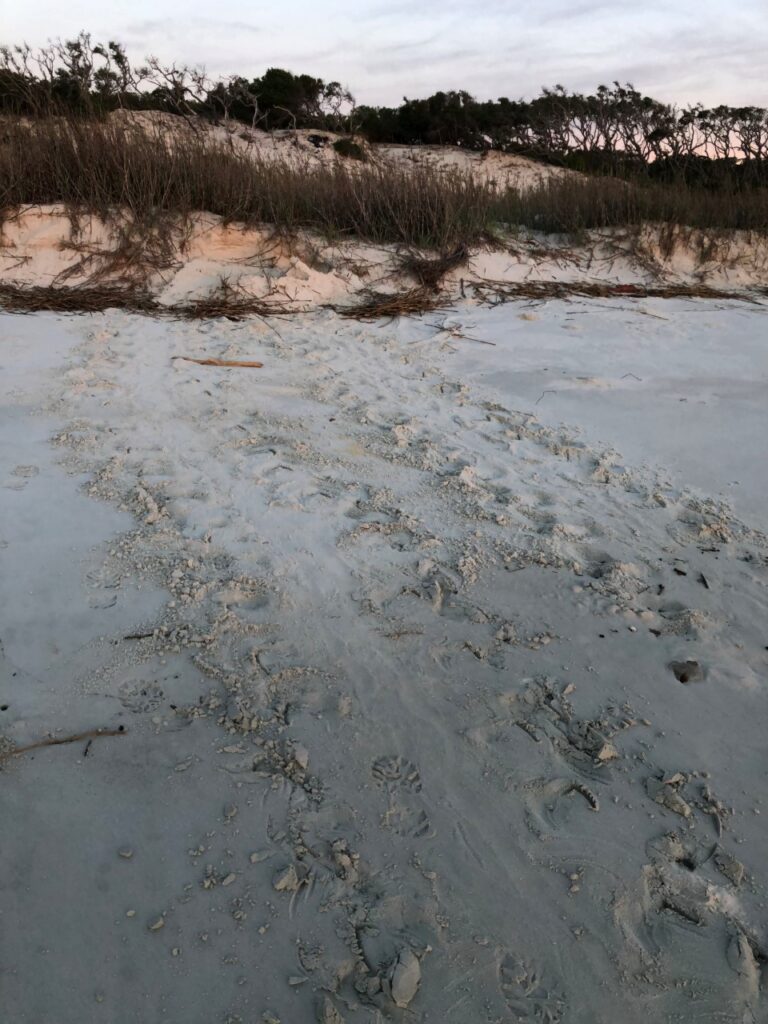
§ Leave turtle tracks undisturbed. Researchers use them to identify the species and mark nests for protection.
§ Properly dispose of your garbage. Turtles may mistake plastic bags, Styrofoam and trash floating in the water as food. After ingesting trash, it can kill them by clogging their intestines.
§ Protect beach vegetation: It stabilizes sand and the natural coastline.
§ When boating, stay alert and avoid turtles. Of the sea turtles found dead or hurt in Georgia last year, 26 percent suffered injuries consistent with being hit by a boat. Boaters who hit a sea turtle are urged to stand-by and immediately call DNR at 800-2-SAVE-ME (800-272-8363).
§ Also report any dead or injured sea turtles seen at 800-272-8363. (If the turtle is tagged, include the tag color and number in the report if possible.)
Sources: U.S. Fish and Wildlife Service, Georgia DNR
ACCIDENTAL CATCHES
Anglers who hook or entangle a sea turtle should call DNR at 800-2-SAVE-ME (800-272-8363). Also:
§ Keep your hands away from the turtle’s mouth and flippers.
§ Safely land the turtle using a net or by walking it to shore. Do not lift the turtle by the hook or by pulling on the line.
§ Leave the hook in place; removing it can cause more damage. (Anglers are encouraged to use non-stainless, barbless hooks when possible.)
§ Keep the turtle out of direct sunlight and cover it with a damp towel.
If an angler cannot reach DNR, cut the line as short as possible and release the turtle.
LOGGERHEADS AT A GLANCE
§ Caretta caretta: Most common sea turtle on Georgia’s coast; found off coast year-round. Also one of the world’s largest turtles, topping 350 pounds and sporting a carapace up to 44 inches long. How long loggerheads live is not known.
§ Range: The Atlantic, Pacific and Indian oceans, and the Mediterranean Sea. Nests in the U.S. from Virginia to Texas.
§ Nesting: Females reach sexual maturity at 30-35 years. From about May through September, they crawl ashore at night, dig a hole in the face of dunes along barrier island beaches, and deposit and cover eggs.
§ Pilgrimage: Eggs hatch in 55-65 days. The young scramble for the water, beginning a journey that can take them from sargassum weed off Georgia’s shores to a current-powered loop that circles to the Azores and the eastern Atlantic Ocean, south to west Africa and back to the western Atlantic.
§ Eats: Fish eggs and small invertebrates when small. As adults, they eat mainly crabs and mollusks, but also forage items like jellyfish and dead fish.
§ Status: Federally listed as threatened since 1978. Georgia DNR reclassified loggerheads in the state from threatened to endangered in 2006.
§ Threats: Primarily mortality associated with commercial fishing activities, but also nest predation by raccoons and feral hogs, poaching, loss of habitat, boat strikes, and even ingestion of plastic litter mistaken as food.
MORE ZEBRA MUSSELS FOUND IN GEORGIA; DNR URGES PUBLIC TO KEEP WATCH
Remember to Clean, Drain and Dry Vessels Used in Other States
SOCIAL CIRCLE, Ga. (April 20, 2021) – With zebra mussels found on a boat in the Lake Lanier area, the Georgia Department of Natural Resources is urging boat owners to CLEAN, DRAIN and DRY their boats, and be aware of the potential for transferring these invasive mussels from waters in other states.
Owners of a boat taken to Lanier after being used on the Tennessee River near Chattanooga, Tenn., recently spotted zebra mussels on the boat and called DNR.
Staff from the agency’s Wildlife Resources Division removed about 1 gallon of dead mussels from the boat and worked with the owners to ensure the vessel was drained, properly cleaned and thoroughly dried. DNR commended the owners for recognizing the issue and taking the necessary steps to report it.
Zebra mussels, a species native to eastern Europe that has spread to many U.S. waters, including the Tennessee River, pose a significant risk to Georgia. If established here they could spur major ecological and economic damage. Zebra mussels and other aquatic invasive species can cause millions of dollars in damage to boats and water intake pipes, while undermining native mussels and other aquatic species.
There is no known established population in Georgia. However, in March zebra mussels were found in Georgia pet stores attached to moss ball plants being sold for aquariums.
For more information on these aquatic invaders and how to report them, as well as how to properly CLEAN, DRAIN and DRY vessels, visit georgiawildlife.com/ans.
SEEING YOUNG WILDLIFE ALONE? IF YOU CARE…LEAVE THEM THERE
SOCIAL CIRCLE, Ga. (April 5, 2021) – In the spring, it is not unusual to see young wildlife that appear to be alone. Before you attempt to help – remember that it is best to leave wildlife where you find them, according to the Georgia Department of Natural Resources’ Wildlife Resources Division (WRD).
“When you take wildlife out of their environment and bring them into your home, it often takes away that animal’s ability to then survive in the wild, where they belong,” explains Kaitlin Goode, program manager of the Georgia WRD Urban Wildlife Program. “In most instances, there is an adult animal a short distance away – even though you may not be able to see it. Adult animals, such as deer, spend most of the day away from their young to reduce the risk of a predator finding the young animal.”
The best thing people can do when they see a young animal is to leave it exactly as they found it for at least 24 hours. If the animal is still there after this time period, reach out to the local WRD office for guidance (https://georgiawildlife.com/about/contact).
Young wildlife demand a great deal of care and have specific nutritional requirements. If they are not cared for properly, they will not be releasable or retain the ability to survive on their own. Persons not licensed and trained in wildlife rehabilitation should not attempt to care for wildlife. In fact, Georgia law prohibits the possession of most wildlife without a permit.
ID used to identify users for 24 hours after last activity
24 hours
_gat
Used to monitor number of Google Analytics server requests when using Google Tag Manager
1 minute
__utma
ID used to identify users and sessions
2 years after last activity
__utmt
Used to monitor number of Google Analytics server requests
10 minutes
__utmb
Used to distinguish new sessions and visits. This cookie is set when the GA.js javascript library is loaded and there is no existing __utmb cookie. The cookie is updated every time data is sent to the Google Analytics server.
30 minutes after last activity
__utmc
Used only with old Urchin versions of Google Analytics and not with GA.js. Was used to distinguish between new sessions and visits at the end of a session.
End of session (browser)
__utmz
Contains information about the traffic source or campaign that directed user to the website. The cookie is set when the GA.js javascript is loaded and updated when data is sent to the Google Anaytics server
6 months after last activity
__utmv
Contains custom information set by the web developer via the _setCustomVar method in Google Analytics. This cookie is updated every time new data is sent to the Google Analytics server.
2 years after last activity
__utmx
Used to determine whether a user is included in an A / B or Multivariate test.
18 months
_ga
ID used to identify users
2 years
_gali
Used by Google Analytics to determine which links on a page are being clicked
30 seconds
_ga_
ID used to identify users
2 years
_gac_
Contains information related to marketing campaigns of the user. These are shared with Google AdWords / Google Ads when the Google Ads and Google Analytics accounts are linked together.