Category Archives: Conservation

How Can Red Snapper Management Be Improved?

Answer to Red Snapper Issue Already Exists
Chris Horton
from The Fishing Wire

I recently read an editorial that suggested recreational anglers should look to the North American Wildlife Conservation Model (North American Model) for answers to the red snapper management debacle in the Gulf of Mexico. While I’m grateful to see this highly successful and epochal model referenced in this unfortunately contentious debate over one of the South’s most iconic saltwater fish species, it became clear that the author, and probably most Americans, are not familiar with the “model” he referenced. Ironically, suggesting recreational anglers look to this model is perhaps the best argument yet for state-based management of our nation’s red snapper fishery, as well as all of our important marine recreational fisheries. States, in cooperation and with the support of recreational anglers and the sport fishing industry, have used this model to successfully manage our nation’s inland fish and wildlife resources for the benefit of all American’s for the last century.

The whole concept of the North American Model is built on the premise that all fish and wildlife are held in public trust and belong to the people – not designated individuals for personal gain. That is actually the first tenant in the North American Model, which has seven principal tenants in all.

However, it is in the second tenant where we find the most defining disparity between federal fisheries management and the North American Model. It states, “Prohibition on Commerce of Dead Wildlife – Commercial hunting and the sale of wildlife is prohibited to ensure the sustainability of wildlife populations.” Of course, that suggests that there be no commercial fishing, period. The model realizes that all you need to do to decimate fish and wildlife populations is provide an open market on what you can harvest from the wild, which is why market hunting was rendered illegal more than 100 years ago. Incidentally, inland game fish, with very few exceptions in certain waterbodies of the country, are prohibited from commercial sale as well. Perhaps that is why you never hear of an inland fishery being “overfished” as defined in the Magnuson-Stevens Act, and lends credence to Theodore Roosevelt’s quote, “In a civilized and cultivated country wild animals only continue to exist at all when preserved by sportsmen.”

Although ending commercial fishing would do more for the sustainability of our marine fisheries resources than the Magnuson-Stevens Act has ever done, the majority of recreational anglers are not advocating for the elimination of commercial fishing, despite many in that industry attempting to muddy the water with claims to the contrary. We simply want a system of management that provides appropriate access to the resource.

Finally, in the same article, habitat restoration was also advised as something recreational anglers should pursue for the long-term sustainability of marine fish stocks. Fortunately, recreational anglers stepped up to carry that burden long ago, not the commercial fishermen or the environmental community. In addition to the license we buy just to go fishing, every time we purchase a package of hooks, a fishing rod, reel, lure, tackle box, depth finder, trolling motor, fuel for our fishing boat, etc., we gladly pay an excise tax that goes into a fund called the Sport Fishing and Boating Trust Fund. The majority of those funds go back to the states for fisheries conservation, angling and boating access and boating safety. However, 18.5% of that fund is dedicated to a program called the Coastal Wetlands Program. In 2015 alone, that 18.5% equates to around $112 million going to on the ground projects to conserve and restore coastal habitats. It’s part of the American System of Conservation Funding – paid for solely by anglers and boaters – and it’s the lifeblood of the North American Model.

Recreational anglers have indeed looked to the North American Model for answers. We helped develop it, we vigorously defend it and we gladly fund it – not just for today, but for generations of American’s to come. It is not recreational anglers who need to look to the North American Model for direction, but our federal fisheries managers.

Chris Horton
Midwestern States Director
Congressional Sportsmen’s Foundation
How Are Trout Doing In the US?

‘State of the Trout’ report details threats to America’s coldwater fisheries
from The Fishing Wire

Trout habitat is endangered

Trout habitat is endangered

The nation’s native trout are in peril, but report shows path to recovery, long-term survival

WASHINGTON — America’s native trout have declined dramatically over the last century thanks to a number of threats ranging from hatchery fish stocking to logging and mining to poorly designed roads and livestock grazing practices. Now a new suite of threats, from energy development to a changing climate, poses even greater challenges.

According to a new Trout Unlimited report titled, “State of the Trout,” these threats are greater than ever, and they make for an uncertain future for coldwater fish if steps are not taken to protect and restore habitat, reconnect tributaries to mainstem rivers and keep native trout populations viable for the benefit of anglers and the country’s riparian ecosystems.

The report notes that, of the nation’s 28 unique species and subspecies of trout and char, three are already extinct. Of the remaining 25 species, 13 occupy less than 25 percent of their native ranges. Trout across America are dealing with the cumulative effects of resource extraction, climate change and the introduction and persistence of non-native fish into native trout waters. But, according to the report, there is hope for trout and for those who fish for them all across the nation. The report lays out a roadmap for native trout recovery and persistence, but it will require a host of advocates playing vital protection and restoration roles for years to come.

“It’s daunting when you consider the scope of the threats facing coldwater fish in the United States,” said Chris Wood, TU’s president and CEO. “But if you step back and look at the work that TU and our partners are already doing all across the country, it’s encouraging to see progress and to know that, with help from volunteers, private industry, government agencies and elected officials, we can replicate that progress and keep trout in our waters.

“And that’s why this report isn’t just for anglers or for biologists,” Wood continued. “This is a report for all Americans, because trout require the cleanest and coldest water to survive—and we all need clean water.”

Like Wood, report author Jack Williams, TU’s senior scientist, believes all Americans have a stake in this report, and that it will require a collective effort to ensure a future for native trout in America.

“The reasons many populations of native trout are on the ropes is because of our growing human population and the increasing demand on water resources,” Williams said. “For eons, the great diversity of trout genetics and life histories coupled with their widespread distribution allowed them to thrive. The changes we’ve made to their habitat over time, just by pursuing our lifestyle, has had a huge impact on water quality, connectivity and trout habitat. We’ve also stocked non-native trout on top of native populations, to the point where even well-adapted native trout are overcome by repeated stockings.”

Williams notes that common-sense conservation measures in the years to come can help native trout recover. But, restoration needs to take place across entire watersheds and be sustained over decades.

For instance, in Maggie Creek in northwest Nevada, collaborative restoration has been underway since the late 1980s. TU’s work with ranchers, the Bureau of Land Management and mining companies have restored 2,000 acres of riparian habitat and today native Lahontan cutthroat trout have been completely restored in 23 miles of Maggie Creek and its tributaries. In Maine, where TU and its partners helped negotiate the removal of two dams and construction of fish passage on a third, more than 1,000 miles of the Penobscot River has been reopened to Atlantic salmon, striped bass, herring and shad. In the West, in states like Idaho and Colorado, sportsmen and women have mobilized and helped protect millions of acres of intact, functional habitat that is vital to trout and the waters in which they swim. Broad-scale restoration work on streams in the Driftless Area of the Midwest has translated into waters that once held only 200 fish per mile to holding 2,000 fish per mile.

TU’s public and private partners are key to the report’s findings. Without help from government, private entities and volunteers, trout truly do face an uncertain future.

“The health of America’s trout is directly connected to the health of our nation’s watersheds—watersheds that provide clean drinking water, drive economic growth and support recreational fishing opportunities for millions of people across the nation,” said U.S. Fish and Wildlife Service Director Dan Ashe. “The ‘State of the Trout’ report provides a valuable overview of the health of these fisheries, helping Trout Unlimited, the Fish and Wildlife Service and our partners identify priority areas for conservation.”

Like Ashe, Neil Kornze, director of the U.S. Bureau of Land Management, believes in partnerships to ensure trout survive for coming generations to enjoy.

“Trout Unlimited’s new report details the many challenges facing our nation’s native trout, and offers some real, science-based solutions to ensure trout remain a part of the American landscape for generations to come,” Kornze said. “Their approach to protecting and restoring native trout populations supports the BLM’s fisheries programs and our landscape-scale approach to land management. The report is thoughtful and scientifically sound—it’s a valuable addition to ongoing efforts to restore our nation’s coldwater fisheries.”

U.S. Forest Service Chief Tom Tidwell also noted that partnerships are vital to the long-term persistence of native trout in America.

“The Forest Service is fortunate to be able to leverage hundreds of thousands of dollars, along with help from TU, hundreds of volunteers, local communities, schools, and citizens to restore healthy trout habitat,” Tidwell said. “The Forest Service will stay a close partner with TU in trout and aquatic habitat protection and restoration across the U.S.”

The report, according to Doug Austen, executive director of the American Fisheries Society, offers a glimpse at just how important trout are to America’s waters.

“Today’s report paints a troubling picture of the status of trout, but it also features the hope that the more than 9,000 members of AFS share: effective partnerships with scientists, government agencies, fisheries managers, conservation groups and landowners can achieve amazing recovery results for these imperiled fish,” Austen said.

And trout aren’t just a biological asset, either. Ben Bulis, the president and CEO of the American Fly Fishing Trade Association, notes that trout are vital to the industry his association represents.
“Trout are the foundation of the fly fishing world,” Bulis said. “Their health and the health of their habitat is vital to the bottom line of the growing fly fishing industry. This report not only lays out the challenges trout face, but it offers solutions and a common-sense approach to ensuring trout persist and thrive well into the future.”

In the end, Wood said, it’s really about hope and optimism.

“While the report’s findings are dire,” Wood said, “there are hundreds of examples where we’ve corrected past mistakes. Trout are incredibly adaptable and resilient—we just have to give them half a chance, and they’ll recover. That’s the message in this report—we can improve trout habitat, increase trout populations and make fishing better. But we need the support and the will to do it. Nobody is saying it will be easy.”

Read the report today at tu.org/stateofthetrout.

What Is A Florida Strain Largemouth Bass?

Florida WRI Biologists Work to Preserve Genetic Purity of Florida’s Premier Freshwater Sport Fish
from The Fishing Wire

Range of the Florida Strain Largemouth

Range of the Florida Strain Largemouth

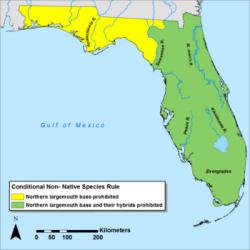
Map of Florida showing the prohibition line for northern largemouth bass and their hybrids.

Florida bass, Micropterus floridanus, have a small natural range; they are only native to peninsular Florida. This species grows larger than any other black bass, which is a big part of the reason they are the premier freshwater sport fish in Florida. Recognizing the ecological and economic value of genetically-pure Florida bass, FWRI biologists conduct research to help prevent these bass from mating and producing hybrid offspring with non-native northern largemouth bass,M. salmoides.

The taxonomy of these two bass sparked a debate amongst scientists for more than a decade. The Florida bass and the northern largemouth bass look very similar, but do they represent different species or subspecies? They were originally described as subspecies of largemouth bass in 1949 and the American Fisheries Society (AFS) has continued to use this terminology – until recently. Many scientists have become convinced that the Florida bass is a distinct species based on genetic, behavioral, and environmental preference/tolerance differences.

During a statewide genetics study, scientists analyzed bass collected from 48 lakes and rivers throughout Florida. The sampled water bodies included populations of pure Florida bass and intergrade (or crossbred) populations where Florida and northern largemouth bass mixed or hybridized. Populations of pure Florida bass were found south of the Suwannee River, while intergrade populations were located in northern and western parts of the state. This led the FWC to amend a rule to designate pure northern largemouth bass as a conditional species (dangerous to native ecosystems) south and east of the Suwannee River. This was intended to prevent this non-native species from being moved into the range of pure Florida bass in peninsular Florida by anglers, private pond owners, or fish dealers.

The FWC is dedicated to preserving the long-term well-being of fish and wildlife resources. To that end, the agency designated four geographic regions of the state as Florida bassGenetic Management Unitsafter research indicated that bass in each area had unique genetic compositions. When FWC is stocking hatchery bass or relocating wild-caught bass, fisheries managers avoid transporting bass betweenGenetic Management Unitsto avoid mixing gene pools. FWC takes this precautionary approach when moving bass because research has shown that fish have adaptations that help them survive and reproduce in the environments in which they naturally occur.

Biologists collect tissue samples from fish in the wild and at the hatchery and send them to the FWRI fisheries genetics laboratory for analysis. Geneticists at FWRI developed a set of molecular markers that are able to effectively identify each species of black bass and detect individuals that have hybrid ancestries. The geneticists work with the Richloam Fish Hatchery staff at the Florida Bass Conservation Center to conduct genetic testing that makes sure that only pure Florida bass are allowed to spawn at the hatchery. This ensures that only pure Florida bass are released into water bodies during stockings. Geneticists are also able to determine whether a bass collected by a biologist in the wild was produced at the hatchery. Resource managers can use this information to determine the survival rate and contribution of hatchery fish after stocking.

Since its creation, the bass genetics project has expanded to include research on all the black bass species that are native to Florida, including Suwannee bass, shoal bass, and the newly classified Choctaw bass. These studies will provide resource managers with information they can use to protect the genetic integrity of native species by preventing or minimizing the chance of hybridization with invasive species.

This program was designated as a high priority by fishery managers in FWC’s Florida Black Bass Management Plan. Fisheries agencies in other states also promote black bass conservation, but FWC’s Florida Bass Conservation Program is by far the most comprehensive genetic conservation and management program for black bass in the country.

How Are Rainbow Trout Doing In Colorado?

Rainbow Trout On The Comeback Throughout Colorado
from The Fishing Wire

Dave Parri

Dave Parri

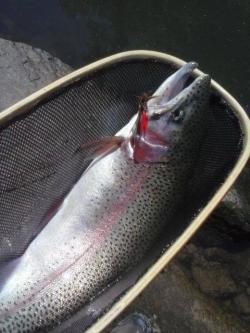
Dave Parri of Hot Sulphur Springs, holds a rainbow trout he caught last winter on the upper Colorado River. The rainbow is a whirling disease resistant fish developed by Colorado Parks and Wildlife scientists. (Credit Colorado DPW)

DENVER, Colo. – After being devastated by whirling disease in the 1990s, rainbow trout populations are increasing in most major rivers in the state thanks to a 20-year effort by Colorado Parks and Wildlife aquatic scientists and biologists.

“It’s been a long road, but bringing back populations of fish that were essentially extirpated from Colorado can only be called a huge success,” said George Schisler, CPW’s aquatic research team leader who is based in Fort Collins.

The comeback is positive news for anglers who can once again fish for rainbows and brown trout in Colorado’s big rivers and streams. For the past 15 years brown trout have dominated most of the state’s rivers. But since last summer, anglers have reported that they are catching nice size rainbows in the upper Colorado, Rio Grande, upper Gunnison, Poudre, East, Taylor, Arkansas and Yampa rivers and others.

The whirling disease problem started in 1986 when a private hatchery unknowingly imported infected rainbow trout from Idaho that were stocked in 40 different waters in Colorado. The disease eventually spread throughout the state and even infected CPW hatcheries which caused more waters to be infected.

Whirling disease is caused by a spore that infects the spine of very young fish. The infection deforms the spine causing the fish to swim in a whirling pattern. They die shortly after becoming infected. When whirling disease hit Colorado’s rivers, natural reproduction of the species virtually ended. That allowed brown trout, which are not affected by the disease, to become the dominant sport fish.

By the mid 1990s rivers in Colorado and other western states were thoroughly infected.

Trout from a hatchery

Trout from a hatchery

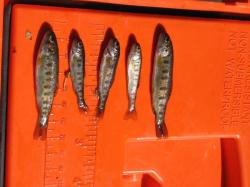
These are hatchery raised fish, all the same age. The larger fish are the Hofer strain. (Credit Colorado DPW)

At a national conference on whirling disease in Denver in 2002, a German researcher presented information that showed trout at a hatchery in Germany, operated by a family named Hofer, were resistant to the parasite. Colorado’s aquatic staff moved quickly to import eggs from Germany which were hatched at the University of California at Davis. The fingerlings were then brought to CPW’s Bellvue hatchery near Fort Collins.

The fish grew quickly and their disease resistance was proven. By 2006 Schisler stocked some of the Hofers in two reservoirs west of Berthoud. Anglers reported that the fish hit hooks hard and were easy to catch. This made them ideal for stocking in reservoirs where anglers expect to catch fish.

But because the “Hofers” had been domesticated in a hatchery for generations, Schisler and his colleagues knew that the fish did not possess a “flight response” to danger. They would have little chance in creeks and rivers where they need to avoid predators and survive fluctuating water conditions. So CPW researchers started the meticulous process of cross-breeding the Hofers with existing strains of trout that possessed wild characteristics and had been stocked in rivers for years.

After three years some of the crosses were ready for stocking in rivers –- with the hope that the fish would survive, reproduce and revive a wild, self-sustaining population of rainbows. Biologists first stocked 5-inch Hofer-crosses, but they didn’t survive. Then in 2010, fingerlings were stocked in the Colorado River near Hot Sulphur Springs. When researchers returned to survey the area 14 months later they learned the experiment had finally paid off. They found good numbers of 15-inch rainbows and evidence that young fish were hatching in the wild.

CPW biologists have been stocking fingerling Hofer-crosses throughout the state at different sizes and times of year to optimize survival. The young fish are surviving and Schisler is confident that Colorado’s rivers and streams are again home to truly wild rainbows.

The Hofers are also providing other benefits to CPW and Colorado’s anglers. Because the
fish grow much faster than standard rainbow strains, state hatcheries can raise more fish in a shorter amount of time. They can also be crossed with CPW’s various trout strains and are well suited to reservoir where they don’t reproduce naturally but are ideal for still-water anglers.

In the late 1990s many CPW scientists worried that truly wild rainbow trout would disappear. Now a new chapter for sport fishing in Colorado is just getting started … again.

How Does Managing Sea Predators Affect Other Wildlife Management?

Recovering predators create new wildlife management challenges

Contributed by Michael Milstein, NOAA Northwestern Fisheries Science Center
from The Fishing Wire

Can sea lions be managed?

Can sea lions be managed?

Researchers suggest multi-species approaches to address tensions around rebounding predators

The protection and resurgence of major predators such as seals, sea lions and wolves has created new challenges for wildlife managers, including rising conflicts with people, other predators and, in some cases, risks to imperiled species such as endangered salmon and steelhead, a new research paper finds.

The study by scientists from NOAA Fisheries’ Northwest Fisheries Science Center and the University of Washington examines recovering predator populations along the West Coast of the United States and in the Greater Yellowstone ecosystem, and the conflicts surrounding them. The study was published today in the journal Conservation Letters.

In the Pacific Northwest, for example, California sea lions that have increased under the Marine Mammal Protection Act have increasingly preyed on endangered salmon. Wolves reintroduced to Yellowstone in 1995 have since cut into elk herds, reducing human hunting opportunities.

“Increases in predators can be seen as successful in terms of efforts to recover depleted species, but may come at a cost to other recovery efforts or harvest of the predators’ prey,” said Eric Ward, a NOAA Fisheries biologist and coauthor of the paper.

The scientists describe three types of conflicts that can emerge as predators rebound under the protection of the Endangered Species Act and Marine Mammal Protection Act:

-Increased competition with humans for the same prey. For instance, sea lions eating fish also pursued by anglers and wolves preying on livestock and reducing elk numbers.
-Predators consuming protected or at-risk prey species, such as sea lions eating salmon and grizzlies consuming Yellowstone cutthroat trout.
-Protected predators competing with each other for prey. For example, sea lions consuming the same fish as killer whales, with wolves and grizzly bears also preying on the same species.

Pacific Northwest waters include many such conflicts, largely because many top predators such as sea lions, elephant seals and several whales are increasing in number and prey upon salmon, steelhead, rockfish and other fish protected by the Endangered Species Act.

Conservation conflicts have also emerged elsewhere: On California’s San Clemente Island, a threatened island fox species preys on an endangered shrike, while protected golden eagles prey on both the fox and the shrike. Also in the Pacific Northwest, protected barred owls are moving into forest habitat long important to threatened spotted owls and double-crested cormorants, like sea lions, have been targeted for culling to reduce predation on Columbia River salmon.

The scientists call for improved monitoring and modeling to better anticipate interactions between predators and prey, and assess whether steps to manage predators may be warranted.

Where conflicts continue, the scientists suggest developing multi-species recovery plans that consider the tradeoffs between increasing predators and other protected species.

“Predators such as bears, wolves and whales are charismatic creatures often seen as bellwethers of ecosystem health,” said Kristin Marshall, a postdoctoral researcher at NOAA Fisheries who completed graduate research in Yellowstone and lead author of the paper. “We’re fortunate to have places such as Yellowstone and the Northeast Pacific where they can recover, but in protecting one species you have to be thinking ahead to account for cascading effects that may impact other species too.”

The Endangered Species Act and Marine Mammal Protection Act do recognize larger ecosystem needs. For instance, the first purpose of the Endangered Species Act is “to provide a means whereby the ecosystems upon which endangered species and threatened species depend may be conserved,” and the Marine Mammal Protection Act seeks to “maintain the health and stability of the marine ecosystem.” Both NOAA Fisheries and public land managers in the Yellowstone region are increasingly pursuing ecosystem-based management with those goals in mind. Research has also found ecological benefits from the reintroduction of wolves in Yellowstone.

Both the Endangered Species Act and Marine Mammal Protection Act also provide safety valves by allowing limited control of recovering predators to manage their impacts under certain circumstances.

NOAA Fisheries has authorized states under the Marine Mammal Protection Act to remove sea lions known to be preying on endangered salmon, for instance. An “experimental” designation under the Endangered Species Act allowed for removal of wolves that attacked livestock, although wolves are no longer listed as endangered in Montana and Idaho and are now subject to hunting.

But the scientists note that resolving conflicts by culling predators may itself have unintended consequences and will face public and legal opposition that may limit management options.

“Thirty years ago scientists predicted that increases in predator populations would cause more of these conflicts to emerge,” Ward said. “We’ve largely seen these predictions come true, and there’s no indication of these conflicts decreasing.”

Can Maps Help Find Potential Fish Habitat?

Maps from the 1930s Help Find Potential Fish Habitat in the Digital Age

Fish habitat map

Fish habitat map

A total of 1.4 million National Ocean Service (NOS) bathymetric soundings from 98 hydrographic surveys represented by smooth sheets in Cook Inlet were corrected, digitized, and assembled in order to produce this interpolated depth surface for Cook Inlet, Alaska.

For years, researchers, fishermen, and policy makers have had to rely on low-resolution navigational charts with limited fish habitat information to analyze fish habitat in Alaskan waters. But now, with the help of technology, detailed survey data from the 1930s may help to improve fish habitat analysis and help us learn more about important fish stocks.

“We now have a much more detailed picture of the seafloor in some areas,” said Mark Zimmermann, research fish biologist with NOAA Fisheries’ Alaska Fisheries Science Center. “We can see variations in depth between areas and unique features like troughs and banks. We will also be studying how fish and other marine life use these different habitats.”

The challenge was to translate the old data that were documented by hand on large flat, one-dimensional sheets of paper called smooth sheets, into a form that would be useful to modern scientists without having to spend millions of dollars.

These smooth sheets exist for many nearshore areas of Alaska. Nearshore areas are important as nurseries for rearing of young fish. Being able to pinpoint where these nursery areas are enables fishery managers to better define and protect essential fish habitat for commercial species of Alaska.

How did the scientists translate the data?

Inshore cartographic features

Inshore cartographic features

Inshore cartographic features of rocks, reefs, kelp patches and islets from smooth sheet H05152. Depth soundings in fathoms are shown as numbers, some with fractions.
NOAA Fisheries scientists developed a new methodology to transform the one-dimensional data on the smooth sheets, into three-dimensional digitized layers of data. They used a geographic information system (GIS) to do this.

Smooth sheets provide 10 times as much bathymetry or seafloor depth than traditional nautical charts. They also provide other data such as; shoreline location, seafloor sediment type, and various features such as kelp beds, rocky reefs, and islets.

What can we learn using digitized maps?

Scientists used the digitalized maps to compare five inshore study areas known to be important habitat for juvenile Pacific halibut and flathead sole. They were able to quantify differences and similarities between bottom type and depths at each of the sites to determine, which ones would provide preferred habitats for these fish.

Scientists in the Gulf of Alaska Project sponsored by the North Pacific Research Board (NPRB), are using these same data sets to predict the preferred habitat across the central Gulf of Alaska for juveniles of five other important species: walleye pollock, Pacific cod, Pacific ocean perch, arrowtooth flounder and sablefish. This knowledge could help design more focused research surveys in the future, saving valuable resources.

Smooth sheets are available for free through NOAA’s National Geophysical Data Center in Boulder, Colorado. For more information on the Alaska Fisheries Science Center’s use of smooth sheets and the study of Alaska bathymetry please visit the AFSC website.

What Is Magnuson Stevens and What Does It Have To Do With Fishing?

Improvements Much Needed in Recreational Fishery

By Jim Donofrio, Executive Director
Recreational Fishing Alliance
from The Fishing Wire

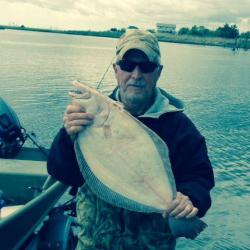
Fluke

Fluke

As a longtime Jersey charter boat captain, listening to my customers’ needs was critical to business success. Now as executive director of the Recreational Fishing Alliance, it’s my responsibility to listen to our individual members’ needs, which in many ways are the same as those I used to take fishing full time for tuna, striped bass, weakfish, bluefish and fluke.

The saltwater anglers I speak to on a daily basis want healthy fish stocks; they also want reasonable access. As rewritten in 2006 by special interests at the Marine Fish Conservation Network, the federal fisheries law (Magnuson Stevens) rebuilds fish stocks by stopping allowable fishing. Black sea bass is a rebuilt fishery that environmentalists tout as a Magnuson victory; New Jersey anglers, however, are not allowed to fish for sea bass from Jan. 1 through May 26, and on July 2 will be allowed only two fish.

Summer flounder (fluke) is a rebuilt fishery that the Marine Fish Conservation Network cites as an example of Magnuson’s excellence, yet two years ago the state was forced into a more restrictive “regional” approach with New York, leading to an increase in state size limit now decimating South Jersey businesses forced to compete with Delaware.

At the same time, the federal government will not allow New Jersey to open the fluke season before May 17, thanks to the federal law and “fatally flawed” data collection. Meanwhile, recreational blueline tilefish anglers are facing draconian cutbacks because the government has failed to collect enough statistical data.

Magnuson Stevens was enacted in 1976 to protect our U.S. recreational and commercial fishing industry. It was meant to foster robust coastal communities while conserving coastal fish stocks. While Marine Fish Conservation Network lobbyists boast of their success with rewriting this law in 2006, they fail to address the impacts of lost angling opportunity. Today, their political operatives take great delight in reducing open congressional review of this law into partisan grandstanding, while the overwhelming majority of commercial and recreational fishing organizations have banded together in mutual support of H.R. 1335 to reform Magnuson Stevens.

The legislation passed by the House Natural Resources Committee addresses the arbitrary, congressionally created timelines for rebuilding fisheries, a hallmark legislative appeals put forth by Rep. Frank Pallone, D-N.J., on behalf of New Jersey fishermen.

With support from new committee member Rep. Tom MacArthur, R-N.J., H.R. 1335 would also modify the rigid requirements now forcing draconian “accountability measures” leading to ever-shrinking seasons. It also would force management councils to provide more public transparency. H.R. 1335 would limit future “catch share” programs in our region (concepts pushed by the environmentalists to issue individual fish tags for all fishermen), and dedicate fishery fines toward data-poor fisheries while taking steps to improve recreational data collection.

As a registered lobbyist who works exclusively to represent saltwater anglers and the recreational fishing industry nationwide, it’s important that I listen to my members while also keeping open dialog with the opposition, wherever possible. Paul Eidman, who as early as December of 2009 was lobbying for Marine Fish Conservation Network to stymie efforts to allow improved angler access to rebuilding fish stocks, continues his partisan attacks against sensible fisheries reform through the Asbury Park Press.
After seven years of congressional hearings, it’s obvious that the federal fisheries law needs reform. It’s time for congressional Democrats to stand up on behalf of their angling public, and allow what once had bipartisan committee support to move forward, without partisan grandstanding on behalf of radical “green” ideology.

This law is rapidly destroying the robust fishing communities it was designed to protect.

Jim Donofrio is executive director of the Recreational Fishing Alliance.

Is It Time for State Management Of Red Snapper Fisheries?

Time for State Management of Red Snapper Fisheries in the Gulf of Mexico

Bob Shipp, PhD
from The Fishing Wire

Nice red snapper

Nice red snapper

Editor’s Note: Bob Shipp, PhD, is one of the most respected fishery experts in the nation, with special expertise in reef fishes of the Gulf of Mexico. A professor emeritus of marine sciences at the University of South Alabama, Shipp’s also author of the book, Dr. Bob Shipp’s Guide to Fishes of the Gulf of Mexico, one of the best illustrated fishery guides on the market, available at www.bobshipp.com. His letter to the editor recently appeared on AL.com and like our companion service The Fishing Wire (www.thefishingwire.com), we believe his observations are not only on-target, they’re worth sharing.

In all likelihood there have never been as many Gulf Red Snapper in recorded history as there are today. In spite of these soaring populations, a broken system of federal management is precluding what would otherwise be a robust and sustainable economic driver to a regional economy in desperate need of a break.

Last year the recreational season was limited to 9 days in federal waters and this year’s season is 10 days. Just 10 days – with only a single weekend — for anglers in their own boats to catch perhaps the most popular offshore fish in the Gulf.

Conversely, the commercial sector can fish year-round and, under a similar plan approved by the Gulf of Mexico Fishery Management Council this year, the charter/for-hire sector will have a 44-day season in 2015.

The glaring inequity of those regulations has rankled everyone from regular anglers to congressmen, yet a solution has remained elusive. The road to this point is roughly 30 years in the making, and there is now virtually no escape from it under federal management.

I served on the Gulf Council for 18 years and encountered countless elected officials in Washington, D.C., and in the Gulf states wrestling mightily over the red snapper conundrum, but all ran into insurmountable roadblocks under the federal system. This year, recognizing that a system that produces results like what we are seeing today is unacceptable, the state fishery management agencies from all five Gulf states did something extraordinary – they came together to produce a viable way out of this mess.

Under a plan unveiled in March, the states have offered to take over management of the red snapper fishery and have outlined exactly how such management would be carried out. Their plan recognizes that there are regional populations of snapper that are fished differently according to local tradition and practice, and would have the flexibility to manage them in different ways.

For example, off Alabama our research indicates we could have a six-month season with a two-snapper bag limit without making a dent in the population. This is due to our extensive artificial reef program. Such flexibility is impossible under federal management, which tends to treat red snapper as one stock, fished one way.

The state fishery management agencies all have seats on the Gulf Council and know that snapper management is at a dead-end under the current system. Responsible for commercial and recreational fisheries in their state waters, they know there are far more efficient and equitable ways to manage this fishery. The system has the same goals as federal management, but the means to reach those ends recognize that one size does not fit all.

The individual Gulf states all know how to provide access to their citizens while managing for conservation of wildlife resources, but rarely do they all agree on anything. The significance of their cooperation here cannot be over-estimated.

Faced with an untenable situation, they have come together to offer the one path out of the manufactured mess of federal management. I encourage Congress to take it.

How Do Science and Politics Affect West Coast Sardine Decline?

West Coast Sardine Decline: Science vs. Politics

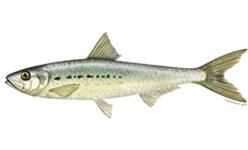
Sardine baitfish and food fish

Sardine baitfish and food fish

Diane Pleschner is E.D. of a California group representing baitfish/forage fish producers on the Pacific Coast. Her take on scientific management of fisheries, versus emotionally and politically-driven management, is worth a read for all anglers and outdoorsmen, whether we’re looking at forage fish or gamefish. FS

By D.B. Pleschner, Guest commentary
from The Fishing Wire

The federal Pacific Fishery Management Council has shut down the remainder of the current sardine season and has canceled the 2015-16 fishing season altogether. Fishermen supported this action.

Why the closure? According to environmental groups like Oceana, it was to stop overfishing and save starving sea lions deprived of essential sardines.

Neither reason is true, but many in the media have trumpeted this hyperbole put forth by groups whose political agenda is to shut down fishing completely.

The scientific facts present a different picture: the sardine population is not overfished. And sea lion mortality has not been caused by overfishing sardines.

As Dr. Ray Hilborn, professor in the School of Aquatic and Fishery Sciences at the University of Washington and one of the most respected experts on marine fishery population dynamics in the world, recently noted, “Even if there had been no fishing, the decline in California’s sardines would have been almost exactly the same.” Dr. Richard Parrish, another esteemed scientist with deep knowledge of sardines and ocean cycles, outlined how natural mortality and predation consume five times more sardines than the fishery harvests.

The truth is that the marine environment plays the major role in determining the size of the sardine stock and its effect on the ecosystem.

Dr. Kevin Hill, a fisheries scientist with the Southwest Fisheries Science Center who leads West Coast sardine stock assessments noted that, “Pacific sardines are known for wide swings in their population: the small, highly productive species multiplies quickly in good conditions and can decline sharply at other times, even in the absence of fishing. You can have the best harvest controls in the world, but you’re not going to prevent the population from declining when ocean conditions change in an unfavorable way.”

That’s why the sardine harvest control rule — developed in part by Parrish for the management plan in place since 2000 — automatically regulates the sardine fishery both by reducing the fishing quota and reducing the harvest rate as the stock declines. And it shuts down the fishery if the biomass falls below 150,000 metric tons.

The 2015 sardine population is estimated to be 97,000 metric tons, a worst-case projection, and the control rule did exactly what it was designed to do — it closed the fishery after a series of poor recruitment years.

The sardine fishery would have been shut down regardless of the frenetic lobbying of groups like Oceana. The goal of the policy is to keep at least 75 percent of the sardine population in the ocean.

Regarding the sea lion problem, the El Niño cycle that we’re experiencing is a major reason for increased pup mortality, not the lack of sardines. Sardines comprise a minor portion of sea lions’ diet. According to NMFS scientist Mark Lowry, who has studied sea lion scat for 30 years, sardines number eighth on the list of typical sea lion dietary preferences.

The sea lion population has increased 5 percent a year even without sardines.

Pup counts dipped during the 2003 El Niño also, and we’re experiencing another El Niño event now. Yet the sea lion population has grown by 600 percent since the mid-1970s; they now hog docks and sink boats from Southern California to the Pacific Northwest.

Hardworking fishermen take pride in the precautionary fishery management that’s been in place for more than a decade, and they resent groups who demonize them for “overfishing.” It’s an unjust and erroneous accusation leveled at people trying to make an honest living, provide a service to the public and do the right thing for the environment.

The fact is that sardines are critically important to California’s historic fishing industry as well as to the Golden State. The “wetfish” industry fishes on a complex of coastal pelagic species also including mackerels, anchovy and market squid, but sardines are an important part of this complex. The industry produces on average 80 percent of total fishery landings statewide and close to 40 percent of dockside value.

Thankfully the Pacific Fishery Management Council recognized the need to maintain a small harvest of sardines caught incidentally in other CPS fisheries. A total prohibition on sardine fishing would curtail California’s wetfish industry and seriously harm numerous harbors, including Monterey, as well as the state’s fishing economy.

D.B. Pleschner is executive director of the California Wetfish Producers Association, a nonprofit dedicated to research and to promote sustainable Wetfish resources.

What Are Horseshoe Crabs and What Good Are They?

As Horseshoe Crabs Near Mating Season, A Bit of Background

Editor’s Note: Today’s feature comes to The Outdoor Wires from the Florida Fish and Wildlife Commission (FWC).
from The Fishing Wire

Horseshoe crab

Horseshoe crab

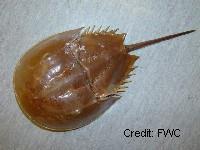
Ancestors of horseshoe crabs date back over 450 million years–long before the age of the dinosaurs.

Four species of horseshoe crabs exist today. Only one species, Limulus polyphemus, is found in North America along the Atlantic and Gulf coasts from Maine to Mexico. The other three species are found in Southeast Asia. Horseshoe crabs are not true crabs at all. Horseshoe crabs are more closely related to arachnids (a group that includes spiders and scorpions) than to crustaceans (a group that includes true crabs, lobsters, and shrimp). Horseshoe crabs are often called “living fossils” because fossils of their ancestors date back almost 450 million years–that’s 200 million years before dinosaurs existed.

Despite inhabiting the planet for so long, horseshoe crab body forms have changed very little over all of those years.

The strange anatomy of the horseshoe crab is one of this animal’s most notable aspects. Unfortunately, the long, thin, spike-like tail of horseshoe crabs has given this species an unfavorable reputation. Many people view horseshoe crabs as dangerous animals because they have sharp tails. In reality, horseshoe crabs are harmless. Their tails are used primarily to flip themselves upright if they are accidentally overturned.

Nesting Crabs

Nesting Crabs

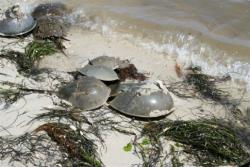
Horseshoe crabs nesting on Florida BeachHorseshoe crabs nest on beaches in Florida and mid-Atlantic states.

Horseshoe crabs are known for their large nesting aggregations, or groups, on beaches particularly in mid-Atlantic states such as Delaware, New Jersey and Maryland in the spring and summer. Horseshoe crabs can nest year-round in Florida, with peak spawning occurring in the spring and fall. When mating, male horseshoe crabs move parallel to the shoreline on sandy flats and intercept females as they pass by. A male attaches himself to the top of a female’s shell by using his specialized front claws, in a position known as amplexus, and together they crawl to the beach. The male fertilizes the eggs as the female lays them in a nest in the sand. Some males (called satellite males) do not attach to females but still have success to fertilizing the female’s eggs as they swarm around the amplexed pair. Most of this nesting activity takes place during high tides in the three days before and after a new or full moon.

Horseshoe crab larvae emerge from their nests several weeks after the eggs are laid. Juvenile horseshoe crabs resemble adults except that their tails are proportionally smaller. The young and adult horseshoe crabs spend most of their time on the sandy bottoms of intertidal flats or zones above the low tide mark and feed on variousinvertebrates.

Why are horseshoe crabs important?

Horseshoe crabs are an important part of the ecology of coastal communities. During the nesting season, especially in the mid-Atlantic States, horseshoe crab eggs become the major food source for migrating birds. Over 50 percent of the diet of many shorebird species consists of horseshoe crab eggs. Many bird species in Florida have been observed feeding on horseshoe crab eggs. In addition, many fish species rely on horseshoe crab eggs for food.

Horseshoe crabs are extremely important to the biomedical industry because their unique, copper-based blue blood contains a substance called Limulus amebocyte lysate. The substance, which coagulates in the presence of small amounts of bacterial toxins, is used to test for sterility of medical equipment and virtually all intravenous drugs. Research on the compound eyes of horseshoe crabs has led to a better understanding of human vision. The marine life fishery collects live horseshoe crabs for resale as aquarium, research, or educational specimens, and the American eel and whelk fisheries use horseshoe crabs extensively as bait along many parts of the Atlantic coast.

Threats to horseshoe crabs and research efforts

Horseshoe crab numbers are declining throughout much of the species’ range. In 1998, The Atlantic States Marine Fisheries Commission developed a Horseshoe Crab Fishery Management Plan that requires all Atlantic coastal states to identify horseshoe crab nesting beaches. Currently, with the help of the public, biologists at the Fish and Wildlife Research Institute are trying to document nesting sites of horseshoe crabs throughout the state. If you are interested in becoming more involved with the horseshoe crab survey, please visit the Survey for Horseshoe Crab Nesting Beaches in Florida for more information.