Category Archives: Conservation

Tour A Wisconsin Salmon Hatchery

Wisconsin DNR sets open house events and tours at egg collection facilities in Racine, Kewaunee, Sturgeon Bay. You can tour a Wisconsin salmon hatchery.
from The Fishing Wire

MADISON — Up and down the Wisconsin shores of Lake Michigan, chinook salmon are staging for the biggest race of their lives – a final run to spawn in rivers including the Root in Racine, Kewaunee in Kewaunee County and Strawberry Creek in Door County.

Workers at DNR's Strawberry Creek Chinook Facility

Workers at DNR’s Strawberry Creek Chinook Facility

Workers at DNR’s Strawberry Creek Chinook Facility outside Sturgeon Bay crowd salmon in a pen before spawning.
WDNR Photo

When the time is right – likely starting in the next week or so – Wisconsin Department of Natural Resources staff will be there waiting to collect eggs and milt used in producing the next generation of fish for Lake Michigan stocking.

Visitors will be able to see the action firsthand at open house events at the C.D. “Buzz” Besadny Anadromous Fish Facility on Saturday, Oct. 3 and Root River Steelhead Facility on Saturday, Oct. 10. At the Strawberry Creek facility, another key source for chinook salmon eggs, visitors are welcome during daylight hours.

“What started in the 1960s as an effort to control alewife populations by stocking Pacific salmon has turned into a sport fishery that generates some $4 billion per year for the economy of the Great Lakes region,” said Justine Hasz, DNR fisheries bureau director. “Each year the fall spawning runs are a reminder of how our stocking efforts contribute to this economic impact by creating recreational opportunities for anglers of all ages. We look forward to welcoming visitors to our open houses where they can learn more about our fisheries management and propagation efforts.”

The open house events at Besadny and Root River feature egg collection demonstrations as well as fly casting and tying lessons, youth instruction and opportunities to learn Lake Michigan fishing tips from expert anglers. The Besadny open house features an opportunity to sponsor tagged fingerling sturgeon and participate in the river release of these young fish.

Mike Baumgartner, who supervises the Besadny facility in Kewaunee, said based on reports of salmon staging near the mouth of the river, he expects a strong run of fish again this year.

“Visitors can expect great viewing along the banks of the river, a fish-eye perspective through the underwater windows and a look at egg collection through a window in the processing area,” Baumgartner said. “We’ll also offer guided tours of the facility, fish print t-shirt making and fishing lessons along with other activities. Visitors can park in a lot down the road and walk or take the horse and wagon ride to get here. It should be a great day.”

The open house events are free and open to the public with food and beverages available from local groups as well as guided facility tours and activities geared to youth. Trails and paths near the facilities offer opportunities for families to explore the river environment and enjoy wildlife and bird viewing.

The Oct. 3 event at the Besadny facility in Kewaunee runs from 9 a.m. to 3 p.m. The facility, on the Kewaunee River, was built in 1989-1990 and collects eggs from chinook and coho salmon as well as brown and steelhead or rainbow trout for rearing in a series of ponds. A processing building featuring a lobby with displays and a public viewing window was completed in 1996.

The Oct. 10 event at the Root River facility in Racine also runs from 9 a.m. to 3 p.m. The facility was built in 1993-1994 along the Root River by DNR in partnership with the Salmon Unlimited fishing club. It serves as a significant source of coho salmon, steelhead and brown trout eggs and plays an important role in the collection of biological data relating to overall fish health, growth rates, migration patterns and other data. In addition, DNR crews collect seeforellen brown trout from the river in November to ensure the ability to stock this important strain in the future.

Fisheries staff members anticipate processing fish at the third egg collection facility, the Strawberry Creek Chinook Facility outside Sturgeon Bay, on Oct. 5, 8, 12, 15 and 19.

The fall egg collection marks the start of DNR’s propagation process. The eggs will be hatched and raised at DNR facilities until they are ready for stocking at about four months for chinook and at one and a half years for coho, steelhead and brown trout. The different species are stocked according to the stage in their lifecycle at which naturally reproducing fish would normally leave the tributaries to live in Lake Michigan. That stage is much earlier for chinook.

To learn more, visit dnr.wi.gov and search “fisheries open house.”

FOR MORE INFORMATION CONTACT: Mike Baumgartner, C.D. “Buzz” Besadny Anadromous Fish Facility supervisor, michael.baumgartner@wisconsin.gov, 920-388-1025; John Komassa, DNR southeast hatchery group section chief, john.komassa@wisconsin.gov, 608-275-3315; Brad Eggold, DNR Lake Michigan fisheries supervisor, Bradley.Eggold@wisconsin.gov, 414-382-7921; Bob Fahey, DNR fisheries operations supervisor, Root River, 608-275-3251, robert.fahey@wisconsin.gov; Jennifer Sereno, DNR communications, jennifer.sereno@wisconsin.gov, 608-770-8084.

Would A Hammerhead Shark Travel Widely?

Would a Tagged Hammerhead Shark Travel Widely”
from The Fishing Wire

Smooth Hammerhead Shark

Smooth Hammerhead Shark

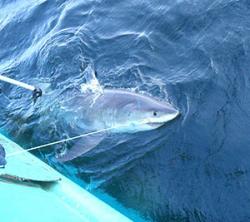
Smooth Hammerhead Shark (Sphyrna zygaena), Nine Mile Bank, San Diego, California.
Credit: Richard Herrmann/NOAA
The first hammerhead shark fitted with a satellite tracking tag off Southern California has traveled more than 1,000 miles to Mexico and back again since NOAA Fisheries researchers tagged it near San Clemente Island about two months ago.

The shark, which is now off Ventura, California, is providing new insight into the great distance hammerheads may cover in search of food, mainly fish and squid. Unusually warm ocean temperatures in the Southern California Bight since last summer has drawn hammerheads north, making them more visible off Southern California.

“The surprising thing we’ve learned from this is just how much they move around within a season,” said Russ Vetter, Senior Scientist at NOAA Fisheries’ Southwest Fisheries Science Center in La Jolla, Calif. “This one went way down to central Baja and then shot back up here again just to find food, and that is a lot of territory for an animal to cover.”

Hammerheads have been sighted off Southern California more frequently in recent weeks, including one case last weekend where a hammerhead on a fishing line bit the foot of a kayaker reeling it in. While hammerheads are not usually aggressive, scientists warn that caution is warranted around sharks since they can act unpredictably.

Researchers on an annual NOAA shark survey caught the tagged female hammerhead June 30 off San Clemente Island and attached the satellite tag to its distinctive dorsal fin. The satellite position only, or SPOT, tag relays high resolution location data as the animal travels. The shark is known as a smooth hammerhead, one of three types of hammerheads that occur in California waters and also include bonnethead and scalloped hammerheads.

attached a satellite tag to a hammerhead shark

attached a satellite tag to a hammerhead shark

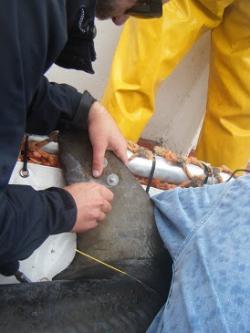
Researchers attached a satellite tag to a hammerhead shark captured in a regular offshore survey June 30. The tag should last two to three years.
Credit: NOAA Fisheries/SWFSC

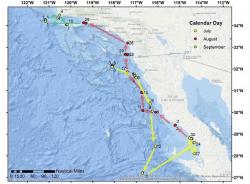
The smooth hammerhead shark traveled more than 1,000 miles to Mexico and back after it was tagged near San Clemente Island June 30.
Credit: NOAA Fisheries/SWFSC
The tagged shark measured more than seven feet long from its head to the fork of its tail. NOAA Fisheries scientists tagged a smooth hammerhead in the same area in 2008 with a different kind of tag that stores data for a few months and then detaches from the animal.

The shark tagging was conducted in collaboration with the Tagging of Pelagic Predators program.

Hammerhead habits are poorly known and researchers took advantage of the animal’s catch to learn more about its movements ahead of an approaching El Niño climate pattern, which typically boosts water temperatures along the West Coast. Patches of unusually warm water known collectively as “the warm blob” had raised temperatures off Southern California last year prior to El Niño, initially attracting warmer water species such as hammerheads.

 shark traveled more than 1,000 miles

shark traveled more than 1,000 miles

The new satellite tag shows that the hammerhead swam more than 400 miles south after its capture to an area off the central Baja Peninsula known for its production of sardines and anchovy, Vetter said. The shark then returned north to an area off Ventura this week.

The sharks’ distinctive hammer-shaped heads carry special sensory features and widely spaced eyes that may help them see and detect prey. The tagged hammerhead mostly hugged the continental shelf along the Pacific Coast but in one case made an open-ocean foray of a few hundred miles off of the Baja Peninsula. Vetter hopes the satellite tag will remain active for two to three years, providing a long-term record of the shark’s movements.

“It’s very interesting to us to see the neighborhoods this shark frequents,” he said. “For an animal to swim all the way to Baja just to see if there’s food suggests its food supply is not super abundant, which tells us something about conditions out there.”

The opportunity to track the shark during a warm El Niño year may provide clues about how hammerhead habitats may shift during gradual warming expected with climate change.

“It’s certainly possible they may spend more time farther north,” Vetter said. “We’ll be very curious to watch how far north this shark goes, which could give us an idea what to expect in the future.”

PETA Loses!

PETA Loses Last-Minute Bid to Block DC-Area Urban Bowhunting
Editor’s Note: Today’s feature first appeared in our companion service, The Archery Wire.
from The Hunting Wire

A judge in Bethesda, Maryland on Friday ruled that the Pilot Archery Managed Deer Hunting Program in two Montgomery County parks could proceed as planned, despite a desperate, last-ditch effort by the notorious and publicity-mongering animal rights group, People for the Ethical Treatment of Animals (PETA), to block the bowhunt through a court order.

Montgomery County Circuit Court Judge Cynthia Callahan denied a motion filed Thursday, September 10 for a temporary restraining order sought by Bethesda resident and PETA member Eilene Cohhn to stop the managed archery deer hunts approved earlier this year by Montgomery Parks.

Bethesda Magazine reported this week the ruling marked the second setback in two days for PETA’s the effort to derail the archery deer hunt, after seeking an immediate restraining order upon filing the suit Thursday. Judge Callahan refused to issue the order before an initial hearing Friday, at which she formally denied the restraining order.

PETA’s legal attempt served only to temporarily delay the parks hunt, which was originally scheduled to begin Sept. 11, the same day as the regular Maryland archery deer season. As a result, the bowhunts designed to control the problematic deer population were free to commence yesterday (September 15) at sunrise and will run through October 21.

The hunt will mark the first time the parks department, part of the Maryland-National Capital Park and Planning Commission, will use archers to safely cull the county’s deer population.

The archery program utilizes pre-approved hunters to take part in managed hunts over a combined area of 733 acres in the Watts Branch Stream Valley Park in Potomac and one section of the Great Seneca Valley Stream Park in Germantown. Candidates for the hunting program were required to provide a resume outlining their archery-hunting experience and written, verifiable references. Further, hunters must have completed the Maryland Hunter Education and Safety Course and a National Bowhunter Education Foundation (NBEF) course.

Other participation qualifications included:
– Minimum age of 18 years.
– At least 3 years of archery hunting experience AND harvest records indicating harvest of at least 5 deer with archery equipment.
– Fulfillment of the requirements of a background check.
– Successful completion of Montgomery Parks Archery Shooting Qualification standards (at specified ranges, only).
– Current Maryland Hunting License and Archery Stamp.

Predictably, a statement issued by PETA this week contained the usual handwringing and anthropomorphic references to animals using human terms and pronouns.

“We are extremely disappointed by the ruling and deeply saddened about the fate of the deer, who are Montgomery County’s gentle Cecils. The day will come when human beings must recognize that wild animals have a right to live on their ancestral lands and not be forced out and slaughtered simply for living as they have for generations.”

Here at The Archery Wire, we believe the only thing better than a victory for bowhunting over animal-rights extremists will be the taste of venison loins in Montgomery County, Maryland during the coming weeks.

– J.R. Absher

What Is the Wisconsin Sturgeon Fest?

Wisconsin Sturgeon Fest to Celebrate a Decade of Progress
from The Fishing Wire

MILWAUKEE – Efforts to return lake sturgeon to the Milwaukee River will enter a second decade with growing support and new evidence of progress thanks to a partnership involving the Wisconsin Department of Natural Resources, Riveredge Nature Center and Fund for Lake Michigan, among others.

The efforts will be celebrated at the 10th anniversary of Sturgeon Fest – a free, family oriented event on Saturday, Sept. 26 from 11 a.m. to 3 p.m. at Lakeshore State Park near the Summerfest grounds. This year’s event includes a free presentation by Scott Sampson, also known as “Dr. Scott,” a dinosaur paleontologist at the Denver Museum of Nature & Science who serves as host and science adviser of the Emmy‐nominated PBS KIDS series Dinosaur Train.

Lake sturgeon

Lake sturgeon

Lake sturgeon hatched from eggs collected on the Wolf River were raised at a streamside rearing facility operated by Riveredge and DNR so they imprint on the waters of the Milwaukee River.
WDNR Photo

“Lake sturgeon are sometimes referred to as living fossils but despite the 150 million year history of the species, they’ve faced a variety of challenges in modern times,” said Jessica Jens, executive director of Riveredge Nature Center. “In partnership with DNR and the Fund for Lake Michigan, our past decade of work to reintroduce a naturally reproducing population of sturgeon to the Milwaukee River has shown tremendous progress and we are excited to welcome everyone to Sturgeon Fest.”

The event features the opportunity for youth and adults to sponsor and release young sturgeon into Lake Michigan. The fish, hatched from eggs collected on the Wolf River, have been carefully raised at a streamside rearing facility operated by Riveredge and DNR where they have imprinted on the waters of the Milwaukee River.

If all goes according to plan, the fish will return to the river for spawning – a day that may well come before the 25-year Return of the Sturgeon project officially concludes. Brad Eggold, DNR southern Lake Michigan fisheries team supervisor, said the department’s lake sturgeon juvenile assessment work shows many of the more than 7,500 sturgeon released over the past decade appear to be doing well.

Releasing sturgeon

Releasing sturgeon

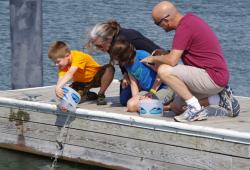
The festival offers an opportunity for youth and adults to sponsor and release young sturgeon into Lake Michigan.
WDNR Photo

In July, fisheries team members caught and released a 5-year-old sturgeon that measured 35 inches and weighed nearly 10 pounds. The fish, which has been growing about 6 inches per year, was the 57th lake sturgeon captured in the Milwaukee River and harbor area and adds to evidence that a number of the stocked fish are staying nearby and using the harbor as a nursery.

Fisheries team members are able to identify the age and origin of the stocked fish thanks to tiny passive integrated transponder – or PIT tags – inserted into the sturgeons before they are released. The pencil-lead sized tags and nets used to conduct the juvenile sturgeon assessments come thanks to additional support from the U.S. Fish and Wildlife Service and Great Lakes Fishery Trust of Lansing, Mich.

“During the past year, we also picked up a young sturgeon that was reared more than 100 miles away in Kewaunee at the C.D. “Buzz” Besadny Anadromous Fish Facility and released at a sturgeon sponsorship event there,” Eggold said. “We’re pleased to see that conditions in Lake Michigan appear to support survival of the fish; habitat work on the Milwaukee River will further improve the odds for successful reproduction.”

Given current growth rates of the fish, some of the males are likely to reach sexual maturity in the next five to six years and the females within 10 to 15 years. That timeline is not lost on Vicki Elkin, executive director of the Fund for Lake Michigan, which has provided nearly $150,000 in the past three years to restore spawning habitat and support improvements to the streamside rearing facility that should lead to higher survival rates for the fish.

“We’re pleased to work in partnership with Riveredge and DNR on projects including construction of a spawning reef in the Milwaukee River that now provides more than an acre of prime habitat for sturgeon as well as walleye,” Elkin said. “Healthy populations of lake sturgeon were found in Lake Michigan as recently as the late 1800s and we hope our shared efforts contribute to natural reproduction in the decade ahead. Lake sturgeon serve as an important indicator of ecosystem health, so work to improve habitat for sturgeon benefits many species.”

Families and individuals interested in sponsoring a sturgeon for Sturgeon Fest are encouraged to register online before 2 p.m. on Friday, September 25, although it will still be possible to sign up at the event. The sturgeon are typically released between noon and 3 p.m. following a short presentation and a blessing of the fish by a Native American representative.

The free, family oriented presentation by Dr. Scott runs from 2 to 3 p.m. at the Johnson Controls World Stage on the Summerfest Grounds, a short walk from the sturgeon release site. Free parking for Sturgeon Fest is available at designated Summerfest parking lots and a shuttle to Lakeshore Park will be available.

To learn more about sturgeon, visit dnr.wi.gov and search for “lake sturgeon” as well as “lake sturgeon rehabilitation.” For more about the festival, visit the Riveredge Nature Center website and search for “Sturgeon Fest” (both links exit DNR).

FOR MORE INFORMATION CONTACT: Brad Eggold, DNR Lake Michigan fisheries supervisor, Bradley.Eggold@wisconsin.gov, 414-382-7921; Jessica Jens, Riveredge Nature Center executive director, jjens@riveredge.us, 262-375-2715; Vicki Elkin, Fund for Lake Michigan executive director, vicki@fundforlakemichigan.org, 414-418-5008; Jennifer Sereno, DNR communications, 608-770-8084,Jennifer.Sereno@wisconsin.gov.

Are Shark Populations Improving off U.S. East Coast?

2015 Coastal Shark Survey Reveals Shark Populations Improving off U.S. East Coast
from The Fishing Wire

Cutting the line

Cutting the line

Cutting the line to release a tagged white shark. Credit: Joe Mello, NEFSC/NOAA.

The longest running coastal shark research survey along the East Coast has completed its 2015 field work, capturing and tagging more than 2,800 sharks, the most in the survey’s 29-year history. The results are very good news for shark populations.

“We caught fish throughout the survey,” said Lisa Natanson, a scientist at the Narragansett Laboratory of NOAA Fisheries’ Northeast Fisheries Science Center (NEFSC) and leader of the coastal shark survey. “Sandbar sharks were all along the coast, while most of the dusky sharks were off North Carolina. We captured a bull shark for the first time since 2001, and recaptured 10 sharks previously tagged by our program and two sharks tagged by the Virginia Institute of Marine Science.”

The survey began in 1986 and is conducted every two to three years. It covers coastal waters from Florida, where coastal shark species concentrate during the winter and spring, north to Delaware, where many shark species migrate during spring and summer as more northerly waters warm. Following this migratory route, at this time of year, makes it easier to survey the whole population.

tagging a shark

tagging a shark

Lisa Natanson tagging a shark. Credit: Joe Mello, NEFSC/NOAA.

The last survey was in 2012, during which 1,831 sharks were captured and tagged, compared with 2,835 in 2015. Sandbar, Atlantic sharpnose, dusky, and tiger sharks were the most common shark species captured this year. In all, 13 shark species were among the 16 species of fish caught. The three non-shark species were remora, cobia and gold spot eel.

“Sharks are very vulnerable. Even though they are at the top of the oceanic food chain and can live for decades, they are fragile in the sense that compared to other fish they grow very slowly, reproduce late in life and have only a few offspring,” said Karyl Brewster-Geisz of NOAA Fisheries Office of Highly Migratory Species. “An increase in the numbers caught and tagged during each survey indicates a slow climb back. It is very good news for shark populations and for the ecosystem.”

This year, the survey was conducted aboard the 100-foot charter fishing vessel Eagle Eye II from Port Royal, South Carolina, from April 4 to May 22, and from just south of Ft. Pierce, Florida to North Carolina. As in 2012, poor weather and time prevented sampling further north. The surveys are conducted in the 5-40 fathom (30 to 240 feet) depth zone with most sampling between 11-20 fathoms (66 to 120 feet deep) and use commercial Florida-style bottom longline fishing methods to standardize survey results. This method uses a long, or main, line with baited shark hooks spaced at regular intervals along the line.

“The number of fish this year was amazing. We captured and tagged more fish than ever before, but once again weather was a factor. It started off nice, but conditions worsened as we headed north,” said Natanson.

sandbar shark

sandbar shark

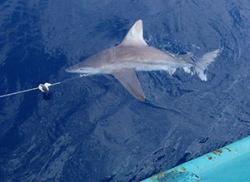
A sandbar shark is brought aboard for tagging. Credit: Lisa Natanson, NEFSC/NOAA.

Most (2,179, or 77 percent) of the sharks captured were tagged and released, 434 (15.3 percent) were brought aboard, and 222 (7.8 percent) were released untagged or lost. Researchers record the length, sex, and location of each animal caught. Environmental information, such as water temperature and ocean chemistry, was also obtained at each station.

Researchers do not intentionally kill any animals for their studies. However, some sharks do not survive capture, and these are carefully dissected at sea to obtain biological samples important for studies on shark age and growth, reproduction, and food habits. On this survey, reproductive information was obtained from 170 sharks, backbones were removed for age and growth work from 109 sharks, and stomachs were examined in 82 sharks. The scientists also collect parasites, DNA and blood samples.

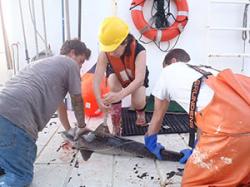
Among the catch this year were three white sharks, which were tagged and released; all were less than eight feet long. No white sharks were captured during the 2012 survey, and only one white shark was captured during the 2009 survey. The largest shark captured on the 2015 survey was a tiger shark, 12.5 feet in fork length, off North Carolina.

Natanson said the survey’s primary goal is to gather information about the distribution, abundance, and species composition of sharks found in these waters. Survey objectives also include tagging sharks for migration studies and collecting catch-per-unit-effort data.

tag a tiger shark

tag a tiger shark

Lisa Natanson (in yellow hard hat) and the ship’s crew tag a tiger shark. Credit: Cami McCandless, NEFSC/NOAA.

“All the survey data are provided to NOAA Fisheries managers to monitor the health and abundance of shark populations in the Atlantic,” said Natanson. “We’ve seen an increase in the number of sharks in every survey since 2001; that reflects management efforts to conserve the populations of various shark species.”

NOAA Fisheries is the federal agency charged with managing commercial and recreational shark fisheries in U.S. waters, including the Caribbean Sea and the Gulf of Mexico. The United States shark management began in 1993; currently 42 species are managed.

In addition to Natanson and colleagues from the NEFSC’s Narragansett and Woods Hole Laboratories, researchers participating in the 2015 survey came from the Southeast Fisheries Science Center, Florida Atlantic University, and the University of New Haven.

Another memorable tale from the 2015 survey
In addition to the record number of sharks caught this year, which was itself cause for excitement, the team aboard the Eagle Eye II also rescued five people off Oregon Inlet in North Carolina during the survey. Their small fishing boat had experienced engine trouble and was adrift in the Gulf Stream. The boat’s mayday signal was not received by the Coast Guard, but was by the Eagle Eye II, who came to the rescue. After determining that everyone aboard was okay, they contacted the Coast Guard and towed the vessel for a few hours closer to shore, where the Coast Guard took over.

What Is Being Done for Endangered Salmon in California?

For Endangered Salmon in California, a Very Measured Sip of Cold Water

With Chinook salmon facing lethally high stream temperatures, scientists deploy a new device to help manage the dwindling supply of cold water that the fish need to survive.

By Rich Press, NOAA Fisheries Science Writer | Follow Rich on Twitter: @Rich_NOAAFish
from The Fishing Wire

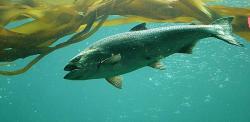
Chinook Salmon

Chinook Salmon

Chinook Salmon. Credit: Michael Humling/USFWS.

The State of California, now in the fourth year of a historic drought, is parched. But in the north of the state, at the bottom of the reservoir behind Shasta Dam, lies a big drink of cold water. For salmon in the Sacramento River, especially winter-run Chinook—considered by NOAA Fisheries to be among the eight endangered species most at risk of extinction—that cold water is a lifeline. Water managers tap it to cool off the river in summertime, when streams become hot enough to kill developing salmon eggs and newly hatched fry.

The cold water flows in from the mountains as snowmelt. But with winter snowpack at record lows, the supply of cold water is dwindling. If it’s not managed carefully, winter-run Chinook might be lost forever.

So last month, scientists from NOAA Fisheries and the University of Nevada, Reno, installed a new system to measure the temperature of the water behind Shasta Dam. The temperature profiler, which is based on fiber optic technology, will allow scientists to accurately estimate how much cold water is available so it can be used as efficiently as possible.

“The big question we’re facing, especially during this drought, is how much of the river can we keep cool enough for salmon eggs to survive?” said Eric Danner, the NOAA Fisheries biologist and salmon expert who is leading the project. “And can we keep it cool through October without running out of cold water first?”

Measuring the Vertical Temperature Profile

lower a fiber optic cable

lower a fiber optic cable

Cherisa Friedlander and Skip Bertolino of NOAA Fisheries and Scott Tyler of the University of Nevada, Reno, lower a fiber optic cable to the bottom of the reservoir behind Shasta Dam. The fiber optic system will provide a continuous, real-time temperature reading at every depth of the reservoir, allowing for more efficient management of the dwindling supply of cold water that endangered salmon need to survive. Credit: Rachel Hallnan/University of Nevada, Reno.
Cold water is heavier than warm water, so when it flows into the reservoir, it sinks to the bottom like hidden treasure. The agency that operates the dam, the U.S. Bureau of Reclamation, manages downstream water temperatures by mixing cold water from the bottom of the reservoir with warm water from above before sending it through the dam.

Until now, technicians from the Bureau of Reclamation measured the cold-water pool manually by going out on the lake every 2 weeks and dropping a temperature probe at various locations. That method is time-tested, but it left a lot of uncertainty in the results.

At the heart of the new system is a fiber optic cable that runs from the surface of the reservoir to the bottom. Photons are shot through the cable, and the backscatter can be interpreted to measure the temperature at every point along the cable. This will provide a continuous, real-time temperature reading at every depth.

The temperature data will be freely available online. In addition, water managers will be able to run computer simulations to predict how long the cold water will last, and what stream temperatures will result, given different scenarios of weather and dam operations.

Surviving in a New Environment

 install a fiber optic-based temperature sensor

install a fiber optic-based temperature sensor

Scientists from NOAA Fisheries and the University of Nevada, Reno, install a fiber optic-based temperature sensor in the reservoir behind Shasta Dam. Credit: Rachel Hallnan/University of Nevada, Reno.
Before Shasta Dam was built, Chinook salmon traveled far upstream to spawn. Today, the dam blocks their passage, forcing them to spawn downstream, where water temperatures are higher. Because they didn’t evolve under these conditions, Chinook and many other species are not adapted to the hot water they find themselves in today.

Winter-run Chinook are especially vulnerable because of their timing. As their name indicates, they swim upstream in winter. Most spawn in late spring, and their eggs and newly hatched fry—the life stages most at risk from high temperatures—must survive the heat of summer.

“If the water gets too warm, the eggs are stuck in a tomb under the gravel,” said NOAA Fisheries biologist Garwin Yip. If high temperatures don’t kill the eggs outright, they can cause higher rates of disease. And even if the young fry do make it out of their nests, they face long odds as well, as high temperatures make predators more voracious.

The goal of water managers is to keep the average daily stream temperature no higher than 56 degrees Fahrenheit through October. Last year, due to imperfect estimates of its volume, the cold-water pool was unexpectedly drained by mid-September, and stream temperatures soon shot up to 62 degrees. Scientists estimate that only 5 percent of winter-run Chinook eggs survived as fry in the upper Sacramento River, compared to 25 percent survival in an average year.

Chinook Salmon

Chinook Salmon

Chinook salmon. Credit: NOAA.

“We don’t want a repeat of what happened last year,” Danner said.

Hopefully, with the new fiber optic temperature profiler in place, water managers will be able to take very controlled sips from the cold-water pool, and make sure it lasts until the salmon are out of danger.

Are There Snakes On My Property?

Yep, You’ve Probably Got Snakes Around

EDITOR’S NOTE: Today’s feature from David Rainer of the Alabama Department of Conservation and Natural Resources points out the fact that healthy land means you have all sorts of wildlife on it- including….snakes.
from The Fishing Wire

Like humans this time of year, just about all God’s critters are looking for some shade, even those that give a good many people the shivers.

Despite being cold-blooded animals, snakes don’t like to get too hot in the summertime, and you may find a variety of reptiles seeking shelter from the hot summer sun.

A buddy of mine was concerned about finding a snake, which may or may not have been a cottonmouth, near his house recently.

Roger Clay, Non-Game Biologist with the Alabama Wildlife and Freshwater Fisheries Division (WFF), said if landowners and homeowners aren’t seeing a snake every once in a while, then something isn’t right.

“A lot of people always try to attribute seeing snakes this time of year to some kind of weather phenomenon,” Clay said. “It’s so hot. It’s so wet. It’s so dry. Some people say they haven’t seen a snake in X number of years, but there’s got to be snakes around. By some coincidence they see a couple in a short amount of time. Because they hadn’t seen any in a long time, they think they are suddenly overrun with snakes. But they’re really not.

“If you have a healthy environment, you’re going to have snakes. That’s the way it is. If you have a field next to you and they’re doing construction work or something, they may run a few snakes onto your property. That might be the phenomenon that accounts for you seeing a couple of snakes.”

Clay said if you live near water, then you’ll likely encounter a few snakes and other critters that live in and around the water or are just coming by to get a drink.

“Some people still don’t realize that any snake that lives around water is not a cottonmouth,” he said. “There are many more snakes that live in and amongst the water other than a cottonmouth.”

Clay said it’s sometimes hard to convince folks there are more than two kinds of snakes, what they call “water moccasins” and “ground rattlers.”

“For some people, every snake they see is a venomous snake, but in Alabama there are only six venomous snakes,” he said.

The venomous species include the pit vipers: cottonmouth, copperhead and the three rattlesnakes – eastern diamondback, timber and pygmy. The sixth venomous snake is the extremely rare coral snake.

“The coral snake is so rare you’re not going to find it in the front yard,” Clay said. “Coral snakes are usually limited to the southern half of the state, although we have records of them in the central part of state. A coral snake is so boldly colored people are not going to mistake it for one of the other snakes.”

There is an old saying about the coral snake that will give people an idea of what they’re looking for in identifying a coral snake.

It goes, “Red touch yellow, kill a fellow. Red touch black, friend to Jack.”

Clay said there are a couple of snakes that mimic the coral snake’s banding, but a coral snake has the only banding where yellow touches red.

“If somebody does see a coral snake, please let us know because they are so rare,” he said.

In terms of identifying the pit vipers, Clay said the dead giveaway is the elliptical pupil in the eye, although he realizes most people don’t want to get anywhere close enough to see an elliptical pupil.

“Some people say you can identify them with their triangular-shaped head,” he said. “That might be kinda true, but you can’t use that for positive identification. There are several non-venomous snakes that can change the shape of their heads to look triangular. It’s not doing them any good, but they want you to leave them alone.”

Clay said the appearance of a cottonmouth can vary depending on its age.

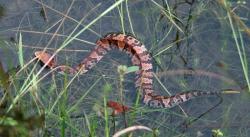
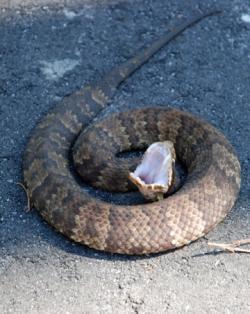
The juvenile cottonmouth (top) has distinct markings and a noticeable lightly tipped tail as it swims through the water. An adult of the species displays its “cottonmouth” (center) as a warning signal. The round pupil in the eye of a rat snake (bottom) indicates it is not a pit viper, which has an elliptical pupil similar to a cat’s eye.

Juvenile Cottonmouth

Juvenile Cottonmouth


Adult Cottonmouth

Adult Cottonmouth


Non-poisionous Snake

Non-poisionous Snake

“When a cottonmouth is young, it has a pretty distinct pattern,” he said. “As it gets older, the pattern gets obscured. Secondly, when cottonmouths and copperheads are young, they’ll have a brightly colored tip on their tail. If you come across anything with a brightly colored tip on its tail, leave it alone.”

Obviously, most rattlers are identified by a diamond-shaped pattern and other markings as well as the rattlers. But other snakes also have distinctive patterns.

“If somebody sees a rat snake, they might think it has a pattern similar to a rattlesnake,” Clay said. “Rat snakes are definitely beneficial. It might be the best mouse and rat catcher out there.

“The question is whether you would rather have a rat snake out in your yard or a rat in your house?”

Clay said all snakes are beneficial in their own ways, especially the kingsnake, which regularly dines on several of the venomous species.

In fact, there was a video on Facebook of an eastern kingsnake consuming a rattlesnake. The video starts with the rattlesnake hopelessly snared in the kingsnake’s coils. The kingsnake then slowly swallows the rattlesnake head first. About 10 minutes later, the rattlers disappear down the kingsnake’s mouth.

“Kingsnakes are famous for eating other snakes, including venomous snakes,” Clay said. “Obviously, you don’t want to kill a beneficial kingsnake. The thing about a kingsnake is that its head is not going to look like a pit viper.”

Clay said sometimes people will mistake other reptiles for a rattlesnake because they hear some kind of rattling noise.

“A lot of snakes will vibrate their tails when they feel threatened,” he said. “If they’re in dry leaves, it may sound like a rattle. That’s just a defense mechanism.

“The good thing about snakes is they eat only small animals and other critters. They don’t eat fruits or vegetables. The small snakes are going to eat insects or small invertebrates. The larger snakes like the black racer, garter snake and rat snake will eat what they can catch, which is mice, rats and other snakes.”

Most snakes will seek an escape from the summer heat and will typically find shelter underground.

“Snakes don’t like it too cold or too hot,” Clay said. “You’re going to find them in shady areas in the summertime. If they get caught out in the sun for too long, they’ll get too hot and die. So they’ll be seeking shelter during the hot times of the day.”

If a snake is encountered, Clay recommends that you give the reptile a wide berth and leave it alone.

“A lot of people want to know if there is anything they can buy that will keep the snakes away,” Clay said. “The short answer is no. Snakes generally like hiding places, so keep your yard mowed low and keep it nice and tidy to eliminate hiding places. If you’ve got a pond nearby, keep the edges trimmed of tall grass.”

—David Rainer
Alabama Department of Conservation and Natural Resources

How Is Alabama Saltwater Fishing Doing?

Alabama’s Saltwater Fishing Doing Just Fine

By David Rainer
Alabama Department of Conservation and Natural Resources
from The Fishing Wire

Judging by the number of record fish caught in the past year and a half, it appears Alabama’s saltwater fishing is doing just fine.

Ten records were established in 2014, and five more have been established in 2015 with several months left to fish.

One of the most impressive fish that made the record book was a snowy grouper caught by Tyler Kennedy of Mobile in 2014. That fish weighed 68 pounds, 9 ounces. The world record is 70 pounds, 7 ounces.

Another record set in 2014 was a king mackerel caught by Jeremy Goldman during last year’s Alabama Deep Sea Fishing Rodeo. That fish was a dollop of fish slime away from 70 pounds. The official weight was 69 pounds, 15.84 ounces.

Cubera snapper

Cubera snapper

The cubera snapper caught by Brett Rutledge of Mobile was another impressive 2014 catch at 84 pounds, 9 ounces. Also on the big fish list was a jack crevalle caught by Joseph Condry Pope IV of Alabaster, Ala., that weighed 40 pounds, 2 ounces.

Others on the 2014 record listed included a 5.0-pound Darwin’s slimehead (aka big roughy) caught by Lance Smith of Lithia Springs, Ga.; a scorpionfish caught by Ike Farmer of Salem, Ala., that weighed 4 pounds, 4 ounces; a sharksucker caught by Dylan Andrew Bauman of Spanish Fort, Ala., at 5 pounds, 13.2 ounces; a great northern tilefish caught by Dick Paul of Pensacola, Fla., at 35 pounds, 5.6 ounces; a tomtate caught by Lauren Ogle of Muncie, Ind., at 1 pound, 4.6 ounces; and a whopper of a big eye tuna caught by Bobby Abernathy of Merryville, La., at 236 pounds.

The first fish to make the record book in 2015 was a 13-pound, 9-ounce monster of a sheepshead caught by Branden Ryan Collier of Irvington, Ala.

Other fish to make the book in 2015 included a huge bull shark caught by Jeff Moore of Birmingham that weighed 448 pounds, 4 ounces; a blue angelfish caught by Natalie Parker-Beach of Fairhope, Ala., at 2 pounds, 10.6 ounces; and a cutlassfish caught by John Robert Frain of Cumming, Ga., at 3 pounds, 5 ounces. A horse-eye jack caught by Marcus Kennedy of Mobile that weighed 22 pounds, 7.2 ounces caught this July is the latest addition to the record book.

“The fact we continue to set state records in many categories, both inshore and offshore, just shows what a good fishery we have in all our waters in Alabama,” said Chris Blankenship, Director of the Alabama Marine Resources Division. “We set records on inshore species like jack crevalle and sheepshead. Then we had the offshore fish in the bigeye tuna, king mackerel and snowy grouper.”

Blankenship said that several species that made the record books in 2013 and 2014 were deep-water species that indicated somewhat of a shift away from the traditional reef-fishing activities for species like red snapper and triggerfish, both of which have limited seasons now.

“I think people were doing more deep-dropping to catch species like the tilefish,” he said. “I think people are branching out into the deep water to fish the edge of the shelf. We’re seeing some species that weren’t as popular in years past.

“But at the end of 2014 and into 2015, the record fish we’re seeing are more of the traditional species. A 13-pound sheepshead is a fine catch, and that came from just off Dauphin Island. You could see the boat ramp from where that fish was caught.”

There was also one application for record-fish status that was rejected earlier this year. An application was submitted for a yellowedge grouper, but the state record fish committee denied the application, determining the fish was a scamp, another member of the grouper family.

“The state record fish committee is made up of scientists, local fishing guides and communicators who are very knowledgeable about the fish,” Blankenship said.

When someone submits an application for a state record fish, the rules that apply are: The boat has to leave and return from an Alabama port; the fish must be weighed on certified scales and be witnessed; photos of the fish must accompany the application for verification purposes.

Catch big fish in Saltwater in Alabama

Catch big fish in Saltwater in Alabama

Another requirement is that if the species can’t be verified by the photos submitted, the fish must be kept frozen for 14 days for possible inspection.

“In the particular case of the yellowedge grouper, Dr. Bob Shipp and Dr. Will Patterson felt sure it was a scamp and not a yellowedge,” Blankenship said. “The fish was not saved for inspection, so the application was denied.

“That shows the state record fish committee worked the way it was supposed to, that records are awarded to those that are deserving and meet all the criteria.”

The special red snapper season in Alabama waters for the month of July recently concluded, and Blankenship was a little surprised by the results.

“The state red snapper season was viewed very positively by the fishing community,” he said. “We didn’t have as much participation as I thought we would. But during the Alabama Deep Sea Fishing Rodeo and the Roy Martin Young Anglers Tournament, I did see a lot of red snapper weighed. It was definitely enjoyable to see people enjoying fishing in state waters during the rodeos.”

Blankenship said one theory for the lack of participation in the state red snapper season was the enforcement issue regarding the state waters limit. Alabama enforces a state waters limit of 9 miles, while federal officials enforce a 3-mile limit.

“I think some people were apprehensive about taking the risk between 3 and 9 miles,” he said. “I do think that was a big part of it. And we don’t have a huge red snapper population in state waters. The bulk of the snapper population is outside that 9-mile limit.

“But we did see some nice triggerfish catches during the state season. Although triggerfish weren’t part of our Snapper Check system, our biologists and enforcement officers saw a lot of triggerfish come in to the docks. I think the population of triggerfish has really rebounded the last couple of years. With the federal management of triggerfish, it has kept down people’s access to that fishery as it rebuilds. The federal system takes a couple of years to catch up with what’s being seen on the water. The population of triggerfish offshore and in state waters has really picked up.”

Amberjack season re-opened on August 1, which gives anglers one of the more popular species to catch while red snapper season is closed.

“Here at Marine Resources, we’re trying to build reefs that are more productive for species like amberjack,” Blankenship said. “We put 25-foot-tall pyramids down two years ago. We sunk a 70-foot boat off Dauphin Island. We sunk a rig as part of the Rigs to Reefs program south of Dauphin Island. We’re increasing habitat for species other than red snapper. We’ve built some great habitat for amberjack so our fishermen will have opportunities to fish for other species while red snapper and triggerfish are closed.”

PHOTOS: No strangers to the Alabama saltwater record book, the father-son duo of Tyler and Marcus Kennedy have two entries each on the list. Tyler’s latest entry is a 68-pound, 7-ounce snowy grouper, while dad, Marcus, added a horse-eye jack that weighed 22 pounds, 7.2 ounces.

What Is Gila Trout Management?

Conservation Genetics Steers Gila Trout Management
Craig Springer
from The Fishing Wire

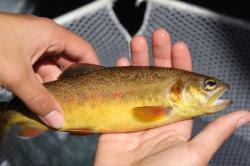
Gila Trout

Gila Trout

A trout that once stared at extinction offers wilderness angling opportunities

The trout stole its color from a southern New Mexico summer sunset. Gila trout sport a painter’s pallet of pink and olive, rose, yellow and copper and a few tones in between. Beneath the black pepper flakes that fleck its side lies a lexis—a language carried forward from another time. It’s an ancient language coded in molecules of proteins written by the press of time and experience in a land turned arid.

Gila trout, native only to headwater streams that vein over the Mogollon Rim of New Mexico and Arizona, have expressed in their genetic makeup a mapping of how to survive in the vestiges of what surely was a large and contiguous range. Their genetics equip them to face what nature may hurl at them in an already harsh environment.

It’s those innate characteristics coiled in the double-helix of DNA that U.S. Fish and Wildlife Service biologists strive to preserve in the fish. Conservation genetics is at its heart an investment in the future with an eye on the past. Dr. Wade Wilson with the Southwestern Native Aquatic Resources and Recovery Center in Dexter, New Mexico, knows Gila trout like few others can; he’s a geneticist and can de-code the language. It’s his charge in the conservation of Gila trout to help ensure that the diversity of genetic characters unique in this fish stay in the fish going forward.

Wilson works adjunct with another U.S. Fish and Wildlife Service facility in New Mexico, the Mora National Fish Hatchery near Las Vegas where captive stocks of the rare yellow trout are held. Hatchery biologists are fully immersed in Gila trout captive breeding, and it’s done smartly, carefully, through the consult of Wilson.

“We monitor genetic diversity in captive trout to ensure that what we have in the hatchery represents what we have in the wild,” said Wilson. That mixture is essential for the future. “The more genetic diversity that exists among the fish, the better chance those future generations of Gila trout can adapt to changing environments and stressors and diseases in wild populations,” Wilson adds.

“Here’s how we get it done,” explains an enthusiastic Nate Wiese, Mora’s manager and lead fisheries scientist. “Each fish gets a microchip injected just under the skin just like your vet can do for your dog. That chip gives each fish a personal ID, like a social security number. Knowing each fish at an individual level is a first step in securing the future of Gila trout.”

With every captive fish in the hatchery marked as such, biologists take non-lethal tissue samples from the fish, a tiny piece of fin. From there it’s up to Wilson and his staff using leading-edge technology to look deep at each fish—at the molecular level. Wilson will pinpoint individual fishes with the rarest of genetics in the captive populations and suggest what Wiese calls “pair-wise spawns.” It’s akin to arranged marriages but with the express scientific purpose to ensure that the rarest of genetic characters found by Wilson are carried forward in the next generation of fishes. Males and females that differ among various genes make the best partners.

The Gila trout was described by science a mere 65 years ago. Through much of that intervening time—50 years—it had been closed by law to angling as the fish stared at extinction. Its lot improved with conservation and was down-listed from “endangered” to “threatened” in 2006, and opened to fishing a year later. And so it remains, threatened and fishable, despite a welter of catastrophic wild fires—the sort that makes the evening network news broadcast for days on end.

“An integral part of the conservation strategy calls to replicate in the wild the distinct genetic lineages,” said Wiese. It’s a measure of conservation security to give a geographic spread between populations. “But what happens when a massive fire threatens to gobble up the original and replicate populations? The hatchery is the back up.”

Fire is hard on trout, particularly when a mountain stream turns into a slug of ash slurry at first rain post-fire. The Whitewater-Baldy Fire that decimated the Gila Wilderness in 2012 necessitated a trout rescue ahead of such circumstances. New Mexico Fish and Wildlife Conservation Office biologist Dustin Myers based in Albuquerque led such rescues involving pack horses and helicopters and hatchery trucks from streams sure to be slugged by ash. Now, Mora National Fish Hatchery is home to the only known population of the Spruce Creek lineage of Gila trout. Three other strains are held there, too: Main Diamond Creek, Whiskey Creek and South Diamond Creek lineages.

Aside from the robust genetics plans that steer captive breeding, Wiese manages the hatchery to produce Gila trout conditioned toward a wild environment. Instead of growing lazy trout as fat as toads, they are in a captive environment that mimics nature—like boulders, plants and fast-flowing water. “We get them off the couch and on a treadmill,” said Wiese. “They are going to be better suited for real streams. It’s like tough-love for your children.”

Those real streams are still healing from the 2012 fire and the Silver Fire that scorched headwaters atop the Black Range in 2013, and fish will return to them this autumn. Myers makes that call as to what streams are ready for trout. “Since the Whitewater-Baldy Fire we’ve replicated Whiskey Creek lineage in McKenna Creek and Upper White Creek,” said Myers. “Whiskey fish will also go into Sacaton Creek this year. But Whiskey Creek itself is still healing and we have to wait for habitat conditions to improve.”

It’s about the habitat—including ensuring that Gila trout waters remain free of mongrel or nonnative trouts that compromise the genetic integrity of pure lineages via interbreeding. Barriers, made on site, or natural waterfalls are a means of segregating fishes. Toward that end, Myers recently worked with the Forest Service to restore a vital barrier, a natural waterfall, by blasting out lodged boulders to ensure 21 miles of prime Gila trout habitat in the West Fork Gila remain free of unwanted fishes.

The lack of habitat has been a vexation in Gila trout conservation. But science married with the resolve of individuals who care about this beautiful bright trout is a way forward. A certain splendor in the spectra of inspiring pigments reflected by a wet Gila trout call to mind Emerson: “If eyes were made for seeing, then beauty is its own excuse for being.” But the beauty is richer than what strikes the eye; it’s that Gila trout sheltered in a hatchery and those facing the rigors of the wild still carry today the impress of the past.

Craig Springer works for the U.S. Fish and Wildlife Service in Albuquerque, New Mexico. Learn more at www.fws.gov/southwest

Editor’s Note:

The Southwest Region recently introduced Emphasis Areas as a way to focus our limited resources on geographic areas with the highest conservation need and potential for success, which also have opportunities for leveraging funding. The Mogollon Rim, home to Gila trout, is one of five geographic areas determined by the Regional leadership team to be an Emphasis Area.

is Lion and Elephant Trophy Hunting Wrong?

Lions and Ivory
from The Fishing Wire

In life, Cecil was a popular member of the lion population of Zimbabwea’s Hwange National Park. In his suspicious killing by a noted United States hunter, he’s become a lightning rod for controversy. The hunter faces possible poaching charges, although he has maintained his innocence, blaming the professional hunters who ok’d him to shoot the lion.

And two major hunting and wildlife groups, Safari Club International and the Dallas Safari Club, wasted no time weighing in yesterday on the controversy. DSC, the first to respond, called on the United States Fish and Wildlife Service to investigate the matter, especially into possible violations of American Wildlife Laws. It also supported the Safari Operators Association of Zimbabwe’s taking actions against its members who violate wildlife laws.

“DSC abhors poaching,” their statement reads (you can both statements in their entirety in today’s news section), commends the swift action of Zimbabewan authorities and supports the prosecution of convicted poachers to the fullest extent of the law.”

Safari Club International found itself in the uncomfortable position of both the hunter and professional being SCI members. But the organization didn’t hesitate to take decisive action in regards to both or to make it clear they supported strong actions when it comes to poaching.

“SCI has imposed immediate emergency membership suspensions of both the involved hunter and his guide/professional hunter,” their statement reads, “and they will remain in place pending the outcome of an investigation.”

“Safari Club International condemns unlawful and unethical hunting practices,” their statement continues, “SCI supports only legal hunting practices and those who comply with all applicable hunting rules and regulations, and SCI believes that those who intentionally take wildlife illegally should be prosecuted and punished to the maximum extent allowed by law.”

With that, two of the major groups representing hunters – especially trophy hunters- took what was an unquestioned stance against poaching-or the appearance of impropriety, since the full details into the death of Cecil aren’t known. And their decisive actions should help reinforce the idea that hunters aren’t some sub-species of human being, intent on wiping out wildlife across the globe in search of trophy animals.

Nothing could be further to the truth when it comes to the true biological facts of trophy animals- they’re generally beyond their prime when it comes to reproduction or contributions to their species’ survival- and in some cases, like last year’s hotly-protested black rhino hunts, the elderly bulls were actually detriments to the survival of their species. Hopefully, the strong statements and action on behalf of SCI, will help open some eyes to the facts, not the emotion of the matter of hunting.

In another matter, however, it’s the action that confirms the intent. The intent of the administration is to kill the ivory trade in the United States- all of it. After delaying a proposed regulation for a year, the U.S. Fish and Wildlife Service has published their proposal for ivory in the Federal Register.

It is, in the words of Knife Rights chairman Doug Ritter, “as bad as expected.” The rule would hit legal owners of ivory- meaning knife owners, knifemakers, scrimshaw artists, and suppliers -hard making a few very narrow exceptions into what is otherwise a total ban on ivory trade -legal or otherwise.

According to the Knife Rights release (again, you can read it in today’s News Section) the ban is based on three premises- all false:

1) Elephant poaching is increasing…when CITES says poaching numbers have been falling since 2011 due to increased enforcement of anti-poaching laws.

2) Large amounts of illegal ivory are being imported into the US, driving the poaching increases…both CITES and U.S. data show that illicit ivory imports into the U.S. are insignificant- both name the Chinese as the demand fueling poaching

3) By banning American ivory trade, the Chinese consumer will abandon his cultural affinity for ivory…when the Chinese demand for illicit ivory is completely independent of the U.S. trade -or demand. The ban seeks to stop trade in decades-old, legally owned, domestic ivory.

As Knife Rights points out, USFWS Director Dan Ashe has stated the goal of the regulation is to implement a near complete ban on the domestic commercial trade of ivory. The federal government lacks the authority to stop trade in states, it seeks to stop any trade across state lines.

As Ritter explained, “there is no evidence this ban would save a single elephant in Africa, but it will take millions of dollars in value from honest Americans.”

So what can we do? Contact our Congressional delegations and tell them they should co-sponsor the African Elephant Conservation and Legal Ivory Possession Act of 2015 to protect honest U.S. ivory owners while providing additional conservation and anti-poaching efforts in Africa.