Category Archives: Bass Fishing

Bass Fishing Information

How and Where to Catch December Bass at Bartlett’s Ferry/Lake Harding

How and Where to Catch December Bass at Bartlett’s Ferry/Lake Harding
with Tommy Gunn

By this time of year lake waters are getting cold and bass are not feeding as good as they did earlier in the fall. Colder water means they are less active and more likely to be holding in deeper water. But a few warm days can turn them on and you can have some excellent fishing before the weather really gets harsh.

Some lakes seem to be better now and Bartlett’s Ferry on the Chattahoochee River below West Point is one of them. Also called Lake Harding, the water levels stay fairly consistent because it is a small lake at 5850 acres and generation at West Point keeps it full. The level can change a couple of feet each day but you will seldom see it more than three feet low.

Bartlett’s Ferry is an old lake that started producing power in 1926. It was bought by Georgia Power in 1930 and it is still owned and operated by them. The shoreline is mostly rocky, steep banks on the old river in the lower lake with some creeks offering different kinds of structure over the whole lake. The river above Halawakee Creek has steep outside bends and mud flats. Almost all the shore is lined with cabins and docks.

For a long time Bartlett’s Ferry was known for its largemouth but spotted bass have come on strong there. In the Georgia Bass Chapter Federation Creel Census Report in 1996 just under 63 percent of bass were largemouth but by 2005 that was down to 48 percent. The population of spots is probably even higher than that indicates since spots are often culled for largemouth in tournaments.

In the Alabama Bass Anglers Information Team report for 2006 angler success rate at Bartlett’s Ferry was seventh highest of all lakes in the report. But it ranks low on the chart overall due to the average size of the fish caught. You can catch a lot of bass at Bartlett’s Ferry but they will mostly be smaller spots.

The good news is now is the time to catch a lot of bass there and you can bring in some quality largemouth if you fish it right. There is little of the boat traffic that plagues the lake during warmer months and you can fish in peace. Add to that the varied structure and cover and Bartlett’s Ferry is a good choice for this time of year.

Access to the lake is fair with a public ramp on the Georgia side at Idlehour and a public ramp on the Alabama side at Long Bridge. There are other ramps but these are open year round and have a decent amount of parking. There are a good many club tournaments on the lake and a weekly pot tournament goes out of Long Bridge ramp.

Tommy Gunn lives about ten minutes west of Bartlett’s Ferry in Cusseta. He started fishing Bartlett’s Ferry in the mid 1980s with his cousin and they fished many of the pot tournaments there over the years. He still fishes them and also fishes the Bassmaster Weekend Series, placing 7th overall in the Alabama South division in 2007.

Tommy agrees the size of the fish has gone down in the past ten years. His best tournament catch ever was a seven fish limit weighing 28 pounds in the mid 1990s but his best catches for the past few years in the tournaments has been five fish limits weighing 17 to 18 pounds. He landed a nine and one quarter pound largemouth in the 1990s, his best from Bartlett’s Ferry, but has not seen many over eight pounds recently.

Not only does he fish as often as possible, Tommy also makes Jawbreaker Jigs. He got started making them so he could have the colors he wanted but could not find. His jigs are sold in many stores in the area around Bartlett’s Ferry and he makes both skirted jigs and plain jigs for jig head worm fishing.

“I like to fish shallow, there are almost always some fish in shallow water here,” Tommy told me. As long as the water is above 55 degrees he is confident he will have a good catch in shallow water this time of year and he sticks with it until the water gets below 50 degrees. Then it is time to go deeper.

Since he is fishing tournaments Tommy is looking for five good bites. For numbers of fish he would go deeper and catch mostly spots, but he wants largemouth for weigh-in. You can catch fish both ways now at Bartlett’s Ferry and a couple of simple patterns will put you on fish.

For shallow fishing Tommy concentrates on docks. There are hundreds to choose from on Bartlett’s Ferry and many of them hold quality largemouth, and some good spots, right now. Tommy will flip and pitch a jig and pig to docks for bigger fish and throw a crankbait between docks as he moves from one to another.

Some docks are better than others. Tommy likes an older dock with wooden post and some brush or rocks under it. The best ones this time of year are at the mouths of pockets and sloughs. They must be near deep water to hold good fish and that is the most important factor. If there is not seven feet of water just off the end of the dock and much deeper water nearby it will not be as good.

Most of his dock fishing is done with a three eights ounce Jawbreaker jig in warmer water and a quarter ounce jig in colder water. He likes a black/blue/purple or black/blue/brown combination with a green pumpkin Zoom Super Chunk on either weight. Tommy tries to put his jig as far back under docks in places that are hard to get to and that are missed by other fishermen.

If the bite is real tough Tommy will throw a green pumpkin Trick worm on a 3/16 ounce head around the docks. That bait tends to catch more but smaller fish, but will sometimes get hit when bigger baits are ignored.

In deeper water Tommy likes a point or hump that drops off steep into the old river or creek channel. He will throw crank baits across it then back off and fish it with a Carolina rig or a jig head worm. He will start fairly shallow on the structure and work deeper until he finds fish. Rocks or brush on the structure help hold the fish in specific areas.

If the water is 15 feet deep or deeper where he is fishing Tommy will also jig a spoon for the fish. Sometimes you have to jig a spoon in their face, repeatedly moving it up and down, before they will hit. If you spot fish on your depthfinder drop a half ounce spoon straight down to them.

You can pick docks to fish by starting at the mouth of every slough on the lake and hitting them. Choose older docks with post and trash and you will do better. For deeper fish the following ten spots all hold bass this time of year and are some of Tommy’s favorites.

1. N 32 41.259 – W 85 09.095 – Put in at Long Bridge and go under the bridge. Ahead of you an island sits off the right bank. Out to the left of the island a hump comes up to within 18 feet on top and has brush on it. The creek channel swings by it and it drops fast on that side. It is an excellent place to jig a spoon or drag a Carolina rig right now.

Go up toward the island and watch behind you. A long narrow point runs off the left bank going upstream just above the bridge and you want to line up the end of it with the first bridge piling on that side. When you get even with the island you will see the hump come up. It helps to drop a marker out to stay on it.

Fish all around the hump from different directions. If there is any current it will help and you want to sit downstream of the hump and throw back up across it and fish with the current. Probe for the brush and fish it carefully when you hit some.

2. N 32 41.446 – W 85 09.401 – Upstream of the island there is a point and a cove behind it. This point leads to a ridge that runs parallel to the bank on that side. Go upstream staying way off the bank, about even with the point behind the island, and watch for a gray house with two small lighthouses to the left of it when facing it. Start going back and forth out off the bank from those lighthouses and watch your depthfinder. You will see it come up quickly on the back side, topping out at about 9 feet deep, then slope off.

Set up to fish across the ridge, bringing your Carolina rig, jig head worm or jig and pig up the sharp drop. Work the ridge casting over it from both sides. Also watch for bass holding on the side or brush on the sloping side. Jig a spoon around any fish or cover you see.

There is one sweet spot on this ridge right out in front of the gray house, according to Tommy. For some reason fish often concentrate in one small area of this long ridge and you have to fish it to find them. If you catch one bass fish that spot hard, there should be more on it.

3. N 32 41.286 – W 85 09.974 – Head up toward the old railroad trestle. Where the lake narrows down look to your left and you will see the last pocket on that side before the trestle. The downstream point of this pocket runs way out, angling upstream, and is covered with rock. There is a good drop on the inside of this point where the channel from the small creek hits the point and turns.

This is a good spot to throw a Carolina rigged Baby Brush Hog or Finesse worm. Spots love this point and those baits are good for them. Tommy likes a green pumpkin bait on cloudy days and stained water or a watermelon red bait on clear days and clear water. He will dye the tails of either color with chartreuse JJ’s Magic. Spots seem to really like a chartreuse tail.

Fish across this point from both sides and work it way out. When you get out on the end make some casts from the deep end up toward the bank and fish down the point on both sides. Also throw a crankbait in the shallow part of the point when you are in near it.

4. N 32 41.234 – W 85 10.416 – Go under the trestle and you will see a big pocket open up to your right. About 75 yards off the right point of the trestle a hump comes up to within 6 feet of the surface. If you start from the point at the trestle on the right going upstream and idle toward the far upstream point of the cove on your right you should cross it. The far point has two swift houses on it, one with gourds on cross arms and the other a condo style on a post.

When you find the top of the hump stop and cast all around, working your Carolina rig, jig and pig and jig head worm from deep to shallow. There is some brush here and the channel swings by the outside of the hump, making a good drop on that side. Fish all around this spot.

5. N 32 41.484 – W 85 07.631 – Head down the creek under both bridges and past the ramp. When the creek makes a turn to your left you will see powerlines crossing the lake from a point on your right where the creek turns back right. Go under the powerlines and watch to your left. You will see a rocky point running upstream at the mouth of the big cove on that side. There is no house on the point but it has been cleared of brush under the big pine trees.

Tommy says this is an excellent point because the creek channel swings in on the outside and the ditch on the inside is deep, making that side drop fast. There is brush and rocks all around this point. Start by throwing a crankbait working around it then back off and fish a jig and pig, jig head worm or Carolina rig down the slope. Watch and feel for brush and hit it hard when you find it.

Wind often blows in on this point and makes it better. Wind blowing across any of these spots will help, as it does when blowing in on a dock. As long as you can control the boat wind makes a spot even better.

6. N 32 41.528 – W 85 06.773 – Head downstream to the mouth of the river and go on the upstream side of the first small island with a house on it. Ahead you will see a big island with a red clay bluff bank on the downstream point. That downstream point forms a flat that drops off into the river channel on the far side of the island. There is an old state brush pile out on this point that no longer has a buoy marking it.

Work all around this flat and point, fishing Carolina rigs, jig and pig and jig head worm. Throw a crankbait and jig and pig in the blowdowns on the west side of the island, too. Watch your depthfinder and drop a spoon or other bait down to any brush you see. The point will top out at about ten feet deep way off the bank then drop fast and that is where the old state brush piles are located.

7. N 32 41.645 – W 85 06.541 – Go across toward the Georgia side of the river and you will see an opening a little to your left. The downstream point of this opening is actually the upstream point of a big island. There is trash all over the top of this point. Throw a crankbait across it then work your other baits deeper. Try a jigging spoon in the deeper areas.

Current coming down the river will rush right by this point and make it much better. Tommy likes to stay on the river side of the drop and fish from shallow to deep, especially when current is moving. Wind will often blow across this point making it better, too.

8. N 32 40.986 – W 85 06.194 – Run down to Kudzu Island, the island with a standing chimney on it on your left as you head downstream. If you look right on the edge of the water out in front of that chimney, with it lined up with the tree that is out from the others, you will see the old foundation of some kind of structure. A small point runs out from this old foundation and there is more cover on it.

Stay out from the point and fish all around it with all your baits. This point drops fast and is not very big, but it holds fish. Current coming down the river often stacks fish up on it.

9. N 32 40.733 – W 85 06.177 – Across the river on the Alabama side there is a big island in the mouth of a pocket. The outside bank of the island drops straight off into the old river channel. You will be in 60 feet of water two boat lengths off the bank. There are rocks on the drop and lots of logs and blowdowns.

Tommy says this is and excellent bank to fish after a cold front and during the winter. Bass hold in the cover and can move deeper quickly. Fish a crankbait around the cover. Then work a jig and pig through the branches of the blowdowns and be ready to set the hook and reel hard to pull a big bass out of them.

10. N 32 41.192 – W 85 05.443 – Go back across the lake and head into the big creek on that side. It does not have a name on the map but Boat Club Road runs out on a point in it. Across from the point with Boat Club Road watch for point with a dead pine on your left going upstream. Just past it is a little cove with a house in it that has a turret like room on the front. The dock in the pocket has a Coke sign on it. There were two flags on this boathouse when we were there in mid-November, one a solid yellow and the other a gray/white cross flag.

There is a hump that comes up to 22 feet deep on top on the point just past the cove with the dock and flags. Find it and fish all around it with different baits you can fish that deep. A spoon is good here most of the winter. Try the top of the hump and sides as it drops off.

These are the spots Tommy will be hitting in tournaments this time of year. Try docks all over the lake if the water is still above 50 degrees for bigger largemouth then hit these deeper spots for numbers of fish, mostly spotted bass. You can find more similar spots all over the lake and they will hold bass now.

September Fishing – The Meanest Month

I often call September “the meanest month” for bass fishing. Water is about as hot as it gets all year, water oxygen levels are at their lowest point, it is still hot and uncomfortable, and fish have been pounded all summer, becoming very skittish. Three trips in the past two weeks back this up.

On September 8, six members of the Flint River Bass Club fished for eight hours at Oconee to land seven keeper bass weighing about 13 pounds. There was one limit and three zeros.

Chuck Croft did it right, catching a limit weighing 9.65 pounds and had big fish with a 2.32 pound largemouth. He said he caught his fish on a buzzbait. My one fish weighing 1.78 pounds was second and JJ Polak had one weighing 1.20 pounds for third.

The next Wednesday I fished Clarks Hill with Nick Kirkland getting information for an October Georgia Outdoor News article. Nick has been fishing Clarks Hill all his life and fishes the lake three days a week. His father was a well-known tournament fisherman and taught him well. Nick now does well in all the tournaments he fishes there.

In seven hours of fishing some of his best spots, we caught one bass. He had warned me fishing was tough and our trip proved it.

Last Saturday, 18 members of the Potato Creek Bassmasters fished our September tournament at Bartletts Ferry. In eight hours, we landed 25 keepers, almost all small spotted bass, weighing about 46 pounds. There were three five-fish limits and four zeros.

Mitchell Cardell won with five weighing 6.88 pounds and his 2.70 pound largemouth was big fish. My five little spots weighing 5.69 pounds was second, Trent Grainger was third with five weighing 5.36 pounds and Raymond English placed fourth with three weighing 4.63 pounds.

The lake was crowded. The Bass Club of Fort Benning put in at the same ramp as us and had at least 30 boats. At another ramp, a 30-boat charity tournament took off soon after we did. Those folks all are local and know the lake well.

I was told it took 16 pounds to win the charity tournament, so some good fish were hitting. Knowing the lake and fishing it often allows fishermen to keep up with where and what the fish are biting.

The good news is the cooler nights and shorter days will make bass start their fall feeding spree soon.
It will happen in ponds first since they cool faster, but even on big lakes, fishermen like me will have a better chance of catching bass.

Z-Man FattyZ

Getting the Most Out of the Z-Man FattyZ
For starters, as a form of stick-bait, the FattyZ falls into an incredibly effective soft-bait category, but it offers lots of extras.

Brian Latimer fishing the FattyZ


From Z-Man Pro Brian Latimer
from The Fishing Wire

About a year ago, I made a YouTube video titled “This is My Favorite Soft Plastic!!!” The piece showcased my love affair with the Z-Man FattyZ, how to fish it, and why I’ve found it so incredibly appealing in a variety of finesse situations. Over 26,000 views later, my take on the matter hasn’t changed; I can’t get enough of this bait.

Let’s start by investigating why this bait is my favorite from an analytic standpoint. For starters, as a form of stick-bait, the FattyZ falls into an incredibly effective soft-bait category. As we all know, it’s hard to beat that shape when the chips are down, for just about any species of bass. But, unlike other stick-baits, the FattyZ has a few unique characteristics.

First off, the body has a slight taper with a plump tail, rather than being perfectly straight, so the FattyZ has a little different fall than the rest. Being made from ElaZtech, it’s incredibly soft and subtle, but the FattyZ contains a good bit of salt – enough where the bait lies at a 45-degree angle on the bottom, rather than just resting straight up. Any rod movement gives the FattyZ a little “wag”.

Just as important – the FattyZ has a hook pocket. More about that in a minute.

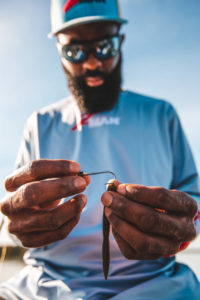
I rig the FattyZ a variety of ways depending on the job at hand but do the bulk of my damage with a snag-free method; sort of a Texas-rigged shaky head. Here, I employ the Power Finesse ShroomZ jighead.

In my mind, the FattyZ / Power Finesse ShroomZ combination is a match made in heaven. They just seem to fit together. That head features a 3/0, forged hook – not a thin wire, so common in finesse-style jigs. That’s important, because I regularly put the bait in places where a lighter hook would fail.

As I mentioned, the FattyZ has a hook slot, which comes in handy for my hooking method. Just like standard Texas rigging, I pierce the tip of the bait on my hookpoint, come back out, and thread the lure up the shank of the ShroomZ. I spin the bait around and re-insert the hook into the slot. Now I’ve got a weedless shaky head and, because of that narrow hook slot, I can easily penetrate the bait without using a bulky, wide gap hook.

I choose a 1/5- or 1/6-ounce Power Finesse ShroomZ, depending on depth and wind. The jighead rests perfectly against the FattyZ and features a wire keeper to hold the bait up. A tiny drop of superglue ensures the bait will never slide down the hookshank. Ever.

The whole package is smooth and slender, so it slides through cover easily, and doesn’t get hung up. That’s a big key – especially around boat docks and cables; places where a normal worm rig just can’t make it through. Hence the need for that stout hook: if I hook a big fish, I need to move him away from the cover quick, before he can break my line. It’s important that my hook doesn’t flex.

After a bunch of trial and error, I’ve settled on one specific tackle combo for fishing this rig: a 7’1″ Favorite Sick Stick rod, twenty-pound test braid, and a ten-pound fluoro leader. Regardless of water depth or the type of bass I’m after, I use only one color FattyZ; Green Pumpkin Blue Flake. It’s that good.

Most of my fishing throughout the Carolinas takes place on lakes with fairly clear water and little heavy cover. It’s mainly boat docks, small stick-ups and laydowns, walkways, maybe seawalls, and stumps. Here, I can pick up a weedless-rigged FattyZ and never put it down. It catches every species and size of bass.

One more tip: to catch the highest percentage of bites, employ a “pull set” with this rig. Hammering the hook home will do no good – it’s better to lean into the fish and not give it any slack. That ensures the needle-point tip of the ShroomZ gets started into the fish’s mouth – his pulling back and struggling will drive it home. Just pull into the fish, and let it fight against the rod. You’ll quickly see why the FattyZ still lays claim to my title as favorite soft plastic.

Brian Latimer
Z-Man Pro-Staff

How and Where to Catch June and July Bass at Woodruff Lake/Jones Bluff/The Alabama River

June and July Bass at Woodruff Lake
with Sam Russell

Bass fishermen know summertime fishing is tough. As the waters in our lakes gets hotter and hotter the bass get harder to catch. But summertime fishing does not have to mean dawn and twilight or night fishing only. Pick a river lake like Woodruff on the Alabama River and you can work the current and catch bass anytime it is moving.

R.E (Bob) Woodruff Lake, also known as Jones Bluff, is on the Alabama River at Prattville, near Montgomery. The dam backs water in the river up all the way to its headwaters where the Coosa and Tallapoosa join. It is a narrow river lake so any power generation at the dam quickly creates current that puts bass in a feeding mood and positions them on structure and cover the whole length of the lake.

As the uppermost of the Alabama River Lakes, Woodruff is the most river-like lake and winds its way for 80 miles and covers about 12,800 acres. There are 11 Corps of Engineers parks with various facilities like campgrounds and boat ramps as well as several other private and public facilities on the water, so the lake is readily accessible for all of its length. Last year there were over 2 million visitors to Woodruff.

There are some good largemouth in Woodruff but spotted bass will make up most of your catch. In the 2006 Bass Anglers Information Team (BAIT) report there were only seven club tournaments reported on Woodruff but the success rate was good at 69.44 percent. Although there were only two bass reported over five pounds, the average weight was 1.66 pounds, respectable for a lake with a 12 inch limit.

Sam Russell was born in Montgomery and lived all his life in Prattville. He works for the City of Prattville on a seven day on, seven day off shift so he gets lots of fishing time. His father loved bass fishing and fished some local tournaments in the 1970s as well as fishing with some local bass clubs. Sam fished with him and started club fishing, too.

After a break from bass fishing Sam started back to bass tournament fishing about ten years ago. He is currently in the Prattville Bass Anglers club and fishes some local pot and charity tournaments. Last year he fished a BFL as a co-angler and placed 12th in that tournament. He also fished the Federation trail last year and although he didn’t go to the championship tournament, he was in the top ten in point standings up to the championship.

Sam likes the river system lakes and loves to catch spots. His biggest spot from Woodruff was a six pounder that hit a topwater plug. He says he though it was a striper the way it hit and fought but when he finally saw it was a huge spot his knees got weak. He still managed to land that fish. Sam has also caught a seven pound largemouth from Woodruff.

In June and July Sam will fish points at the mouths of creeks, bluff banks with wood and rock cover and blowdown trees in the water. Those three kinds of places are all over the lake and hold fish all summer long. Although you can catch fish from all of them anytime, current will make them all better and mean you catch better quality fish.

On the points Sam will start with a topwater plug like a Zara Spook. After covering the point with it he will throw a Carolina rig or a jig head worm on it. The bluff banks are also hit with topwater then fished with a spinnerbait and a jig head worm. If those patterns fail, or if he is looking for a kicker fish, Sam will flip laydown trees and shady wood cover with a jig and pig or a big worm.

A fellow club member started the W-3 Tackle Company a few years ago and pours custom jig heads. He is one of Sam’s sponsors and Sam really likes the design of the Tip-Up jig head he makes. They are a modified mushroom head with the eye of the hook forward so the jig rolls up as you pull on it, making the trailing worm move with an action the bass love.

Sam fishes a 3/16 ounce jig head with a 5 inch Senko or a Trick worm trailer on 8 pound Fluorocarbon line with a spinning rod on points. He will throw the same jig and worm on 14 pound line on a casting outfit when fishing wood cover. The Gamakatsu and Owner hooks in the W-3 baits are sturdy enough to stand up to a lot of pressure.

A few weeks ago Sam showed me the following 11 spots to fish in June and July. We were a little early for this pattern and we hit a bluebird clear day after a storm front moved though at the end of April but we still caught about 15 keepers in a half day of fishing. All were spots and most hit on the jig head worm, with a couple hitting a Spook.

There was no current the day we fished so most of what we caught was in the one to two pound range, but bigger fish will hit on these spots with current. You can call 334-682-4896 to get the generation schedule at the dam so you can plan your trip when current is moving. Give them a try to see the pattern Sam fishes and you can find similar spots the whole length of the lake.

1. N 32 21.458 – W 86 42.154 – The mouth of House Creek is typical of the kinds of points Sam likes to fish this time of year. There is a sign showing House Creek on the downstream point and the creek mouth has a no-wake buoy in the middle of it.

Start fishing the upstream point, working a topwater lure around the small grassbed there. There is a little cypress tree on the point that is worth a cast and out from it and the grass a small flat extends out then drops off into the river channel. That makes the perfect kind of feeding area to fish.

Work into the mouth of the creek on the upstream side, fishing into the creek about 50 yards then jump across and work out to the downstream point. There are some trees in the water on the downstream side and the point has overhanging trees. Cast under them and around any wood in the water with topwater then run a spinnerbait through them. Follow that up with a jig head worm.
Before you leave jump across the mouth of the creek and work upstream, hitting the docks along this bank. Sam hooked what looked like a good keeper on this point but it pulled off his Spook. If you catch a fish keep working the area, they often stack up on these spots now.

2. N 32 21.273 – W 86 41.480 – A little ways upstream of House Creek on the same side there is a bluff bank that Sam likes. As you head upstream the channel will swing slightly to your left. Watch on your right for a broken off snag tree on the bank and start fishing there. Just past it a fallen tree has pulled its roots away from the bank, leaving a bare dirt bank. Fish that tree in the water.

Work on up this bluff and hit any wood and weeds along the edge. Fish at an angle here, casting upstream and working your bait back. Sam watches his depthfinder and swims his bait back at the depth he sees fish after hitting the bottom near the bank. The bottom drops off fast here. It is important to keep your bait moving with the current so cast upstream as you work along this bluff.

Fish past the steep gray clay bank, hitting the rocks along the edge of the water. If you catch a fish keep working this bank, there should be more along it. If the current is moving fish these places carefully. If there is no current fish faster and cover more water.

3. N 32 21.333 – W 86 40.639 – A little further upstream on the same side past the boat ramp at Holy Ground Battle Park the mouth of Cypress Creek is good. We took several spots off the downstream point, casting a jig head worm out past the log and grass on the point. There are some rocks on the bottom and a few big stumps here the spots like.

As on most of these creek mouth points the current will move baitfish across them and make them better. The current positions the bass on the point so you might have to fish around it some to locate how they relate to it. Since there was no current the day we fished the bass were not as active and we had to work the bait on the bottom on the rocks to get them to hit.

Fish into the creek a short distance then fish the upstream point, too. There is a big shallow flat in the mouth of the creek that bass sometimes run shad up on, so always keep and eye out for schooling fish and have a topwater bait ready to throw to them.

4. N 32 21.823 – W 86 40.222 – Molly Branch is on the other side of the lake and has a good sandbar that runs across the mouth of the creek from the downstream side. The sign for Molly Creek is on the downstream point. This is a real good point to work with topwater. There is also some gravel and a few scattered stumps to hold fish here, so fish it with worms, too. Sam says this is a good Carolina rig hole.

The long tapering sand point runs almost all the way across the mouth of the creek. Concentrate on it rather than the upstream point here. Probe for any irregular features in the point where it makes a little cut or dip. Those are the places the bass will hold. We caught a couple of keepers here when we fished and it should be even better now.

5. N 32 24.220 – W 86 38.115 – Going upriver the mouth of Swift Creek is on your left. The upstream point runs way out across the mouth of the creek and there is a no-wake buoy lying on its side in the mouth of the creek. There is a short no-wake zone at the mouth of the creek.

Fish the upstream point, working all around it. Fish it from the river channel side, casting up to the shallow top of the point, then fish all the way around the end and up the creek side. Cast across the point from several angles probing for anything on the bottom like rock or wood that will hold fish.

6. N 32 23.613 – W 86 36.747 – Going up river watch the left bank for a gap where the underbrush has been cleared. There are four big trees with nothing growing under them and a big dead tree on the downstream edge of this gap. That marks the start of a good bluff to fish. On the upstream end of the bluff is a double ditch entering the river and there is a big log lying on the downstream point of it.

The bluff bank is marked by a high yellow clay bank. Start fishing where the dead oak stands on the bank and fish upstream. This bank gets some shade during the day and is a good example of the kinds of bluffs Sam likes, with a steep drop, wood cover along it and some shade from shoreline trees and overhanging bushes.

Fish topwater in the shade then work a jig head worm or a spinnerbait through any wood cover. When you get to the ditch, fish the log on the point carefully as well as the drop on this downstream point. This is also the kind of bank that is good to flip a jig and pig or Zoom Ole Monster worm to wood cover, especially on bright sunny days.

7. N 32 22.544 – W 86 37.041 – Across the river, on your right going upstream there is a dock with four tall white poles. It marks the start of another good bluff bank to fish. Upstream of it is a steep yellow clay bank just past a ditch that enters the river. Start fishing upsteam of the ditch and work upstream, casting to any shade from overhanging bushes and trees in the water.

Along this bank there is usually a lot of water dripping in. This can help the fishing a little since it is cooler and has more oxygen than the lake water. Bass will move close to the bank under overhanging bushes and take advantage of the inflow. You can take advantage of them by casting under the bushes where they are holding.

8. N 32 22.014 – W 86 36.340 – Upstream on the same side is Tensaw Creek. There are ledge islands on both sides of it and the points on both sides are good. The sign marking Tensaw Creek is on the downstream point. The river channel runs in right by the mouth of the creek, offering good deep water to fish holding here.

Fish the upstream point working into the mouth of the creek. The island that makes the point has some grass on it that is worth a few casts if the water is high. Fish across the channel between the island and the bank. You will see the top of a buoy in the middle of it and there is a ledge that runs across it, dropping into the channel. Fish that drop.

The other side of the channel comes up on what looks like an old roadbed or pond dam. Fish all around it, work the tree lying in the water on the end of it and into the pocket behind it. Then jump across to the other side and work out, hitting both sides of the ditch on that side and out to the main river point.

Jump back across the mouth of the creek and fish the outside bank of the island going upstream. It drops fast and there is some wood cover along it. When you get to the upstream point fish it carefully. There are good rocks here and a big log was lying on the point when we fished it. Sam said he watched Kevin Van Dam fish this spot several times in the Bassmasters Elite Series tournament held here.

9. N 32 21.712 – W 86 35.701 – Just upstream of Tensaw Creek the river makes a bend back to the left and the outside of this bend is a good place to fish. There is a small flat running off the bank for about 20 feet then it drops straight off to 60 feet deep. Wood has washed in along this drop and flat and it holds bass.

Start fishing at the first dock you see on your right just downsteam of where the bend starts and fish up the bank, casting to the bank and working your bait across the flat to the boat. Keep your boat over the channel. Topwater works well here and a spinnerbait fished through the wood will draw strikes, too. Follow up with a Carolina rig or jig head worm.

10. N 32 22.123 – W 86 35.335 – Upstream and across the lake is Bear Creek. There is a sign for it and you will see two big standing snags in the middle of the creek. Just downstream of the creek mouth is a backout with a ridge across the mouth of it from the downstream point.

Start fishing on the point on the backout and work up it, keeping your boat out in the deeper water and casting across the point. Fish to the end of it then cut across to the downstream point of the mouth of Bear Creek. Fish it and the point across from it.

This is a complex creek mouth with several drops and some grass beds wood cover and rocks, too. All can hold fish so spend some time here checking out the different angles and drops. Fish it all before leaving.

11. N 32 20.391 – W 86 35.184 – Run up to the mouth of Tallawassee Creek on your right where the river bends back to the left. There is no sign here, you can see the pole for it on the downstream point, but there is a red striped channel marker on the back side of the point that runs off the downstream point and there are two poles marking stumps on the top of the point. There is a red river channel marker just downstream of this point, too.

As we idled up to this point in the middle of the day Sam said there had been a million bass caught here. We caught three, including one of the biggest of the day, so make that a million and three now.

This point runs way out across the mouth of the creek from the downstream side and there is wood and rock cover all along it. The channel swings right by the point and makes it a ledge coming out of the channel. Fish hold all along the point on top and along the drop.

Keep your boat out in the channel and cast up onto the point, working your jig head worm through the rocks. They are rough and you will get hung up, but you will hang up on fish, too. A topwater bait would work well here, especially early in the morning and as Carolina rig works off the end of the point. Fish it carefully since it is a big, long wide, sloping point.

These 11 spots are some of Sam’s favorites and give you an idea of the kids of places he fishes. There are many more all over the lake. Use his tips and tactics to fish them and learn how to catch fish off them then you can find others to fish.

Sam has decided to do some guiding on the Alabama River lakes like Woodruff and Miller’s Ferry. Call him at 334-301-0922 if you want him to show you first hand how he catches bass on those lakes.

How about a “contacts” box somewhere in the article – if you need more space used up:

Generation Schedule for Woodruff – 334-682-4896
Contact Sam Russell for Guide Trips – 334-301-0922
W-3 Tackle Company – 334–567-8486
Corps of Engineers Office – info and maps – 334-872-9554
Finesse Fishing for Bass

Finesse Fishing for Bass: Lighten Up for Bass

Shaw Grigsby on finesse fishing


Legendary bass pro Shaw Grigsby talks the why, how, and when of finesse bass techniques
from The Fishing Wire

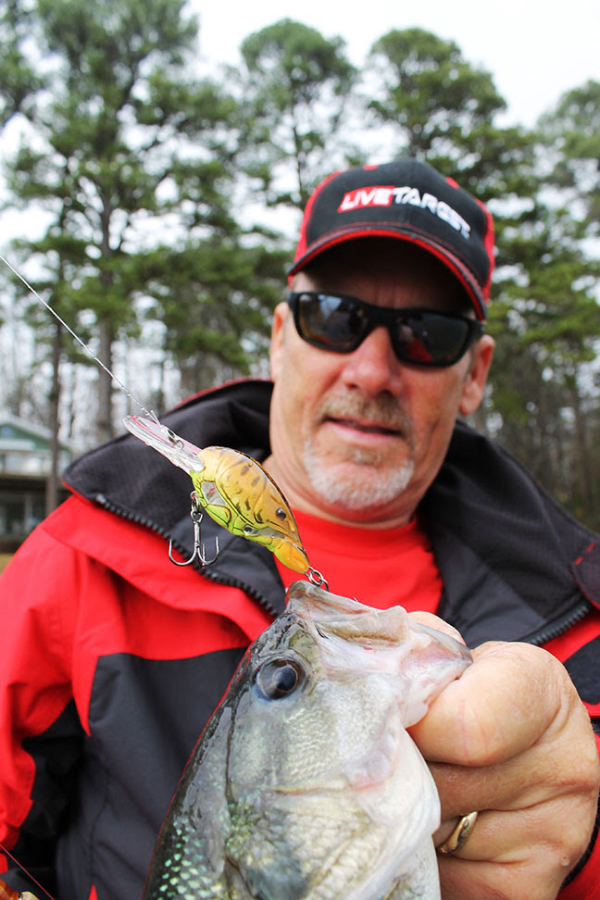
Louisville, KY – Bass fishing isn’t always easy. Weather conditions like cold fronts and high-pressure systems, as well as probing the same waters as lots of other anglers can make fishing tough. But there are ways to up your odds in these and other difficult conditions. One of the best? Finesse fishing – fishing smaller baits on lighter line with a more deliberate and slower approach.

When it comes to finesse fishing, one of the greatest finesse bass anglers on the scene – legendary bass pro and tournament angler, Shaw Grigsby – has a wealth of critical information to share that can boost your game on the waters you fish.

“One of my favorite fishing techniques is finesse fishing – smaller baits, lighter line, a lot of fish and loads of fun! Why finesse fishing? There are so many times that big baits are just too big for the fish,” Grigsby says. “Bass see them but they just don’t want them; they see the lure too well or the conditions are difficult, like cold fronts, high blue skies, clear water or a lot of people around you fishing, and you just can’t catch them. So downsizing and going finesse can be the key. Just lay your bait out there and kind of jiggle it and really, what it does is all these smaller baits make it look like what’s natural for the bass to eat in their environment.”

In terms of specific techniques, some of Grigsby’s favorite presentations are drop-shot rigs, shaky head worms, wacky worms, tubes, and the legendary Ned Rig, all of which he typically presents in natural colors like green pumpkin and watermelon red.

“And when you present these techniques to them, it appears so real and it’s so small that they don’t have an issue with it,” Grigsby continues. “A lot of times a big bait may appear too bulky – and maybe you’ll catch a giant fish using a big bait at times – but when you get clear water and difficult conditions, then it’s pretty much time to downsize and go finesse. And I’ve caught giants on finesse tactics. Finesse techniques catch as many big fish as they do small and average-size ones.”

Grigsby keeps a half dozen spinning rods rigged up with finesse presentation in his boat at all times. He’s a fan of medium-light power, fast-action Skeet Reese Signature Series spinning rods, typically in the 7’3” range, and Skeet Reese size-30 Victory Pro Wright McGill spinning reels, which he favors for their large spools.

The linchpin to the system, though, is his choice in line. He spools his with Seaguar FINESSE Fluorocarbon, a line designed specifically for finesse bass fishing applications. “It’s really delicate yet strong stuff that excels for all my finesse fishing,” he offers. “I wouldn’t think of using anything else. And compared to other 8-pound line, Seaguar’s 8.4-pound is remarkably thin, supple, and strong, it’s typically my first choice in every finesse fishing application.”

Seaguar has a host of FINESSE 100% fluorocarbon lines for every finesse-fishing situation including 5.2-pound, 6.2-pound, 7.3-pound, and 8.4-pound sizes. These are double-structure fluorocarbon lines, which is an exclusive and superior Seaguar line technology that combines two different resins into one line. The high-density interior resin improves tensile strength and sensitivity while the softer exterior resin enhances knot strength. That means great sensitivity, knot strength, and the strength to handle any big fish you hook while remaining super supple.

“When you’re dealing with spinning tackle, that’s what counts – having a nice supple line that still has the hook-setting power and the strength to hold them,” Grigsby emphasizes. “Because when you’re finesse fishing you never know when that next hookset could be an 8-, 9-, or 10-pound bass. It could be the biggest fish of your life because they’re suckers for those little baits. So that’s why I always carry specific technique rods and reels and use line designed specifically for finesse fishing.”

One of Grigsby’s favorite finesse techniques is fishing a drop-shot rig, which essentially consists of a small plastic bait suspended above a short length of line terminated at the bottom with a weight. “With the drop-shot, you can literally float your baits above bottom and really catch ‘em,” he says. “For most of my drop-shot set-ups I’m using Seaguar 7.3- or 8.4-pound 100% FINESSE Fluorocarbon, which holds up really well and the fish can’t see, whether I’m fishing in clear, open water or around a lot of cover.”

That brings up another point Grigsby is adamant about, and that’s not limiting finesse fishing tactics to clear waters. “You might find flooded areas with a lot of cover where the instinct is to pound with a jig, but finesse tactics – even in heavy cover – can really produce,” Grigsby advises. “Don’t overlook finesse even though you’ve got a lot of cover. It’s simple – hook ‘em, play ‘em, and get them out. Always concentrate on getting the strike, don’t worry about landing them. Landing them generally happens.”

Grigsby is a big fan of fishing wacky worm rigs in heavy cover, typically a 5-inch Strike King Ocho on a Trokar hook with weed guard on Seaguar 7.3- or 8.4-pound 100% FINESSE Fluorocarbon line. “When you throw something really light like a wacky worm into heavy cover on a finesse rig, it can really produce. A lot of times you can catch ‘em when other methods fail to produce.”

Lastly, Grigsby also carries a rod or two in his boat for Ned Rig fishing, a finesse technique that has earned an almost magical reputation across the country.

“The Ned Rig has really come along to be one of the main finesse baits to just catch ‘em,” says Grigsby. “It’s awesome. I got introduced to it about three or four years ago with its flat head – like you took an Aspirin and put a hook in it – and using something like an Ocho worm that you cut in half. I didn’t have any of the right jigheads so I just took the Ochos I had, cut them in half, and started fishing them on a regular 3/16-oz. shaky head and just caught the fire out of the fish!” he recalls. “But once you get a Ned jighead and it stands up so perfectly it works even better. Something I found out that’s really interesting is that when you discover the bass are eating this little bait, a Ned worm also works wonders on a Trokar nose hook fished as a drop shot. I started fishing it on a drop shot and the fish I caught was ridiculous. So, I now combine the two techniques quite a bit.”

No matter where you fish bass, going finesse can definitely up your odds for more and bigger fish when the going gets tough. Take a few tips from legendary bass pro and finesse expert, Shaw Grigsby, and we promise you’ll put more bass in the boat, too.

For more information, call 502-883-6097, write Kureha America Inc., 4709 Allmond Ave., Suite 4C, Louisville, KY 40209, or visit us on the Web at www.seaguar.com or on Facebook.

About Seaguar Fishing Lines

As the inventor of fluorocarbon fishing lines in 1971, Seaguar has played a prominent role in the advancement of technologies to improve the performance of lines and leader material for both fresh and salt water anglers. Seaguar is the only manufacturer of fluorocarbon fishing lines that produces its own resins and controls the manufacturing process from start to finished product. Today, Seaguar is the #1 brand of fluorocarbon lines and offers a full spectrum of premium products including fluorocarbon mainlines and leader material, fly tippet and leaders, 8-strand and 16-strand braid and monofilament fishing lines.

How and Where To Catch Seminole Bass In November

Seminole Bass In November with Steven Wells

All summer long the hydrilla beds at Seminole have been full of bass, but often the weeds are so thick you can’t fish it very effectively. In November the hydrilla begins to die back and open up, giving you access to those bass. And the cooler temperatures mean they feed even better.

Seminole is a one-of-a-kind lake in Georgia with its huge grass flats and stumpy water. So far south the dam is in Florida, it is like a Florida lake in many ways. The bass grow fat and spawn early in its warm waters. And every bit of the lake looks bassy, like you should be able to cast anywhere and hook a hog.

Unfortunately for the bass fisherman used to other lakes, looking good and being good are not always the same thing. The sheer size of the grass flats often make it difficult to locate bass unless you have an idea what they are doing and where to start. The bass are in the grass but you still have to find patterns within the grass to catch them.

Seminole is right in the corner of Georgia, Alabama and Florida on the Chattahoochee and Flint Rivers. It covers 37,500 acres and has been famous for its bass fishing for many years. Jack Wingate and his Lunker Lodge are one of the reasons for that fame and many happy bass fishermen have passed through his restaurant and dock over the years.

Steven Wells grew up right on the lake in Faceville, and is kin to Jack. He loves to fish and was on the lake so much Jack talked him into guiding there. Jack told him “As much as you like to fish you might as well let somebody else pay for your gas.” Steven also manages Outland Plantation, a hunting preserve near the lake, so he gets to spend all his time outside studying nature.

His time fishing paid off in another way this year when he married Pam Martin, a top angler on the Women’s Bass Fishing Association professional trail. She guides on Seminole out of Wingates with Steven when she is not off on the national tournament trail. She and Steven share patterns, tips and fishing spots and help each other out on the lake.

“If you are not fishing the hydrilla you are not fishing where the bass live, they get in the hydrilla,” Steven told me. We were fishing on a hot early October day and he was showing me patterns and places that would be good in November when the water cooled down a little.

In November you should start with topwater, then switch to spinnerbaits and lizards as the sun gets up,” Steven told me. He likes to fish a topwater bait around the hydrilla early in the morning, varying his bait according to the wind. If it is dead calm he throws a Mirror Lure topwater bait but if there is some ripple he switches to a Pop-R.

“Throw the plug within inches of the grass mat,” Steven said. You have to get it close to the edge, especially early in November when the grass is still thick. Work it slowly in place, keeping it as close as possible to the grass while making it act like a hurt baitfish. The longer you can keep it close to the grass the better your chances of getting bit.

Steven chooses a silver plug and throws it using 12 pound Stren line. The lighter line helps the bait work better and will still bet most fish out of the grass if they head back into it after you hook them. You can also make longer casts which are needed if the water is real clear.

Later in the month when the grass mat on top is breaking up, Steven will throw a buzz bait since it can be worked better. He likes a white one and ties it on 14 to 17 pound Stren line. If the grass is thick under the water he uses the heavier line to horse big bass out of the cover. The lighter line allows longer casts.

As the sun gets up Steven will switch to a spinnerbait and work it through openings and channels in the grass. Some of his favorite places will have clumps of grass out from the main mat even early in November and he tries to run it right beside those clumps, too.

Steven always chooses willowleaf blades since they come through the grass better and he varies the color depending on the water color. White with silver blades is better in clear water and gold blades and chartreuse skirts are best in stained water. The spinnerbait is fished on 14 to 17 pound Stren like the buzzbaits and for the same reasons.

“Bring two packs of watermelon seed lizards and leave everything else at home and you won’t go too far wrong,” Steven said. His go-to bait and what he uses most of the day is a Texas rigged Zoom watermelon seed lizard. He uses a 1/8th ounce lead unless the current or wind forces him to go heavier since the slower fall seems more attractive to Seminole bass.

Tie your lizard on 12 or 14 pound Stren since you will be fishing right in the grass. If the water is heavily stained Steven will go to Junebug lizards and sometimes he dies the tails of both colors chartreuse. Lizard fishing is slow so he likes to start with topwater and spinnerbaits, but the lizard will produce all day long.

“Cast the lizard right on top of the hydrilla and slide it to the edge, letting it fall when it hits open water,” Steven said. You must watch your line carefully since bass hitting on the fall often don’t give much indication they have taken the bait. If you see your line tick or move at all, set the hook hard to pull them away from the grass.

Steven shared 8 of his favorite November spots with me and they will all produce fish this month. They are just a few of the hundreds of similar places but there are key things to look for. Most of these are within a few miles of Wingates and Steven says some of the best fishing on the lake is a couple of hundred yards either side of the channel going in there.

1. N 30 47.355 W 84 43.050 – Upriver from Wingates at channel markers 13.8 through 13.3 the Flint River makes a sweeping turn across the lake. Along the downstream edge of the channel the water is shallow and hydrilla grows in a thick mat all along it. People use a cut-through behind a small island to run down to Wingates so sometimes there is a channel in the grass there.

Start at the first red channel marker just downstream of the grass island and work the edge of the hydrilla all the way past the turn back up river to the third red marker. The grass drops off deep here so you must cast topwater baits right to the edge of it. Concentrate on any cuts or holes in the edge and try to work your topwater bait in it as long as possible.

After the sun gets up switch to a lizard. You may need a 3/16 or even a 1/4 ounce lead here if there is any current since you want the lizard to drop straight down the side of the grass. The bass will hold all along the vertical face of the grass and suck in food, and your lizard, as it falls.

Cast your lizard up on top of the grass and pull it off. That insures it is as close to the wall of grass as possible. Watch your line carefully. When it stops falling, make sure it is not a fish then twitch it to make if fall on down. If it is on the bottom twitch it a couple of more times then reel in for another cast.

If you start here early, it is worth a pass with topwater then another pass with the lizard, especially if you catch a few fish on the first pass. The fish may be scattered the whole length of the bed or concentrated in one place, so pay attention to where you get bites.

2. N 30 46.736 W 84 44.381 – Just upstream of the Wingate cut there is a rockpile out on the old river channel where the ferry used to cross. You can see the old road bed on most maps. The grass bed along this edge is another good place to fish. The fish hold in the grass and also hold on the rocks and move into the grass to feed.

Fish the outside edge of the grass here. There is a wide band of grass and there is some open water behind it, but the best fishing in November is usually on the outside edge. Work it with topwater first then come back with a lizard. The water is not as deep on the outside edge of the grass here and a light sinker is usually best.

3. N 30 46.397 W 84 45.351 – The poles marking the Wingate cut have grass around them out where they get to the river channel and this can be an excellent place to fish. If you start upstream of the marker poles you should work the outside edge of the grass. Below the cut there is a bed of grass on a ridge and it has water 9 feet deep on the back side of it. This is a good place to work both sides of the bed.

The outside edge has clumps of grass growing out from the main bed and a spinnerbait or buzz bait is good in that area. The inside edge drops to 9 feet and a lizard falling down that drop is an excellent way to get a bass to bite. You can fish down the outside edge then cut through and fish the inside edge going the other way to cover both sides. If you catch a fish, concentrate on that area since there should be others nearby.

4. N 30 46.143 W 84 45.710 – Further downstream out from a couple of docks and pontoon boats on the bank the grass bed continues in closer to the bank. The river channel is a long way away here and the big flat has some grass on it, but as you get closer to the bank you will find a thick ridge of hydrilla. There is standing timber out toward the channel but it will be well behind you when you are fishing the outside edge of the grass.

On the outside edge clumps grow up well out from the mat. This is a good area for spinnerbaits and buzzbaits. The inside edge has enough water to be worth fishing and the lizard should be better here. Work all around the ridges of grass and fish both sides. Again, if you catch a fish work that area carefully since there should be others nearby.

5. N 30 45.943 W 64 46.122 – Straight downstream from areas #4 you will see a red channel marker where the channel swings back across the lake. Where it turns and runs down the bank is another good ridge of grass to fish. It is right along the channel and drops off fast. Fish the outside edge of it, keeping your boat in the channel and casting to the edge of the hydrilla.

6. N 30 46.036 W 84 48.063 – The Tractor bank is a well known local fishing spot. It is called that because the DNR used to keep a tractor there to use in the management area. You can follow the channel downstream then cut across to the north bank just downstream of a tall dead tree standing in the water. Be careful, there are a lot of stumps in this area and you need to find the clear area before running it if you don’t know it.

You will see a point of land with a cove on the upstream side. In the mouth of the cove is a small grass island and you will see a yellow sign on a pole out in the water upstream of it. There are big grass beds all along this bank. Start fishing near the management area sign and work down the bank. You can fish all along here, concentrating on areas where you catch fish.

Watch here for scattered clumps of grass out from the main bed and fish them with spinnerbait, buzzbait and lizard. It often pays off to drop a lizard down beside one of these clumps after running a buzz bait or spinnerbait through the area to catch a bass that is attracted by the faster bait but will not hit it.

There are also scattered stumps near the bank here so watch for them and cast to them. You also need to keep your boat out in 10 feet of water or more when running this bank because of the stumps in closer to the bank.

7. N 30 45.550 W 84 47.903 – Back across the lake at red channel marker 7.3 a ridge runs out from the bank and hydrilla grows on it. Fish both sides of this grass bed. It runs down to channel marker 6.9 and there are several sand bars in the area.

This is a spawning area for bass and most of these grass beds are good in November because they are near spawning areas. At Seminole bass are often moving near spawning beds to hold until the water warms, which can happen in January here. When looking for similar places to fish keep in mind that you should look for fish near spawning areas.

8. N 30 44.134 W 84 51.837 – Down near the dam where the bank turns south, a huge area of grass runs all the way from the swimming area at Chattahoochee Municipal Park down to the Coast Guard station at the dam. There is an old road bed running parallel to the bank and some real shallow places on it are marked by danger poles. Grass grows all along the ridge the roadbed is on and also behind it.

You could easily fish this area all day. Work both the inside and outside areas of grass. This is a big spawning area full of sandbars so fish will be positioning themselves here in November. Concentrate on areas where you catch a fish and look for keys. Is the bottom a little deeper, are there cuts in the grass or is it a solid mat? All those keys can point to concentrations of bass in similar areas.

Seminole is a great place for a November trip. It will be much warmer and the bass more cooperative than in more northern lakes if we have a cold month. And just fishing legendary Seminole is a thrill. Check out these patterns and spots and you will be able to find many more like them.

Finesse Fish for Bass

Finesse Fish Your Way to Bassing Success
By Frank Sargeant, Editor
from The Fishing Wire

Finesse Jig catch fish


Elephants eat peanuts, one of my fishing guide buddies likes to say.

That was right on target for two major national tournaments in the last month, as both a B.A.S.S. Elite event and the Major League Fishing Redcrest championship were won by anglers relying heavily on tiny jigs that would appear better suited for crappies or bluegills than bass.

And while elephants also eat hay bales, a switch to finesse-sized lures and tackle can bring a change in luck for Alabama anglers, particularly in the dregs of summer when hot water and months of fishing pressure have slowed the bite to a trickle on many days.

At the St. Lawrence River B.A.S.S. event, winning angler Micah Frazier relied on Z-Man ShroomZ jig heads, tipped with little 2.5 inch YUM Ned Dinger tails that look like a leftover section of the head of a conventional plastic worm. While smallmouths in the clear waters of the St. Lawrence are a long way from largemouths in the murky waters of the South, the lures and tactics work here as well as there.

These jig heads come in a wide variety of sizes, but the ones that won at the St. Lawrence were not what most anglers would think of a “bass-sized”. They weighed just 1/8 ounce, with hooks about size 4. Compare that to the typical jig used for largemouths, with a 1/2 ounce head and a size 5/0 hook, and you get a better understanding of the difference between finesse fishing and standard bass gear.

The ShroomZ heads are made to sit on bottom with the head down, the hook standing up vertically, particularly when rigged with the high-flotation ElaZtech soft plastics. (The whole system is based in part on the Ned rig, devised not by Ned Flanders of The Simpsons but by Ned Kehde of Missouri, who devised the set up, pushed into Z-Man production by Missouri angler Drew Reese.) The look and action is so different from most other bottom-hugging lures that it seems to have an almost magical appeal to bass.

The finesse package includes a whole suite of gear; it’s not just about the lures, though they are key. The little lures might work on conventional bass tackle if you could cast them, but you can’t–a 1/8 ounce lure simply won’t throw on a baitcaster. In fact, it doesn’t cast very well on a full-sized spinning rig with the typical 10 pound test mono many anglers use, either.

The set up that most pro anglers now use is a spinning reel with the spool filled with 10-pound-test braid, running to at least a rod’s length of 6- to 8-pound-test clear mono. This gives them the sensitivity of the braid, but the clear mono is nearly invisible to the fish and also lets the tiny lures work naturally.

The lure may imitate a hellgrammite or a crawfish, or perhaps a small baitfish feeding head down. Whatever it represents to bass, they consider it edible, often when they ignore everything else you throw at them. (Part of it may just be that it’s so different from the hundreds of lures they’ve been seeing all summer–bass definitely get conditioned to avoid lures they’ve been stuck with.) It may just be the potato chip syndrome–while you may only be hungry enough for a steak at dinnertime, you’re likely to eat a chip most anytime someone offers one. Ditto bass.

Bites tend to be light–just a tap on the line sometimes, or unexpected slack or tightening. Hard strikes are rare.

Setting the hook is a bit different with the finesse gear, too–the sharp over-the-head snap that many anglers use for conventional tackle will result in a lot of breakoffs but few hookups. Best way to set the small but very sharp hooks is simply to raise the rod until you feel tension and then start reeling. Most of the time, the hook sets itself.

Anglers used to water-skiing their bass to the boat on heavier tackle may have to re-educate themselves a bit, too–with the ultra-light gear and 6-pound mono leader, even a 2 pounder can present an interesting challenge. But in the open water where the tactic works best, it’s just a matter of keeping the pressure on and pumping and reeling–eventually the fish gives in. (Of course you can’t jerk them into the boat on the light line, either, if they weigh over a pound or so–the lip lock is necessary.)

Finesse fishing is a particularly good tactic when you’re after lots of fish rather than a few giants—that’s why the guys in the MLF circuit like them so much. The made-for-TV competition is all about putting numbers of fish in the boat, not size. But finesse lures are also great for the weekend angler who’s got the kids or grandkids out for the day and wants to make sure they put something in the boat—the little lures will often outfish larger baits by a wide margin.

Frustration with My Minn Kota Ulterra

In April, I decided to celebrate finishing chemo and radiation by buying a new trolling motor. I have wanted the Minn Kota Ulterra for several years. My old one worked fine but was a little hard to turn, and my old back did not like pulling it in by the cord.

The Ulterra self-stows and self deploys. You tap a button on the foot pedal twice and it goes into the water. Tap it once and it comes back in. And it has spot lock, a feature that allows you to tap another button and the motor will keep you within a few feet of the spot where you tapped it.

It also comes with a Bluetooth remote to control the motor. You can sit in the back of the boat and use the trolling motor. A commercial for it shows a man by himself backing his boat in the water and letting it float off. After parking, he goes to the dock, has the remote deploy the motor and drive it to him on the dock. Very convenient.

Striper and hybrid guides especially like this feature. In their center console boat they can stay in the middle of the boat, within easy reach of all the rods out, and control the movement of the boat.

I got the motor, had it installed and took it to

Jackson Lake to test it. The foot pedal was very different, but I thought I would get used to it. I loved the self-stow and spot lock just from playing with them.

The motor worked fine the next weekend in a tournament, but the foot pedal was very frustrating.
For 45 years I have used a cable drive trolling motor. Guiding the boat did not require any thought. It was an automatic act for years, just like driving a car.

The new pedal uses a motor to turn the trolling motor. That is nice in some ways, but the pedal has no “feel” like the old one. I constantly turned the boat in the wrong direction and had to look at it all the time to control it, distracting from my fishing concentration. And the buttons were placed badly, it was way too easy to hit the stow button when trying to turn the motor with my heel.

I started to hate it on that trip and my feelings about it got worse.

The next weekend in a tournament, the spot lock feature and remote would not work. When I got home, I sent an online message to Minn Kota support and they told me to take it to Riverdale Marine, an Authorized Service Center. I did, and the control head was replaced.

Everything worked great for eight trips, and
I was starting to get used to the foot pedal. Then, in the Potato Creek Logan Martin tournament, at my first stop Saturday morning, the motor would not deploy. I sat there not fishing, fooling with the motor, for 30 minutes, missing the best fishing of the day because of the motor.

Then, it finally deployed and I was able to fish for a few hours. But the motor acted crazy, trying to stow when I was not touching the foot pedal or remote and doing other things it was not supposed to do, all on its own. I managed to catch two fish under those frustrating conditions.

Sunday morning in the tournament it worked fine for a couple of hours and I caught three keepers. When I decided to move, the motor would not stow. I was stuck in the down position and I was about four miles from the weigh-in site.

I started idling back to the ramp with my three fish, messing with the foot pedal buttons and remote. It finally stowed, and I ran to the ramp area and fished the last few hours with a crazy motor, doing weird things, but I managed to catch one more keeper.

When I got home I had it taken off my boat, fearing to try to use it again. I sent another message to Minn Kota support on their web form and got no response for three days. I started posting my message to them on social media.

That got attention and I received a call from Minn Kota. I explained all the problems and that I did not trust the motor, even if it was repaired and did not want to use it again, even though I really needed a self-stow motor for my back.

The representative offered to swap the Ulterra for an Ultrex, a non-self-stow motor that cost about $450 less – but with no refund of the difference in cost, not to mention sales tax, shipping and irritation.

The next day I called him back and left a message, asking them to swap the lemon motor I bought for a new one of the same model and cost, since I really needed the self stow. Several people said they had the Ulterra and had no trouble with it, so I thought maybe I had just gotten a lemon, and was willing to try again.

So far, no response.

I am looking at all options. There are a lot of other brands out there.

St.Croix PS60MHF Premier Spinning Rod Review

I like this St Croix spinning rod

Like many fishermen my age, my first rod and reel was a closed face Zebco 202 with a matching rod. It was frustrating to use because the line jammed inside it so much.

When I was 16 I got a new-fangled Mitchell 300 spinning reel with a Garcia rod. It was a heavy outfit, and had problems all it own, but it was a big step up. I used it even after I got into a bass club in 1974, it was one of my two rods and reels back then .

Over the years I replaced it with better spinning rods and reels. But I almost stopped using spinning equipment years ago when I got baitcasting outfits that would handle light baits.

For the past couple of years I have been using one of my old spinning outfit to skip weightless Senkos under docks, but the old rods just were not right. I like a short rod for skipping baits and these were less than six feet long, but the action was too light to wrestle bass past dock posts.

A few weeks ago I got a St.Croix PS60MHF Premier six foot medium heavy fast action spinning rod. It is just what I wanted. The fast action tip skips a light bait easily, but the medium heavy weight gives me the control I need to keep bass from hanging me up.

To clarify some terms:

Rod length is pretty obvious. But the other terms can be confusing.

Rod action is how fast a rod bends from the tip. A fast action rod has a light tip that bends easily. A medium action bends less, and a heavy action bends little. Lighter actions are best for lighter baits. For heavier baits, heavier action is needed.

Rod weight is how stiff the rod is. A light weight rod is usually lighter in heaviness, but mainly it bends a lot, often from the tip to the butt, in a parabolic arch. A heavy weight rod will bend little even at the tip. Again, a lighter weight rod is better for lighter baits but the heavier the weight is, the more “backbone” you have to control the fish.

The six foot length is short compared to the seven foot rods many use, but I like shorter rods for skipping. They have a little less leverage, but many of my cast are sidearm with rod tip point toward the water, and the shorter length helps me avoid hitting the boat and the water on my casts.

I have used this rod in several tournaments and caught enough fish on it to know it is just what I wanted. It helped me catch fish at Sinclair and place 4th in the Flint River Bass Club tournament.

The Premier Family of rods come in both spinning and casting, with various lengths, actions and weights to meet most needs, and sell for about $140.00

Disclaimer – I got a discount when I bought this rod. But no discount is big enough to make me say something good about a product I don’t use or like, and I would never reccomend something I do not use with success to anyone else.

Trying To Catch Bass at Clarks Hill

August 10 and 11th, nine members and guests of the Flint River Bass Club fish a miserably hot two-day tournament at Clarks Hill. At least the fishing was tough. In 18 hours of casting we landed 41 12-inch keeper bass weighing about 65 pounds.

There were three limits and one fisherman didn’t catch a keeper in two days. But there were some good fish, five weighed more than three pounds each.

Raymond English, fishing as Niles Murray’ guest, won with ten weighing 17.11 pounds. Niles placed second with nine keepers weighing 14.51 pounds, Travis Weatherly was third with seven at 10.24 pounds and Chuck Croft came in fourth with six weighing 6.66 pounds. Jerry Ragen had big fish with a 4.39 pound largemouth.

I thought I had found some fish on deep rock piles and caught two Saturday, including one close to three pounds, and lost another one that felt as big as the three pounder. But that was it, two fish all day. And Sunday I missed one bite and had another good fish pull off the dropshot worm. No fish for me after eight hot hours of trying Sunday.