| Tips from Tony Roach from The Fishing Wire Nearly fifty years after the inception of the modern live-bait rig—what’s today known simply as the ‘Roach Rig’—its sheer effectiveness still raises eyebrows and turns heads. Take a vigorously squirming minnow, nightcrawler or leech, and couple it with a hook, leader and sliding sinker and you’re fishing the deadliest walleye presentation of all time. Get a natural, lively bait to the bottom, and just start creeping your way along fruitful structure. Sooner or later, a walleye is going to eat. It’s just that simple. Well, sort of. During the same fifty years, a number of nice little developments have transformed a serviceable bait delivery vehicle into a precision live-bait system. The walking sinker evolved into the Quick-Change Roach Sinker. The bottom bouncer transmogrified into the Northland Slip Bouncer. Live bait care tools, like those by Frabill, now ensure a healthy supply of critters. All the while, hooks, lines, and electronics have advanced almost beyond comprehension. Which is where “power rigging” enters the equation. It’s old school rigging (light and easy) meets heavy metal bottom bouncing (head-banging fast), plus a dash of new wave tackle and tactics. Developed by ace guide Tony Roach, this hybrid live bait system is indeed, as he calls it, “Roach rigging on steroids.” “Power rigging lets me maintain a natural live bait presentation, while triggering fish with a bit more speed,” states Roach. “Sort of like rip jigging, the presentation induces a reactionary response, while the live bait closes the deal. Early in the season, you’re moving slow with rigs and jigs, presenting bait to fish on a definite ‘feeding bite’; show ‘em a tempting morsel, keep it in front of their snouts, and they’re going to eat. Later on, as water warms, and the food supply expands, walleyes can turn a little tricky—a slight boost in speed is often all it takes to get fish to go. “What I really like about the power program is that I can work quickly along a lengthy edge or over a vast flat, moving .9- to 1.2-mph,” he continues. “I can still put natural bait in front of them, but I can show my wares to a lot more active fish. What I also like is that the more boats there are working a spot slowly with rigs, the better. I can cruise right along and mow down the active biters.”From a lake-wide perspective, Roach’s power spots aren’t secrets. “This approach works on nearly any classic late summer and fall walleye location. Rock points, weed edges, transition areas, mudflats—anywhere you can drag a standard walking sinker and live bait, you can power rig,” he asserts. “It’s really sort of a hybrid between slow-down rigging and dragging spinners on three-ways. I’ll start doing this pretty early in the summer—right after those initial insect hatches— and stick with it on and off through late summer into early fall. Once surface temps hit 60-degrees or so, it’s time to break out the power rigs. Then again in August and September, it really shines as water begins to cool a bit.“Those days when everyone is either creeping along with a standard rig or bottom bouncing at a good clip–especially on flat calm days–that’s when I’ll break out the power rigs. ”Roach’s power program employs a straight wire bottom bouncer, such as the Northland Slip Bouncer, coupled with a super long leader—up to 15-feet for coverless flats— tied with 8-pound test Berkley XT. At slower speeds he typically rigs a live ribbon leech, small shiner or chub on a single #6 or #4 hook. If Roach is pulling crawlers, it usually means he’s moving a bit faster, employing a dual hook harness. For added attraction, he occasionally adds a single fluorescent bead, or a single 00 flicker spinner. Often, too, especially with longer snells or near vegetation, he likes to add a Rainbow Float, 1 to 8-inches above the hook. “You can pin the float in place using a rubber Snubber Stop,” he asserts. Keeping the float well above the hook holds the entire leader off bottom, rather than just the bait itself. While the hook, float and live bait power the presentation, the Slip-Bouncer drives. Unlike the standard R-bend bottom bouncers, Slip-Bouncers are composed of a single straight wire shaft with an open eyelet on top, which lets you feed line freely to biting fish—no resistance. The 5-inch wire “feeler” transmits bottom types like a stethoscope, while a slide-on weight system yields rapid adjustments to varying depths, speeds and currents. Another advantage: tickled over soft silt, mud or sand, these needle-like weights disturb very little bottom substrate, an occurrence that often spooks walleyes. “Slip Bouncers are a gem—something every angler should add to their bag of rigging tricks,” Roach says.“Power rigging is ideal for inexperienced anglers and old pros alike. If I’ve got beginners in my boat, I can just set soft-tipped 8-1/2- foot trolling rods, like my Mr. Walleye SuperPros, in rod holders, and let them load up and set themselves. If we start missing fish, we simply hold rods and delay our hooksets. Drop the rod tip back toward a biting fish, feel for solid weight, and give a nice long sweep. Once you get things dialed in, you’ll hook every biter. It’s a pretty forgiving system. “Really, power rigging can be the answer on any given summer day. Right in the middle of a classic ‘slow-down’ rigging bite, you can really put on a clinic. But the power program shines later on, too, when everyone else is moving faster, pulling standard spinner rigs. In both cases, the system can really make you a hero on those tougher flat calm day bites. Tell you what, any method that saves my hide on tough guide days is okay in my book.” |
Five Tips for Making Fishing a Memorable Family Affair
Multispecies angler, Josh Peacock, shares what he has learned throughout the process of igniting the fishing flame in his kids
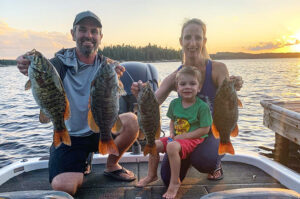
Take your family fishing
PARK FALLS, Wisc. (May 31, 2022) – Raised in Kenora, Ontario where the water from all one million acres of Lake of the Woods eventually flows into the Winnipeg River, Josh Peacock is a fisheries biologist, tournament bass angler, and a former full-time fishing guide. Like many other men his age, Josh is also a husband and a father.
Peacock comes from a long line of river rats. His four-year-old son, Brock, and two-year-old daughter, Eva, make it six generations of Peacock’s on the Winnipeg River dating back to the early 1900s. “The Winnipeg River is a special system with lots of fish, flora, fauna and an abundance of space to recreate,” says Peacock. He claims the river is in his blood. “Some days I swear I can feel it coursing through my veins. There have been days where I’ve felt such an intense connection with my surroundings that it has actually brought tears to my eyes. Not usually because of a fish, either; sometimes it’s just the way the water looks or the way the wind blows,” he states. “It can be a chance encounter with a normally secretive great blue heron that keeps following me around as we are on the same fishing pattern, or an osprey that suddenly appears overhead while I’m thinking about someone that isn’t with us anymore. Those are the connections I want my kids to have with Nature.”
Peacock says he never really thought much about how his family goes fishing together until recently. Seems his frequent family-fishing social media posts began to illicit a steady stream of messages and comments from inspired new parents, friends, and family members. “How do you get to spend so much time on the water?” they ask. “It must be nice!” they exclaim. “Got any tips for new parents wanting to get their kids out in the boat?” Peacock took pause.
“I guess I do!” was the answer he heard in his head. Peacock offers five “rules” for making the most of family-fishing fun on the water.
Rule # 1 – Start Them Young
Peacock advises parents to involve their kids in outdoors experiences as early as they are comfortable getting them out. “My parents had me in a boat at three weeks of age,” Peacock shares. “I truly believe that the gentle rock of a boat, the hum of an outboard, and the sound of water lapping against the boat not only calms newborns, but it alters their DNA in a positive way. Both our kids were born in the wintertime, but as soon as the ice melted, we made sure to get them out in their snow suits – all bundled up for their first ride on the river.”
Peacocks says he and his wife, Paula, have made the first boat ride of the year a family tradition. “Our kids have taken center stage in that tradition,” Peacock says. “We do lots of idling and sight-seeing, run the auto-chart live and make a few maps, maybe fish an hour or so tops – just to be able to say we caught our first bass of the season. These annual first rides get our kids reacquainted with wearing their sunglasses, lifejackets, sunscreen, and hats so it becomes second nature throughout the rest of the boating and fishing season. We make it fun and say things like, ‘don’t forget your fishing hat, or your special fishing glasses!’ We teach them good habits by wearing PFDs ourselves and always wearing the kill-switch tether. As you get older, you realize you are more than a role model to your kids. You are their super-heroes, and they are like sponges and parrots.”
Rule # 2 – Make it Fun, Keep it Fun
Peacock says you can’t fake true enthusiasm, and kids are excited when you’re excited. “I’m constantly astounded by what a child can pick up on,” he says. “I truly believe if you are positive, enthusiastic, and excited. They will be to. I love to go fishing and I love to catch fish, so my kids love those things, too.”
Peacock says keeping things fun starts with making sure kids are comfortable. “Pick a fair-weather day. Light winds, no rain, and sunshine but not heatstroke weather,” he offers. “Make sure they are dressed for the conditions and pack plenty of snacks. Not the ‘Tournament Lunch’ like a bag of trail mix and a Gatorade; I’m talking the whole nine yards. My wife, Paula, is the snack master. Kids love snacks, so spoil them a bit. Have them associate fishing with fun things, not just fishing, and certainly not just sitting there bored while mom or dad fish. A picnic in the boat with the Power-Poles down, or a nice shore lunch or beach spot to break up the day is always a good idea.”
When fishing, Peacock says to pick quantity over quality. “You and I would love to spend all day flipping for largemouth and getting six bites in eight hours for 20 pounds, but kids not so much,” Peacock advises. “Think action! Live bait and slip bobber setups are great for catching almost anything. A couple dozen live minnows are your best investment in making sure your kids have an unforgettable day. When fishing is slow kids, love to play with them, too.” Peacock extends the fun by setting a minnow trap and checking it regularly with his son. “Whether we catch eight minnows or five dozen, he loves it. We get some fresh air and exercise and extend our lessons about nature.”
Rule # 3 – Temper Your Expectations
Peacock says not to stay out too long and advises on planning for what happens when kids start to get restless. “We often bring two vehicles to the launch. I usually launch the boat ahead of time and have everything ready to go,” he says. “If your trip needs to be cut short for whatever reason – inclement weather, forgot diapers, maybe your ‘threenager’ is having a meltdown, etc. – one parent can cut bait while the other can deal with kid # 2, loading the boat, or maybe stay out on the water for a couple of extra hours to catch supper! Anytime on the water is better than none at all.”
He also says you shouldn’t expect to be fishing nonstop yourself. “You can fish on your own time. Focus your attention on helping your kids be successful,” he offers. “You will have successes and you will have failures, but if you remain focused on your kids, they’re going to have a good time, and that’s the win, not how many fish you catch.”
Rule # 4 – Have the Right Gear
“For early spring, we all wear our snowmachine or ice-fishing suits, neck warmers, toques, long underwear, winter boots, gauntlet mitts – the whole nine yards,” Peacock says. “Bring heavy blankets, too. Our kids have always slept really well under the consoles of my Skeeter. We make them comfy beds with blankets, or a ‘fort’ as Brock likes to call it. We also bring a stretchy sunshade that drapes over the console. Some days it feels like we are moving out of the house as I struggle to find another boat compartment to put more snacks or clothes into, but it pays to be prepared.”
Peacock says Brock’s rod of choice is a super-hero-themed spincast combo, but he is starting to become more interested in his dad’s full-sized St. Croix rods, so he keeps a couple of them – Avid and Triumph models – outfitted with spincast reels he helps Brock use whenever he asks. He also bought and stocked a matching tackle box for Brock. “Making sure kids have their own gear goes a long way in giving them ownership of what’s going on, makes them more excited, and begins to teach them lessons about taking care of your equipment,” Peacock says. “Buy your kids a small net with a long handle and invest in a couple of minnow scoops, too. Even if your kid isn’t catching they will love netting the fish and helping out. It also doubles as a sweet bug or frog net!”
If your kids are a bit older or your family in general is new to fishing, Peacock recommends simple 6’0 – 6’6 medium-light, fast action rods, like those available in St. Croix’s Triumph, Avid, and Premier series. “This rod length, power and action combination is one of my favorites of all-time,” Peacock says. “It’s such a perfect and forgiving rod for jigging live bait, slip bobbers, or casting for bass and pike. And if you happen to stumble onto a large pike or a musky this rod will pass the test. Spool up with some inexpensive eight-pound monofilament line and you are in business.” Peacock adds that while these rods are all very durable, he says it’s nice to have St. Croix’s warranty and customer service to fall back on if any accidents happen. “St. Croix truly has a rod for everyone in the family at every price point. Their quality, craftsmanship and warranty set them apart from the rest.”
Rule # 5 – Make Memories
Peacock advises any parent going down the path of introducing their kids to fishing to simply enjoy whatever stage they are at. “Enjoy the journey,” he says. “If you start thinking there’s a concrete destination and are in a rush to get there you’re going to miss a lot. Celebrate every fish and every outing with your kids. More than once on the drive home from the lake, when the truck is all quiet, I’ve heard an innocent and grateful voice in the back seat say, ‘dad, that was a really fun day.’ Or at bedtime when instead of reading a story book he wants me to recount our day on the water and talk about all of the super fun things we did and experienced.
“That’s why the Peacock’s go fishing.”
Why Does Virginia Says NO to Alabama Bass
| From Virginia Department of Game and Inland Fisheries from The Fishing Wire |
What are Alabama Bass?
Alabama Bass (Micropetrus henshallii) are one of approximately twelve species of black bass. They are an aggressive species that outcompetes Largemouth Bass and readily hybridizes with Smallmouth and Spotted Bass. Alabama Bass are nearly identical in appearance to Spotted Bass, and were formerly known as the Alabama subspecies of the Spotted Bass. The other former subspecies of Spotted Bass, the Kentucky Spotted Bass, is found throughout Virginia and is native to the southwest portion of the Commonwealth.
The jaw of Alabama Bass lines up with the middle rear of the eye, while Largemouth Bass jaws extend past the eye. Alabama Bass have a dark, blotchy lateral band from head to tail, and have spots below this band. Largemouth Bass have a more continuous lateral band. Alabama Bass also typically have a tooth patch on their tongue, which is rare in Largemouth Bass. Alabama and Spotted Bass are differentiated by differences in lateral line scale counts or genetic analysis.
Where are Alabama Bass found?
Alabama Bass are native to Georgia and Alabama, occurring primarily in large river systems and large impoundments. Alabama Bass are confirmed to be present in Lake Gaston, Claytor Lake, Philpott Lake, and Martinsville Reservoir. They are suspected to be present in Diascund Reservoir and possibly other lakes. The Department of Game and Inland Fisheries (DGIF) is conducting genetic testing to better identify the extent of Alabama Bass throughout Virginia.
Why are Alabama Bass a concern in Virginia?
Alabama Bass represent a tremendous threat to Largemouth and Smallmouth Bass fisheries. Largemouth and Smallmouth Bass are Virginia’s most popular angling targets, with more than 60% of anglers targeting either species over the course of a fishing season. Largemouth and Smallmouth Bass fisheries in Virginia are valued in the millions of dollars. Declines in either population will result in not only the loss of sportfishing opportunities, but in economic harm to the region.
As an invasive species, Alabama Bass are capable of outcompeting Largemouth Bass, causing declines in abundance. For example, in Lake Norman, North Carolina, the relative abundance of Largemouth Bass decreased to less than 8% of their former abundance following the introduction of Alabama Bass. Declines in Largemouth abundance seem to be most pronounced in lakes that are relatively clear and which have limited vegetation. Systems in Virginia such as Smith Mountain Lake, Lake Anna, South Holston Reservoir, and Lake Moomaw are likely to see declines of Largemouth Bass populations if Alabama Bass are introduced into those waterbodies.
Alabama Bass also can hybridize with Smallmouth or Spotted Bass, often resulting in loss of the genetically pure Smallmouth Bass population. This occurred in Chatuge Reservoir, Georgia and North Carolina, and Nottely Reservoir, Georgia. Smallmouth Bass populations in lakes such as Smith Mountain and Moomaw, as well as in rivers such as the James and Shenandoah, might undergo a similar fate following introduction of Alabama Bass.
Although large Alabama Bass may appear for a few years following introduction, this situation is short lived and occurs primarily when population densities are low. Once established, Alabama Bass populations often increase to the point where stunting occurs, resulting in greater abundance of smaller bass. Fisheries are likely to shift from being dominated by 2–3 lb Largemouth or Smallmouth Bass to being dominated by 1 lb Alabama Bass.
What can you do?
Anglers are the primary vector for the spread of Alabama Bass in Virginia. Current populations are the results of angler introductions that have occurred over the last ten years.
Anglers are reminded that it is illegal to stock fish into a public body of water without an authorization from the DGIF. Anyone with knowledge of intentional stockings of Alabama or Spotted Bass should contact DGIF law enforcement at 800-237-5712 or WildCrime@dgif.virginia.gov.
Anglers who suspect they have captured an Alabama Bass should take a picture of the fish, clip off a thumbnail-sized portion of one of the pelvic fins, and store the fin clip dry in an envelope. The pelvic fins are located on the bottom of the fish, just under the head. They should then either contact the DGIF at fisheries@dgif.virginia.gov or at 804-367-1293.
Flint River Bass Club Fishing At Lake Oconee In 2017
Two weeks ago 13 Flint River Bass club members and one youth fished our June tournament at Lake Oconee. We landed 23 keeper bass longer than the 14-inch minimum size that weighed about 41 pounds. There was one limit and two members did not catch a keeper.
Niles Murray wore us all out with a limit weighing 12.49 pounds and had big fish with a 3.99 pound largemouth. My three at 5.34 pounds was second, Wes Delay placed third with two weighing 4.53 pounds and Don Gober was fourth with two at 4.34 pounds.
Harrison Edge, fishing with dad Ryan, won the youth division with two keepers weighing 2.22 pounds. We allow youth to fish all our club tournaments with no entry fee and they compete only with other youth. Any youth catching fish win a prize package rather than cash.
Last Saturday 16 member of the Potato Creek Bassmasters fished our June tournament at Oconee. We landed 26 keeper bass weighing about 49 pounds. There was one limit and four members zeroed.
Ryan Edge won with five weighing 9.27 pounds. Donnie Willis placed second with four at 7.97 pounds and Jack Ridgeway came in third with four at 7.07 pounds. William Scott placed fourth with three weighing 7.13 pounds and had big fish with a 3.60 pound largemouth, and my two weighing 3.5 pounds was good for fifth.
Last Tuesday I went back to Oconee with Brad Stalnaker, a local tournament fisherman that knows the lake well. We fished nine hours in the rain getting information for the August Georgia Outdoor News Map of the Month article.
The day was perfect for throwing a buzzbait on shallow grassbeds and seawalls, Brad’s favorite way to fish in the summer. We landed about six keepers and Brad had one that weighed about 3.5 pounds. Even with the good conditions, fishing was tough. I landed one keeper. I am seeing a disturbing downhill pattern on Oconee for me, and the Sportsman Club is fishing it today.
In the first tournament, I landed 11 bass under the 14-inch minimum size limit and just three keepers. In the second one I had a dozen short fish and only two keepers. With Brad I landed about eight short fish but only one keeper.
I hope the fishing for keepers is better for me today and does not follow the pattern. If it does I won’t catch a keeper! I am torn trying to decide whether to fish my pattern that produced five keepers in two trips or Brads that produced more keepers, but the conditions were very different.
Lake Oconee is getting as bad as Lanier with all the big off-shore boats running around. It is hard to fish after about 10:00 AM with huge waves rocking the boat and crashing into the bank.
I hope it rains all day today!
Tracking Sailfish Off the South Carolina Coast
| FEATURE |
| By SCDNR biologist Wally Bubley (originally published on North Carolina Sea Grant’s blog, Hook, Line & Science) from The Fishing Wire |
Using pop-up satellite tags, scientists can get a much better understanding of billfish movement and migration.
Research Need
Typically, researchers measure the movement of large, offshore pelagic fish using traditional streamer tags, but to get information, the fish must be caught again. This method only provides information on the tagging and recapture locations, but no information about what the fish did in between, including movements up and down the water column.
Ideally, to get the best understanding of how, where, and why a species interacts with its environment — and ultimately where to fish for it — a 3D map would incorporate depth with high-resolution horizontal movement.
What did we study?
We used pop-up satellite tags to track the movement of billfish caught in South Carolina Governor’s Cup tournaments. These tags capture the 3D location while attached, using sunlight and pressure sensors. The tags pop off at pre-programmed times and, once at the surface, transmit information to satellites and ultimately to the researcher.
We then used this information to provide a 3D model of movement.
What did we find?
One species of billfish (sailfish) off the coast of South Carolina moves seasonally and tends to stay closer to shore. But sailfish will venture offshore, too, including as far north as New Jersey and as far south as the northern coast of South America.
The depths through which fish travel change throughout the day and potentially during different types of movements, such as whether the fish are migrating or staying in an area to feed.
Overall, by tracking depth, we can capture a more complete picture of what these fish are doing and how they interact with their environment and with other species, which we might miss otherwise.
Anything else?
The advantage of satellite tags over streamer tags was apparent in one sailfish especially. This fish, tagged off the South Carolina coast, traveled to Turks and Caicos before returning to within 150 miles of where it originally was tagged, before its tag finally surfaced.
If this study had used a typical streamer tag on this fish, the only information we would have gathered is that this fish covered the same amount of area that a garden snail could cover over the same time period. Obviously, we would have assumed that likely something more happened with our fish, but without data to know what. Using the satellite tag, however, revealed the fish was much more active.
So what?
Depth plays an important role in limiting competition for food between sailfish and other species. Knowing these differences is especially important in some commercial fisheries, which can be a major source of mortality.
Understanding sailfish and other billfish movement patterns can allow for management and fishing practices that target only the species of interest, while minimizing interactions with billfish species, in turn making them more available to recreational fishermen.
Reading
Walter J. Bubley, Benjamin Galuardi, Amy W. Dukes, and Wallace E. Jenkins’s “Incorporating depth into habitat use descriptions for sailfish Istiophorus platypterus and habitat overlap with other billfishes in the western North Atlantic,” in Marine Ecology Progress Series, Vol. 638: 137–148 2020, https://doi.org/10.3354/meps13239.
Summary compiled by Walter Bubley
Lead photo by SCDNR
NOAA Fisheries, the Guy Harvey Ocean Foundation, and the SC Governor’s Cup Billfishing Series provided support for this research.
The text from Hook, Line & Science is available to reprint and republish, but only in its entirety and with this attribution: Hook, Line & Science, courtesy of Scott Baker and Sara Mirabilio, North Carolina Sea Grant. HookLineScience.com
Cut Grass Or Go Fishing
The sound of lawnmowers, weed eaters and blowers often disrupt the peace while I am fishing. Those are both sounds I did not hear in my early years. We had rakes and hoes, not leaf blowers and weed eaters, and many of the folks I knew had brush brooms, not lawnmowers. Their yards were dirt, not grass.
If anyone wasted time and effort on a lawn, they did it with an old push reel grass cutter. I had the “pleasure” of using one of those a few times in my preteen years but could never really push them hard or fast enough to make it work very well.
By the time I was 13 we did have a nice lawn. The year before my parents had torn down the old farm house we had lived in for 12 years, building a nice split level brick house on the same lot. Termites in the old house sped up the need for my mom’s dream house and my parents went way out on a mortgage limb to build it, something they did not believe in. Borrowing money was not something they wanted to do and going into debt was much less common 55 years ago than it is now.
The old farm house had a huge living room and kitchen in front and two bedrooms and a bathroom in the back. All the way in the back was a bedroom, a small kitchen and bathroom that my grandmother lived in for several years. I think those are now called mother-in-law suites.
We tore down the front half of the old house and lived in the back rooms while the new house was being built within feet of those rooms. When we tore down the old house we found the floor beams were hand hewn pine logs. The ax marks were plainly visible on them.
The old section had a big fireplace and chimney. My dad, being frugal, had us tear it down and chip off the old mortar and he sold the bricks. I was weird to me that folks would pay so much for old bricks that we could buy about ten times as many new ones with the money.
Daddy decided to plant carpet grass since he had seen some pretty lawns of it in Florida. It was delivered to our house in sod pieces about two feet wide and three feet long. Rather than place those pieces for an instant lawn, my frugal dad made us pull it apart and plant sprigs in shallow furrows. That was a hot, tiring job but within a couple of years we had our thick carpet of grass.
That grass required a good lawn mower and dad got a gas-powered push mower. I spent many hours struggling to crank it then slowly pushing it along. We had a big yard and it took several hours to cut it all.
One of my friend’s dad was a sergeant in the Army and was very strict. As punishment, he made my friend cut grass – with scissors! He would be told to take the scissors out and cut for an hour to punish him for misbehavior. That would probably be called child abuse now but it taught him discipline. I never had to do that, at least.
Its funny now that I hate cutting grass in my yard although it is small and takes less than an hour. But I like going to the farm and cutting with the rotary mower for several hours at a time. I guess it is knowing I am getting ready to hunt the field after getting it plowed and planting winter wheat.
Cooking and Camping Growing Up
The smell of bacon frying over a campfire made my stomach growl. That enticing smell, mixed with the aroma of wet canvass, was a staple of our “wilderness” camping trip in the woods a couple of hundred yards
behind Harold’s house. Although we camped like this several times each summer, each one was special.
I was glad we had taken precautions and made a lean-to cover of an old tarp to keep firewood dry in the rain. The lower end was stacked with everything needed from twigs to sticks of firewood cut with our hatchets, and the upper end was high enough to shelter the fire from the falling water that seemed to mark every trip. Our Cub Scout and Royal Ambassador training paid off.
Last night we had tried to stay awake all night, but as usual sometimes during the dark we gave up our talking and drifted off to sleep. It was not always easy to go to sleep in the army surplus pup tent with a ground tarp. No matter how hard we tried to remover them all, we always left some sticks and rocks to poke us through our sleeping bags. They seemed to grow during the night.
When we first woke in the dim green haze of tent light our voices sounded strange as they always did early in the morning. They took on quality never heard anywhere else. And there was the usual treat of a rainy morning. Small puddles had formed on the ground tarp where water had worked under the edge of the tent. Those puddles made an interesting game of floating our mess kit pans and making them spin when we tried to eat inside sheltered from the rain.
A mess kit contained all our necessities. The knife, fork and spoon clipped together with two small brads to hold them in a stack. The frying pan handle swung over the pan holding them together, making a container to hold the small pot with a top and coffee cup.
Perfectly cooked bacon, eggs and toast at home never seemed to taste as good as strips of bacon half burned in the middle and rubbery on the ends, scrambled eggs that ranged from watery to too dry, and toast with black burned areas. Cooking over an open fire was a slowly acquired skill and we were not there yet.
Coffee was not as good as at home, though. We all tried to drink it black with a little sugar but missed the cream that was mixed about half and half with coffee at home. Without no way to keep it cool, cream or milk was not an option on those trips.
The night before we had cooked our favorite dinner on the coals. We called it a “Hobo” meal and it was perfect for a camping trip. Before leaving home, we had made a huge ground beef patty and placed it in the center of a square of tinfoil. On top of the meat went a slice of onion, then slices of potato. Sliced carrots topped the pile of food then a big chunk of butter was placed on it. A little salt and pepper finished up the preparation.
The edges of the tinfoil were pulled up and twisted into a seal to keep it all together. If the tinfoil was formed perfectly, and we didn’t poke a hole in the bottom when placing them on the coals that were carefully drug from the main fire, they would cook evenly and be floating in butter. But we seldom had any butter when the tinfoil was opened. At least we did not have a plate to wash, the tinfoil served fine.
We never camped for more than one night. We had to go home to get some sleep, put iodine on the inevitable cuts and scrapes and Watkins Salve on the ever-present chigger bites. It was also a lot easier to wash up our mess kits at home. We had only one each and although we tried various cleaning methods in the woods none worked very well. And we had to dry out tent, tarps and sleeping bags.
After carefully covering the fire pit with the same Army surplus folding foxhole shovels we had dug it with, we packed up our gear into army surplus duffel bags. We would not have survived without Army surplus equipment!
The trip home seemed to be miles longer that the trip to the campsite. Although everything was usually heavier from water at the end of the trip, I think our hearts were the heaviest load since the trek home meant the camping trip was over.
NOAA Fisheries Calls on Anglers to Report Sturgeon Sightings and Catches on Sturgeon Hotline
| Wild animals, especially those living underwater, can be hard to find and track. Biologists compile and use public sighting information to learn more about different animal species. Atlantic sturgeon are found along the Canadian and U.S. Atlantic Coast as far south as Florida. Understanding where they go, how they get there and where they spawn (lay their eggs) is important for resource managers. It helps them to put protections in place for this endangered species. With their built-in “armor,” also known as scutes, sturgeon appear to be indestructible. They actually face a number of threats including: Unintended catch by fishermen Dams that block access to spawning areas Poor water quality Water withdrawals from rivers Vessel strikes NOAA Fisheries monitors a sturgeon hotline, (844) STURG-911, as a way to collect sightings information. Recent reports to the hotline have come from as far away as California and as far north as Maine! One of the most common reporting locations is New Jersey. About a week ago, while walking along the shore in Cape May, New Jersey, a family discovered a sturgeon that had washed ashore. The fish, which was about 2.5 feet long, did not appear to be injured. The family found an odd yellow “streamer” with number 53869 attached to the animal. It turns out that yellow streamer was actually a scientific tag applied by a sturgeon researcher! Our partners with the U.S. Fish and Wildlife Service confirmed the tag was issued in North Carolina in 2019. Thousands of miles away, we received another tip via the hotline that a sturgeon was spotted off Marina Bay Beach in Richmond, California. The animal had a large bite on its underside. Based on what we know about the abundance of sturgeon in the San Francisco Bay area, this animal was likely a white sturgeon. Without photo evidence, it’s tough to know for sure. Regardless, calls like these provide valuable data to NOAA researchers. Closer to home, we’ve had more than a dozen reports so far this year. There were two from North Carolina, one from South Carolina, three from Georgia, and three from Florida. You might wonder, how can scientists learn anything from a dead fish, but depending on the animal, we gain lots of useful information. We can determine if it’s been growing, we can determine where it might have hatched using genetics. We can also get a sense of where and when they are migrating (traveling between locations). For example, by re-sighting a sturgeon, like the one tagged in North Carolina but found in New Jersey, we are able to compare size. We can tell how much the animal has grown between when it was first caught and when it washed up dead. Your information helps! If you find a stranded, injured, or dead sturgeon, please take a photo, if you can do so safely. In the Southeast you can report it to (844) STURG-911/(844) 788-7491, or send us an email at NOAA.Sturg911@noaa.gov. In the Northeast please call the NOAA Fisheries Greater Atlantic Regional Fisheries Office at (978) 281-9328. Provide additional information such as: Where you saw the animal (latitude/longitude)Approximately how big it was Any weird marks (like a tag) or wounds you notice when you saw it These are also very helpful pieces of information! |
Hot Tough Tournament At Lake Sinclair
Last Saturday 14 members of the Potato Creek Bassmasters fished our July tournament at Lake Sinclair. Fishing from 5:30 AM to 12:30 PM unsuccessfully trying to beat the heat, we landed 24 bass longer than the 12-inch minimum with a total weigh of about 39 pounds. There were three five-fish limits and six people did not have a keeper.
Lee Hancock had a good catch far outpacing the rest of us with five weighing 11.80 pounds for first. Raymond English was second with five weighing 5.42 pounds, Dan Dupree’s three weighing 5.23 pounds was third and my five weighing 5.19 pounds placed fourth. Donnie Willis had one fish but it weighed 4.94 pounds for big fish.
Since we started before daylight I just knew I could catch some bass around lighted boat docks, but after hitting three in the first half hour I had not gotten a bite. I then went to a rocky point leading into a cove with grass beds and docks where I have caught many bass in the past.
A good fish hit my buzzbait on the point but I missed it. I did not get another bite in that cove. The next stop was a deep rocky point with a brush pile on it and I caught a short bass there. In a nearby cove nothing hit around docks but I finally caught a keeper at 8:00 AM in a brush pile about eight feet deep on a jig head worm.
I got no more bites until 10:00 when a bass hit my jig head worm on a point. I set the hook and the fish came to the top and I saw it was a two pound plus bass. I guess I got too excited and tried to get it in the boat too fast. It came unhooked as it came over the side of the boat, hit the deck at my feet, bounced twice and went over the other side. I almost went into the water trying to grab it.
After that I was totally disgusted. It was hot and I had lost a fish. But at 11:00 I decided the sun was high enough to drive some bass into the shade under docks. The third dock I fished, skipping a Senko under them, I caught my best fish of the day, about a pound and a half.
I continued to fish docks and at noon caught my fifth keeper. I just had time enough to secure all my tackle and make a long run in very rough water back to the ramp.
The Sportsman Club is fishing our July tournament today at Sinclair. I wonder if I can catch a bass under docks?
Mike Frenette, Legend of the Louisiana Saltmarshes, On the Segar Fishing Line Pro Staff
| from The Fishing Wire The biggest, baddest fish swim in salty water, and the limitless saltmarshes and bayous of the Mississippi River Delta are home to more than their share. The allure of hard-charging bull reds, aggressive speckled trout, wary black drum and slashing jack crevalles draws anglers from around the world to quietly glide along roseau cane-bordered channels and pursue these tackle-testing adversaries. Few anglers know these waters as intimately as Capt. Mike Frenette, who has been fishing, guiding, and competing in and near the Mississippi River Delta for more than 40 years. Seaguar, the inventor of fluorocarbon fishing line, is proud to partner with Capt. Frenette to deliver his hard-earned wisdom to an eager inshore audience, and to enhance our braided line and fluorocarbon leader offerings for saltwater fishing. Capt. Frenette first ventured into the saltmarshes near Venice, LA while enrolled in high school, and began building his saltwater fishing business in the early 1980s. His primary targets during his early years as a guide were found offshore. “We chased marlin, tuna, wahoo – you name it,” notes Capt. Frenette, “and during those early years, we didn’t have any competition at all. Nobody was offshore, just us and the fish – big ones, and lots of ‘em.” Indeed, Frenette was the first full-time guide in the now bustling Venice Marina, hanging his shingle for offshore and inshore trips in 1985. Recognized by Sport Fishing magazine as one of the Top 50 Charter Captains in the World, Frenette and his clients are responsible for 28 top 10 Louisiana State Records and four World Records, including a 117 lb wahoo caught on 30 lb test line. Fast forward into the 21st century, and most of the trips that Capt. Frenette runs from the Redfish Lodge of Louisiana – his family-owned, full-service lodge in Venice – take him inshore rather than to the blue waters of the Gulf of Mexico. “First, fishing inshore gets my clients into the boat for more days than the volatile offshore environment permits,” asserts Frenette. “Moreover, fishing inshore gives me the chance to do what I do best: teach my clients the technical aspects of chasing trophy-caliber reds. I don’t pick up a rod when I’m guiding; all of my time and attention is devoted to helping my guests find and catch the redfish of a lifetime – and then, to catch another.” While the Mississippi River Delta offers a broad spectrum of fish to pursue, Capt. Frenette does have his favorite. “There’s nothing more exciting than sight-casting to redfish in skinny water,” confesses Frenette, “which is really hunting and fishing combined into one all-encompassing experience!”Capt. Frenette remains an active competitor in saltwater fishing circuits and has tallied 25 top 10 finishes in professional redfish events, as well as wins or top-three placements in a variety of billfish, tarpon, and other big game tournaments. “Tournaments are my ‘selfish’ fishing time. I’m a very competitive person, and tournament fishing is what drives me,” states Frenette. “I embrace the challenge of going to places that I’ve never fished before, because dissecting that bite teaches me new ways to succeed – not only in that event, but also back home with my clients. I still learn something new every single day, and that desire to keep learning – and to keep teaching – makes me a better guide.”Seaguar lines and leaders are integral components of Frenette’s arsenal. “Whether I’m guiding clients, fishing a tournament, or just looking to pop a couple slot reds for dinner, I’m spooled up with Seaguar. For example, my favorite set-up for sight fishing reds is a seven-foot, medium power baitcasting rod, with the reel spooled up with 30 lb test Seaguar Smackdown. Depending on water clarity, I’ll add an 18-36″ leader of Seaguar 100% fluorocarbon. My favorite leader material by far is a new Seaguar product that will be all the rage at ICAST this year; it’s really terrific and precision engineered for the inshore environment. I’ll finish the rig with either a spinnerbait or a weedless jig tipped with a soft plastic. That combo – from rod to line to lure – has brought more redfish to the boat than anything else I can think of. ”Reflecting on what the future may hold, Frenette notes that, “in 10 years, I’m planning to be just as excited and motivated to fish, learn, and teach as I am today. I’m truly blessed to have the opportunity to work with Seaguar, where I enjoy an unparalleled level of engagement, particularly when it comes to product development and refinement. Watching a prototype that I have worked on come to the market, so that other anglers can use it to catch more fish, is both gratifying and humbling. ”Seaguar is proud to welcome Capt. Mike Frenette into its family of angling professionals. Follow Capt. Frenette on his social media channels and make plans to visit the Redfish Lodge of Louisiana, and you’ll quickly learn why Frenette – and the Seaguar lines and leaders that he relies on – are Always the Best! |