May Fishing Tournaments At Lake Lanier

Tom Perdue and I fished Lanier on a Wednesday in early May a few years ago, trying to find some bass and a pattern for me to fish in the Spalding County Sportsman Club tournament that weekend. We had only three keepers so I am not sure we were successful.

Tom was determined to catch a fish on a jerkbait and he threw one a lot. He accomplished his goal when a pretty 2.5 pound spotted bass hit his jerkbait and he landed it. Several hours later we were near a dock and I cast a Trick worm under it when I saw a bass hanging there. It hit and I landed a 3.5 pound spot, one of my top four I have ever caught.

Although we caught a lot of bass shorter than the 14 inch limit, I landed only one more keeper just before we quit. It hit a tube bait near the bank and probably weighed about 2.5 pounds. I hope I catch two as big as the two I got Wednesday in the tournament today!

Lake Lanier was good to Donnie Willis the past few weeks that year. He won both the Potato Creek Bassmasters’ April tournament and the Flint River Bass Club’s May tournament there. Winning back to back tournaments in two clubs is hard to do, even on the same lake.

On April 16th 25 members of the Potato Creek club fished Lanier for nine hours. They brought in 48 bass weighing about 93 pounds. Lanier has a 14 inch minimum size limit on bass and a 14 inch keeper will usually weigh at least 1.5 pounds.

Donnie had a five fish limit weighing 13.34 pounds for first. Chris Corley had five weighing 12.21 for second and had big fish in the tournament with a 4.99 pound bass. Raymond English had five weighing 8.44 pounds for third and Brian Lee placed fourth with 4 bass weighing 7.94 pounds.

Two weeks later on May 1st the Flint River Bass Club fished Lanier and Donnie won with five bass weighing 9.35 pounds. Gary Morrow was second with 8.76 pounds, I placed third with five weighing 7.97 pounds and Tony Roberts was fourth with 7.95 pounds.

There were 16 fishermen in the Flint River tournament and we brought in 40 bass weighing 75.21 pounds. Donnie said he caught his fish on jerk baits and Carolina rigs. I did not have a bass at noon that day after fishing docks and shallow water all morning. At noon I decided to move to main lake points and caught my five in less than an hour on a spinnerbait.

Fishing In the Wind at Clarks Hill

It was windy the last weekend in April a few years ago. If you were on an area lake, like 19 members of the Spalding County Sportsman Club, you know what an understatement that is! The wind had Clark’s Hill white capping as far as the eye could see, and waves breaking on the riprap at Price’s Bridge threw spray up on the road.

Wind can make lakes dangerous, and there was a wind advisory for lakes in Georgia last weekend. Four times in my life I thought the waves might sink a boat I was driving, and two of them were at Clark’s Hill. One of the other one was at Eufaula in a Top Six tournament and the other was at Lake Lanier in a club tournament.

When I was a teenager my family had a 18 foot outdrive with a 120 hp motor. I ran all over Clark’s Hill in that boat, skiing, fishing and just having fun. We often ran from Raysville Boat Club down to the dam to meet friends and enjoy the lake.

When you come out of Germany Creek where Raysville Boat Club is located, you can look east and see Price’s Bridge about 13 miles away. That is a lot of water for the wind to blow across, and wind out of the west doesn’t have much to slow it down other than a few islands.

That weekend four of us had gone to the dam to a picnic and the wind got up. We headed back up the lake and the waves were awful. We would go down into the trough of one and not be able to see the banks the waves were so high. I was younger and dumber and didn’t really get scared, but looking back, if the motor had died I am sure the waves would have turned the boat over.

Years later Linda and I had run down to a cove we liked to fish in April, and stayed there most of the day. We knew the wind had gotten up, but did not realize how much until we came out across from Mistletoe and hit the waves coming down the lake. They were so big all I could do was keep the boat at a high idle and break through them.

We were in our brand new 17.5 foot Procraft bass boat with a 150 hp motor. I got really scared when I looked back and the waves we crashed through would come back together and almost cover the engine. I was afraid it would drown out and we would capsize. We finally got near a bank where it was more protected and made it back safely.

The waves were different this past weekend. They were shorter and more choppy, but even so while trying to fish in the wind and hold the boat, every few minutes a series of big waves would come along and make the front of my 20 foot Skeeter bass boat dip water. It was not real dangerous but it was hard to fish.

Gary Hattaway battled the wind and had a great catch Saturday. He brought in a 7.13 pound bass and had five weighing 17.69 pounds. He added two more keepers Sunday and got first place with 7 bass weighing 23.27 pounds, and his seven pounder was big fish for the tournament.

I got a limit each day and had 10 bass weighing 22.36 pounds for second. I did not catch a bass weighing over 3 pounds, I just could not find a kicker bass. I had a feeling I could catch a big fish off the riprap if I could fish it with the wind blowing into it, and I did. I landed an 11 pound channel cat on a crankbait. It gave me a great fight but I could not weigh it in.

Billy Roberts battled his brother George both days and managed to beat him, barely. Billy had 8 keepers weighing 14.52 pounds for third and George had 9 weighing 14.36 for fourth. Wayne Gibbs had 8 weighing 13.69 for fifth place.

The wind was so bad, and it was so cold Sunday morning that eight of the 19 fishermen didn’t show up for the second day’s fishing. There were 7 five fish limits on Saturday but only two on Sunday. We weighed in 89 bass during the two days.

I caught bass on Carolina rigged Baby Brush Hogs, crankbaits, spinnerbaits and Trick worms. Most of my fish hit on wind blown points and humps and my best bait there was the Carolina rig. With the full moon I thought bass would be bedding, but the cold and wind turned them off, I guess.

Water temperatures on Saturday ranged from 60 to 68 degrees but areas that were 68 degrees Saturday afternoon had dropped to 62 by Sunday morning. I could not believe I needed to wear a snowmobile suit on April 25 here in Georgia, but I kept it on all day and it felt good!

Ott Defoe On Using Electronics To Catch Bass

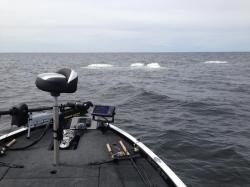
The View from Ott’s Boat

Advice from Bass Fishing’s ‘High-Tech Redneck’
from The Fishing Wire

Admit it. Our eyes are drawn to fancy, new-fangled objects. It’s all over pop culture: Pimp My Ride. The Bling Ring. Tricked Out TV. Every time we turn around, it seems, someone’s flashing another superficial doodad or device. In fishing, it’s a slightly different story.

Ott Defoe studies his electronis

Ott Defoe studies his electronis

“The high-tech redneck himself, Ott DeFoe angles from the helm of his tricked-out office.” (Courtesy of Ott DeFoe)

“Man, the front of your boat looks like an aircraft carrier!” quipped a Bassmaster fan, studying Elite Series angler Ott DeFoe’s ride at a recent event. Flashing his trademark grin, the affable bass pro nodded and casually replied “Yessir, I’m a high-tech redneck.”

DeFoe, who in a short span of four years has racked up some impressive credentials on the B.A.S.S. tournament trail, has also emerged as one of the more techno-savvy anglers on tour. In a game that’s increasingly driven by technology, however, competitive fishing for DeFoe is still mostly about dropping the trolling motor and zinging casts down the bank.

But even the trolling motor’s a techno-tool. Albeit after decades of routine use, the common bow-mounted device has become as synonymous with bass fishing as a plastic worm. Like a rod and reel, livewell or crankbait, the trolling motor serves a purpose; has a singular function that helps put more fish in the boat. So while DeFoe speaks with many folks each year who puzzle over his vast network of electronics, he’s comfortable saying that each and every device plays a critical role in his success on the water.

As one of the nation’s top bass anglers, DeFoe freely admits he’s in an enviable position that gives him access to all the sweetest stuff. (Admit it, you would too.) And if the ‘bling on his bow happens to carry a certain “cool” factor, that’s just fine with him.

“These days, no matter where I go, I probably get more questions from folks wondering about electronics than any other topic or piece of equipment,” says the Knoxville, Tennessee based angler. “Specifically, they want to know how electronics can help them catch more bass. That’s the main reason we spend the money and put ’em on our boat-trolling motors, Side-, Down- and 360 Imaging, Talons, GPS mapping and underwater cameras. If they don’t help us catch bass we’re not going to use ’em for very long.”

Shallow Water Scouting

For years, many anglers neglected their sonar-fish finder units. The reason was simple. Most bass anglers spent most of their time in shallow water, casting to visible cover along the bank, where sonar beams couldn’t “see.”

Last season, DeFoe and a few other anglers on tour began using a new sonar tool that unlocked the unseen shallows. Not only was it now possible to see structure below the boat, but the new 360 Imaging device also revealed the water in front of and on all sides around the boat-even in 10 feet of water and less.

A breakthrough occurred for Ott at the 2013 Elite Series event at Lake St. Clair. “On day one, there were three of us fishing this 8 foot point. Little wolf packs of big smallmouths were working all around it, but the point didn’t seem to have any cover to actually concentrate fish.” DeFoe and several others had taken numbers of 3 to 4 pounders off the point, but at day’s end, it seemed to have dried up.

On the second morning, after a few bites, the fish again appeared to vanish. “After the other boats left the area, I decided to hang around a little longer. I felt the fish were still close by, so I returned to my waypoints on the spot, and just moved along studying the screen of my Humminbird 360 Imaging unit.”

Finally, DeFoe spotted a single object on screen-a moderately sized boulder lying on the otherwise clean point. Set to search 100 feet all around the boat, the 360 unit allowed him to determine that the boulder was approximately 75 feet ahead of his position. “I picked up a tube,” said DeFoe, “cast toward the target and immediately got bit. As I fought the 3-1/2 pound smallmouth, I spotted a bunch of his buddies following him to the boat.

“DeFoe calls his underwater camera an ‘awesome time management tool,’ confirming fish species seen on sonar, as well as bass size and their position relative to cover.”

“In my head, a light switch went off. The bass hadn’t left at all but had simply moved away from the boat traffic and repositioned around this single insignificant boulder. Without 360, I would have never seen or caught this fish without spooking him first. Nor would have I stayed and caught several more good fish off the same rock on day 2 and day 3.”

Classic Conditions

At the 2013 Bassmaster Classic, DeFoe cashed a sweet 4th place check, riding the same 360 Imaging unit to success. “Worked awesome for identifying the sweet spots on offshore structure. I could quickly zero in on the stuff that looked good and fire casts right to targets that held bass.”

DeFoe indicated that ultimately, his specialized “full-circle” sonar guided him to key little ditches that cut across main river bars. “Fishing new water on Guntersville, the 360 showed me stuff all around the boat that I couldn’t have found in days or weeks of random casting. At the Classic, you don’t have time to scout. But if you can scout while you’re casting, that’s huge.”

“The coolest thing about 360 was that while I fished, it helped pick out targets-stumps, small patches of emerging grass-before my boat reached them and potentially spooked fish. It showed me these little low spots on the bar, where I eventually caught most of my fish. Got to where I could come pretty close to hitting on-screen targets on the first try. Often, I’d get bit right away.”

Camera Confirmations

Strategically placed among two giant 10-inch Humminbird LCDs, a Minn Kota-mounted 360 Imaging unit, and a HydroWave sound attractor, DeFoe’s boat also houses an Aqua-Vu Micro underwater camera. Underwater viewers, he says, help solve mysteries, yet can also be tremendous time management tools.

“In practice, we’re always trying to find active fish, but not necessarily catch too many of them before the tournament starts. Last year on the St. Lawrence River, which has really clear water, I pulled in to a spot, made a few casts and finally started catching them on a dropshot with a Berkley Gulp Fry. I was marking a few fish on my sonar, but it was hard to tell how many were there. I dropped the Aqua-Vu and immediately saw a nice looking rockpile and probably several dozen smallmouths cruising around. It gave me the confidence to leave the area alone, so it would be fresh come tournament day.”

At the recent Elite Series event on Table Rock Lake, DeFoe’s 2-D sonar identified a massive school of sizeable fish, suspended in timber 20 feet down over 35 feet of water. “It looked like the mother lode. So I spun around and threw a swimbait through the zone. Fished this way for 20 minutes without a bite. I could see fish on sonar, grouped so tightly they almost cluttered out the screen. Finally, I dropped the Aqua-Vu, and saw . . . Gar. Piles of ’em.

“For that reason alone-fish identification-I always keep the camera in the boat. Imagine how much time over the years we’ve spent fishing for the ‘wrong’ species, and wondered why they wouldn’t bite.”

A 360 Degree Sonar helps find fish and cover

A 360 Degree Sonar helps find fish and cover

“At the 2014 Classic, meticulous use of 360 Imaging sonar lead to a 4th place limit, anchored by Ott’s final day 8-pounder.” (Courtesy of Humminbird)

DeFoe adds that he often simply uses the camera to confirm or disprove what he’s seeing on sonar. “It’s awesome for showing bass that get lost in cover-grass, brushpiles or under docks. I like to watch how they’re relating to the cover; how they move around and alongside it. Fun to watch all this on screen. My kids love it. But it’s also a great learning tool that can help determine patterns or even indicate what type of presentation will work best.”

Whether your rig resembles a tricked-out tournament battleship or not, the game’s the same. Find bass. Catch a few. Look cool . . . well, who really cares? Just have fun. So says bass fishing’s high-tech redneck.

–Ted Pilgrim with Ott DeFoe

How Much Fishing Is Enough?

I almost got enough fishing during the past two weeks a few years ago in early May. After fishing the two day Spalding County Sportsman Club tournament at Clark’s Hill April 23 and 24 I left for Center Hill Lake in Tennessee on Tuesday. I fished there four days in a row, and it rained all day each of them.

Although I caught a lot of spotted, smallmouth and largemouth bass and was in second place and had big fish in a tournament there on Friday, it was a two day tournament and I did not catch a keeper on Saturday. To add insult to my zero, my big fish the day before was beat three times on Saturday.

I left Center Hill at midnight Saturday and drove five hours to Lanier, arriving at the ramp in time to get a 30 minute nap before launching the boat. I decided the lack of sleep was my problem when I lost six bass early that morning, but then caught a limit just after noon. The fish that morning hit flukes and I broke my line on one, had two more hit and get off, and I just did not get a good hookset on three more.

After that tournament I drove home and got a little sleep, then got up at 4:30 Monday morning to drive to Oconee. I picked up a couple at the Ritz Carlton and took them fishing for a four hour tournament their business group was hosting. They placed 3rd in their group with the three keeper bass we caught weighing 6.25 pounds. One of them hit a Rat-L-Trap and the other two hit a spinnerbait.

It was fun that morning trying to help the couple learn to cast. Neither of them had ever been fishing. The woman caught a 12 inch bass on her first few casts, the first fish she had ever caught. I think she was thrilled and kept casting hard the rest of the morning.

In that stretch I fished 8 days out of 10 and was on 4 different lakes. I also drove just over 1100 miles in those ten days. I could not stand it when I got home last week so I went to my pond and fished on Tuesday and Wednesday, then went to Bartlett’s Ferry and fished Thursday.

Bass were biting good at Bartlett’s Ferry. I met Randy Duncan there to get information for a Georgia Outdoor News article and we caught about 15 bass in five hours. Most of them were small, but they were fun to catch. To round out the week I fished in my pond on Friday and Saturday.

I love being retired!

My love of fishing came from my mother and her mother. Some of my best memories are of fishing with mother and grandmother on ponds around the house. Mother’s Day always makes me think about those trips and how much they influenced my life. I wish I could thank them again for the time they spent with me and the ways they influenced me, but both are gone now.

May all mothers, fathers and children get to go fishing together any time they can, and make some memories that will last a lifetime. All too soon the chance to go fishing with each other will end.

Should I Use A Big Worm for Post Spawn Bass?

Big Wormin’ During The Postspawn
from The Fishing Wire

Use a big worm for postspawn bass

Use a big worm for postspawn bass

“I always have a 10″ Power Worm tied on during the postspawn because it’s just one of those baits that the bass will eat.” – Scott Ashmore

Broken Arrow, OK – Elite Series pro Scott Ashmore lists a 10″ Berkley PowerBait Power Worm as his confidence bait when it comes to targeting postspawn largemouth.

“The big worm really starts to shine when the water temperature approaches 80-degrees, regardless of where you’re fishing across the country,” explains the Oklahoman, who has amassed over $120,000 in career earnings. “After spawning, the bass begin migrating to main lake points and ledges, and a 10″ Power Worm is the best bait that I’ve found to intercept bass during that transition period.”

Ashmore begins his search for schools of postspawn largemouth by looking at prime spawning areas in the backs of creeks or pockets. “Bass will use the same routes to leave the spawning areas that they used to enter the spawning areas earlier in the spring,” states Ashmore. “If you can identify where they spawned, you have a starting point where you can slowly begin working towards the main lake, combing classic postspawn areas like secondary points and subtle ledges.”

Another key underwater feature that Ashmore likes to target when searching for postspawners on manmade fisheries is ditches or creek beds running into pockets that were created before the lake was filled. “They’re natural migration routes that the bass use year after year,” he points out.

Covering water is a key component to success during the postspawn, and Ashmore believes that there’s not better tool for the job than a Carolina-rigged 10″ worm fished with a 2′ to 3′ leader and ¾ oz. tungsten weight. “In the heat of the summer, I’ll throw a Texas-rigged 10″ worm with a ½ oz. bullet weight and catch fish all day long out of isolated brushpiles,” he explains. “But during the postspawn when the fish are not as target oriented, a Carolina-rig allows me to cover more water and find those groups of cruising bass that are in transition.”

The majority of the time, Ashmore relies on 20-pound-test Berkley 100% Fluorocarbon line for both his main line and Carolina-rig leader. “I like 20-pound-test fluorocarbon because most of the time my line is dragging across rocks and the weight is bouncing on the line,” he states. “If I’m fishing in really clear water, I’ll drop down to 15-pound-test 100% Fluorocarbon for my leader.”

As a general rule, darker colors like Red Shad and Plumb get the nod. “Red Bug seems to work well on some of the southern fisheries like the St. Johns River, and Blue Fleck is probably my favorite color on Oklahoma lakes,” explains Ashmore.

When it comes to hook selection, he pairs the meaty 10″ worm with a light wire 5/0 or 6/0 wide gap worm hook. Ashmore believes that the light wire allows for easier hook penetration when setting the hook at long distances, and it also gives the worm a more realistic action and allows the bait to flow naturally through the water.

On the topic of a natural appearance, Ashmore has difficulty explaining exactly why bass have an affinity for 10″ worms. “All I can say is that I guess a 10″ worm puts a little mystery in the ballgame,” he states with a chuckle. “I don’t think the bass really know what they’re looking at when they see a big worm, so it generates a reaction bite. All I know is that they eat the bait and that I have a lot of confidence in it. Beyond that, I don’t try to over think it.”

Can I Catch Saltwater Fish On Artificial Lures?

The Lure of Artificials

Florida charter captain avoids the hassle of live-baiting.

By Frank Sargeant, Editor
from The Fishing Wire

Catch big redfish like this on artificials

Catch big redfish like this on artificials

There aren’t many charterboat skippers around Florida’s central west coast that specialize in tossing artificial lures these days. The ease of catching fish with live sardines, particularly for anglers without a lot of experience, has made live bait the go-to standard for dozens of guides, and there’s no question the silvery baitfish are deadly on every inshore gamefish.

But Captain Ray Markham of Terra Ceia has taken another route.

“I just don’t like fishing live bait,” says Markham. “I like the idea of fooling the fish with a lure, and I like the process of casting, working the lure just right, setting the hook at the right moment–the whole thing is just more interesting.”

Of course, it’s a whole lot more challenging, too.

Unlike guides who use live ‘dines both as bait and as magic chum, Markham does not get that nice string of explosions along the shoreline to tip him off as to where the snook and reds are hanging out.

And since artificials don’t feed the fish and keep them in one spot, it’s not common to sit in one location and catch a dozen or more, as is sometimes the case with sardine skippers.

“It’s basically just a different clientele I cater to,” says Markham. “Anglers who have done enough fishing to know how to cast reasonably well, and who appreciate getting to see a lot of backcountry and picking out the spots for each cast are the ones who really prefer fishing lures to fishing sardines. For people who can’t cast at all, of course, live baiting is a lot easier, and that might be the better route for them.”

Markham says that if he had only one lure to fish year around, it would be a DOA CAL jig head in quarter-ounce weight, with a 4 to 5 inch soft plastic shad tail in white or pearl color.

“Just about everything from snook to reds to trout to flounder will hit that lure,” says Markham,” and it’s very easy to work–just pop it up off bottom, let it sink, and then repeat.”

He also likes the DOA shrimp, most often fished under a popping cork–an easy system for those new to fishing artificials to learn because it’s very similar to live baiting–and tossing an assortment of MirrOlure hard baits, including the MirrOdine in shallow grass flats.

He typically arms his anglers with spinning tackle, with 2500-size reels and 10-pound-test braid, tipped with a length of 20 to 30 pound test fluorocarbon leader. His lures are tied on with a loop knot to allow them extra action.

I’ve fished with Markham many times, and he consistently outfishes me, even though I consider myself a reasonably good lure angler. The difference, he thinks, might be the power he puts into the retrieve.

“I really snap that lure up off the bottom–it’s a quick, violent action, and that seems to trigger the strikes a lot more often than just a pull and drop retrieve,” says Markham.

He uses the same tactic when fishing a popping cork–the violent jerks he uses makes the cork chug and pop loudly, and the noise seems particularly attractive to trout.

Of course, the other thing that makes Markham effective is his bone-deep knowledge of the terrain–with more than 20 years of guiding the area, he knows every pothole, cut and mangrove point intimately.

On the half-day I joined him, we fished the string of bays and mangrove islands that stretch south from the Skyway, and caught a steady assortment of big redfish, trout and flounder, along with an occasional snook. It was rare to go 5 minutes between bites–for those who get impatient waiting for something to find their sardine, there’s something to be said for run-and-gun lure tossing.

The other major advantage of fishing artificials, Markham points out, is that you can start casting at first light; prime time for low-light feeders like snook.

“I just hate the idea of spending that best hour of the morning throwing a castnet for bait instead of fishing,” says Markham. “And the other nice thing about lures is that they’re always there in my tacklebox–there are no days when I have a hard time getting bait.”

For more, visit www.captainraymarkham.com

Bird Watching On Land I Manage for Wildlife

There are two small ponds on my property in east Spalding County and I try to make them as wildlife friendly as possible. Both have wood duck nesting boxes and floating goose nest platforms on them. The ducks and geese seem to like them.

Last year a pair of geese raised a couple of goslings on one pond and one of them stayed after the others left. It still hangs around with a female mallard duck. They have been inseparable all year. I really thought the goose would take up with other geese when they came back to nest, but it has not. I call them the odd couple.

Geese checked out both ponds and a pair nested on the lower one about a month ago. About a week later a pair nested on the upper pond, too. A week ago the eggs hatched on the lower pond and I saw the pair of adult geese with five little yellow puffballs following them around.

The next day no geese were on the lower pond, but when I went to the upper pond the pair had moved up there with their five little ones. They had moved about 100 yards through the woods, swimming in the little creek and walking around brush jams and up the dam. For several days they moved back and forth between the ponds.

I saw them several days in a row, then one day there was only one gosling left. I guess a hawk, snake, weasel, raccoon, turtle or some other critter had a meal of four little geese. The pair still moves back and forth between the two ponds with just the one left. It has doubled in size in a week.

When they are on the upper pond it gets funny. The odd couple is there as is the pair nesting on the platform. When one of the pair with the little one gets near, or one of the odd couple approaches the nest, the male tries to chase them off while the female stays on the nest.

I never realized Canada geese could swim underwater until I watched one last week. The goose of the odd couple got too close to the nest and the male attacked him. He would dive under, swim about 15 feet them pop back up. That did not stop the attacking goose and I saw the one fleeing swim underwater three different times.

Also, the pair with the little one got too close to the edge of the water and my dog Rip took off after them. The gosling dove and swam out of sight under water half way across the pond. That is a good escape tactic but I did not know geese could do that.

It is fun watching the geese, especially the little one, try to get near enough to eat the fish food I throw out without getting too close. The little one will head toward me and the parents will be right behind it, making noises that I take to be saying “Be careful, don’t get too close!”

The eggs in the nest the one is still siting on should hatch soon. It takes about three weeks for the eggs to hatch. I am not sure they will hatch since there was one egg in that nest that was abandoned. I hope she is not sitting on that bad egg.

Baby birds of all kinds are hatching right now. I remember many times while I was growing up watching nest, counting the eggs and learning the different colors and numbers of eggs birds laid. All too often I would find a baby bird on the ground and try to feed it and keep it alive. Earthworms were easy to get and I fed them all they wanted, but all of the baby birds died within a day or so.

Some baby birds abandon the nest immediately and are able to move around. Ducks and geese can swim almost immediately after hatching. Last year wood ducks hatched on both ponds and soon got together. I would see an adult with 10 or 11 little ones behind it. I guess it was the baby-sitter.

I have read that some kinds of woodpecker chicks leave the nest immediately after hatching. The nest smells and attracts predators that would eat them, so they leave and hop out on branches or go to the ground where the mother keeps them fed.

Birds and they ways of nesting and raising young are amazing. The great variety of ways they nest, from hollow trees to small depressions on the ground to the familiar twig and stick nest in bushes and trees is fun to study. Some, like hummingbird nest, are unbelievable.

Watch for nesting birds. Enjoy them without disturbing them. They can entertain and amaze you.

Managing Your Land for Wildlife

I have 75 acres of land in east Spalding County that is my little piece of heaven on earth. It is mostly wooded with two small ponds and a two acre field, and I have seen deer, turkey, squirrels, geese, ducks, raccoons, possums, fox, coyotes, beaver, otters and muskrats there. The ponds have bass, bream, catfish and shiners in them.

When I bought the land in 1999 I knew little about managing it, so I contacted the Georgia Forestry Commission here. Through them I had a Forest Stewardship Plan written. It gives me guidelines on everything from productive timber practices to pond management.

To start the plan I had to fill out an application and list my priorities for the property. I chose wildlife, soil and water, timber, recreation and aesthetics, in that order, as my management goals for the property. The plan would be developed around those goals.

To set the plans, my property was visited by the Management Forester and District Stewardship Forester from the Georgia Forestry Commission, a wildlife biologist from the Department of Natural Resources, the District Conservationist from the Natural Resources Conservation Service and someone from the Soil and Water Management Service.

Along with topographic maps showing soil types, vegetation types and contours, I received written information about these subjects. These maps would help with tree and soil management, and instructions were given for avoiding problems like erosion around creeks. There was also information about endangered and threatened species that might be found there.

A section discusses both ponds in detail and suggests how to keep them in good shape. One is very old and there is not much that can be done for it since there are big trees on the dam and it could leak at any time. I did have the water tested in both and got liming and fertilization guidelines from the local County Extension Service.

The notebook prepared for me had several hundred pages of information, including practices to improve the land for wildlife. Sizes and types of food plots were suggested as were tips on controlled burning, thinning trees and planting fruit and nut trees for forage.

I have followed most of the guidelines and they seem to be working well, with one exception. I was supposed to do a controlled burn on about 1/3 of the property each year in a three year rotation. Controlled burns help wildlife as well as improve timber growth.

A little over a year ago, just before the burn ban went into effect, I had scheduled a burn for about 10 acres. The Forestry Commission technician arrived that morning and warned me the humidity was very low, but I insisted we go ahead and burn anyway. He unloaded his bulldozer and plowed a fire break, and we started the burn.

As warned, the fire got way too hot and most of the pines lost their needles in the next few weeks. But within days they has put out new needles and looked good. Unfortunately, during the winter I found pine beetle damage and had to clear-cut the area to stop them. I was going to end up with no trees anyway, so I might as well get some money for them.

After the timber company finished I waited until just before the burn ban went into effect the beginning of this month and burned off all the residue left. I waited as long as possible to let it dry as much as possible, and it worked. I guess fire and me just don’t get along. The fire burned way more than expected, moving across what looked like bare ground to me, and I had to call for help to stop it before it got into the woods.

Right now the place looks bad, but I will plan pines there and will have a new stand of trees growing soon. Again, the Georgia Forestry Commission people helped me with what I needed to do and even provided some grants for planting some kinds of pine trees.

As the weeds, grasses, briars and other plants grow in the cleared land, deer and other wildlife will find it a great place to live. I will add food plots in the cleared area so there will be plenty for them to eat as well as good cover. I expect to have an abundance of deer for the next few years.

If you have land and want to manage it wisely, contact the Georgia Forestry Commission. They can help you be a good conservationist, managing your resources and using them wisely.

Can I Catch Bass In the Late Spring Swimming A Jig?

Swimming the Jig for Bass In Late Spring

A great postspawn tactic.

By Frank Sargeant
from The Fishing Wire

Swim JIg

Swim JIg

Most of us think of jigs as deepwater baits designed for fishing bottom, but for a short time in spring, jigs become topwater baits that are hard to beat, and they often produce some huge fish that are hard to catch with other lures.

Swimming a jig is basically a postspawn tactic; the fish that have spawned in the pads, primrose vines and other emergent weeds remain in the shallows for days or sometimes weeks after leaving the beds, and they’re typically very hungry. The places they prowl may be anywhere from a foot to 4 feet deep, typically in the backs of the feeder creeks that make up the bays around the larger lakes across much of the southeast and west into Texas.

The jigs that work best are not the heavy, fat models that work so well on the ledges. Swim jigs are flat-bottomed to help them scoot across the weeds, and are typically lighter in weight than those used in deep water, from 3/16 to ½ ounce, with large hooks designed to hold large soft plastic crawfish or swimmer tails. A nylon weedguard is also standard, helping to keep the single-hook lures from catching the cover.

These lures are cast into cover near spawning areas-sometimes the shadows of the beds can still be seen in the cover. However, the fish may be some distance from the nests-they no longer guard them after the fry swim off on their own, but they do hang in the area to feed for a time.

The trick in working a swim jig is to put the reel in gear instantly at the end of the cast, keep the rod high, and start the lure moving, slowly but steadily, just fast enough to activate the soft plastic swimmer legs or tails. Most anglers use either heavy mono, 25 pound test, or braid of 30 pound test or heavier, to allow pulling the lure free when it snags-and also to give them a chance to derrick large bass out of the thick stuff.

The strikes tend to be sudden and explosive-it’s just short of the blow-ups inspired in fall by crawling a frog over the moss beds. The nice advantage of swimming the open hook jigs is that the fish more often than not actually get hooked, not the case with the weedless but sometimes also fishless frogs.

Once a fish strikes, the tactic that works best is to set the hook hard, then crank as fast as possible with the rod high-ideally, you pop the fish up on top of the weeds and scoot him across them to open water. Of course, this plan is not always effective-they often bog down, and then the only way to get them out is to ease in on the troller, follow the line down and get a liplock on them.

It’s also common for fish to blow up on the lures and miss them completely. When this happens, a second cast back to the same spot immediately often gets a second strike, but if not it can be useful to keep a Texas-rigged worm handy on the front deck. Cast the worm to the spot of the blow-up, bounce it up and down in the cover a few times, and you’ll often coerce the fish into taking.

All colors of swim jigs work, but the ones that are easiest to see are the brighter colors-white, pearl or chartreuse are easy for you and the bass to spot.

Fishing the swimjig is a short window in the fishing spectrum, but it’s one of the more interesting and productive tactics for big fish when the bite is on-give it a try this spring.

Club Tournament at West Point Lake In April

An early April Sunday 19 members of the Flint River Bass Club fished our April tournament at West Point. After all the rain on Thursday and Friday the lake looked like coffee with cream in it
and the water temperature dropped from 63 degrees on Thursday to 56 Sunday morning. My truck thermometer showed 34 degrees when I launched my boat at 6:30 AM.

Even with those bad conditions there were five limits of bass brought in. We had a total of 47 keeper bass weighing right at 77 pounds. Most were spotted bass which I think hit better under bad conditions than do largemouth.

I managed to win with five weighing 9.79 pounds, Kwong Yu was second with five weighing 8.68 and his partner Steve Blackerby was third with five weighing 8.48. Toney Roberts placed 4th with five weighing 8.01. Dan Riddle had just one keeper, but it was a big one. His 5.91 pound bass was big fish for the tournament.

Bass were caught on spinnerbaits, crankbaits and Carolina rigs. The largemouth bass Jim Berry and I found in shallow water before the tournament had mostly moved back out with the dropping temperatures and were harder to catch.

The next Monday and Tuesday the Georgia BASS Chapter Federation Top Six tournament was at West Point. The three Griffin clubs, Flint River Bass Club, Potato Creek Bassmasters and Spalding County Sportsman Club each had six man teams fishing this tournament.

Griffin fishermen had a tough time at the Top Six last week. Although everyone caught a lot of bass, 14 inch keepers were not easy to find at West Point for some of us. It seems easy, in theory, to catch just five keeper bass in 6 to 8 hours of fishing, but it isn’t always so.

It took 10 bass weighing 30.64 pounds to win this tournament and 23.57 pounds to earn 12th spot on the state team. If you had 19.12 pounds you came in 25th and got a check. There were 86 clubs with six man teams in the tournament, so about 516 of us were beating the waters trying to catch bass Monday and Tuesday.

Lee Hancock, fishing with the Potato Creek Bassmasters, was the highest Griffin area fisherman. He weighed in 13.76 pounds of bass in two days. Kwong Yu and Javin English, fishing with the Flint River Bass Club, had 11.74 and 11.69 pounds respectively, to lead that team. Jimmy Waddle lead the Spalding County Sportsman Club with 11.30 pounds and I had 11.19 pounds in that club. I finished 139th!

The Top Six Tournament is quite and experience each year for the fishermen that qualify for it. I have been to 26 of them, missing only one since 1979. I was too sick to go to one in the early 1990s and hate missing that one.

Members of each club are fishing now for points in club tournaments to qualify for the Top Six next year. It is not too late to join a club and try to make it. Maybe you can show us how to catch fish in that tournament next spring.

How do you fish in muddy water in the spring? Share your thoughts in them comments section