Im Going To the Bassmasters Classic

I’m going to the BassMasters Classic in Greenville, South Carolina and Lake Hartwell this week – as a media observer. Way back in 1983 in almost qualified to fish the Classic through the federation and going as an observer is a far cry from fishing it, but I went last year and had fun.

The Classic is the biggest tournament in bass fishing each year. It is often called the Superbowl of bass fishing. Last year I was quoted in Sports Illustrated saying “the Suprebowl should be called the Basssmasters Classic of football!” It is that big, and the winner can expect to earn over one million dollars during the next year in sponsorships and endorsements.

On Wednesday I will ride with one of the pros during the final practice day. I am a little worried since the weather guessers say the high will be 37 with a chance of rain, but it gives me the chance to see first-hand how the pros try to find fish and figure out how to catch them.

Thursday is media day and I will have lunch with the pros – me and about 150 other media representatives. After lunch the pros will be at their boats to do interviews. Last year one question I asked was “What advice would you give to a young fisherman wanting to be a bass pro?” The results of those interviews are in an article I wrote in this month’s Georgia Outdoor News.

Friday is the first day of the tournament and while the pros are fishing there will be a huge outdoor show at the TD Convention Center in Greenville. There will be dozens of vendors there, ranging from boat companies to lure manufacturers. And many of them will have special discounts on their products. The show will run all three days, Friday through Sunday, and it is free.

The weigh-in each day will be at the Bon Secours Wellness Arena and is also free. Live weigh-ins will be streamed on the internet so you can watch from home. And there will be a live blog each day of fishing from on-the-water observers as well as streaming video of the pros fishing, all at http://bassmasters.com.

The show and weigh-ins in Greenville are a little over three hours from Griffin. It would be a fun trip to go to the show and see some of the weigh-ins in person.

Bassmaster Classic Audience Expected To Grow This Year

The cameras used to film The Bassmasters on ESPN are now capable of also streaming live on-the-water video that will be accessible on Bassmaster.com during the 2015 GEICO Bassmaster Classic presented by GoPro. Photo by Bassmaster

The cameras used to film The Bassmasters on ESPN are now capable of also streaming live on-the-water video that will be accessible on Bassmaster.com during the 2015 GEICO Bassmaster Classic presented by GoPro.
Photo by Bassmaster

Bassmaster Classic Audience Expected To Grow In 2015 Through Innovative New Media

BIRMINGHAM, Ala. — The GEICO Bassmaster Classic presented by GoPro next week on Lake Hartwell, South Carolina, is expected to become the most widely watched and thoroughly covered fishing event in history, B.A.S.S. officials predict.

“It will certainly be covered in more different ways than previous Classics, which historically have reached more fishing fans than any other tournament,” said Jim Sexton, VP/Digital for B.A.S.S. “With new live coverage of fishing action on Bassmaster.com and advances in content for mobile devices, we’re hoping to surpass 1 million unique visitors on our website alone.”

The 2014 Classic on Lake Guntersville attracted 979,000 unique visitors to the site, and they generated a total of 33 million page views in February 2014, including 22 million during Classic Week.

In addition to web coverage, ESPN2 will air 12 hours of programming on the Classic, which is being held Feb. 20-22 on Lake Hartwell, with weigh-ins to be held in Greenville, S.C. The programs will be re-aired on ESPN2, ESPN Classic and on The Outdoor Channel. The 2014 Classic on Lake Guntersville attracted more than 1.3 million viewers, including approximately 880,000 on ESPN2 and 400,000 on The Outdoor Channel.

Bassmaster Magazine will cover the 45th Classic in its April issue, reaching 500,000 B.A.S.S. members and 3.7 million readers.

The “Super Bowl of Bass Fishing” also has attracted a record number of journalists representing independent media ranging from websites to magazines and newspapers to television networks. Approximately 275 media representatives have applied for credentials to cover the event.

Among the media contingent, a crew from The Weather Channel will be broadcasting live from the take-off site, Green Pond Landing in Anderson, S.C., Friday and Saturday mornings, Feb. 21-22.

Another form of live broadcast from the Classic will be “huge,” predicts Mike McKinnis, producer of the award-winning The Bassmasters TV show. Internet coverage of the Classic will feature live on-the-water video of anglers on Lake Hartwell.

Employing somewhat new technology built into the same cameras used for the television show, video is transmitted through cell service and streamed live on the website, McKinnis explained. “We do things that inspire us, and we know if we get excited, typically the fans can get excited about it,” he added. “I think the fans will be blown away.”

The video will be streamed in the “Bassmaster Classic Live presented by Lowrance” programs on Bassmaster.com each competition day, Feb. 20-22, from 9 a.m. to 1 p.m. ET.

Classic television coverage on ESPN2 will premiere Saturday, March 7, with a three-hour block covering Day 1 and Day 2 of the competition, and the final round will be covered in a two-hour show Sunday, March 8, from 10:30 a.m. to 12:30 p.m. on ESPN2. (See Bassmaster.com for complete listings.) The programs are videoed, edited and produced by the same team that’s responsible for The Bassmasters show on ESPN2 and the Outdoor Channel. That show recently received the prestigious Golden Moose award for “Best Fishing Show” — the third such award in the past four years for the program.

In addition to “Bassmaster Classic Live,” the Bassmaster.com website offers several other ways to keep up with the fishing competition in real time. BASSTrakk uses cellphone technology to record the location of each angler on a GPS map. Marshals assigned as observers for each of the anglers operate the BASSTrakk devices and send in updates immediately after each fish is caught and kept or released. That information is displayed in the Real Time Leaderboard, an unofficial ranking of each of the competitors, and is sent automatically to followers of @BASSTrakk on Twitter.

Teams of writers and photographers prowl the lake, following the leaders and filing reports and photos in the “Live Blog” feature on the website, which also publishes photos taken by marshals of the angler’s biggest bass. “Near-live” video interviews will be posted online in the BASSCam section, and select video from GoPro cameras installed on all 56 contender boats will be posted daily on the website.

Fans will be able to contribute to the Classic coverage as well through Twitter and/or Instagram. By using the hashtag #BassmasterClassic, their Tweets and photos will appear on video screens in the Bassmaster Classic Outdoors Expo presented by Dick’s Sporting Goods, on the big screen during weigh-ins at the Bon Secours Wellness Arena and on Bassmaster.com.

Social media is expected to play a major role in telling the story of the event this year, according to Social Media Editor Tyler Wade. “More than 2,500 Instagram photos were posted with our hashtag during last year’s Classic, and we had barely established our Instagram presence then. With 25,000 fans on our Instagram account, @bass_nation, the number of posts will be much higher this year.”

About B.A.S.S.
B.A.S.S. is the worldwide authority on bass fishing and keeper of the culture of the sport. Headquartered in Birmingham, Ala., the 500,000-member organization’s fully integrated media platforms include the industry’s leading magazines (Bassmaster and B.A.S.S. Times), website (Bassmaster.com), television show (The Bassmasters on ESPN2), social media programs and events. For more than 45 years, B.A.S.S. has been dedicated to access, conservation and youth fishing.

The Bassmaster Tournament Trail includes the most prestigious events at each level of competition, including the Bassmaster Elite Series, Bass Pro Shops Bassmaster Open Series presented by Allstate, Old Milwaukee B.A.S.S. Nation events, Carhartt Bassmaster College Series, Costa Bassmaster High School Series, Toyota Bonus Bucks Bassmaster Team Championship and the ultimate celebration of competitive fishing, the GEICO Bassmaster Classic presented by GoPro.

Can I Catch Stripers In Cold Water?

Stripers–Cold Water Angling Option

By Frank Sargeant, Editor
from The Fishing Wire

If you’re brave enough to get out on the water anywhere north of Florida this month, you may have a bit of Inuit in your ancestry–or perhaps you fished from an ice shanty.

Stripers in cold water

Stripers in cold water

These landlocked stripers were caught next to bridge pilings in Lewis Smith Lake, an impoundment in North Alabama, an swimbaits. (Frank Sargeant photo)

Cold weather not only makes it almost impossible to endure sitting in a bass boat, it shocks the fish into a state that resembles suspended animation; they simply hang in the water near bottom, nose down, moving only enough to stay upright. They’ll come back to some semblance of normalcy after a few days of more temperate weather–but it will be the end of February before bassing returns to normal, even in Mid-South states like Tennessee and the Carolinas.

However, there are some species less affected by the cold. Top among them is striped bass, which actually thrive on cold water, and these may be the best target for the next month in many lakes around the country.

Stripers feed almost entirely on shad in open water and can be tough to find, but fortunately many lakes in winter have some “bird dogs” that make it easier. Sea gulls that winter from the Mason-Dixon Line southward keep a sharp eye out for shad being driven to the surface by stripers, and anywhere you see a flock of gulls diving–or even sitting on the water–it’s likely there are stripers below.

Striped bass are native to the TVA lakes that stretch across Tennessee, Alabama, Mississippi and Kentucky, but numbers were strongest when they were heavily stocked years ago. Now, most found here are native-spawned; the long flow-way of the TVA rivers allows the eggs to hatch in years when there’s good rain. Tennessee is also continuing to stock upstream TVA lakes, and some of these fish, as well as their eggs, arrive in North Alabama’s TVA lakes as a result.

Striper caught in cold water

Striper caught in cold water

Stripers can sometimes be located on sonar in winter hanging close to bait schools: Lower a heavy jig down to them and this can be the result. (Frank Sargeant photo)

Stripers, as distinguished from white bass, have a longer and more streamlined body shape, and grow to much larger sizes–over 50 pounds on occasion, and the world record for the landlocked strain, caught from the Black Warrior River last February, is a stunning 69 pounds, 9 ounces! Caught by James Bramlett, that 45.5 inch fish is unlikely ever to be bested; it appears to have lived in the warm water outflow of the Gorgas Steam Plant where it was able to stuff itself on swarms of shad and other baitfish prowling there to keep warm. It was built like a basketball with fins.

Stripers of 15 to 20 pounds are not that uncommon, and the average size is 7 to 10 pounds, big enough to give most freshwater anglers the fight of their lives.

Fishing live shad or shad-type lures under the sea gulls is one of the best ways to locate these fish in winter. You may have to visit several gull flocks before you find one with active stripers below, but running main channels near dams or in larger bays will eventually put you on the fish. A check of the sonar can confirm bait and stripers below–these large fish have a very obvious signature on the screen.

Stripers are great eating if cleaned properly, far better than largemouths, which most conservation-minded anglers release anyway these days.

Stripers have snow-white flesh that’s much like that of a saltwater grouper–just peel away the skin, cut out the red line and the rib cage and the boneless fillet is ready to be grilled, baked or broiled.

(A side-note–the largest stripers have higher concentrations of mercury than recommended for consumption, as with most long-lived fish. Those under 10 pounds have no issues in most lakes, however.)

A Bass Tournament Shows You Should Fish Slow in Cold Muddy Water

The last Sunday in January last year 14 members of the Spalding County Sportsman Club braved the cold and muddy water at Jackson for our first 2014 tournament. It was very tough except for one very lucky fisherman with only one limit and five zeros. We had 15 keepers weighing about 28 pounds total. Surprisingly, seven of the 15 keepers were largemouth.

I managed to catch a limit weighing 11 pounds for first. Second was Mickey McHenry with two at 5.48 pounds and big fish weighing 4.15 pounds. Third place was Mark Knight with one keeper weighing 2.14 pounds and fourth was Keith Chambers with one at 1.91 pounds. Second through fourth place are new members to the club this year.

I knew fishing would be tough and planned on stopping on a rocky point in a creek near the mouth of Tussahaw Creek then going on up Tussahaw to try to find clearer water. The water was very stained and 43 degrees when we took off at the dam at 8:00 AM. Where I stopped I could see my chartreuse crankbait down only about five inches.

I fished around that point four times, trying two different crankbaits, a jig and pig and a jig head worm. I also jigged a spoon where I saw bait and fish down about 20 feet deep in three or four places. After 55 minutes of casting I felt weight on my line and set the hook. The three pound spot did not fight much in the cold water and I landed it.

After another 30 minutes of casting I was going to run up the Tussahaw but decided to go across the small creek to the other side. On my first cast with the same crankbait the first bass hit I got a good keeper largemouth. After putting it in the live well I threw back to the same spot on the seawall and got another keeper largemouth.

That made me fish on around the creek, and at 10:40 I hooked a 3.85 pound largemouth. It fought a little bit but not much. After working around the creek I was back on the point where I started and landed my fifth fish, a keeper spot.

Although I fished hard the last four hours in Tussahaw Creek, where the water was a little clearer, I never got another bite. I was very lucky to be in the right place at the right time with the right bait to land a limit. I had to crank the plug down then just crawl it along almost like fishing a worm to get a bite in the cold water.

When Do Bass Get Ready for the Spawn In the South?

Bass Get Ready for the Big Event Spawning in the south

By Frank Sargeant, Editor
from The Fishing Wire

Though spawning season is still many weeks away for largemouth bass in most of the South with the exception of Florida, the internal time clocks of these fish are already counting down for the big event. Each year prior to the spawn, the fish feed heavily, packing on weight that they’ll need during the energy-sapping process of mating and then guarding the nests for weeks afterward.

Captain Mike Carter shows a 12 pounder caught in the pre-spawn period from Alabama’s Lake Guntersville on a swimjig fished around primrose bushes. (Photo Credit Mike Carter)

Prespawn bass

Prespawn bass


This pre-spawn feeding period has become the favorite time of the year for anglers who specialize in chasing big bass because the fish are hungry, and also less wary than they’re likely to be later on when more boats get back out on the water after the cold goes away.

Many of the 8 to 10 pound fish that are caught across the Southern U.S. each year are weighed in between mid-January and mid-March. To be sure, it’s not easy fishing, usually requiring lots of casting to produce any hits at all, but when a bite comes, it can be the lunker of a lifetime.

The fish tend to gather in areas that are not too far from prime spawning spots, but in much deeper water. In many lakes, scattered weeds in 8 to 12 feet of water on secondary points in the larger bays are some of the prime areas, perhaps because these are some of the areas where shad first come up on the structure.

On sunny afternoons the fish also make brief forays into the spawning areas, typically the backs of bays and shallow flats with depths of 1 to 5 feet with scattered weeds, as well as around boathouses in areas with firm shell bottom. Areas with dark mud bottoms can also attract these early fish–look for lily pads and primrose, which typically grow in this mud, as an indicator. The mud apparently acts as a heat sink, increasing water temperatures in these areas during sunny hours.

Prespwan Florida Bass

Prespwan Florida Bass

Captain Mike Shellen guided his anglers to this giant in late winter on Florida’s Lake Okeechobee. (Photo Credit Mike Shellen)

Because the big female spawners tend to be few and far between, it makes sense to use a fast-moving lure to locate them on the deeper points–a Rat-L-Trap or other vibrating, lipless lure is the favorite of many anglers, but lipped crankbaits and heavily weighted swimbaits can also be effective. The lures are cranked through the scattered weeds, then “ripped” or pulled rapidly with an upward snatch of the rod, which both knocks weeds off the hook and creates a strike trigger for any bass that may be following the lure–strikes often come just after one of these pulls.

When the fish move into the lily pads and primrose, a more weedless lure is in order–many anglers do well with swimjigs like those from Strike King, dressed with a flapping crawfish or beaver type soft plastic. These jigs are cast into the cover, then cranked slowly but steadily back, twitching occasionally to free them from weeds.

Swimjigs are generally best reserved for sunny afternoons, and for later in the season–as the actual spawn approaches, typically on the strong moon period in the last half of March and on through April–they become steadily more effective.

The fish anglers catch late January through February are not numerous, but they’re typically big ones, calling for stout tackle–a baitcaster with 17- pound test fluorocarbon line is the best bet.

These trophy class fish are the future of Southern lakes, and it makes sense to release them promptly after a few photos. They generally survive tournament weigh-ins well at this time of year, however, so release after a trip to the stage also makes sense.

Fishing Bartletts Ferry for Bass In February

The last Sunday of February last year 18 members of the Spalding County Sportsman Club fished our February tournament at Bartlett’s Ferry. After eight hours of casting we brought in 53 keepers weighing about 78 pounds, much better than the Flint River club did two weeks ago there. The warming weather really made it better.

There were two five-fish limits brought in and only two people didn’t land a keeper. Most were spots, with only eight largemouth caught. We must be doing something wrong, though. A club weighed in just before we did and that tournament was won with an incredible five fish limit weighing over 19 pounds. That sounds like a Bassmasters Classic catch!

Sam Smith won with a limit weighing 7.1 pounds, Mark Knight was second with four at 6.85 pounds, Micky McHenry was third with four weighing 6.5 pounds and Gary Hattaway’s limit at 5.3 pounds was fourth. Niles Murray won the big fish pot with a 3.4 pound bass.

My day started wrong, as usual, with problems latching the trailer hitch on my trailer. I have got to figure out what is causing that problem. At least I didn’t follow the detour this time and made to the ramp on time.

Then, on the first place I fished, a bass hit my jig and pig by a dock but when I set the hook the line was around the concrete piling and broke. I caught my first keeper off that dock a few minutes later.

It took an hour to get another bite but I landed my second fish on a Texas rigged tube in about a foot of water on a seawall. Almost an hour later I saw a bass swirl at my crankbait right at the boat and saw others suspended off the bottom on that point. I threw a jerk bait to the area and caught my third keeper but no more hit.

Another hour passed then another bite. This one hit a Shadrap near a log. That made four. A few casts later I hooked a big, strong fish on the Shadrap and it fought hard, but I was worried. It stayed deep and did not fight like a bass. Sure enough, when I got it to the boat a five pound channel cat had my plug in its mouth. Good eating but I couldn’t weigh it in.

I landed no more fish. I did hook a good two pound keeper on a crankbait but it came off the second time it rolled on top. I was trying to keep it down but it would not stay underwater. I guess it knew it could get off by coming to the top.

Although we had a cold week this past week, everything is setting up for the bass to start feeding a lot in shallow water. The water early in the morning on the main lake at Bartlett’s Ferry was 49 degrees but that afternoon, back in a pocket, it was 57 degrees. Even though the sun was not bright it warmed the water a lot.

Get ready to catch some bass, they will be ready to hit soon. And the crappie are already eating jigs and minnows, and a catfish should eat some liver if that one hit my crankbait.

Can I Catch Trout Through the Ice In Small Waters?

Small-water tactics for rainbows, browns, brookies and more

By Dan Johnson
from The Fishing Wire

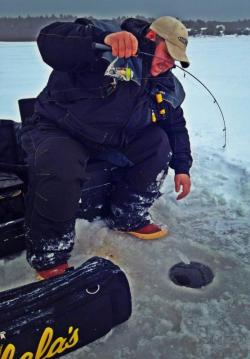
Ice fishing on small waters

Ice fishing on small waters

Trout provide fine ice fishing action across the North, but in many areas of the country, large, deep lakes don’t develop a trustworthy coating of ice until well after Christmas. Good news is, opportunities abound to enjoy fast action on smaller, quick-freezing lakes guaranteed to deliver a welcome dose of holiday cheer.

“In Colorado, our big, high-mountain lakes generally don’t freeze until Christmas,” reports veteran Rocky Mountain trout guide Bernie Keefe, but this expert says smaller lakes are a different picture.

Based in the high-altitude nirvana of Granby, Colorado, Keefe connects clients with lakers, browns, rainbows, brookies and kokanee salmon on lakes of all sizes throughout the year. But right now, he focuses on small systems offering walkable ice and healthy populations of hungry trout, and his tactics apply to trout fans coast to coast.

“Lakes ranging from 100 to 500 acres in size are ideal because you can easily cover them on foot,” he says.

Pre-trip scouting begins at state fisheries department websites, which often offer detailed information on fish numbers and sizes, along with helpful hydrographic maps. Keep in mind, lakes with relatively simple structure are easier to search than those with multiple reefs, points and other trout-attracting features.

Small; waters ice over early

Small; waters ice over early

Why wait for big lakes to freeze when small waters offer opportunities for a variety of trout and salmon?

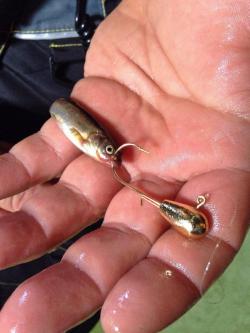
Once he sets his crosshairs on a potential hotspot, Keefe gears up with a lightweight yet potent supply of tackle including several 28-inch, medium-action Clam Jason Mitchell Series Meat Sticks spooled with 4-pound-test Berkley Trilene XL monofilament line. A small tackle box houses a selection of dainty jigs, spoons and swimming hardbaits, while a bait puck loaded with waxworms supplies the tippings.

Carefully testing the ice with a spud bar as he goes, Keefe ventures out in search of prime lies such as shoreline points and lush green weedbeds. “The inside edge of the weeds is typically hot right now, but open pockets are always worth checking, too,” he says, noting that thin ice and clear water often enable visual recon without chipping or drilling.

Since trout frequent depths of five to 15 feet of water this time of year, sight-fishing is a great way to get a handle on the underwater world. “A pair of holes 30 inches apart make it easy to watch two lines at a time,” he says. “I chip them out with my spud bar and pop up my Clam portable on top of ’em.”

In one hole, Keefe wields an active jigging presentation, which draws curious trout and often triggers strikes. “An 1/8-ounce Clam Blade Spoon tipped with a waxworm or two is perfect for the job,” he says. “Drop it to bottom or the top of the weeds, and then slowly reel it back toward the surface, shaking it as you go. When you reach the ice, reverse the process and backreel the spoon back down.”

Hard bait catch

Hard bait catch

Swimming hardbaits such as Clam’s Psycho Shad are deadly on early-winter trout.

While spoons are a stellar option, swimming hardbaits such as Clam’s Psycho Shad are also deadly weapons for luring in winter trout. After a strike or two, Keefe focuses his efforts on the depth at which the trout hit. “It tells me the level at which the fish are cruising,” he explains.

His second hole holds a deadstick presentation. “A 1/16-ounce marabou jig or Clam Duckbill drop is tough to beat,” he says. “But a Clam Half Ant can be dynamite when trout are keying on a horizontal bait.” Deadstick tippings consist of two or three waxies threaded onto the hook so they dangle temptingly while oozing scent into the surrounding water.

If trout are cruising the area, it usually doesn’t take long for fish to move in and check out Keefe’s wares. “If nothing shows up within half an hour, I pull up stakes and move on,” he says.

Keefe’s small-lake pattern holds water well into January, when dying shoreline weeds push trout into deeper water offshore. “The same tactics apply, you just have to walk our farther to find the fish,” he notes. Until the migration begins, however, the shallow-water shoreline bite is a great way to put a mixed bag of tasty trout on ice.

Contact Information
For more information or to book a trip with Keefe, visit: fishingwithbernie.com or call (970) 531-2318.

Are You Dangerous If You Have A Gun Carry License?

Do you have an Alabama Carry Permit, allowing you to carry a concealed weapon? Could you pass the fingerprint background check and get one if you wanted to? If so, the Brady Campaign to Prevent Gun Violence considers you a dangerous person.

The silly anti-gun Brady Bunch sent out at least seven emails in the two weeks before the Vitter Amendment was voted on a few years ago. The Vitter Amendment was an amendment to the Department of Defense funding bill that would have allowed people with a gun license from one state to carry a gun in other states.

Right now you can drive in every state in the US with a driver’s license issued to you in your home state. You still have to obey local traffic laws, and the Vitter Amendment said you had to obey local gun laws when in other states. But the gun control fanatics went crazy opposing this amendment.

This is a quote from a July 9 Brady Bunch press release on the Vitter Amendment: “This legislation would force states, your state, to allow dangerous individuals to pack heat in public.” So they consider you a dangerous individual if you have a gun license! Here is more from a July 17 press release: “Very dangerous legislation that would force states, your state, to allow dangerous individuals to carry loaded guns in public could be voted on as early as Monday, July 20. And we must stop it!”

This amendment failed by a 58 to 39 vote in the US Senate. No, 58 US Senators voted in favor of your rights. Only in the US Senate is a 58 in favor to 39 against vote a defeat!

But the Brady Bunch was ecstatic! On July 22, after the Vitter Amendment lost although it got 58 yes voted out of 97 cast, the Brady Bunch crowed “You helped stop the gun lobby’s legislation that would have forced states to allow dangerous individuals to carry loaded guns in public.”

Yep, now law-abiding citizens like you and me who have gone through a fingerprint background check to get a concealed carry permit can’t cross a state line and be legal. No doubt someone planning on robbing a convenience store across the state line will stop and leave their illegal handgun in the car because this amendment failed.

It is not rational to limit law-abiding citizen’s rights thinking criminals will obey laws. By definition, criminals break laws. All gun control laws do is disarm law-abiding citizens and make them venerable to criminals.

Both Senator Shelby and Senator Sessions voted in favor of this amendment to protect your rights, as did all but two Republican US Senators. There were 37 Democrat votes against your rights.

Thank Senator Shelby and Senator Sessions for voting to protect your rights. And also thank Troy King, Alabama State Attorney General, for signing a letter to U.S. Attorney General Eric Holder expressing his opposition to reinstatement of the federal ban on semi-automatic firearms.

King is one of 23 state Attorneys General, the top law enforcement officers in each of their states, to sign this letter. That is amazing. The top law enforcement officers in almost half our states oppose renewing the assault weapons ban. Kinda makes claims that banning these guns will reduce crime look stupid, doesn’t it?

So far only US Attorney General Eric Holder is the only one talking about bringing back this useless ban. Most elected officials realize it is a useless law and will hurt them politically, but unfortunately there are unelected folks like Holder that can affect our gun rights.

Keep a watch on our elected officials but keep a closer watch on those unelected bureaucrats that control our lives.

How Good Is January Bass Fishing In Georgia?

Bass fishing was tough last month with the water temperatures in the 40s but it will start getting better this month when we have a few warm days in a row. But since bass clubs here fish 12 months of the year, we put up with the good and bad.

Three weeks ago the Flint River tournament at Sinclair was won with just over nine pounds but it took only 4.89 pounds for fourth place. The water got even colder by the next Saturday when the Potato Creek Bassmasters went to Sinclair.

In that tournament a week ago last Saturday 15 fishermen landed 35 keepers weighing 55 pounds. There were two limits. Raymond English had five weighing 7.57 pounds for first. William Scott placed second with four at 7.35 pounds, JJ Compton had five at 6.19 for third and Mike Cox, with just one fish, but the right one, was fourth and had big fish with a 5.18 pounder.

Last Sunday the Spalding County Sportsman Club fished Jackson for our February tournament. After fishing eight hours 13 members brought in 19 keepers weighing about 25 pounds. There was one limit and three fishermen didn’t have a keeper.

I won with five at 7.34 pounds, Chris Davies had two at 4.03 for second and his 2.54 pound spot was big fish, third was Sam Smith with three keepers weighing 3.03 pounds and Jordan McDonald had one weighing 1.74 for fourth.

This year has been Déjà vu all over again for me. Last year and this year in the first Flint River tournament at Sinclair I got second place and second biggest bass. Lee Hancock beat me for both first and big fish both years. Last year at Jackson I had the only limit and won, and had second biggest fish, just like this year. I hope I break that pattern since the Flint River club is fishing Bartletts Ferry next Sunday and last year I zeroed that tournament!

Jackson was tough. Linda and I had gone to Jackson on Wednesday and rode around, mostly looking for baitfish, a good sign bass are in an area. I fished a little and landed one keeper on a crawfish crankbait.

On Sunday Jordan and I started on one of my favorite rocky points but got no bites. After about an hour we headed to the creek where I won last year and there were six boats fishing the area. I will not pull in right ahead of another fisherman so I went to another place.

After working a few points and banks I cast a crawfish crankbait to a boathouse and ramp in front of it and thought I hooked a stick.

My line went a little sideways but I felt nothing. Then it pulled a little and I landed a keeper largemouth at 10:10 AM.

We started fishing places I fished years ago but had not tried for a long time. The reason I fished them was the shad I saw on my depthfinder in the areas on Wednesday. At 11:10 I hooked a spot off a seawall and rocky point and landed it, and on the other side of the point Jordan got hung on the rocks. As he pulled his crankbait loose his keeper hit it and he landed it.

At 12:10 I cast to another rocky point and landed my biggest fish, a two pound spot. Then I cast to a seawall and started reeling and again my line went sideways like I had hooked a stick. But I saw a flash in the water and landed my fourth keeper at 12:45.

After trying a few more places I went to where I had landed the keeper Wednesday and again my line went sideways coming off a seawall. It was another keeper largemouth and filled my limit at 2:15. After that I started fishing a big jig and pig hoping for a big fish and giving Jordan a chance to cast his plug to places first. I was trying to help him catch more keepers as well as trying to land a big fish myself, but it didn’t work for either of us.

The bass were very sluggish in the 45 degree water and I was surprised to land three largemouth. Spots usually bite better in cold water and there were only five largemouth brought to the scales out of 19 keepers in the tournament.

When the water is that cold I fish a crankbait very slowly. When it hits the water I turn my reel handle a couple of times to get it down to the bottom then move it as slowly as I can to keep it there. I told Jordan I thought he was fishing too fast. He was making two casts to my every one cast.

Until the water starts warming and gets above 50 degrees, fishing slowly and fishing for spots are your best bets. Some really big bass are caught this time of year. You may not get many bites, but they may be bragging size. Most of my biggest bass, including my first two eight pounders, my biggest ever, a nine pound five ounce largemouth and my last eight pounder, a eight pound thirteen ounce largemouth, were caught at Jackson in January and February. All but one hit crankbaits.

Don’t let the cold keep you home. You can catch bass this time of year.

Tips On Fishing for Bass In January

Tips for Bass Fishing in January from Denali Pro Michael Murphy
from The Fishing Wire

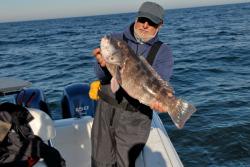
Catch bass like this in January

Catch bass like this in January

Unless you live in Florida or south Texas, the bass in your local lakes are likely swimming in some of the coldest water they see all year. Fishing for them can seem like an exercise in futility, not to mention a great way to expose yourself to some pretty unfriendly conditions.

As intimidating as the negatives of winter fishing can be, there are also some positives. The scenery can be amazing, there is little to no competition, and the fish you do catch are usually the right ones.

By focusing on those positives, FLW Tour veteran and Denali pro Michael Murphy has developed a healthy appreciation for winter bass fishing.

“We can talk all day about the cold, or how they don’t always bite well in the winter.” Murphy said. “But what I like to focus on is how refreshing it is to have the lake to yourself, see some beautiful scenery, and catch giant bass.”

Murphy has always been a jerkbait fisherman, a trait bred into anglers that fish the clear, blueback lakes around his Lexington, S.C. home.

“I spend a lot of time on lakes like Murray, Hartwell, Clarks Hill, and Wateree. All of them have clear water and have dynamite winter jerkbait bites. The bass are suspended in that cold, clear water. A jerkbait just hanging in their faces triggers strikes on even the worst weather days.”

Obviously, the first key to success with winter jerkbaits is to put on some cold weather gear and actually get out on the water. Once there, Murphy has the following tips to help you extend your bass catching season into the New Year.

1. Use the right rod

Murphy said that the number one thing anglers struggle with when fishing jerkbaits in cold water is getting the setup rod right. “Having a rod that is designed perfectly for your technique is more important in the winter than it is any other time of the year. It’s already cold, your hands may not work as well, and you’re likely wearing a bunch of gear. If you’re frustrated from fighting with backlashes or missing and losing fish (which are all things that happen with jerkbaits when you don’t have the right rod), you’re not going to be successful or have fun.”

Murphy uses the Denali Rosewood jerkbait rod (S802JBC) that he designed, and pairs it to a 6.4:1 Lews BB1 casting reel. As the primary designer of the rod, Murphy put a lot of time on the water testing to ensure that it has the absolute perfect flex and power for fishing jerkbaits in cold water.

“We built the Denali jerkbait rod as an alternative to the high dollar custom jerkbait rods lots of guys were using. We shortened the rod handle so it doesn’t get in the way of heavy clothes, gave it the right parabolic bend to keep fish hooked up, and kept a good tip for getting the proper action.”

Winter bass are lethargic and often just slash at jerkbaits, resulting in poorly hooked fish. If you’ve got a big bass hooked up with just a single hook or outside the mouth, having a parabolic action with some give is imperative to keep the hook buried.

In addition to the parabolic flex, Murphy also designed the rosewood jerkbait rod to have a fast tip to impart the perfect subtle flash required to draw strikes in cold water.

“A lot of crankbait rods have that good parabolic action we were after, but they are kind of dead in the tip which makes them less than ideal for jerkbaits. We kept the flex in the mid-section of our jerkbait rod but added a faster, more sensitive tip so that you don’t lose the ability to precisely control your bait.”

As far as baits go, Murphy has had experiences with a number of different baits over the years, and said that almost all of them can be successful if the conditions are right. The one he uses the most though is the Ima Flit, which he also had a hand in designing.

“I look at the Flit as one of the only jerkbaits out there that can be successful under any conditions.” Murphy said. “It dives 6-8 feet deep like a Lucky Craft Staysee , has the subtle darting action of a Megabass Vision 110, the high pitched bb sound of a Rogue, and lacks the internal weighting system like a Husky Jerk. It does it all and I have a ton of confidence that it will catch fish no matter what conditions you’re experiencing.”

2. Work slow, fast

This might sound confusing at first, but winter bass often group up and suspend over different types of structures, making it important to fish a variety of different locations in a day to locate bass.

“I have seen winter bass suspend around almost any type of steep cover available.” Murphy said. “Sometimes it’s bluff walls, other times chunk rock points or dock pilings. Whatever it is though, it’s important to hit a bunch of spots in a day to figure out where the bass are. That’s where the fast comes in. I like to hit a spot for 15-20 minutes tops, and if I don’t get a bite then I’m off to somewhere else.”

The slow part refers to the actual fishing, and Murphy doesn’t stray from convention. He recommended anglers move from a jerk to more of a slide as the water temperature drops, while increasing the length of pauses.

“In really cold water, I actually do more of a slide than a jerk. Baitfish don’t really dart in cold water, so you need to mute it down some. The important thing is to start with slack and end with slack, then experiment with your pauses depending on how the fish react.”

3. Listen to the fish

Remembering the circumstances surrounding a fish catch can be important at any time of the year, but Murphy said that it’s exceptionally important when throwing a jerkbait in the winter.

“Sometimes the bass will get really dialed in to a specific cadence or pause length. If you pay attention to what you were doing when a fish eats, you can often replicate it and score the rest of the trip. I’ve seen it before where they only eat a bait after a 5 second pause and won’t touch anything different.”

The same can be said for the type of cover or structure a bass is caught near. Even though winter bass are more lethargic, they will position on different structures depending on the weather, wind, or light penetration.

“You hear pros talk all the time about pattern fishing, and winter jerkbaiting is awesome pattern fishing.” Murphy said. “If I catch a couple off a 45 degree pea gravel point, there are likely to be bass on other 45 degree pea gravel points all around the lake. I can then focus on those the rest of the day.”

The Final Word

In addition to the pointers above, Murphy has one last one that he said may be the most important, and that’s to not let cold and winter stop you from getting on the water.

“I can’t believe how many fishermen put their rods and reels away when the calendar flips to January. It may be cold, but if you pick up a jerkbait and put some time on the water, you’re going to catch a lot more bass than you will from your couch.”