Dove Shooting Memories

Did you get a chance to shoot at some doves yesterday? Opening day of dove season was always a highlight of my year while growing up. Although it was bittersweet, since it always was about the time school started back, I really looked forward to trying to hit the little gray birds. Opening day always bring back greet dove shooting memories.

Dove shoots were a big family affair back then. My Uncle J.D. always had a field and I got to go with daddy from the time I was able to walk to the blind and stay still. I was daddy’s retriever and I prided myself on never losing a bird he hit, no matter how thick the briars were where it fell.

I finally was allowed to carry my .410 shotgun on those shoots when I was about eight years old. On the first hunt that I was allowed to have my gun Uncle J.D. gave me an old army surplus gas mask bag to carry my shells and other supplies. Although that was almost sixty years ago I still use that bag when deer hunting.

I had a tough time hitting doves with my .410 since I didn’t get much practice shooting at flying birds. I was deadly with it on squirrel in trees but hadn’t learned to hit moving targets. And I didn’t shoot much since I think the adults put me and my cousins my age in blinds out of the main fly routes.

Sometimes I shot five or six times all afternoon, and didn’t hit a bird for the first couple of years I tried. I still remember the first dove that actually fell when I shot. I was very proud of it!

Daddy was the Agriculture teacher at the local high school and knew all the farmer in the area. So he got invited to many shoots and there were very few Saturdays during season we didn’t go after I proved myself at Uncle J.D.’s farm. On one exceptional shoot, when I somehow ended up in a good blind, I actually killed five doves. And it took only one box of .410 shells.

Back then most people didn’t pay much attention to the limit on doves and would kill all they could. Time were different and the doves provided good eating for the family, but you needed a lot of bird for a big family.

On one shoot when I was about 16 years old I killed a lot of birds. I was shooting a 12 gauge shotgun and it was more efficient, but at the end of the day I had shot five boxes of shells! Even on my best day I missed about three out of four shots!

My uncle Adron shot a 16 gauge shotgun and was deadly with it. I watched him many times in amazement. He almost never missed a bird – you could count on one dropping when he pulled the trigger!

Dove shooting is expensive, especially if you try to have your own field. It is bad enough shooting up several boxes of shells to kill a limit, but that is cheap when you consider the cost of plowing, planting, fertilizing and taking care of a field.

When I moved to Griffin in 1972 I wanted to go to a dove shoot that first fall but knew no one with a field. I saw an advertisement for pay shoot in the paper and went to it. Some farmers set up a dove field and charge people to hunt it to recoup their expenses.

That was my first and last pay shoot. I didn’t really pay much attention to the field, just watching the doves flying around when I checked it out. The day of the shoot I set up on a fence line and had killed two birds when I saw two game wardens coming across the field, checking each hunter.

I wasn’t worried since I was doing everything legally – I thought. But when the federal agent took my license and put it in the stack he was carrying I knew something was wrong. He said I needed to take my stuff to the parking lot and wait there for my ticket. The field I was on was baited.

The field owner had a legal field and sold all the spots on it he had, and had more people wanting to pay him to shoot. So he spread wheat on a nearby hay field and sold shooting spots on it. There were about 30 of us that got fined in federal court for being on a baited field. Each hunter paid a $75 fine and I heard the field owner had to pay a $2000 fine!

If you have a place to shoot doves, enjoy it. Make some great dove shooting memories! Just follow the laws. Don’t get that sick feeling I had when the game warden took my license! It is the only time I have ever gotten any kind of fine for anything related to hunting or fishing, and I never want another one!

What Is the Fall Kokanee Salmon Run?

By Dan Johnson
Fall kokanee salmon run offers fine fishing

Kokanee Salmon

Kokanee Salmon

Kokanee head to the shorelines and inlets to spawn in fall, providing good targets for anglers in many areas of the northwest.

Autumn is a time of plenty for anglers, as cooling water temperatures spark feeding binges among a variety of gamefish. For some species, however, fall ushers in an equally primal urge, causing fish to migrate en masse toward spawning areas.

Such is the case with many members of the trout and salmon family, including the kokanee salmon. A downsized freshwater version of the Pacific sockeye salmon, the kokanee is nonetheless hard fighting and great tasting.

Plankton eaters that mature in four years, kokanee salmon can reach weights of 3 to 5 pounds, but 1-pounders are the most common catches in many waters.

In states where stocking efforts produce fishable populations, the fall kokanee run is a huge draw for anglers. “It’s a really fun bite, there’s nothing not to love about it,” says veteran fishing guide Bernie Keefe of Granby, Colorado.

“As water temperatures fall into the 55- to 60-degree range, usually sometime in September in Colorado, salmon begin migrating from their summertime haunts in the main lake toward the spawning grounds,” he explains.

Normally bright silver in color, kokanee undergo a dramatic transformation as spawning draws near. Both sexes develop reddish sides and green heads, but the male’s red caste is most pronounced. Amorous bucks also develop a humped back and hooked jaw—also called a kype.

Spawn makes the fish change

Spawn makes the fish change

As the spawn nears, male kokanee develop a humped back and extended jaw.

As schools of fiery red salmon gather in predictable places, the fishing can be nothing short of amazing. “You can get into some pretty fast action,” Keefe grins.

Kokanee spawn over rubble, gravel and sand in tributary streams and along lake shorelines. This narrows the search, but Keefe adds another nugget of information on their whereabouts.

“They typically return to the area where they were stocked,” he says. “Inlets and boat ramps are two of the most common areas.”

To pinpoint the best lakes and stocking points, Keefe recommends contacting local fisheries biologists and bait shops. “Most lakes are a little different, so pre-trip research can really pay off,” he says.

On the tactical front, Keefe offers two surefire plans of attack.

“One great option is to get on the water before sunrise and quietly wait for the fish to start porpoising,” he says. “As soon as it’s light enough to see where they are, use your electric trolling motor to sneak within casting range. Just be careful not to crowd them or it’s game over.”

Salmon often school close to shorelines, making bank fishing a great alternative. “You don’t need a boat to enjoy the action,” he says.

When fishing the morning bite, Keefe wields a lightweight spinning outfit armed with either a bobber rig or small spoon.

Given the kokanee’s soft mouth and spirited fight, he typically spools up with a forgiving monofilament mainline like 6-pound-test Berkley Trilene XL. “You can use superline with a fluorocarbon or mono leader, but set your drag really loose or the fish will tear the hooks out,” he cautions.

The bobber setup includes a 1/16- to 1/8-ounce micro-jig tipped with a 2 1/2-inch Berkley PowerBait Power Tube, positioned two to six feet below a small float.

“Either slip- or fixed floats work in early fall, but fixed floats are the rule once temperatures drop below freezing,” he adds.

Keefe avoids adding split shot for ballast. “Don’t expect the fish to pull the bobber under,” he notes. “A lot of times they just lay it on its side, so you can’t have any extra weight on the line or you’ll miss fish.”

He does sweeten the jig with bait, however. “Two or three waxworms work great, as do kernels of shoepeg corn,” he says.

To fish the float rig, he lobs a long cast past fish dimpling the surface. “Let it sit a minute,” he says. “Most mornings there’s enough breeze to ripple the surface and work the jig just enough to attract nearby salmon.”

Surface feeding salmon

Surface feeding salmon

Afoot and afloat, Keefe casts to schools of Kokanee dimpling the surface.

After the initial pause, he pulls the rig about six inches, lets it sit again, and repeats the process until his float is out of the strike zone.

Spoons are another productive presentation. Keefe favors something long and slender, like an Acme Kastmaster or Johnson Splinter, in the 1/16- to 1/8-ounce class.

Retrieves are slow and gently animated. “One rotation of the reel handle per second is fast enough,” he says. “Spice it up by raising and lowering the rodtip six inches to a foot, reeling the whole time. Most fish hit when the spoon begins to fall.”
Keefe cautions that once the sun hits the water, salmon sound and the near-surface bite dies. “Wind, clouds and waves can prolong the action a little, but not for long,” he adds.

At that point, he recommends trolling small willow-leaf spinners 1.5 to 2 mph in the top 10 feet of the water column. “The fish will move around the immediate area, so you have to go looking for them,” he explains.

Keefe says the fall kokanee bite typically lasts from September until ice covers the lakes, usually sometime in November or December.

“Kokanee are great table fare,” he adds. “But they die after spawning, and by the end of the season are looking pretty rough, like the swimming dead.”

As a rule of thumb, he says, “As long as the meat is orange, it’s good to cook. Once it turns pale, however, put it in the smoker.”

How Can You Catch Suspended Bass?

If you ask most bass fishermen how to catch suspended bass, don’t be surprised if the response is: “you can’t.” Suspended bass present fishermen with one of the most difficult problems to solve and many just give up and go look for easier fish to catch. But there are ways to get them to bite and tactics that will help you land fish that others give up on.

Bass suspend away from structure and cover for a variety of reasons. One of the most common is when lakes stratify, forming a thermocline between hot upper oxygenated layers of water and cooler, deeper layers with little oxygen. Bass can’t live in the cooler waters so they get as close to it as they can, suspending over deep water at the level where they can still find enough oxygen.

Suspended bass will often be found holding off points and humps at the most comfortable depth to them. They will be over a deeper channel but not far from the rise in the bottom where it meets the depth they are holding. That allows them to run in and feed, then move back out over deeper water.

Some lakes present a special situation where standing timber under the water rises many feet off the bottom. Bass will often use these trees as cover, relating to the trunks and limbs while holding well off the bottom of the lake.

The best way to find suspended bass where you fish is to ride the lake and watch a depth finder carefully. Follow channels and ditches while watching for fish holding between the bottom and the surface. Riding back and forth over a point or hump, not turning your boat until well past the drop of the bottom contour, will show you schools of bass suspended near them. And moving slowly over standing timber will reveal bass suspended in it if your depth finder is a good one.

Depth control of your bait is critical to catching suspended bass. They are holding at a set depth and will not move far up or down to take a bait. So finding the bass and knowing what level they are holding is just the first step. You must then find a way to put your bait at the level where they will see it.

A crankbait is a good way to catch suspended bass but you must make it work at the dept the bass are holding. There is an old tried and true method of doing this that has fallen out of favor. Trolling it a great way to get your crankbait down to a set depth and keep it there while covering a lot of water, but it is against the rules in bass tournaments so many bass fishermen have abandoned it, but it still works.

Most lure companies have designed a variety of crankbaits that run down to a set depth. For example, a Bandit Series 400 will run 12 to 16 feet deep and a Series 700 will run 14 to 18 feet deep. A Bomber Fat Free Shad will run 14 to 18 feet deep while a Fat Free Fingerling will run eight to 10 feet deep.

The depth varies depending on factors like trolling speed, line size and amount of line out, so you need to experiment to find out the exact combination to produce the exact depth you want. Mark a set depth on a point then troll over it varying line size, length of line out and trolling speed until your bait just ticks the bottom at the depth you want it to run, then troll through schools of bass at that depth.

You can do the same thing if you are limiting yourself to casting, but line size and the distance you cast are even more important. And boat position becomes critical. When you cast a crankbait like the Bomber or Bandit it will dive to its maximum depth as you start your retrieve then rise when it gets near the boat.

Since your crankbait will stay a the desired depth for only a short distance when casting, you must locate the schools of bass then position your boat near them so you can cast past them and work the bait back, keeping it at the critical depth as long a as possible.

Some newer baits on the market make casting and controlling your depth easier. Both the Swarming Hornet and the Fish Head Spin are lead-head baits with a small spinner under the head. When you attach a Roboworm E-Z Shad or other shad looking plastic bait, it imitates a baitfish.

Tie on one of these baits and vary the weight of the lure and the line size to match the conditions like wind, water clarity and depth you want to fish. Smaller diameter line helps keep the bait at the depth you want to fish and you can get by with lighter line since the bass are away from cover.

Position your boat near the school of suspended bass and make a long cast past it. Feed line to the bait as it falls so it drops straight down and count it down. Figure one second per foot of drop, but to be more exact cast to a known depth and count it down to make sure your are accurate.

When the Fish Head Spin or Swarming Hornet reaches the correct depth, slowly reel the lure along. A slow, steady retrieve keeps the spinner turning and keeps the bait at the optimum depth. You can cover much more water at the best depth with one of these lures than with a crankbait since the lure drops straight down to the correct depth then stays at that depth all the way back to the boat.

One of the easiest and most effective ways to control the exact depth you want to fish is by using a drop shot rig. A drop shot rig is one where the lead is tied to the very end of your line and a hook tied on up the line. Special hooks and sinkers are designed for drop shotting and make it a more efficient way to fish, but you can use any sinker and hook as long as the hook is very sharp.

Gamakatsu hooks are known to be super sharp and they make a Drop Shot/Split Shot hook that comes in a variety of sizes and you can choose red or black hooks. These hooks are relatively small and are perfect for nose hooking small plastic bait like a Slider Worm, Roboworm or Gulp Minnow Grub.

A soft, straight worm like the Slider or Roboworm is the usual choice for drop shotting, but experiment with other shapes of baits, too. Some days the bass might like a fat Gulp Grub with a quivering curly tail over a thin straight worm.

Choose one of the plastic baits that match the size of the baitfish the bass are eating, and use a color based on water color. Clear water is usually best for drop shotting so line choice is critical, too. Fluorocarbon line is the standard for drop shotting and Sunline is invisible in the water and holds up well. The lack of stretch of fluorocarbons like Sunline also help with hooking fish on light line.

You can drop shot at any depth you find the fish holding. If they are three feet off the bottom, tie your hook three feet up the line. If they are 15 feet off the bottom, tie your hook 15 feet up the line.

This may sound strange but, since the sinker is at the end of the line, when you hook a bass and reel it in, there is nothing to get in the way of landing it. You may have a lot of line trailing the bass but you can land the fish without reeling it all in.

Get your boat right on top of the school of bass and hold over them watching your depthfinder. Let the sinker on your drop shot rig hit the bottom and you know your bait will be at the exact depth you tied it above the sinker. Twitch your rod tip, making the worm or grub dance right in front of the bass’s mouth.

Drop shotting is the best way to catch bass suspended in timber, too. For these bass, tie a hook a few inches to a foot above a sinker and get right on top of the fish. A good depth finder will allow you to watch your bait as it falls and you can stop it right in front of the bass and shake it. You are usually targeting a single bass in timber rather than a school. A drop shot rig moves the sinker away from the bait while still giving ou exact depth control.

Don’t let suspended bass ruin your day. Try these techniques to land them when others are just shaking their heads.

Fishing Was Tough At Lake Oconee

At Oconee last Sunday 15 members of the Spalding County Sportsman Club fished for eight hours for our August tournament. We landed 20 14-inch long keepers weighing about 38 pounds. There were no limits and four members didn’t land a keeper.

Jay Gerson won with two fish weighing 6.35 pounds and his 3.57 pound largemouth was big fish. Kwong Yu came in second with four at 5.42 pounds, John Miller placed third with 3 weighing 4.97 pounds and my two weighing 4.04 pounds was fourth.

We started at 5:30 so we had about an hour to fish in the dark, and I caught both my keepers before 6:30. They both hit a Texas rigged worm near two different docks. After that I fished all over the lower end of the lake, trying many different kinds of structure and cover at different depths, and caught a few short fish. It was a very tough day.

At 11:00 I heard thunder rumbling back to the west and I looked at the radar app on my phone and saw a line of red headed my way. So I ran the five miles back to the ramp, tied the boat to the dock and sat in my van until noon when the lightening stopped. I will not stay on the water when it is lightening.

After it stopped I fished for another hour and a half and caught a throwback but that was it.

Where Should I jig a Spoon for Georgia Bass?

Jig A Spoon For Bass

One of the most efficient ways to catch a bass this time of year is to jig a spoon. But which of our lakes are best for jigging, and what works best on them?

Way back in 1974 I was spending my Christmas holidays at Clark’s Hill. I had my first depth finder, a Lowarence flasher, on my first bass boat and I was learning to use it. On a ridge in Germany Creek I kept seeing flashes just off the bottom in 12 feet of water. Although I drug crankbaits and worms through the area I never hit anything, so I guessed it must be fish. But I never got a bite, either.

I remembered something I had read about jigging a spoon and dug around in my tacklebox. I didn’t have a spoon but did have some Little Georges, so I tied one on. After trying a variety of retrieves, from casting and hopping to dragging along the bottom, I found if I jigged it straight up and down about two feet, feeling the blade spin going up and down, I would get a hit.

In three days I landed over 60 bass from that school before they moved on. I often find bass stacked up in deep water schools like that and catch them on spoons and Little Georges starting in November and that pattern usually holds up until late February.

What makes a good jigging lake? Clear water helps. Deep structure like trees and rocks can be good, but sometimes bass like a hard clay or sand bottom. A good population of threadfin shad is good since they usually have a die-off from cold water and bass hold under the schools looking for an easy meal.

What do you need for jigging a spoon? A good depthfinder is a must. My old Lowrance flasher worked but to really find fish you need a high quality unit that will show you fish even when they are holding tight to cover. And you need to find the little changes in structure and cover that attracts them.

I like a six foot baitcasting rod and reel spooled with 12 to 17 pound fluorocarbon line. The rod needs to have a fairly light tip so you can feel every move the spoon makes but plenty of backbone so you can set the hook and get the fish away from cover.

Lake Lanier offers almost perfect jigging conditions and I have heard jigging spoons in Georgia got its start there back in the 1960s. Spotted bass are also seem to take spoons even better than largemouth and Lanier is full of spots. But be prepared to go deep in Lanier – spots there often hold in water 50 to 60 feet deep in the winter.

Find standing timber in deep water and ride over it until you spot fish. When you find fish drop a marker near them – it is very easy to get off the fish if you don’t. Drop your spoon down and jig it up and down in front of them. You can usually see your spoon with a quality depth finder to know exactly where it is. If your spoon stops before it hits bottom, set the hook. Bass will usually hit on the fall.

Other good clear water lakes like Lanier are Russell, Hartwell, Allatoona and many north Georgia lakes. They have similar cover and fish as Lanier.

Clark’s Hill is where I got my start and it is a good place to jig, but it is usually more stained. In stained water I often use a Little George for more vibration and flash. And the fish are shallower. Check hard clay and sand humps and points in 12 to 30 feet of water there and on Oconee, West Point and Jackson for similar fishing.

Don’t let the weather keep you inside this time of year. Get a spoon and get on the lake.

Can Alabama Shows Congressional Staffers Just How Good the Red Snapper Fishery Is?

Alabama Shows Congressional Staffers Just How Good the Red Snapper Fishery Can Be

By David Rainer
Alabama Department of Conservation and Natural Resources
from The Fishing Wire

Alabama Marine Resources Director Chris Blankenship has a point to make, but the audience he needs to reach is not on the Alabama Gulf Coast.

Alabama’s saltwater anglers are well aware of the red snapper story, so Blankenship reached out to what is known as the Washington (D.C.) bubble, where outside information has a hard time gaining attention.

Blankenship came up with a plan for a “show and tell” event that would expose staffers from the offices of U.S. Congressmen and Senators from Alabama, Mississippi, Florida, Louisiana and Texas to exactly what a red snapper fishing trip off the Alabama Gulf Coast is like.

Red snapper caught in Alabama

Red snapper caught in Alabama

Last week, he pulled that off with great success, utilizing the Gulf Headboat Collaborative Program to accomplish the mission.

“We wanted to show the congressional staffers exactly the condition of our fishery here,” Blankenship said. “I’ve been to Washington four times over the last year-and-a-half to talk about red snapper and the need for changes in federal legislation to give the states more flexibility and to transfer some of that management to the states.

“We can talk about it, but they hear from a lot of people. We wanted them to have the opportunity to come down here personally and see how great our fishery is and what that fishery means to our community. This puts people’s faces and names with a very important issue.”

The reason Blankenship was able to arrange the trip out of Orange Beach on Capt. Randy Boggs’ Reel Surprise outside of the regular red snapper season is because of a pilot program that has been in effect for the last two years, the aforementioned Gulf Headboat Collaborative (GHC).

The GHC is an exempted fishing permit program for 17 headboats from across the five Gulf states. It essentially takes the amount of fish these headboats have historically caught and holds them out of the recreational quota. These federally permitted boats are allowed to catch those allotted red snapper any time during the year. When the allotment is depleted, no more red snapper can be retained. Each vessel in the program is equipped with a VMS (vessel monitoring system) that tracks its movement via satellite.

Catching Alabama Red Snapper

Catching Alabama Red Snapper

“It doesn’t allow them to catch any more fish than in the past,” Blankenship said. “It just allows them have a business plan and make their quota last throughout the year. The program has worked very well. They have to send Marine Resources an email before they leave dock and send us an email one hour before they reach the dock in the afternoon so we can have an officer inspect their catch.

“We wanted to go out with Capt. Randy Boggs and catch a few red snapper to bring back and cook to really show the people how important this fishery is not only to the charter boats but to the restaurants and other businesses that depend on having access to this great fishery.”

The GHC pilot program was in effect for 2014 and 2015. Despite its success, the program may not be renewed by the Gulf of Mexico Fishery Management Council in time for 2016.

“There is a proposed amendment that would essentially extend that program, but the Gulf Council process is very slow,” Blankenship said. “It looks like in 2016 the headboats will be back in the fishery with all the other charter boats. That program will have a hiatus of at least one year while they work out the extension through the Gulf Council.

“This pilot program is showing that it works on headboats, so the charter boats in Alabama are interested in a similar type program to use a portion of the quota assigned to the charter boats in Alabama.”

Last week, Capt. Boggs set a course to one of his artificial reefs about 30 miles from the mouth of Perdido Pass to provide an example of how good the red snapper fishing is off the Alabama coast.

After a leisurely ride in 2-foot seas, Boggs pulled back the throttles and gave the order to “drop ’em down.”

“Don’t let it go to the bottom,” he said. ‘That’s where the little fish live. There are fish showing up starting at 35 feet. Give it a count of about five or six and see what happens.”

Big Alabama Red Snapper

Big Alabama Red Snapper

What happened was a fantastic, frenetic example of snapper fishing in Alabama’s artificial reef zone.

In less than 10 minutes, big red snapper after big red snapper hit the deck. When Boggs gave the order to “keep ’em up,” there were 24 impressive red snapper caught by the congressional staffers in the fish box.

The crew changed tackle to try to target the smaller vermilion snapper at the next two stops, but all the anglers caught and released were different-sized red snapper.

Trolling on the way back in, a small king mackerel was added to the catch.

“We went to one reef and red snapper just came to the top; there were so many red snapper there,” Blankenship said. “The action was fast and furious with big snapper. The next two places we went had plenty of small red snapper that were 12, 13, 14 inches mixed in with larger fish. It just shows that we really do have a good, mature fishery with good recruitment with a lot of small snapper coming up behind these big ones.

“We really want to be able to manage the fishery for the benefit of the anglers and the resources, and we feel like we can do that better locally than Gulf-wide.”

Blankenship said the congressional staffers were “extremely impressed” by the red snapper fishery off Alabama.

“Even though we talk about how we have plenty of red snapper, it made a real impression for them to go out after the charter season and after the recreational season and see how many red snapper are still on our reefs off the Alabama coast. It gave them an appreciation that the states can do more accurate assessments and better manage that fishery to give our people more access to the fish.

“And they wanted to see the restaurants, marinas and dock stores. They really wanted to see how many businesses rely on tourism and rely on a healthy fishery here in the state of Alabama and rely on continued access to red snapper, the fish that the Alabama Gulf Coast is most known for. The staffers asked some great, probing questions, not only about the recreational fishery but the charter and commercial fishery and how we could manage the different sectors fairly.”

The fishing trip turned out exactly as Blankenship had envisioned.

“It probably could not have turned out any better,” he said. “We were able to catch some very large snapper very quickly on one of our reefs, and then go to some other reefs and catch small snapper mixed in with big ones. Several big snapper came up to the top right off the stern of the boat on one of the well-known public reefs, which just shows you how many snapper are available on those reefs.

“We feel like our fishery is so good because of our reef-building program and partnerships with other agencies. There couldn’t have been a better opportunity to showcase our fishery and to discuss the real issues that need to be solved in Washington to fix the current federal management.”

To top off a great day of fishing, the cleaned red snapper were taken to the Flora-Bama Yacht Club for a sumptuous dinner meal prepared by Chef Chris Sherrill, Sous Chef Haikel Harris and the restaurant staff.

“Chris is a talented chef and was really able to showcase the fish and hospitality of the state of Alabama,” Blankenship said.

“This type of trip shows that we’re not sitting idly by and waiting for something to happen on red snapper,” he said. “We’re working every avenue we can to give our fishermen more access and to give us the ability to sustainably manage the red snapper fishery the way that it needs to be managed.”

Got To Do Something About Guns

We’ve got to do “Something” about guns. We’ve got to take on the NRA and do “Something.”

I am terribly sorry Mr. Parker lost his daughter when a mad fool shot her while she was doing a broadcast in Virginia last week. And his reaction, emotionally lashing out, trying to find something to blame, is understandable. But blaming me is not rational.

The victim’s blood had not even stopped dripping before the gun control buzzards were circling their bodies. The usual thoughtless politicians were immediately calling for some kind of law – to do “Something,” regardless of what it might be. And the Brady Bunch gun control advocates were busy sending out emails asking for donations. I got one a few hours after the shooting made the news.

Governor Terry McAuliffe of Virginia had the best comment I saw. While ranting about how laws must be passed to restrict law-abiding gun owners, in order to do “Something,” a reporter asked him what he knew about the details of the shooting. And his response was perfect. Reminded me of Sergeant Schultz on Hogan’s Heroes.

“I don’t know anything” he said. And he was right. He was determined to use this tragedy to further his political agenda on gun control although he had no idea what he was talking about. That is not unusual.

The current evil they want to do “Something” about is what they call common sense background checks. Never mind the murderer in Virginia had gone through a background check, and had put a deposit on the pistol he used two months before he shot the reporter. So much for waiting periods, too.

People die every day from car accidents caused by someone illegally driving and texting. If the reporter had been killed in such an accident, would her father be demanding we do “Something” about cell phones? Maybe a background check and waiting period before buying one? How about the common sense action of not allowing individuals to sell their cell phones to someone else? Those are the kind of illogical things they apply to guns.

Keeping the insane from getting guns is reasonable. But how? Do as some are trying and take guns away from those drawing social security because they can’t take care of their own finances? Or take guns away from any veteran who has admitted war bothered him?

While Amy Parker’s father blamed the gun, not the fool shooting his daughter, and wanted to do “Something” about guns, the husband of Vicki Gardner, executive director of the Smith Mountain Lake Regional Chamber of Commerce who was also shot, said he didn’t blame the gun. He knew the murderer that shot his wife would have, as he said, done it with a machete, bomb, knife, he would have found something.

Maybe “Something” could be done if the gun grabbers didn’t always go to extremes to try to take all guns.

The definition of insanity is doing the same thing and expecting different results. In the case of extended background checks, several studies have shown that the background checks do not reduce crime. So why extend them? That is definitely insanity.

Don’t Drink and Drive – Drunk Boating Kills

Drunk Boating Kills

As Labor Day approaches—one of the busiest boating days of the year—the Coast Guard is issuing a somber warning: Drunk Boating Kills.

By Petty Officer 2nd Class Cynthia Oldham
from The Fishing Wire

Drunken boating destroys lives.

A Coast Guard Station Boston response boat crew is underway, Friday, July 3, 2015 in Boston Harbor. (U.S. Coast Guard photo by Lt. Karen Kutkiewicz)
Drinking alcohol and driving any vehicle is taking a risk, but on the water risks are elevated and consequences are devastating – and deadly.

This summer, New England Coast Guard crews have responded to multiple incidents involving alcohol and boating. In one of the most recent, it was not another boater who reported the reckless behavior aboard a boat near Martha’s Vineyard, but a fearful passenger on the boat who called for help.

The marine environment – the sun’s heat and water’s motion – intensifies the effect of alcohol, and an inebriated mind, coupled with relaxed inhibitions and inexperience, is why alcohol is the number one contributor to fatal boating accidents.

Petty Officer 2nd Class Thomas Ciarametaro, a coxswain and boarding officer at Coast Guard Station Boston, put it simply; Boston Harbor has no lanes.

People generally have a lot more experience and confidence on the road than on the water. In fact, national data shows recreational boaters average only 110 hours – less than five days total – on the water each year.

Walt Taylor, the 1st Coast Guard District’s expert in recreational boating safety, said the Coast Guard wants people to have enjoyable boating experiences, but also to know things can and do go wrong.

“Alcohol use can impair a boater’s judgment, balance, vision, and reaction time,” said Taylor. “Combining alcohol with environmental stressors and motion of the boat can cause fatigue, dehydration, and may unknowingly intensify the effects of alcohol.”

A sudden change of weather, boat malfunction, or medical emergencies can quickly turn a pleasant day on the water into a disaster. If tragedy strikes, boat operators and passengers must have clear, sober minds to take appropriate action.

Consider what happened in May, when a boating disaster near Spectacle Island in Boston Harbor cost a woman her arm, and nearly ended her life.

The woman was one of many passengers aboard a boat partying with an operator who was under the influence. After jumping in the water, the woman was swimming near the boat’s stern and the propeller struck her, sliced off her arm, and inflicted severe body lacerations.The party turned to chaos.

When the Coast Guard rescue crew, which included Ciarametaro, arrived on scene, the boat’s operator was intoxicated and disorderly.Ciarametaro said the Coast Guard crew quickly focused on saving the woman’s life while the State Police took the boozed-up boat driver into custody.

This kind of inter-agency teamwork is common during emergency responses and routine safety patrols.

Operating a boat, including paddle boats, with a blood alcohol content of .08 or higher is reckless and illegal. The statistics are scary. A boat operator with a blood alcohol concentration just above the legal limit, at .10 percent, is 10 times more likely to die in a boating accident than a sober boater.

Ciarametaro said the station’s crew does recreational safety boardings every day, and if there is probable cause to conduct a Field Sobriety Tests on a boat’s operator, they will.

In other situations, if a Coast Guard crew observes a boat operating erratically or putting other boaters at risk, they will board that boat and test the operator without hesitation.

Operators may decline, but in Massachusetts for example, refusing to participate in the test is an automatic civil penalty, admission of guilt, and a fine up to $3,000.

Legal repercussions, coupled with the severe risks to life and property, are real, terrifying consequences of drinking and boating.

Alcohol use on one boat threatens everyone on the surrounding water. If you plan to party on the water, have a designated sober boat driver and a reliable means to call for help.

Channel 16 on a VHF-FM radio is the preferred method to contact the Coast Guard, but the Coast Guard also has an easy-to-use boating safety app that features an emergency assistance button, which with locations services enabled, will call the closest Coast Guard command center. It could save your life.

How Far Did A Shark Tagged Near Cuba Swim?

Rare Shark Tagged Near Cuba “Phones Home” Near U.S. Coast

by Hayley Rutger, Mote Marine
from The Fishing Wire

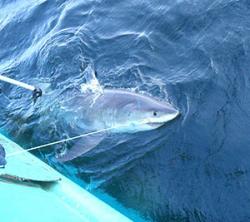
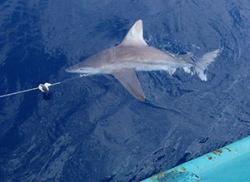
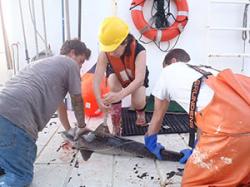
 Shark tagging


Shark tagging

Tagging of longfin mako shark was featured in Discovery’s Shark Week, will air with updates in Shark Weekend

A rare longfin mako shark satellite-tagged near Cuba recently “phoned home” off the U.S. Atlantic coast, say Mote Marine Laboratory scientists and colleagues who tagged the mako during the first-ever expedition to satellite-tag sharks in Cuban waters.

The shark was tagged on Feb. 14 offshore of Cojimar in northern Cuba, during an expedition by scientists from Mote, a world-class marine research institution in Sarasota, Fla., from Cuba’s Center for Coastal Ecosystems Research, the University of Havana, and other Cuban institutions, and from the Environmental Defense Fund, which facilitates U.S.-Cuban collaborations in science and conservation.

The expedition — including satellite-tagging the longfin mako — was filmed by Tandem Stills + Motion, Inc. and Herzog Productions and featured in early July in “Tiburones: The Sharks of Cuba,” a program of Discovery Channel’s Shark Week. An updated version of the program with these fascinating findings will air at 7 p.m. on Aug. 30 as part of Shweekend on Discovery.

The team also tagged three silky sharks in the Jardines de la Reina (Gardens of the Queen) National Marine Park off Cuba’s south coast. Each tagging was a dream come true for the U.S.-Cuban scientific team that had worked for years to obtain permission and resources to place the first satellite tags on sharks of Cuba.

“Our dream was to be able to deploy satellite tags on sharks in Cuban waters, on both the north and south coasts, in an equal partnership of Cuban and American research teams,” said Dr. Robert Hueter, Director of the Center for Shark Research at Mote. “We were able to accomplish these goals for the first time with this expedition.”

Tagging the longfin mako was especially exciting. This species generally inhabits deeper waters and poses more unanswered questions than its shallower-water cousin, the shortfin mako.

“There is a ton known about shortfin makos and almost nothing known about the longfin, which wasn’t described until 1966 by the Cuban ichthyologist Dr. Dario Guitart Manday,” Hueter said.

"Maximum likelihood track"

“Maximum likelihood track”

“Maximum likelihood track” of the longfin mako shark tagged by the U.S.-Cuban team off the north coast of Cuba in February 2015. Credit Mote Marine Laboratory.

On July 15 the longfin mako’s tag separated from its tether to the shark, as it was programmed to do, floated to the surface and began sending its archived data to Mote scientists via satellite. Since then, the research team has received and analyzed all the data to accurately document the shark’s movements.

After being tagged in mid-February, the shark departed from waters off Cojimar in northern Cuba, traveled with the Gulf Stream current between Florida and the Bahamas, and then doubled back into the eastern Gulf of Mexico, where it swam in a clockwise loop in April and early May between Florida and Mexico’s Yucatan Peninsula. Then in May the shark swam back along the Gulf Stream, through the northern Bahamas and into deep waters of the open Atlantic, where it proceeded north until it was offshore of New Jersey in late June. Finally, it headed south to waters off Virginia, and its tag popped off and surfaced about 125 miles east of the mouth of the Chesapeake Bay. The total track covered nearly 5,500 miles in five months, averaging about 36.5 miles per day.

This shark is the second longfin mako tagged by Mote, and one of just a few tagged worldwide. Its travels are raising exciting questions.

“The amazing thing is this longfin mako’s tag popped up in nearly the same exact location as another one we tagged in the northeastern portion of the U.S. Gulf of Mexico a few years ago,” said John Tyminski, who processed the satellite data and was joined on the expedition by Mote scientists Hueter and Jack Morris. “The movement patterns of the two sharks are remarkably similar: both sharks were in the eastern Gulf in April/May, showed comparable movements through the Straits of Florida, and ended in a similar area off Chesapeake Bay in July. Both tags came off during the month of July and both sharks were mature males. Clearly there’s something in that location that’s attracting mature males in summer.”

One possibility is mating, but satellite tags alone cannot confirm that or rule out other possibilities like feeding or just passing through.

The tag also showed the mako spent a majority of its time in depths of less than 1,640 feet (500 meters), staying mostly deeper during the day than at night, but the shark made some extreme dives including one to 5,748 feet (1,752 meters), more than a mile deep. “At that depth the shark is dealing with extreme cold, close to freezing,” Hueter said. “The data from this tag will help us understand why these sharks are diving so deep and how they are dealing with such cold temperatures.”

Two of the silky sharks reported back when their tags popped off early, about a month after the expedition. The tags revealed that the sharks had made movements away from the inshore reef area where they were tagged and into deeper offshore waters, spending most of their time in the upper water column but also diving during the day. One of the sharks reached a maximum depth of 2,073 feet (632 meters). The remaining silky shark wears a real-time satellite transmitter that can relay data to scientists when the shark’s fin surfaces — but so far it has tended to stay below.

The longfin mako’s results remain the most tantalizing — shedding light on the life of a rare species while demonstrating an important point: The U.S. and Cuba are fundamentally connected by the sea.

“The fact that these sharks go back and forth among the waters of multiple nations – in this case, Cuba, the United States, the Bahamas and Mexico – shows the importance of coordinating our fisheries sustainability and conservation efforts on a multilateral, even global, scale,” Hueter said. “Clearly it is important for the U.S. and Cuba to work together to protect vulnerable marine resources like these rare and depleted species of sharks.”

Founded in 1955, Mote Marine Laboratory & Aquarium is celebrating its 60th year as an independent, nonprofit 501(c)3 research organization. Mote’s beginnings date back six decades to the passion of a single researcher, Dr. Eugenie Clark, her partnership with the community and philanthropic support, first of the Vanderbilt family and later of the William R. Mote family.
Today, Mote is based in Sarasota, Fla. with field stations in eastern Sarasota County and the Florida Keys and Mote scientists conduct research on the oceans surrounding all seven of the Earth’s continents.

Mote’s 25 research programs are dedicated to today’s research for tomorrow’s oceans, with an emphasis on world-class research relevant to the conservation and sustainability of our marine resources. Mote’s vision also includes positively impacting public policy through science-based outreach and education. Showcasing this research is Mote Aquarium, open from 10 a.m. to 5 p.m. 365 days a year. Learn more at mote.org.

Contact Us:
Mote Marine Laboratory and Aquarium, 1600 Ken Thompson Parkway, Sarasota, Fla., 34236. 941.388.4441

Fishing and Writing About Fishing

Im a pretty good club fisherman. Over the years I have won the yearly point standings in the Sportsman Club 19 times and 18 in the Flint River club. And I have made the state team finishing in the top 12 fishermen out of over 500 at the Top Six tournament, the club championship of all clubs in the state, five times over the years. But I will never be as good as the top level fishermen, or even those guys that do well at the state level.

I love fishing and writing about fishing. The articles I write in GON and AON and Georgia sportsman are really like research reports I wrote getting masters degrees and a doctorate. I do research, going out with other fishermen, and report what they say. The research part is the fun part, the sitting at a computer for three hours writing it is not the fun part

The research can get hectic tho. I often drive four or five hours to the lake, go out in the boat for four to eight hours, then drive home. Makes for a long day!

The longest day I ever had was several years ago. I was doing an article with Karen Elkins on Neeley Henry Lake in Alabama. I made the mistake of telling her I could get her picture on the cover of the magazine if we could catch a five pound bass for pictures.

I drove four hours to meet her at 6 am. We went out and stayed on the water until 9 PM that night – 15 hours! And then I drove 4 hours home, arriving 23 hours after I left. And the biggest bass we caught was about two pounds!

I also write my column in the Griffin daily News each week and every other month in Kitchen drawer. And I do a web site on fishing. In those I sometimes try to write creatively but Im not sure how successful I am. But I write about anything that I want in them. Some of my favorites are about growing up wild in Georgia – my memories of the 1950s and 60s – a very different time.

In 2001 I wrote “The Everything Fishing Book” for Adams Media. An agent contacted me and asked if I would be interested. I had just retired from my day job and it seemed like a good idea at the time. When I found out the details I almost backed out. They wanted a very specific book, kinda a “fishing for dummies” covering all the basics. The worst thing was they gave me four months to write 85,000 words! I did manage to get it done and I think it sold a few thousand copies.

I have also put some of my Map of the Month articles into book format. For both Clarks Hill and Lanier I put together an article for each month of the year. It is in eBook format and I also sell it on CD and email it in Microsoft word format. Some fishermen have found it useful.

Those articles do help. I have won a good many tournaments following the old articles. One of the best was at Allatoona. I don’t fish that lake much, I had been on it only three times, all for articles, when the flint River Club scheduled a September tournament there. So I pulled out those articles, printed out the one for September and took it with me.

The article was with David Millsaps, one of the best fishermen on Allatoona and in Georgia. The article said start by going around a certain small creek up the Little River, fishing a jig and pig, so I took off at the start of the tournament and ran to it.

After going around the creek and catching two keepers I fished the upstream rocky point of it with the jig and pig with no bites. That was hole number 2. I pulled in the trolling motor, cranked the big motor and pulled out the article to check where hole three was. I noticed the last line on hole two said throw a big crankbait across the rocky point before leaving.
I turned off the motor, picked up a rod with a big fat free shad on it and the first cast caught a 3.5 pound spot. That fish turned out to be big fish in the tournament. And on hole three and four I got a keeper on each one, filling out my limit. I had five weighing 11 pounds that day – second place was five pounds! So the article works.

My wife says I can remember every bass I have ever caught, and I used to be able to. I still remember most. I may not remember her birthday or our anniversary some years but I do remember bass!

Its funny. I have been the secretary of both bass clubs pretty much since I joined, and I have all the old tournament results. A lot of times someone will talk about a tournament from years ago and how they weighed in a limit of fish weighing 18 pounds or in a tournament they had a nine pounder. But when I look back at the actual results, they had ten pounds. Or the big fish they caught was actually five pounds, not nine. Fishermen don’t lie, but our memories surely do grow! I have always heard a fish gets bigger the longer it has been since you caught it and that seems true.

Sometimes lucky bounces happen at tournaments even if they don’t seem lucky at first. Last weekend the Flint River club fished Clark Hill for our August tournament – which Niles won, by the way. I went over on Wednesday to practice two days before the two day tournament.

At 1:30 Thursday – On my birthday of all things – I was about five miles from the ramp and ran out of gas. No problem, my boat has two 25 gallon tanks and I knew I had at least ten gallons in the other tank. But for some reason I could not get the motor to pick up gas from that tank. It took me over two hours go get back to the ramp with my trolling motor in the hot sun.

But going in I saw the symbol for an old underwater house foundation on my GPS – something I would not have noticed if riding faster with the gas motor. Friday afternoon I rode over it with my depthfinder, saw fish on it and caught a two pounder. During the tournament my partner and I caught our three biggest bass from that foundation.
Another lucky bounce!
You have to take advantage of all your bounces! When life gives you lemons, make lemonade – or Margaritas if you prefer