What Is the Most Important Improvement In

Bass fishing equipment has made unreal advancements in my lifetime. When my uncles took me fishing in my preteen years we went in wooden jon boats, usually homemade, and paddled them around ponds and backwaters of Clarks Hill. Fishing was always close to where we put in, paddling very far was too hard.

My job was to scull the boat, working the paddle quietly without taking it out of the water, while my one of my uncles fished from the front of the boat. Maneuvering around was difficult and we fished slowly. Sometimes, if I was lucky, I got to make a few casts with my trusty Mitchell 300 spinning reel while my uncle paddled.

Line was a black braid that broke all to easily, or the new-fangled monofilament line that was stiff, weak and hard to tie. Lures were wooden, hand painted creations like Jitterbugs, Hula Poppers or Lazy Ikes. Sometimes we fished a Crème “rubber” worm with a two or three hook harness and a small spinner up front. They came in two colors, black or red.

We used the paddle for a depthfinder and usually fished water where it would touch the bottom. Fish were kept on stringers, either metal chains with clips or cords with a ring at one end and a metal shaft on the other. All fish were kept to eat.

Now bass boats fly over the water at amazing speeds while electronics show depth, water temperature and exactly what is under and out to the side of the boat, like looking at a picture. Rods and reels are light and trouble free and line comes in so many choices it gets confusing.

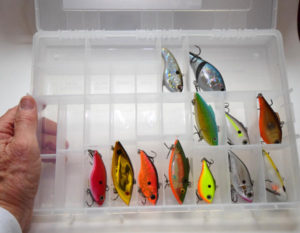
You need only to walk into Berry’s Sporting Goods to see the vast array of shapes, color and sizes of plastic worms and huge numbers of hard baits that will run from the top down to more than 30 feet. And they come in colors that look exactly like bait.

Bass are put in live wells with pumps that keep fresh water circulating to keep the fish alive, and almost all are released. Pictures are taken with cell phones to share with hundreds of people on social media. And you can win money in tournaments.

But what is the most important advancement for actual fishing. There are discussions of this in magazines and on-line. People have varying ideas but to me, without a doubt, the most important improvement is the foot-controlled trolling motor on the front of the boat.

You can sit or stand on the front of the boat and, with practice, move the boat precisely, without even thinking about what you are doing, while casting. You can go into tight places quietly and cast to spots that would be inaccessible without the trolling motor.

What do you think the most important of all those changes over the past 60 years?

Bad Tournament At Sinclair With Troll Motor Problems

Only one I caught

Last Saturday the Potato Creek Bassmasters held our January tournament at Sinclair. In seven hours of casting in the cold and wind, 12 fishermen landed 32 bass weighing 68 pounds. There were four bass weighing more than five pounds each!

Doug Acree won with five weighing 12.80 pounds, Raymond English placed second with five at 9.14 pounds, Richard Dixon was third with five weighing 8.58 pounds and Mike Cox came in fourth with three weighing 7.72 pounds. Tom Tanner drove up from Florida to catch one bass, but it was the right one, weighing 6.13 pounds for big fish.

I guess I used up all my luck the week before at Jackson. I had taken my boat to “Lanier Jim” in Gainesville to run dedicated wires to my front depthfinders to try to get rid of interference from the trolling motor. When I got home that night I noticed my circuit breakers were flipped so I re-set them. Everything seemed to work ok.

My first stop Saturday I put my trolling motor down and nothing happened, it had no power. The wind blew me against a dock and I checked everything I could think of, first re-setting the circuit breakers, since that is a common problem. Nothing helped.

During the day I tried to fish, letting the wind blow me down banks when it was in the right direction and putting down the power poles to hold the boat in one place when it was shallow enough. It was very frustrating.

At 9:00 as I blew toward a tree in the water I cast a jig and pig to it. Just before the boat hit the tree I felt a bite and landed a three-pound largemouth. That was the only good thing that happened all day!

Not long before weigh-in I set my power poles near a dock and cast around it. I felt a thump in a brush pile and brought in half a worm when I set the hook. After putting on a new one I cast under the dock. At the angle I was sitting I could not really see my line.

Slowly pulling my worm, I felt resistance but thought I was over a board on the dock, and I was, but it pulled back. A bass had sucked in my worm and I was trying to pull it over the board. By the time I realized it was a fish and set the hook it was too late, and I missed it.

That was a terrible start to my year in that club. I hope my luck is better at Sinclair today in the Sportsmans Club tournament at Sinclair. At least the weather is supposed to be much better.

Boat Order for Start of Lake Hartwell Classic March 16-18

B.A.S.S. Announces Boat Order for Start of Lake Hartwell Classic March 16-18
from The Fishing Wire

Earlier this week, B.A.S.S. officials held a random drawing at its headquarters to determine the boat order for the 2018 Bassmaster Classic at Lake Hartwell.

The first two spots in the 52-boat field were predetermined with 2017 Elite Series Angler of the Year Brandon Palaniuk occupying the number one position followed by 2017 Classic champion Jordan Lee.

Here’s how the boat order will look at Hartwell for the Classic, set for March 16-18, according to a report published on Bassmaster.com.

After day 1, the boats will leave the dock in reverse order listed here.

Flight 1
1. Brandon Palaniuk
2. Jordan Lee
3. Jason Williamson
4. Kevin VanDam
5. Luke Gritter
6. Mark Davis
7. Brent Ehrler
8. Cliff Pace
9. Bradley Roy
10. Josh Bertrand
11. Jacob Wheeler
12. Matt Lee
13. Caleb Sumrall
14. Bobby Lane
15. Keith Combs
16. Skeet Reese
17. Ott DeFoe
18. David Walker
19. Brandon Lester
20. Mark Daniels
21. Stanley Sypeck
22. Jacob Foutz
23. Mike Iaconelli
24. Edwin Evers
25. Rick Morris
26. Russ Lane

Flight 2
27. Marty Giddens
28. James Elam
29. Steve Kennedy
30. Mike McClelland
31. Hank Cherry
32. Brandon Coulter
33. Jesse Wiggins
34. Seth Feider
35. John Cox
36. Clifford Pirch
37. Carl Svebek
38. Todd Faircloth
39. Randy Howell
40. Jason Christie
41. Micah Frazier
42. Jacob Powroznik
43. John Crews
44. Ryan Butler
45. Dustin Connell
46. Gerald Swindle
47. Jamie Hartman
48. Alton Jones
49. Casey Ashley
50. Aaron Martens
51. Greg Hackney
52. Luke Clausen

Have You Ever Been On A Snipe Hunt?

If you grew up like I did in rural Georgia, you may have been invited to a snipe hunt. You had to go at night and one person, you, got to hold the sack while your “friends” drove the snipe into the sack. Of course, they left you “holding the bag” out in the dark while they went home.

There really are snipe around here. They live in wet area and probe the mud for worms with their long bills. When spooked they make a strange squawk and take off in irregular, darting side to side flight.

When young I was very curious about them and other birds. Like James J. Audubon, I wanted to examine them up close, so I shot them when I could. Over the years I shot everything from field larks and starlings to killdeers. If they were not good to eat, I killed one to examine and was satisfied.

One bird that was very elusive was a brown one that lived in a marshy area on our farm. I would see them every year but could not get very close, and when I did get into range I could not hit them with my trusty .410 when they flew.

I finally killed one. It was brown with a long, thin bill and I found out in my Encyclopedia Britannica, my google back then, that it was a snipe. I discovered they were related to woodcock, hard to shoot as I knew from experience, and good to eat. But that was the only one I ever killed.

Tomorrow is the last day of woodcock season in Georgia. Woodcock are popular upland game birds further north but here they are mostly limited to the north Georgia mountains. Some folks do hunt them in Georgia and they are good to eat. I think woodcock and snipe are considered the same for the season since they are closely related. And you need a shotgun and dog, not a sack, to get them!

Fluorocarbon Line

Fluorocarbon Line for the Cold Flow
By David Rose
from The Fishing Wire

Flurocarbon LIne Steelhead


Photo courtesy of Jon Ray

It had been well over a decade since I’d last set foot in the fast-flowing river very near Colorado’s Continental Divide with fly rod in hand. The change in esthetics surrounding the waterway was extreme.

The alteration in environment most obvious was how the once little town at its headwaters had grown so substantially it was now surrounding its banks several miles further downstream. One good thing was there was more angler access to the river; the bad was the rainbows, browns, cutthroat and brook trout in this flies-only catch-and-release section had all been fooled at one time or another by just about every type of fuzz and feather combination one could imagine.

To say the fish that reside here all winter are weary of every offering that wafts past them is an understatement. Luckily, I consulted with those in the know at the local fly shop and was able to catch a few of the finicky fish because of the tips and tricks they shared.

What I found interesting was there was little reform from years ago when it came to the tiny, down-to-size-22 nymph imitations that were suggested I drift under my strike indicator. The one thing the fly-flinging professionals were adamant about this time around, however, was that fluorocarbon leaders were a must if one were to fool a fish into striking.

And it worked.

The rod I packed in my carry-on was a 4-piece, St. Croix 5-weight Imperial, perfect for the miniscule nymphs I bought at the shop. A couple packets of Seaguar’s Knotless Tapered Leaders in size 7X (thinning down to 2-pound test at its tip) were also purchased. A few of my casts were actually flawless enough to fool a few fish; in reality, more fish than the last time I was here. And I do believe it was the presentation of my flies and the hook-setting abilities of this thin 100% fluorocarbon line that made the difference.

Fluoro facts for flies

Fluorocarbon is now a standard go-to for so many fishing applications, including fly fishing.

“First off, you need to get your fly down into the water column faster in winter,” says Jon Ray, a full-time fly-fishing guide with Hawkins Outfitters near my home waters in Michigan’s Northwest Lower Peninsula. “Casts tend to be shorter this time of year, and the fish are in smaller areas of a river; fluorocarbon tippets allow your fly to sink quicker, as well it will stay in strike zone from the top to the bottom of the drift.”

More fluorine atoms and less hydrogen than monofilament is what makes fluorocarbon pack more mass into the same space. It’s more compressed because the fluorocarbon resins give it close to neutral buoyancy. It’s a great choice for vertical personations, like dangling a fly under a strike indicator.

It also has less stretch due to its denseness, which allows an angler to get good hook sets; especially when using the light-pound-tests lines needed for proper presentations of such minuscule bugs during the winter months.

“And fluorocarbon is thinner than monofilament, which creates less drag in the water helps your fly drift more naturally,” Ray adds. “And if your fly isn’t drifting perfectly with the current, your bug’s not going to get bit. Period.”

Opposites attract

But it’s not just nymphing on ultra-light tippets that take trout during the winter months, especially when targeting the largest fish in a system.

“While big trout will suck up a little bug once in a while, it’s not their meat and potatoes,” states Fly-Fishing Guide Russ Maddin, who’s created some of modern day’s most popular streamers for trout. “Big fish eat little fish, and I’m not just talking small minnows and whatnot, but other younger, 5- to 8-inch trout in the system, as well.”

Maddin’s been using fluorocarbon tippet material for stripping big streamers for years, and says this tactic is no place for light line and finesse, even when these cold-blooded fish seem lethargic within their ice-water realms.

“You’ll have to slow up your stop-and-go retrieve a little compared to when the water’s warm, with longer pauses in-between pulses, but you really don’t need to lighten up your leaders,” Maddin adds.

Twelve-pound-test (1X in Seaguar’s Max Fluorocarbon Tippet Material) is the lightest Maddin may tie on, but overall 14-pound test (1X in Grand Max Tippet Material) is his go to. No matter the test, it’s the condensed make up of fluorocarbon that keeps his streamers in the strike zone, neither rising or falling on the pause.

Timing and safety

Two things rookie fly anglers often overlook when their planning a winter’s fly-fishing excursion is the time of day to hit the river, as well, taking a few extra precautionary steps for one’s safety.

Unlike summer months when dawn and dusk may be the best times for catching, smackdab in the middle of the afternoon is usually best for fly fishing in winter. It’s during this time when the waters will warm to their maximum for the day, and all it takes is a half-degree rise in water temperature to turn inactive fish active. And unlike other times of year, the brighter the sun overhead the better the bite can be.

Even if your legs are strong, it’s not only a good idea to have a wading staff with you, but to use it. One quick jab into the river bed and you’ll be able to catch your balance if, say, a rock overturns under foot. Donning ice cleats with small carbide spikes, like the slipover Ice Creepers from Frabill ice anglers wear, will keep you steady-footed if it’s cold enough that ice starts forming on the rocks, or in areas with algae covering the bottom.

Up your odds

Overall, fly fishing in the heart of winter isn’t all that different than the summer months. Your goal is to imitate nature to a tee with nothing more than feathers and fur that’ve been spun onto a hook.

As I learned from my last trip to the Colorado Rockies, keeping your fly drifting behind a thin, strong, and nearly invisible fluorocarbon leader will up your odds greatly.

Guatemala Sailfish by Kayak

Guatemala Sailfish by Kayak
from The Fishing Wire

Anglers fish “Billfish Capital of the World” in Old Town Predator PDL kayaks

Old Town, ME – Angler David Hadden’s eyes light up when asked about kayak fishing Guatemala’s Pacific Coast, what many consider “The Billfish Capital of the World.”

If big game fishing in world-renowned billfish waters wasn’t enough, Old Town’s David Hadden and Sport Fishing editor Doug Olander took it one step further, hauling Old Town Predator PDL kayaks some 40 miles offshore, “mothership fishing” from one of Casa Vieja’s charter boats under the expert direction of Captain Chris Sheeder.

“It was a life-changing experience,” says Hadden. “For anglers, it’s the zenith of the sport. You get out there in the blue with big fish and it’s heaven. The first day Captain Chris took us right to a ledge, we dropped the kayaks in the water, and within 30 minutes we were doubled up.”

Although Hadden’s no stranger to big fish like tarpon and tuna, his first Pacific Sailfish pushed the limits of what he’d accomplished from an Old Town Predator PDL kayak.

“I fought that first sail like I’d fight any big fish from a kayak, and it took me all of twenty minutes. The first couple runs a sailfish makes are part sleigh ride, part acrobatics display, but after five to eight minutes, the combination of warm water temperature and lactic acid buildup run down the fish. Captain Chris pushed me to lock down the reel and get it done. With a single swipe of the tail they can go 10 feet in any direction, but you don’t want to completely exhaust the fish.”

Drag tightened and a quick fight routine dialed in, sailfish releases from the Old Town Predator PDL jibed well with Casa de Vieja’s catch and release conservation program.

“Casa Vieja takes the ‘The Billfish Capital of the World’ designation seriously, protecting all billfish to fight another day. That was the beauty of Predator PDL kayaks; we could hold the bill with one hand and pedal and revive the fish after the fight. That might have been the most satisfying part,” says Hadden.

And many successful releases there were. Hadden, Olander, and two other kayak anglers fished for three days, doubling up on countless occasions, with double-digit fish totals some days. “I was able to fight, land, and release every fish that bit. At the end of the three days, I went seven for seven. But I had to work for them. We pedaled up to 10 miles a day in 90-degree temperatures with high humidity while deploying baits, re-rigging, fighting fish… It was very physical and very rewarding. We always kept the mothership within range and Captain Chris and crew kept a close eye on us.”

Along the way, Hadden and crew planted their flag in some new angling territories, including being the first anglers to fish sailfish from pedal-driven kayaks 40 miles off Guatemala’s Pacific coast. And on the last day, they pioneered a unique play that merged charter boat outrigger teaser bait tactics with precise kayak angler boat control and bait placement.

Sailfish anglers will often use long outrigger poles when trolling to place baits high in the water column off both sides of the boat. When a sailfish is teased up on an outrigger bait—essentially used as a decoy—they’ll quickly pull in the outrigger and line and use a rod to flip a bait to the fish.

“On Day 3, Captain Chris yells from the charter boat to me, ‘Get right next to me!’ So I pedaled to stay right with the moving boat, and sure enough, he yells ‘Behind you! Behind you!’ and a sailfish had emerged right behind the boat to the outrigger bait. At the last minute Captain Chris swings the outrigger off and tells me to swing the kayak in with my bait. As I came off the wake and into the spread, the fish surfaced right behind my bait! It was so close, but the fish didn’t eat. Still, it was the coolest thing I’ve ever done.”

Hadden eventually caught the lingering sailfish, but catching the fish on the fly in a seamless choreography is his future goal. “That moment when you’re pedaling and then slip the kayak over the wake and into the spread right next to a high-rising sailfish is pretty magical. Those fish are fired up and ready to attack. I know Captain Chris and I could get the same scenario to work on the fly.”

Familiar with the latest in kayak fishing tactics, techniques, and trends, Hadden believes he and Captain Chris were the first to attempt precise pedal-driven kayak boat and bait placement in tandem with a trolling charter boat on an outrigger-teased sailfish.

GEAR

While Johnson Outdoors Watercraft manufactures numerous kayak models suitable for saltwater big game fishing, the Old Town Predator PDL has quickly become a favorite with anglers.

“It all comes down to the hands-free fishing experience the rugged and efficient Old Town PDL Drive provides. Especially with fighting any kind of big billfish species, having forward and reverse right at your feet is a huge asset for controlling the fish. Trolling and deploying baits is also made that much easier than having to work a paddle. Of course, the PDL Drive itself is built for saltwater use and the 10.3:1 gear ratio allows speeds up to 5.5 mph for reaching and returning from distant spots quickly and efficiently,” says Hadden.

In terms of tackle, Hadden and company fished live blue runners on circle hooks with 80-pound Seaguar braid main line and an 80-pound Seaguar fluorocarbon leader.

“Live bait was definitely the way to go for multiple fish days. I paired Accurate reels with St. Croix Mojo Salt rods, which had plenty of backbone to put the wood to fish after I locked up the drag. I held the rod and line in my hands so I could feel the take and drop back. A couple guys were just free-trolling. My thing was having a rod that was sensitive to feel when the bait got nervous—the calm before the storm.”

TRAVEL & LODGING

Logistically speaking, Hadden says the trip to Guatemala’s Casa Vieja Lodge couldn’t have been easier. “I flew from Portland, Maine to Atlanta, right into Guatemala City. The whole trip took about six hours. I was greeted at the airport by Casa Vieja staff and we were bused right to the gated lodge. Seamless, safe, and super professional.”

Once to the lodge, Hadden and crew were met with first-class accommodations. “The lodge was as nice as anything in the Bahamas. Fine cuisine and a great beer, scotch, and rum selection. Five-star all around, but what really impressed me was their staff.

From the servers to the guides, I can’t imagine a better operation. Every morning they came to your room with coffee, a really nice touch. And Casa Vieja guides are as good as they get. Captain Chris Sheeder is the best blue-water guide I’ve ever fished with. It was an honor to learn from one of a handful of anglers who’ve released 20,000 billfish.”

To learn more about Guatemala’s legendary billfish angling, visit www.casaviejalodge.com.

Want to win a brand new Predator PDL, St. Croix Legend Tournament Inshore rod, plus lots of other St. Croix and Old Town gear seen in the video?

Enter here:

#AdventureLivesHere

About Old Town:

JOHNSON OUTDOORS is a leading global outdoor recreation company that inspires more people to experience the awe of the great outdoors with innovative, top-quality products. The company designs, manufactures and markets a portfolio of winning, consumer-preferred brands across four categories: Watercraft Recreation, Fishing, Diving and Camping.

JOHNSON OUTDOORS WATERCRAFT RECREATION includes Old Town canoes and kayaks, Ocean Kayak, Necky kayaks, Carlisle paddles and Extrasport personal flotation devices. Old Town canoes and kayaks have created genuine watercraft with innovative designs for over 100 years.

Visit Old Town canoes and kayaks at www.oldtowncanoe.com

Visit Johnson Outdoors at www.johnsonoutdoors.com

Brady Bunch Efforts to Ban Guns

he latest email from the Brady Bunch begging for donations crows that they are suing the ATF as well as sellers, marketers, and manufacturers of “bump stocks.” This is a tactic long used by gun banners to try to eliminate everything related to gun manufacture, suing them out of existence and making it impossible for citizens to buy guns.

This tactic got so ridiculous a few years ago that congress passed a law making it illegal to sue gun manufacturers and sellers unless the gun was defective, placing guns in the same category as all other things we can buy.

Using this illogic, Ryder trucks, rental truck centers, truck manufacturers, fertilizer sellers and producers would have all been sued after Timothy McVeigh used a rental truck filled with fertilizer to bomb a federal building and kill 168 people and injure more than 600 in 1995.

Look for more and more efforts to “do something” about guns, even though folks making those efforts will admit, if forced, that nothing they are proposing would have made any difference at all.

Those wanting to end your civil right to own a gun will do anything to overturn the constitution.

Can Spawning Fish Influence River Profiles?

Sex that moves mountains: Spawning fish can influence river profiles
By Eric Sorensen, WSU News
from The Fishing Wire

fishPULLMAN, Wash. – It turns out that sex can move mountains.

A Washington State University researcher has found that the mating habits of salmon can alter the profile of stream beds, affecting the evolution of an entire watershed. His study is one of the first to quantitatively show that salmon can influence the shape of the land.

Alex Fremier, lead author of the study and associate professor in the WSU School of the Environment, said female salmon “fluff” soil and gravel on a river bottom as they prepare their nests, or redds. The stream gravel is then more easily removed by flooding, which opens the underlying bedrock to erosion.

“The salmon aren’t just moving sediment,” said Fremier. “They’re changing the character of the stream bed, so when there are floods, the gravel is more mobile.”

Alex Fremier, associate professor at the WSU School of the Environment and author of “Sex that moves mountains” in the journal Geomorphology, with a rainbow trout on Lake Pend Oreille.
The study, “Sex that moves mountains: The influence of spawning fish on river profiles over geologic timescales,” appears in the journal Geomorphology.

Working with colleagues at the University of Idaho and Indiana University, Fremier modeled the changes over 5 million years and saw streams with spawning salmon lowering stream slopes and elevation over time. Land alongside the stream can also get steeper and more prone to erosion.

“Any lowering of the streambed translates upstream to lower the entire landscape,” said Fremier.

Different salmon species can have different effects, Fremier said. Chinook salmon can move bigger pieces of material, while coho tend to move finer material. Over time, this diversification can lead to different erosion rates and changes to the landscape.

The paper is another way of looking at the role of living things in shaping their nonliving surroundings. Trees prevent landslides; beavers build dams that slow water, creating wetlands, flood plains and habitats for different trees and animals.

In 2012, researchers writing in Nature Geoscience described how, before the arrival of trees more than 300 million years ago, landscapes featured broad, shallow rivers and streams with easily eroded banks. But tree roots stabilized river banks and created narrow, fixed channels and vegetated islands, while log jams helped create the formation of new channels. The new landscape in turn led to “an increasingly diverse array of organisms,” the researchers wrote.

Similarly, said Fremier, salmon can be creating new stream habitats that encourage the rise of new salmon species. On the other hand, streams where salmon drop in number or disappear altogether could see significant long-term changes in their profile and ecology.

“The evolution of a watershed can be influenced by the evolution of a species” Fremier said.

Read more like this at Washington State University News here

Lake Martin Tournament

Lake Martin produced a lot of fish, as always. Although it was very hot and the lake was full, the first time I have seen it full in October since I started going over there in 1975, we still had a lot of fun.

In the two-day tournament 25 members of the Potato Creek Bassmasters, Flint River Bass Club and Spalding County Sportsman Club landed 194 keeper bass longer than 12 inches that weighed a total of 268 pounds. There were 31 five fish limits and everyone caught at least one keeper.

Raymond English won with ten weighing 21.58 pounds, I placed second with ten at 18.46 pounds, Lee Hancock caught ten at 17.64 for third and Kwong Yu was fourth with ten at 17.33 pounds. Gary Hattaway had big fish with a 3.16 pounder.

I went over on Wednesday and set up camp in my van in my usual spot at Wind Creek State Park, got my boat in the water and relaxed. That night I had to run a fan blowing on me all night but still did not sleep well due to the heat. I should have taken my air conditioner.

Before daylight Thursday morning I was on the water and landed three nice spots on a spinnerbait just as it got light. Then I caught a few more trying different things, but it got tough with the bright sun. I was afraid that was an indication of things to come, and it was. The lake was totally different with the full water.

Friday morning, I slept in and then tried a pattern a guide had told me was working. I landed six fish throwing a rattletrap but they were all small so I did not think it would be worth fishing in the tournament. That afternoon I took up money and we drew boat numbers for take-off.

I went out first Saturday morning and ran to the point where I had caught three on Thursday, but did not get a bite. On another point nearby I watched as a six pound plus bass followed my spinnerbait to the boat then turned away. I guess he could identify my bait as fake in the very clear water.

By then I was already frustrated. My pattern was not working so I went to things that had worked in the past, fishing brush piles and docks, and landed my first small keeper at 9:00. Fishing hard for the next eight hours I managed to land ten keepers on a jig and pig and a shaky head worm, but my best five weighed only 7.5 pounds. Raymond shocked us all with five weighing 13.15 pounds that day.

Sunday I was last going out and ran to another point where I had caught fish in the past. Within minutes I had landed three good spots, two on a spinnerbait and one on a jig and pig. I have no idea why it was so different. As the sun came up I kept throwing a jig and pig and landed five more bass, the biggest a 2.69 pound largemouth.

My best five weighed 10.99 pounds and I won for the day, and my largemouth was second biggest fish, missing big fish by only .05 of a pound. It had gotten very tough after 10:00 and all my best fish hit before 8:30 that morning.

I was so worn out after not sleeping good for several nights that I decided to stay another night and woke to rain Monday morning. I went out and bass were easy to catch, just like in the past. I swear those bass know when it is the weekend and quit biting!

I’m already looking forward to the trip next October!

Golden Time for Fall Fishing in Wyoming

Now is the Golden Time for Fall Fishing in Wyoming According to the WGFD.
from The Fishing Wire

Cheyenne – October is the golden month for fall fishing. The fish are active, and the Wyoming Game and Fish Department fish managers around the state agree it’s the best time to get outside with your rod.

Brown trout spawn in autumn so expect good action. A trip to the North Platte never disappoints, and there is plenty of public access. The Miracle Mile, Cardwell, Gray Reef and Saratoga reaches of the North Platte are all Blue Ribbon waters, holding more than 600 pounds of trout per mile. Anglers can expect to catch fish on streamers, nymphs and dry flies this time of year. The Miracle Mile is especially popular with fall anglers since October is when large brown trout from Pathfinder Reservoir begin moving into the river.

Brown trout seekers who visit the Salt River near Jackson will be rewarded with strong populations through December or January. The Salt River runs almost entirely on private land, but there are numerous public access areas for fishing. The Green and New Fork rivers are good options, too, that offer plenty of fishing access. Dry flies such as grasshoppers are still working during the day.

Some smaller North Platte tributaries near Laramie will also be rewarding. Laramie Regional Fisheries Supervisor Bobby Compton recommends visiting Big Creek, Brush Creek, Douglas Creek, French Creek, or the lower Encampment River. And, as usual, the Laramie Plains lakes will be hopping as temperatures cool. Good fishing is predicted at Meeboer, Gelatt Lake, Twin Buttes and Lake Hattie. Wheatland No. 3 is also expected to be hot again this season. At Hattie and Wheatland 3, anglers should watch for fall-spawning rainbow trout populations that swim close to the shore.

Rainbows are also flourishing and growing large in Boysen Reservoir this year. Game and Fish is stocking almost double the amount than in year’s past, and people have noticed an increase in quality and numbers.

For an all-around good trout experience, the North Tongue River, Middle Fork Powder River and Sand Creek are northern destinations not to be missed. Also, the Green River below Fontenelle Dam will have plenty of rainbow, Snake River cutthroat and Bear River cutthroat trout eagerly feeding on nymphs, San Juan worms and minnow patterns. The Finger Lakes near Pinedale are a good destination for lake trout — try Fremont, Boulder, Halfmoon and New Fork. Lake trout will move into the shallows starting in October as the nights dip into the 30s. Soda Lake continues to fish well and will be open to fishing until Nov. 14. Healthy looking browns and brook trout over 16 inches are common.

Anglers who target warm-water species should plan to head to waters around Sheridan, Casper and Lander. Healy Reservoir, near Buffalo, is a great destination for bass, with some largemouths over 20 inches and 5 pounds. Keyhole, in the northeast, has good water levels and the summer treated the fish well. Casper and Lander area waters should hold active walleye thanks to higher-than-normal flows from good snowpacks around the state.

“At Glendo, the main forage fish in the lake — gizzard shad — begin to die off in September and October, and the walleye and channel catfish really key in on this,” said Matt Hahn, Casper regional fisheries supervisor. “Anglers should plan on trolling crankbaits that resemble shad or vertical jig schools of suspended fish with jigging spoons.”

Hahn also points walleye-seekers to Pathfinder and recommends casting large swimbaits to the shore, especially in the upper end of the lake.

Farther west, Boysen Reservoir cleared in the late summer and Craig Amadio, the Lander regional fisheries supervisor, has heard excellent reports from the field.

“Walleye fishing is the best it’s been in a long time, and I expect that to be the case this fall. Walleye in Boysen are feeding on bigger fish now — perch and rainbow trout. A lot of anglers will troll open water using crankbaits and planer boards,” Amadio said.

October isn’t too late for an adventure. Many alpine lakes offer quality golden trout and cutthroat trout if you’re prepared to fish in the snow. Higher elevations are known for storms as early as September. Thumb Lake and Atlantic Lake are a couple good golden trout waters, and the Wind River Range has goldens in the Sweeney Lakes and Hobbs Lake. Chasing tiger trout is an option for anglers wanting to reel in something different; visit Upper Silas Lake, Willow Park Reservoir and Cow Lake.

An added bonus of fall fishing is the solitude. Many avid sportsmen and women have exchanged rods for rifles by October. For those looking for a peaceful angling trip, visit Grayrocks and Hawk Springs in the southeast for walleye, crappie and bass. Boysen is also expected to be less crowded as hunters head afield. Robb Keith, Green River fisheries supervisor, reminds anglers that the Hams Fork River downstream of Kemmerer City Reservoir is home to a variety of trout species and has public access through a Game and Fish fishing easement along the river in a stretch of private land below the reservoir. Bring your streamers as the fall progresses, dry flies and grasshoppers won’t do here.

If elbow room and aggressively feeding fish sound like a good combo, the Shoshone River below Buffalo Bill Dam should be on the list. Between Buffalo Bill Dam and Willwood Dam there are 2,500 trout per mile and relatively good access for both wading and floating. Big Horn Lake and the Bighorn River will also be less crowded and the sauger big and active — the biggest tipping 5 to 6 pounds, with an average of 2 to 4 pounds. Sam Hochhalter, Cody regional fisheries supervisor, recommends everything from jigs and crankbaits to night crawlers and live minnows to bring in a big one.