UPDATE – St Croix has discontinued the Avid series – my favorite – but they have a great closeout sale on them – two I ordered arrived today!! They are at a $90 discount right now if any are left
Fishermen have their favorite rods; it is largely a matter of personal preferences. My favorites are St. Croix Rods. They have a model for any fishing need, and I have several in different models, weights and actions.
I won a St. Croix rod at a tournament in Wisconsin back in the early 1990s and fell in love with it. The Avid model seven-foot, medium weight, fast action is the best all-around rod I use. It works well for topwater baits, crankbaits and spinnerbaits. I also use it successfully for small swim baits and underspins.
The next year I bought two more Avids but didn’t pay careful attention and ordered the medium heavy weigh, a lucky accident. I used them for throwing the shaky head and small jig and pig and they were perfect. I seldom lost a fish on any of my three rods.
I broke the first rod and St. Croix replaced it under warranty for $50. They did not even ask how I broke a two-year old rod, but I am sure I hit it on the side of the boat working a topwater plug based on where it broke, cracking it.
I managed to lose one of the second two I bought, a whole nother story of my stupidity, and ordered two more of the medium action. Since I was mostly fishing shaky heads and small jigs, one of them was dedicated to the small jigs.
After losing several fish on the jig, I quit throwing it for a time. I finally realized all the fish I lost were on the medium action and had not lost fish on the medium heavy rod fishing a shaky head, I ordered another medium heavy action a few months ago. Since then I have not lost a fish on the jig, including a 4 pounder at Guntersville and many other keeper fish.
Rod weight makes a difference! The slightly heavier weight helps set the hook on the jig and shaky head where the lighter weight is fine for other baits. I fish both shaky head and small jigs on those two rods every tournament now and use the medium weight for most of my other baits.
I also have a Mojo Crankbait rod and it is perfect for casting big crankbaits, and small ones for that matter. Jamie Koza, owner of The Dugout Tackle shop in Atlanta and well-known tournament fisherman, told me it is the best crankbait rod he has ever used.
St Croix rods are not cheap but are all quality rods with a great warranty. But they make a series for most any budget, from their Bass X at about $100 to the very top end Legend Family, made for the deadly serious bass fisherman, at around $420. The Avid Family model I love is about $180 – second only to the Legend, and their Mojo Family is about $130. Their Premier series is about $120.
St Croix makes quality spinning and casting in all the above models and have models for saltwater, salmon, fly and even ice fishing. I have a St Croix Premier spinning rod and five Avid casting rods and the Mojo now and have ordered a Legend jig rod – just gotta try it out.
Disclaimer – I get a discount from St. Croix but would never use so many of them – at any price – if they did not work for me. I would recommend any fisherman try the St Croix rods in the model and action that they like.
UPDATE – St Croix has discontinued the Avid series – my favorite – but they have a great closeout sale on them – two I ordered arrived today!! They are at a $90 discount right now if any are left
St. Croix Builds the Right Rod for the Job
from The Fishing Wire
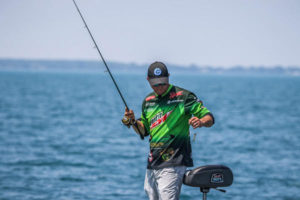
Using a St. Croix rod for spybait fishing
Image by Kyle Wood, courtesy of FLW
Chad Grigsby calls on St. Croix Legend Xtreme and spybait combo for FLW Majors Win
Park Falls, WI – There are players on the bench that wait their entire careers to get called into the game. Often those players have a very specific skillset that only requires being tapped every once in a while. And when it’s their time to lace up, they better perform. Chad Grigsby has one of those players in his boat.
There’s that moment when a professional bass pro simply changes up. It doesn’t matter if they are engaged in a catching streak—they just know it’s the right time. It’s those on-the-fly decisions, along with being prepared for those change-ups, that separate the pros from the amateurs. For Grigsby, a St. Croix Rod pro, it was what led to his 2nd FLW Tour career win and a $125,000 check.
A big part of being prepared is having the right equipment in your boat. Grigsby only fishes St. Croix rods. “I’m spending the holiday with my family at our cabin in Wisconsin. St. Croix is made here – not just in the USA – but in Wisconsin. And they are a family-owned company. That means a lot to me; I can visit the factory in Park Falls and see the people making the rods I rely on every day,” he said.
Grigsby’s boat is filled with rods. He’s had people come up to his boat and ask why he carries so many rods. “Golf is the analogy I use to explain it. You don’t use a driver on the putting surface and vice-versa. Every rod I own has a purpose; it’s why I have so many rods. St. Croix designs rods with different actions, powers and lengths for each situation. On tour we go to so many different lakes with varying conditions that require the use of multiple lures and techniques. We need rods rigged and ready if the conditions change.”
The Lake St. Clair tournament was a perfect example of this. To win the tournament, Grigsby had to be ready for every change. On the final morning, it was calm before sunup. “I started out fishing a 4-inch green pumpkin and gold-colored Venom Lures Tube on a ¾ ounce jig head with a 7’6” Legend Elite (EC76MHMF) medium-heavy power moderate-fast action casting rod. I was catching fish,” said Grigsby.
During an active bite, the sun popped out. It was at that moment that Grigsby’s instincts made him switch-up. “My photographer gave me a strange look when I set the rod down and picked up a Legend Xtreme (LXS76MLXF) 7’6” medium-light power extra fast-action spinning rod rigged with a spybait. Call me crazy but the change in conditions told me to switch,” he said. On his second cast, Grigsby’s premonition was validated when he caught a six-pounder and sealed the deal for the tournament.
“The smallmouth on that lake are old and smart. You need to throw the bait a long way to get them to bite. When the conditions are sunny and calm, the spybait is the best choice. Because you’re casting a long distance, you’re in for a long fight and you’ve got to keep the fish hooked.
I picked this rod because of the bait. The Legend Xtreme helped me 1000%. This rod has a really soft tip that allows me to throw a 4” bait into the wind a long way. The rod tip is so soft that they can’t pull the hooks out. Also, this rod is super sensitive, making bite detection easier. It’s the key to landing these fish. If people miss fish throwing spybaits, they are using the wrong rod,” added Grigsby.
“I fish Legend Elite and Legend Xtreme in every tournament but this was the only time I used that specific rod this year. Every tournament is different and it’s hard to know exactly when you’ll need a certain rod. That’s why I always carry it– it’s why I have it in my arsenal.”
Only time and conditions will determine if Grigsby calls on that combo again. Regardless, it will always find a home in his rod locker, hoping to be called into the game.
#stcroixrods
About St. Croix Rod
Now in its 70th year, Park Falls, Wisconsin based St. Croix Rod remains a family-owned and managed manufacturer of high-performance fishing rods with a heritage of USA manufacturing. Utilizing proprietary technologies, St. Croix controls every step of the rod-making process, from conception and design to manufacturing and inspection, in two company-owned facilities. The company offers a complete line of premium, American-made fly, spinning and casting rods under their Legend Elite®, Legend® Xtreme, Legend Tournament®, Avid Series®, Premier®, Wild River®, Tidemaster®, Imperial® and other trademarks through a global distribution network of full-service fishing tackle dealers. The company’s mid-priced Triumph®, Mojo Bass/Musky/Inshore/Surf, Eyecon® and Rio Santo series rods are designed and engineered in Park Falls, Wisconsin and built in a new, state-of-the-art manufacturing facility in Fresnillo, Mexico. Founded in 1948 to manufacture jointed bamboo fishing poles for a Minneapolis hardware store chain, St. Croix has grown to become the largest manufacturer of fishing rods in North America.
BEMIDJI, Minn. – We’re making ice across the upper Ice Belt, and with colder temperatures in the forecast, ice fishing conditions should improve considerably in coming days.
While lots of anglers are pursuing early-ice walleyes at destinations like Minnesota’s Red Lake and to the north, lots of smaller lakes have locked up, too, providing easy access for some great crappie action.
We talked with Northland pro and veteran guide, Tom Neustrom—a master crappie angler on all fronts—and he shared his insights for more and bigger early-ice crappies. Take it from us, Tom’s got the 411 and is worth listening to.
Tom Talks Crappies
“Early crappies, honestly, are probably not as far in the basin as a lot of anglers think,” shares Neustrom. “They have a tendency, but it depends on the body of water, to roam around a little bit more during early-ice. They haven’t set up yet. But when you get into late-December and January, they’re on wintering spots in the basins and are not going to move much.”
Instead, Neustrom says during early-ice, crappies tend to establish by the first break in correlation with deeper water. The key is soft bottom. And sometimes, they’re in the deep weeds, and hang out as long as the weeds are still a little green, because there are all kinds of bugs and forage available.
“Get into mid- to late-December, and crappies start moving to the basins. The key is to find those basin-areas with a soft bottom. That’s where the critters are emerging out of the mud. Bloodworms (midge larvae) are critical; crappies chow down on them during early- to mid-ice. They’ll stay in close contact with that food source,” shares Neustrom.
Neustrom says that a lot of early-ice crappie anglers make the mistake of starting too deep during early-ice, concentrating their efforts in 25- to 40-feet—but quite often the crappies aren’t set up there yet.
“In Minnesota, I’m starting to work the basins in late-December and early-January. Before that, I’m working the first break and available green weeds just inside the basins,” shares Neustrom.
Basin crappies will tend to hold to the bottom, especially in the morning; then, as the day progresses, they’ll move up in the water column.
“If you look at your electronics in the morning—I use a Humminbird Helix 7 Ice Bundle—crappies will show up like a blanket or lumps laying on the bottom. They don’t really appear as suspended fish until it gets a little lighter outside. Critters start emerging out of the soft bottom and the crappies follow them up in the water column,” notes Neustrom.
Neustrom adds that LakeMaster mapping is critical to finding—and catching—hardwater crappies. “The new VX Premium LakeMaster card adds aerial mapping imagery, improved depth contour shading to find those spots-on-the-spot, bottom hardness, and SmartStrike, which is like having your own digital fishing guide.”
Winning Presentations
Neustrom says a 1/28-ounce Northland Tungsten Gill Getter has long been a winning bait of choice for early- to mid-winter crappies.
“I use glow patterns. If there’s water stain, I lean on orange and chartreuse patterns; if the water’s clear, I like white glow with a little chartreuse,” says Neustrom.
“I fish both the 3/32- and 1/16-ounce, depending on depth. It rocks sideways and drops quick and cuts the slush if you’re fishing outside. It has a thinner body and an excellent hook. I’ll put three or four waxies or Eurolarvae on it, and if I can’t catch ‘em that way, I’ll fish a really small crappie minnow on it. I hook the minnow through the tail—that’s key.”
Neustrom’s also a fan of spoon-style baits for early- to mid-ice crappies like the 1/16th-ounce Northland Forage Minnow in Super Glo finishes.
Neustrom adds: “The 1/8-ounce version is also a great walleye bait on deadsticks, rattle reels, and even jigging when the fish don’t want a rattle spoon. I’ve caught an awful lot of big crappies on this bait. Funny thing is, when they’re really going, I don’t put anything on it—no bait, no nothing. When they’re really fired up you can catch ‘em meatless.”
Lastly, when the crappies are really going, Neustrom will hole-hop a series of 10- to 15 different spots with a 1/8-ounce Northland Puppet Minnow for getting to active fish fast.
Rods, Reels, and Line
I terms of line, Neustrom uses 4-pound Sufix Elite mono on a spinning reel or in-line style reel.
“I like Daiwa 750-size spinning reels, which I helped design for ice, a nice medium between 500 and 1000 size reels. All of the models, QZ 750, QG 750 and QC 750, are great and have a little larger spool than most ice reels,” remarks Neustrom.
When it comes to in-line reels, Neustrom likes trigger-style models for one-handed operation and quick, vertical fishing. In shallow waters, he will turn to fly-reel-style in-line reels that often require the angler to manually strip out the line.
When it comes to rods, Neustrom fishes the St. Croix Custom Ice (CCI) 32” Perch Seeker, a great medium-light power, extra-fast action rod with a soft tip. He’s also using the economical St. Croix Tundra SCT30LF, a great option for fishing smaller jigs.
“I don’t use spring bobbers for crappies, although I’ll use them occasionally for finesse-bite bluegills. Crappies are a little more aggressive than ‘gills. The bluegill bite is kind of a ‘twitch’; a crappie bite is more of a ‘thunk’,” observes Neustrom.
Typically, crappies feed upwards at a 45-degree angle, flare out their gill plates, and suck in water to inhale the bait. So, you’ve gotta watch the tip of your rod because all of a sudden, the bend will disappear and your line will go slack. Then it’s time to quickly reel up a little bit and lightly sweep the hook into place.
“For my second rod, I run a plain-Jane deadstick, typically a glow hook or a 1/16-ounce Forage Minnow Jig, split-shot, and a crappie minnow. I’m old school; I just set the rod on a 5-gallon bucket top. I also like the St. Croix Custom Ice (CCI) 32” Perch Seeker for my deadsticking,” shares Neustrom.
Bait Choices
“A good crappie angler fishes everything—waxies, Eurolarvae, crappie minnows, and soft plastics. You’ve gotta have some maggots in a little container for insurance. Crappies sometimes want that scent over soft-plastics. To go out with one thing is a huge mistake,” concludes Neustrom.
ABOUT Northland® Fishing Tackle
In 1975, a young Northwoods fishing guide named John Peterson started pouring jigs and tying tackle for his clients in a small remote cabin in northern Minnesota. The lures were innovative, made with high quality components, and most importantly, were catching fish when no other baits were working! Word spread like wildfire, the phone started ringing… and the Northland Fishing Tackle® brand was in hot demand! For 40 years now, John and the Northland® team have been designing, testing and perfecting an exclusive line of products that catch fish like no other brand on the market today. Manufactured in the heart of Minnesota’s finest fishing waters, Northland® is one of the country’s leading producers of premium quality jigs, live bait rigs, spinnerbaits and spoons for crappies, bluegills, perch, walleyes, bass, trout, northern pike and muskies.
Forestville, WI – The National Professional Anglers Association (NPAA) 2023 Annual Conference kicks off in Fort Myers, Florida, January 6 through 8, and headline speaker Gerald Swindle can’t wait to get started.
“I hope you’ll be there to hear me because I plan to really bring it,” says Swindle. “This is not just a meeting for professional anglers, it’s for anyone making a living in the recreational fishing industry – and you don’t even have to be an NPAA member to attend because everybody’s welcome. This meeting is going to be a conference where we’re talking about how to make money.”
That’s something Swindle says other industry pros don’t generally discuss but it’s going to get full attention at this event, the focus of which is “Controlling Your Destiny!” With this conference NPAA is providing a first-class ticket to meet, network, speak with and glimpse the psyche of top professional anglers, industry representatives and sport fishing leaders across the country.
“This is your chance to see, hear and learn how top professionals do business,” points out the legendary bass pro from Guntersville, AL, who has appeared in 20 Bassmaster Classics, twice been named Bassmaster’s Angler of the Year, broken the magical 100-pound tournament limit twice, and earned roughly $2.5 million in prize money in the process.
NPAA president, Patrick Neu couldn’t be more thrilled than to have Swindle lined up for the event. “He’s the right guy to headline our speakers,” said Neu. “He’s an NPAA member, a social media icon, and a no-nonsense motivational speaker that knows this industry inside and out. He’s true to himself in every aspect of our sport and not afraid to speak his mind. In short, when the G-Man speaks, everybody listens.”
Swindle has plenty to say, of course, but we’ll let him speak for himself in the video link above. Just know that attendance is limited to 200 and tickets are selling fast – so, don’t wait to sign-up, meet, network, speak with and glimpse the psyche of top professional anglers, industry representatives and sport fishing leaders across the country.
The NPAA Annual Conference features business-related educational seminars, networking opportunities, and partner booths in a fun but professional format. It is a key component of the NPAA platform, which exists to help members grow their professional angling careers and run successful industry businesses. The event will also host a Benefit Banquet for the Future Angler Foundation (FAF), which introduces millions of potential new anglers and boaters each year to the thrill and fun of sportfishing and boating.
Additional seminar speakers will include Jason and Jay Przekurat, MLF Redcrest Champion Bobby Lane, Louisiana guide and Redfish Lodge owner, Mike Frenette, plus a myriad of other angling professionals from top guides to industry veterans, all sharing their knowledge freely in sessions throughout the weekend. Event central is the 5-Star rated Holiday Inn Fort Myers Airport – Town Center, which is 5 minutes from the SW Florida Regional Airport (RSW) and just off I75 in Fort Myers.
The NPAA 2023 Annual Conference registration fees include all activities, meals, and a ticket for the FAF Banquet. More information on registration can be found on the NPAA Conference Page. (Note: Non-members who pre-register for the Conference and opt to join the association prior to the end of the Conference will receive a $50 rebate on their Conference Registration Fee.)
For more information on joining the NPAA, attending the Annual Conference, and exploring the many benefits membership provides, visit www.npaa.net.
The 2022 version of the open water fishing season was an interesting one on several levels. Some of the events/developments of the fishing season were good, some not so good. One of the developments that has really caught on in the past few months is the ongoing popularization of forward-facing sonar (FFS). First, a little bit of history regarding sonar.
My first exposure to fish-finders, depth-finders, sonar, fish locators, whatever they were called, was a Lowrance Green Box. It was an amazing experience for a young, curious angler. Instead of just seeing the surface of the lake, we could now see what was on the bottom of the lake. By today’s standards it was a very antiquated look at the bottom of the lake, but back then it was groundbreaking. We could see how deep the water was directly below the boat, we could see gradual and abrupt changes in the bottom structure, and we could see where the bottom changed from sand to mud. Every now and then we even saw what we thought might be a fish. Remarkably interesting times, and truly an era of learning more about fish and fishing. Some people were worried that with this new technology, fish populations would be in jeopardy. Due to the efforts of fishery managers, they weren’t.
Later, paper graphs hit the market. They drew an outstanding picture of the bottom of the lake and showed the history of the path of the boat. An angler could see what they were going over and what they had gone over. And you could definitively see if fish were in the area. But the paper had to be changed often, and when the wind was blowing or it was raining, that was an inconvenience. Paper graphs weren’t around for exceptionally long.
The next technology was liquid crystal graphs. The early versions of LCG’s were crude by today’s standards, but a huge improvement in what we were accustomed to using. No paper changing and exceptionally good displays. I recall a day on Rainy Lake when I was just learning about LCG units. We would see on the screen in water 20 feet deep what we thought was a fish, then we would catch a fish. Those really were the fish that we were seeing! Another very interesting time and era of learning more about fish and fishing. Some people were again worried about the impact of this new technology, and again, the fisheries people prevented over-harvest.
A few years later, side-imaging came into play. This technology enabled an angler to see what was going on off to the side of the boat. More learning and more interesting discoveries about what goes on in the fish’s world.
Most recently, forward facing sonar entered the picture. It has really impacted the fishing world. It shows what is in front of the boat, and when mounted to do so, will show what is all around the boat. Fishing guide and expert angler Mike Frisch says that he has learned more about fish and fishing while using FFS this past summer than he did in the previous 10 years combined. Mike has the transducer of his FFS unit mounted to a Rite-Hite Turret mount that enables him to scan all around the boat. The Rite-Hite Turret is a slick deal. He says that when he sees a group of bass to the side or in front of his boat, he can put an Ocho Worm exactly where it needs to be, and much of the time he can see how the bass reacts. If they look but don’t eat, he knows that a different presentation is needed. And the folks in charge of our fisheries will make sure that this new technology doesn’t negatively affect fish populations.
The wonderful thing about fishing is that we make it whatever we want to make it. Some enjoy the technology, others, like me and the young anglers that I take fishing, sometimes enjoy dipping a jig along a dock with a Lew’s Bream Buster rod: A long rod with no reel and 6 feet of line tied to the tip of the rod. Extremely basic but highly effective. However you like to fish, there is a way for you to enjoy doing so.
Once it gets cold outside, anglers in many states immediately start wishing for more of it. If it’s going to be cold out, it might as well be cold enough to freeze the lakes and rivers. Right now, ice fishing season is quickly approaching in many regions and one of the best ways to get in on the action is by targeting first ice panfish.
A trio of Wisconsin guides, Troy Peterson, Vince Moldenhauer, and Josh Teigen, all count early ice panfish as one of their favorite bites, and each has a unique approach to fishing this time of year. They each share their thought processes and methods for early-season ice fishing.
Moldenhauer Airboats to the Ice
Guiding on the Upper Mississippi River out of La Crosse, Wisconsin, Vince Moldenhauer has a unique approach to ice fishing the big river for perch. He uses an airboat to reach prime ice fishing waters, primarily shallow backwaters.
To access these areas, Moldenhauer hauls clients and gear to the spots, as the ice on the river is generally not thick enough to cross safely. “We’ll even cross open water to get to some of the areas,” he said.
The best areas, according to Moldenhauer, are areas where perch spend much of their time during the winter. These places are out of the current and have vegetation.
“The key to finding perch on the river is to find areas with no current and green vegetation because it creates oxygen,” said Moldenhauer. “Some perch will live out in the current, but a lot of them stack up in the backwater spots in very shallow water. It could be 1, 2, or 3 feet deep and every year, the best spots can be a little bit different based on the water levels on the river.”
Targeting river perch that can weigh 2-pounds or more, Moldenhauer prefers 3 to 5mm tungsten jigs, small 1/16 to 1/32-ounce spoons, and live bait on tip downs.
“We typically drill a pile of holes and hole hop around,” he said. “When you find the right hole where they are grouped up, you can catch a pile of them.”
While the Mississippi can generally be a stained body of water for much of the season, the places Moldenhauer targets can be exceptionally clear. Because of this, he prefers the near invisibility of Seaguar’s IceX fluorocarbon.
“Most think of the river as dirty, but it gets crystal clear in these areas, and I believe that fluorocarbon is key to getting more bites,” he said. “I prefer 6 lb., which may seem a little heavy for perch, but we are always hooking into pike and bass, and you lose fewer baits. IceX performs great for us.”
Teigen’s Approaches Based on Water Clarity
Depending on if he is fishing a clear or stained body of water, Iron River, Wisconsin guide Josh Teigen adjusts his areas when targeting perch, bluegill, and crappie through the ice.
“On stained lakes, the best fishing for us is on the main basins of the lake,” he said. “Many times, they’ll be deep and suspended 5 to 7 feet off the bottom. It’s best to drill a bunch of holes, keep it moving and use your electronics to find the groups.”
Teigen also uses sound to his advantage when targeting stained water panfish and chooses noisy lures. “We like to use louder baits to call the fish in,” he said. “One of the best is a 1/12-ounce ACME Rattle Master spoon or Acme Google Eye Tungsten Jig, both tipped with a wax worm or two.”
For cleaner water, Teigen seeks out vegetation. “On many clear lakes, the weeds will stay green all winter,” he shared. “I look for the cabbage or sand grass that ends around 18 to 22 feet of water and will fish the same baits. On the clear water lakes, the morning and evening bite seems to be the best and it’s more of a midday bite on the stained bodies of water.”
Teigen prefers Seaguar IceX fluorocarbon line for both lake types, primarily the 3 lb. test.
“I prefer to use straight fluorocarbon for panfish and you can feel the bite very easily,” he said. “IceX is very durable and has a tiny bit of stretch, which is good for crappie because they have such soft lips. The invisibility is also key because the fish in clear water can get line-shy sometimes.”
Mr. Bluegill’s Ultra-Shallow Bite
Troy Peterson is known as “Mr. Bluegill,” and he guides anglers for them, along with many other species, throughout the year. As soon as the ice forms on the lake, his approach is to stick close to shore and search for vegetation and warmer water.
“Right when the ice forms, everyone is itching to get out and you have to be quick,” he said. “The first two weeks of the season can be excellent, but the fish get pressured and areas get fished out. I look for weedy bays and houses on the lake that have pumps or artesian aquifers because that will show you that warmer water is coming into the area. The panfish will stay in the areas as long as possible until it gets too cold and they will head out deeper.”
Typically, Peterson targets panfish in depths of 3 to 5 feet of water early in the ice season and he says that necessitates a stealthy approach.
“The first thing we do is drill a bunch of holes,” he said. “That way, we can fish one and then quietly walk to fish the next one. We also use longer rods, 4 to 5 feet long, so you can fish one, turn slightly, and drop into another hole without making muchnoise. The water and ice are clear and there isn’t usually a lot of snow on the ice, so you have to be very stealthy.”
To catch his early ice panfish, Peterson primarily uses 3 or 4-mm tungsten jigs matched with small plastics such as the Eurotackle EPM Minnow or Micro Finesse Stone Fly, both just a little longer than an inch.
With these finesse offerings, Peterson prefers a light fluorocarbon line. “2 lb. IceX is what I use for all of my panfish,” he said. “It has a very thin diameter and with small plastics – you get more action with a thin and supple line. It also has good knot strength. I’ve even landed pike on that line.”
Ice fishing is a way of life for many anglers and the action can be excellent at first ice. If targeting panfish is your preference, there are many different ways to get in on the action. The above three approaches work well for three of Wisconsin’s premier fishing guides.
Seaguar IceX Fluorocarbon is a low-memory, micro-diameter line with exceptional abrasion resistance. It is available on 50-yard spools in 2, 3, 4, 6, and 8 lb. test sizes.
Other Seaguar lines for ice fishing include:
Smackdown Smackdown Braid for Jigging Rods from 10-65 lb. test sizes
TactX Camo Braid for Tip-Ups from 10-80 lb. test sizes
Gold Label Leader material from 2-80 lb. test sizes
About
As the inventor of fluorocarbon fishing lines in 1971, Seaguar has played a prominent role in the advancement of technologies to improve the performance of lines and leader material for both fresh and salt water anglers. Seaguar is the only manufacturer of fluorocarbon fishing lines that produces its own resins and controls the manufacturing process from start to finished product. Today, Seaguar is the #1 brand of fluorocarbon lines and offers a full spectrum of premium products including fluorocarbon mainlines and leader material, 8-strand and 16-strand braid fishing lines. Visit seaguar.com for more information.
I wrote the review below about a month ago – tried to work with them but I am done with this battery now. Don’t waste your money!
Last weekend the LiFePO4 12V 30Ah Lithium Iron Phosphate Battery was fully charged Saturday morning. Due to tire problems I never got to launch my boat.
Sunday morning in my club tournament the Garmin went dead in less than one hour!!
Fortunately, the wires to my cranking battery were not hooked up but still there. I took about 15 minutes of tournament time hooking the Garmin to those wires then hooking to the cranking battery.
Eight hours later I still had 12.4 volts on my AGM cranking battery.
I am done with this battery messing my fishing up!
Fast service, works well most every trip
I ordered a 5A 12V Automatic Smart Battery Charger and Maintainer with LCD Display for Lead Acid and Lithium (LiFePO4) Batteries and a LiFePO4 12V 30Ah Lithium Iron Phosphate Battery on Friday, June 25, 2021 at 10:09 AM – Order #7467 confirmed
I received the battery and charger quickly and hooked up my Garmin Panoptix system to it. The Garmin system, head unit and black box, is the only thing on the battery. That system had been pulling down my battery for other electronics too fast to last an eight-hour tournament day.
The first time I used the system with the Ecoworthy batter it was still running after nine hours, and all my other electronics were still running. It did exactly what I wanted it to do.
I hooked up the charger with the included battery clamps and it did fine for several months. Then it seemed the battery would not take a full charge, running down below 11.3 volts needed to run the Garmin system within a few hours. One time the Garmin went out after only 30 minutes, even though it had been on the charger for a week.
Several times I noticed the charger would not reach a full charge, showing 12.3 volts maximum. And the charger jumped from 1.3 to 3.8 amps and many numbers in between, with no consistency, even after being plugged in for 24 hours.
|I switched the battery charger to the screw on clips and it seemed to help, but sometimes my Garmin stills goes out in less than eight hours at times.
I contacted support and they quickly responded, trying to help me isolate the problem. They have responded quickly to all my emails and were very supportive.
I am mostly happy with the battery and charger and if I can make it consistent on every trip will be extremely satisfied.
Nichols Lures, a recognized brand name in high-quality, American-made fishing tackle, announced today its acquisition of Wisconsin-based Dirty Jigs Tackle. Both brands will be manufactured under one roof in Thomasville, Georgia.
“We have built a reputation at Nichols Lures for creating tournament-grade tackle delivered on time,” says Brooks Woodward, President of Nichols Lures. “We are excited to extend our commitment to excellence with the Dirty Jigs brand and product line. Curt Demerath, the founder of Dirty Jigs, built an incredible company around a superior product, and our entire team stands ready to continue that legacy.”
When asked of the transition, Curt replied, “Now is the time to hand the reins to someone else who sees that same vision and has the same passion for the sport and the product. I can’t think of anyone that I have more respect and faith in to do that than Brooks Woodward of Nichols Lures and I know there will be many new and better things to come from Dirty Jigs with him at the helm.”
Production of the Dirty Jigs line will be nothing new for the Nichols Lures team, as they have been assisting Dirty Jigs with OEM production since late 2021. “It is essential that we maintain only the highest standards for Dirty Jigs products,” remarks Brooks. “Keeping production under our control in Thomasville, Georgia, ensures that the tackle fishermen love will continue to be made properly, and it provides numerous jobs in our community.”
Dirty Jigs was founded in 2004 by Curt Demerath of Shiocton, WI. “Almost 20 years ago after building jigs for myself and a handful of friends I got the crazy idea to start selling them. It all started with one simple rule, build the jig to do the job the best I was able. That meant using the best hooks, making detailed colored skirts, and offering the right head shapes with the proper weedguard. As time went on many new colors and styles were created. As the industry and market changed, some things stayed and some things went away but not that original rule. I’ve never been afraid to design a new skirt pattern or skirt material color, or try a new jig design,” says Curt.
“Nichols Lures exists not just to make the perfect fishing lure, but more importantly, to make an impact on our community. Our vision is to employ and support as many people in Thomasville, GA, and our surrounding area as possible. The acquisition of Dirty Jigs will ensure that we have plenty of work in the pipeline to keep our entire crew busy!”
ABOUT NICHOLS LURES
No matter what you want in your tackle box, Nichols Lures can take care of you. Spinnerbaits, Jigs, Flutter Spoons, and multitudes of terminal tackle are all part of our extensive line-up of products. Founded in 1989, Dave Nichols began by creating jigs and spinnerbaits out of his garage in East Texas. From there, the company grew, adding new and innovative products at every turn. In 2012, Dave and his wife, Lynn, sold the company to Brooks Woodward, the current owner and operator. Each morning, Brooks wakes up, goes into work, sits down at his desk, and begins hand-crafting each lure that comes his way. We still value high-quality, hand-made, American products, and plan on continuing a 30 year old legacy the right way, with hard work and determination.
Air temperatures were in the mid-40’s last night where I live. They’ll get into the 70’s today, and, for the next few weeks, we’ll see those ranges daily. Birds and butterflies are starting to move south, and across walleye country, anglers who like to catch walleyes are starting to get excited. If you live in an area where walleyes live, here’s how you can get in on that action!
Autumn is big walleye time. If a trophy walleye is your goal, select a body of water that has a history of being home to the big ones and fish it hard, now. Some lakes are big fish lakes, others are eater fish lakes. For many of us, the opportunity to catch truly big walleyes is better now than it was just a few years ago. Usually, the biggest walleyes come from lakes that are home to cisco, smelt, and other oily baitfish.
In the fall, bigger baits usually catch the biggest fish. There is a theory that big fish are more likely to eat one big meal than several smaller meals. Hunting down several smaller meals requires more energy, and using that energy keeps the weight down on the fish.
Some folks like to troll crankbaits in the fall, and trolling cranks at night can be especially productive on big fish. Those baitfish we talked about earlier are fall-spawners. They suspend over deep water during the day and move to shallow sand/pebble spots at night. When they’re shallow, it’s easier for the walleyes to catch and eat them. A Lucky Shad style crankbait that enters a walleye neighborhood has a very good chance of getting eaten.
Mike Frisch makes his living chasing walleyes and other species of fish. In the fall many walleye anglers will tie a jig to their line and leave it there all day. Jigs are traditionally a good way to catch walleyes during any season, but they’re particularly good in the fall. Mike will go against tradition and tie on a bottom-bouncer. Behind that he’ll add a 3-to-4-foot snell made of 10-pound test line. Depending on water depth he’ll use a bouncer up to 4 ounces, with 2-to-3-ounce bouncers being what’s on his line most of the time. He goes with the heavy weights because he wants to move quickly. When he catches a fish or sees a group on the sonar he might slow down, but often the faster presentation is what it takes to get the fish to bite. To go against tradition even more, a nightcrawler will be on his hook. It’s often thought that minnows will be most productive in the fall, and at times they are, but there are plenty of times when the crawler will out-produce a minnow. Traditions are good, but don’t let a tradition get in the way of success at catching more fish.
But no matter how good crankbaits or bottom-bouncer rigs can be in the fall, there are times, especially if you’re looking for numbers of fish, that a jig simply cannot be beat. In the past several years, more walleye catchers are going to plastic on the jig. Something like a Rage Swimmer or Rage Grub on a ¼- or 3/8-ounce jig has become the go-to rig for some of the most successful walleye catchers.
If you like to catch big walleyes or lots of walleyes, now and until the water gets hard is the time to do so. As the weather gets cooler, the walleyes get hungrier. If you’re on the water doing what we just talked about, your chances of getting bit will be very good.
A new finesse jig based on what works on highly pressured Japanese waters
Cypress, CA – Known for their extraordinary bass-catching abilities, there’s just something special about rubber-skirted jigs. Pitched, flipped, dragged, or hopped, they simply catch fish—no bones about it. Largemouth and smallmouth bass all eat forage that rubber-skirted jigs resemble—like young-of-the-year bluegills, and, of course, crawfish in all stages of development.
Enter the Ever Green IR Finesse Jig, a rubber-skirted jig unlike any other on bait shop shelves. A new take on the rubber-skirted finesse jig design—like a lot of cutting-edge baits and techniques—the IR Finesse Jig finds its origin on pressured, Japanese waters where anglers are constantly having to find the next big thing.
So, Ever Green is proud to introduce a radical new take in rubber-skirted finesse bass jig design. The lure is sure to please the most discerning anglers looking for that perfect cross between a football-head, round head, grass jig, and sim jig to ply bluegill and crawfish inhabited waters.
The new IR Finesse Jig is fraught with stealthy and consequential features. For one, the head is perfectly rounded to drop straight, deflect of structure, and crawl linearly on bare bottoms like gravel and sand. The head’s line-tie is at a 45-degree angle, which accommodates direct line to your rod tip for better feels and control. The intended line-tie angle also assists successful hooksets. Its custom long-shank hook is bloody sharp and unbending. The IR Finesse Jig also features a significant wire bait-keeper to fortify plastic trailers, while a single and double rattle holder on the base of the head allows for an audible addendum for mimicking crawdad “clicks”. Lastly, you’ll appreciate the weed-guard, which extends beyond the hook point, beating back snags, yet keeps the hook gap open for bass inhales and the subsequent hookset.
The IR Finesse Jig is available in three sizes – 5/16-, 3/8- and ½-ounce – and ten uber-bassy colors, to include: DARK GREEN PUMPKIN, BROWN PURPLE, GREEN PUMPKIN CRAW, BLACK BLUE TIP, SAPPHIRE CRAW, DK GRN PUMPKIN BRN CRAW, CLASSIC BROWN, CLEARWATER CRAW, ALABAMA CRAW, and HITE’S HOT CRAW.
Again, designed in Japan to service bass anglers used to difficult, discerning bass on waters like famed Lake Biwa, the Ever Green IR Finesse Jig was painstakingly designed and tested to catch fish when other methods fail.
Its design is simple—yet effective. Satoshi Ito, Ever Green Product Manager, comments, “Since Ever Green started designing and building baits, our first concern has been to create lures that look and act realistically. With the IR Finesse Jig, you’ve got a great option for largemouth, smallmouth, and spotted bass that looks and behaves like juvenile baitfish or crawdads skittering along the bottom. It can be fished like a football jig—and dragged on bottom without snags—but also excels as a flipping jig when you want a slightly smaller profile for neutral to negative fish. It also comes through the grass and junk easily for fishing all conditions. All around, it’s just a great bass jig.”
You’ll immediately appreciate the IR Finesse Jig, a bass jig unlike any other. There are numbers of other realistic-looking bass jigs on the market, but none are capable of summoning so many bites.
The bait also casts, flips, and pitches like a bullet. DAIWA recommends throwing it on baitcasting gear with Daiwa J-Braid and a green and brown J-Fluoro Samura Hidden Concept fluorocarbon leader or straight fluorocarbon to feel the slightest movement of the bait and anticipate bone-crushing strikes.
FEATURES
Crossover rubber-skirted finesse design with a compact, round head
Ten initial crawfish/panfish colors in the bait family
Strong, unbending custom, long-shank design hook
Wire bait keeper that keeps plastic trailers buttoned and prevents sliding off
Single or double rattle holder
Plastic brush weed guard that extends beyond the hook point but keeps hook gap open
Three sizes: 5/16-, 3/8- and ½- ounce
About Daiwa Corporation
Daiwa’s first spinning reel rolled off the assembly line in 1955. Since then, the company has grown into one of the largest and most influential tackle companies in the world today. To handle sales and distribution in the United States, Daiwa Corporation first opened its doors on September 26, 1966, operating from a small facility in Culver City, California. Today, based in Cypress, California, Daiwa Corporation sells tackle throughout the United States, Canada, Central and South America. From the very beginning, Daiwa’s emphasis has been upon innovation and quality. The result is a long list of product features, design and materials that have become standards for the fishing tackle industry. Daiwa’s long-standing record of innovation has left a visible mark on the majority of tackle manufactured today and continues to advance the sport of fishing.
Cookie Consent
We use cookies to improve your experience on our site. By using our site, you consent to cookies.
ID used to identify users for 24 hours after last activity
24 hours
_gat
Used to monitor number of Google Analytics server requests when using Google Tag Manager
1 minute
__utma
ID used to identify users and sessions
2 years after last activity
__utmt
Used to monitor number of Google Analytics server requests
10 minutes
__utmb
Used to distinguish new sessions and visits. This cookie is set when the GA.js javascript library is loaded and there is no existing __utmb cookie. The cookie is updated every time data is sent to the Google Analytics server.
30 minutes after last activity
__utmc
Used only with old Urchin versions of Google Analytics and not with GA.js. Was used to distinguish between new sessions and visits at the end of a session.
End of session (browser)
__utmz
Contains information about the traffic source or campaign that directed user to the website. The cookie is set when the GA.js javascript is loaded and updated when data is sent to the Google Anaytics server
6 months after last activity
__utmv
Contains custom information set by the web developer via the _setCustomVar method in Google Analytics. This cookie is updated every time new data is sent to the Google Analytics server.
2 years after last activity
__utmx
Used to determine whether a user is included in an A / B or Multivariate test.
18 months
_ga
ID used to identify users
2 years
_gali
Used by Google Analytics to determine which links on a page are being clicked
30 seconds
_ga_
ID used to identify users
2 years
_gac_
Contains information related to marketing campaigns of the user. These are shared with Google AdWords / Google Ads when the Google Ads and Google Analytics accounts are linked together.