Category Archives: Bass Fishing

Bass Fishing Information

Are You Ready for January Fishing?

January bass fishing can be good, but it is often not consistent. Two club tournaments and a trip to Lanier proved this point during the past few weeks. Some people catch fish and some don’t this time of year, but that is true at any time of year.

Ryan Coleman and I fished Lanier last Sunday. The weather the week before had been so nice we had planned to fish all day, but the rain and cold wind made us quit after only a little over four hours on the lake. We started just before 9:00 AM and headed in when the rain got hard a little after 1:00 PM.

Ryan caught four spotted bass, two of them over the 14 inch size limit, and I had one 13 inch spot during that time. On light tackle, those bass really put up a fight. Spots seem to fight twice as hard as largemouth, and in cold water they really let you know they do not like being hooked!

Our trip was for a February Georgia Outdoor News article. Ryan grew up in Griffin and lived here until a few years ago. He now lives within two miles of Lanier and fishes it often. We fished main lake points for spotted bass since the cold air had made the largemouth we had planned on catching head for deeper water.

Ryan caught his fish on a Texas rigged 5 inch Finesse worm and mine hit a 1/4 ounce jig and pig. All the bass were near the 30 foot depth level and fought hard. They were fun to catch, and the one I landed was my first bass this year!

If you go to Lanier, try little worms and jigs in about 30 feet of water on main lake and creek points. Rocks and brush help, and the bigger fish usually stay tight to the cover. Shake your bait when you hit the brush to make them bite.

Potato Creek Bassmasters fished their first tournament of the year last Saturday, and Bruce Odom started it out right by winning with two bass weighing 2.68 pounds. He also had big fish with a 1.78 pound bass. Twenty three members fished at Jackson for 9 hours to catch 12 keeper bass.

In that tournament, Lee Hancock placed second with two keepers, Donnie Willis was third and Chris Corley finished fourth. Ten of the 23 fishermen landed a bass big enough to bring to the scales on that cold, clear, windy day.

Members of the Flint River Bass Club did not fare as well on the weather for the first tournament of the year. Held two weeks ago today, the pouring rain kept all but six members at home. Bruce Willis had a good day, catching three bass weighing about six pounds to win. Three other members caught a bass or two, and two other members did not catch a keeper, if my information is correct.

George Hamby fished with Bruce and said they caught their bass in shallow water in a 30 minute span about an hour before the tournament was over. They fished hard all day, and really worked that pattern after catching four bass fast, but did not catch any more. Fishing is really hit or miss this time of year. If you are in the right place, you hit. Otherwise you get lots of casting practice.

The Spalding County Sportsman Club is holding its first tournament of the year today, at West Point. Hope we have good luck and nice weather, but that is always a gamble this time of year. Being in a club does make you go fishing even when the weather is not perfect, and sometimes I need that little nudge in January.

All three clubs in Griffin have tournaments scheduled in February. Visit one and consider joining. You can meet lots of nice people and maybe learn something about bass fishing. Or you may teach us about it. Come on out and join us for fun, fellowship and fishing!

Get out on the water and go fishing. You might catch some bass, or you might just cast a lot. Either way, it is better than sitting at home wishing you were fishing!

It was the best of times, it was the worst of times for me in my Top Six tournament

“It was the best of times, it was the worst of times.” That quote from ‘Tale of Two Cities” pretty well sums up my fishing at the Georgia Bass Nation Top Six tournament at Lake Eufaula last Friday and Saturday.

I went to Eufaula Wednesday morning, registered the Flint River Bass Club team, got a campsite, and put my boat in the water to look for something that would work in the tournament. The first place I stopped I quickly caught a two pound largemouth and a 13 inch spot on a ledge, so I felt I at least had something to rely on.

After about six more hours of riding ledges watching my depth finders looking for fish, I had found a couple more places that looked good. That night I tried to think of what to do the next day, the last day of practice, and in the tournament.

Niles Murray and Jennifer Spell, the other two team members, met me the next morning at the boat ramp and we headed out just as the sun came up. We tried some shallow lily pad fields and a couple more places and Niles caught one fish. Then we went into a small creek. Niles and I cast at about the same time to a rocky bank with overhanging bushes and we all three saw a nice bass come up and eat Niles’s Trick worm.

He landed a four pound bass and when I picked up my rod I had a nice keeper on the jig and pig I was fishing. I told them I knew where I would start the next day. They were both co-anglers, fishing with someone else in the tournament from their partners boat. I would be fishing from mine.

We then fished a brush pile and I caught a five pounder on a jig and pig. A little later Jennifer caught a good keeper off some riprap, then added a 2.5 pound fish from the edge of some lily pads in a cove. After looking at a ledge in the area that was covered with fish we could not get to bite we went in for the drawing.

I was boat 20 so there were only 19 boats ahead of me the next morning at blast off, but after running five miles to the small creek there was already a boat fishing there. So I went to the brush pile where I had caught the five pounder the day before. That fish hit at noon, with the sun high. The sun was just coming up when we stopped.

Neither my partner nor I caught a fish from the brush, so we went to the riprap. I quickly caught two solid 15 inch keepers on a Bitsy Bug jig and pig. Then we fished the lily pads and a 3.5 pound bass hit my topwater frog. I felt pretty good with three keepers at 9:00.

After fishing the pads we went to the ledge where we had seen the fish and I caught a 14 inch keeper. At 10:00 I went back to the brush pile and within a few minutes I landed two bass just under three pounds each on a Rattleback jig with a Zoom Fat Albert trailer. That culled my smallest fish so I told my partner he could have control of the boat the rest of the day since I had a pretty good catch.
He wanted to run up a creek and fish a frog in the lily pads, so we did that the rest of the day. I missed two good bass on the frog and he caught three, and missed about ten hits. It is often hard to hook a bass on a frog in lily pads.

Just as time ran out my trolling motor batteries went dead. It was not a problem since we had to go in, anyway, and we had been churning through lily pads for four hours, rough on any motor. I had fished at Lake Martin for ten hours on Saturday and seven more on Sunday a couple of weeks earlier with no battery problems, so I was not worried.

At weigh-in I had just over 12 pounds and felt good about my catch when I headed to the campground, hooked up the battery chargers, cooked and ate dinner and went to bed.

I was asleep by 8:00 since I had to get up at 4:00. A little after 9:00 my microwave beeped when the power went out and woke me a little. The wind had gotten bad and I was so groggy from sleep my only thought was that I hoped the power would come back on so I could have coffee in the morning.

Just after 3:00 the microwave woke me again when the power came back on. I had enough sleep that I woke well enough to think about my battery chargers. They don’t work very well with no power. I got up and checked and they were back on, too.

When I got up an hour later my batteries were still charging so I left them on until the last minute when I had to leave to pick up my partner for the day. When I met him he said he had checked and I was in fifth place out of 98 people.

We ran to the brush pile as soon as we started and the wind was so high it was hard to fish. Nothing hit but I was not worried, the sun was not bright yet. We tried to fish the riprap and lily pads but the high wind kept the fish from biting. At 10:00 I went back to the brush pile and found out my batteries were already so drained I could not control the boat in the wind.

For the next five hours we had to find a bluff bank where the wind was not so bad and drifted and fished. I never caught a fish and dropped to 24th place!

I have two new batteries in my boat for the Flint River tournament at Lanier today!

Why I Love Lake Martin

As usual, the three bass clubs in Griffin had a great trip to Martin for our annual tournament last weekend. The weather was great, except for a bad thunderstorm that hit Sunday morning a little over an hour before daylight and delayed our blast off for 30 minutes.

Some members of the clubs went to Martin a week early and spent five or six days trying to come up with a good pattern for the two day tournament. Many of us camp at Wind Creek State Park, others stayed in cabins there, and some got motel rooms in Alexander City. I love camping at Wind Creek, it is a beautiful place and the weather is usually great.

I did my usual, leaving Wednesday afternoon and getting to Wind Creek in time to put my boat in at the ramp, go around to my campsite and leave it then walk back to the ramp for my van. It was so nice I didn’t even mind the walk. Also, I was not worn out from fishing all day.

Thursday morning I got up before daylight and went looking for places to catch fish. I landed four nice keepers on a crankbait before it even got light enough to see. As the sky got gray I picked up a topwater plug and caught nine keepers and several throwbacks before 9:00.

After riding around some looking at different spots I went in and took a nap in my van. Then I went back out and caught several more bass after lunch. Two of them hit a top water plug at 2:00 in the bright sun, and they were the two biggest fish I caught all day. I was sure I had found something good.
After eating dinner at the campsite I got in bed early. Since I thought I had figured out what I needed for the tournament I slept in Friday morning. But when I went out at 7:30 and tried topwater in some new places I didn’t have much luck. I did catch a nice three pound largemouth on a worm in a brush pile, another good keeper from under a dock and two or three drop shoting deep points. So I had a plan “A,” “B,” and “C.”

Good plans often are great until the fishing starts. Saturday morning I had a limit of fish within 30 minutes, but they were all small. By 10:00 I lost count of the keepers I had caught when I went over 18, but only one was close to two pounds. So I took off up the river.

That worked. I caught a three pound bass and others that culled every keeper I had in my live well from that morning except one.

Sunday was completely different. At 10:00 I had caught a lot of short fish but only two little keepers. So I went out on a point to drop shot, and fish came up schooling. I caught two drop shoting and two on top so I did get my limit. Then I went to the brush pile where I had caught the three pounder Thursday and quickly caught two decent spots from it.

In the tournament 23 fishermen brought in 166 keepers weighing about 223 pounds in 17 hours of fishing. There were no fishermen with no bass and we had 33 five-fish limits. On Saturday only two fishermen didn’t weigh in limits, but there were only 12 with limits on Sunday.

In this tournament we fish it like two one day tournaments. On Saturday Bobby Ferris won with 9.84 pounds, I was second with 9.82 pounds, James Beasley had 9.52 pounds for third and Raymond English was fourth with 9.14 pounds. Robert Proctor had big fish with a 3.67 pound largemouth. My 3.05 pounder was second biggest.

Sunday was much tougher. Lee Hancock won with five at 8.26 and had a 2.95 pounder for big fish, Kwong Yu was second with five at 8.22, Billy Roberts placed third with five at 7.51 and Raymond English was fourth again with five at 7.41.

The thunderstorm that delayed us broke my heart. A guide I know fished a pot tournament Saturday and he and his brother had seven fish that weighed 21 pounds. He told me they caught four spotted bass over three pounds each the first 30 minutes they fished, but it got tough after that.

The place he told me they caught them was a point the had shown me about five years ago, and I won that year with fish I caught there before the sun got over the trees. The sun hitting the water there is like a light switch being turned off – they just stop biting.

I was going to make the 20 plus mile run to that point Sunday morning, but the thunderstorm delay meant I could not get to it before the sun got up. As I said, the best laid plans last until the tournament starts!

I can’t wait to get back to Lake Martin!

Where Do Tournament Caught Bass Go When Released?

After Lake Champlain Fish Tournaments: Study Finds Where the Fish Go
from The Fishing Wire

Today’s feature, an interesting study on where bass go after being released at weigh-ins, comes to us from Lake Champlain International; www.mychamplain.net.

By Daniel Kelly

The Crew

The Crew

The Lake Champlain bass dispersal project crew (Credit: Lake Champlain Research Institute, SUNY Plattsburgh)

Lake Champlain has been a popular bass fishing spot for some time, made so by its size, surrounding scenery and abundant fish habitat, especially in its northern end. The lake’s expansive tributaries also draw in anglers who like to rev up their fishing boats and make waves.

But with prized bass there getting more and more attention, scientists with the Lake Champlain Sea Grant wanted to know what impacts all the activity was having on the fishery.

“There are probably 75 tournaments on this lake each year,” said Mark Malchoff, aquatic resources specialist with the Sea Grant. “And about four to six of them are big ones with sometimes 100 boats.”

Malchoff, along with investigators from the Lake Champlain Research Institute at the State University of New York – Plattsburgh, wanted to quantify the impacts of catch-and-release policies at the competitions and how bass disperse after they’ve been released back into the water.

Their study began with tagging fish. Some were fitted with radio transmitters, but a vast majority were tagged with T-bars: tiny tags inserted between spines in dorsal fins. All of those had Malchoff’s phone number and email address on them.

“You sort of release them and hope someone finds one, but there’s no guarantee,” said Malchoff. “It’s a classic letter in a bottle.”

Inserting Tracklng Device

Inserting Tracklng Device

Surgery underway on a Lake Champlain bass (Credit: D. Garneau, SUNY Plattsburgh)

The approach was useful because two tag methods allowed researchers to find if one was more reliable for tracking and if there were any effects caused by the tags themselves. Malchoff says there was good agreement between the two, with both helping researchers track bass movement through Lake Champlain during and after tournaments.

Largemouth bass, researchers found, are especially affected during tournament time. They experience more stress than smallmouth, as judged by a series of indicators including bloody fins, hook wounds or fin damage. A lot of the stress comes from being housed in livewells, which takes its toll. They may also be targeted more as competition labors on.

“With tournaments – the big ones at least – by day three, only the Top 10 to 20 anglers are still fishing,” said Malchoff. “At that point, they’re targeting the biggest fish they can find.” And with live fish valued more at weigh-in time, fishermen try to keep fish swimming. “But the farther you move them (in livewells), the more likely it is they’ll get beat up,” said Malchoff.

A post-op tagged smallmouth (Credit: Lake Champlain Research Institute, SUNY Plattsburgh)

Released Smallmouth

Released Smallmouth


Smallmouth bass also exhibited signs of stress, but not as much as largemouths. Both bass types appeared more prone to bloody fins as water temperatures increased. And after they had been released back into Lake Champlain, researchers found that bass swam toward the north side. There is plenty of high-quality habitat on that end, says Malchoff, and going north saves a trip over deep-water areas to reach the southern end.

All the findings boil down to a few things fishermen and tournament organizers can do to protect and conserve bass in Champlain. “Don’t transport them as far (in livewells), and lake temperature – in a lot of places, waters are warmest in late July or early August – avoid scheduling tournaments at those times if at all possible,” said Malchoff.

Researchers also provided evidence against a commonly held notion that many types of fish stress could be attributed to barotrauma, or damage caused to them by sudden pressure changes. Fish that don’t maintain equilibrium don’t always need to have their air bladders deflated, Malchoff says, something that tournament anglers often do.

“My real interest is looking at tournaments as a sustainable resource,” said Malchoff. “And like a lot of things, there’s always room for improvement.”

How To Find Fish In Transition with Electronics

Finding Fish In Transition
from The Fishing Wire

How experts use Humminbird technologies to put the bead on fall and winter fish

Eufaula, AL – Typically, as fall arrives, many of us head for the tree stand or blind, turning our attention to birds and bucks. Yet, what’s happening on the water this time of the year can be equally as awesome as what’s happening in the field.
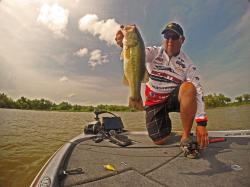
Electronics help catch bass

Electronics help catch bass

Vahrenberg verifies the presence of a kicker fish on the tree identified with 360 Imaging.

Here’s how a handful of fishing’s top experts find and pattern bass, walleyes and panfish during the fall and winter – and how you can do the same.

Open-Water Bass: Fall & Winter

Missouri-based tournament pro Doug Vahrenberg says his fall and winter bass game has never been better thanks to the trifecta of Humminbird’s LakeMaster mapping, Side Imaging and 360 Imaging.
“As the water cools and bass school up in the fall, they’ll begin to move from the main lake into creek arms. And you’ve got main lake fish on the flats adjacent to those creek arms. Both have one thing in common: they’re looking for lunch.”

Vahrenberg says it all comes down to surveying a lake quickly because fall bass can be here today, gone tomorrow. With two ONIX units at the dash – one set to full-screen Side Imaging, the other to Humminbird LakeMaster mapping – Vahrenberg is similarly on the prowl for baitfish and bass.

“I typically have my Side Imaging set to look 100 feet right and left. On a new lake I’ll increase that range to 130-150 feet until I find bait and ambush targets like trees, stumps, and submerged cover most anglers can’t see, especially in shallower stained water. Then I mark anything that looks like a good ambush site with a waypoint.”
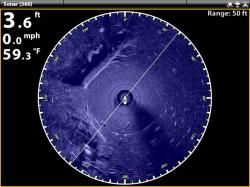
Hummingbird 360

Hummingbird 360

Humminbird 360 Imaging reveals the submerged tree in shallow, stained water that produced Vahrenberg’s bass (shown), only 25 feet from the boat.

He adds: “Seems like fall bass like flats close to a channel swing. They’ll move up from deeper water and push the bait into two-, three- or four feet of water and feed. With LakeMaster mapping you can find those spots where the channel swings in close to the bank. A lot of times your screen will be absolutely full of bait so I like to concentrate on those areas right before or after the giant wads of bait. Helps make the presence of your bait known.”

Once he’s located a channel swing, good cover, baitfish – even the bass themselves – Vahrenberg will jump from the console to the bow.

“As soon as I start pinging Bow 360 every waypoint will show up on my bow ONIX unit and I can motor right to ’em. Seems like if there’s a lot of cover, the fish tend to be isolated. Where there’s no cover, fish tend to group up in ‘wolf packs’. That’s where 360 Imaging really helps locating the stuff that you can’t see. The beauty is that it does all the work for you. You’re not controlling anything with your foot – all you have to do is look at the screen and think about where to cast next.”
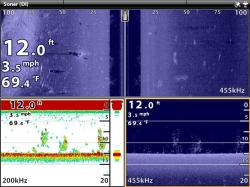
ONIX split-screen

ONIX split-screen

This ONIX split-screen reveals the presence of baitfish in Side Imaging, 2D Sonar and Down Imaging.

From fall through winter, Vahrenberg breaks down his presentations into two preferred categories.

“I always have one stick rigged up with a creature or jig and craw combo to flip the isolated fish on cover. Those fish will position right behind the timber, waiting for lunch to swim by. On lakes with less cover I’m fishing fast search baits to connect with the wolf packs – square bills, spinnerbaits, buzzbaits, lipless cranks – and searching out aggression bites. A shad pattern is always good but if there’s an overabundance of forage, I’ll switch over to a bluegill pattern, which is often just different enough to get bit. Look at it this way, if you’re eating a chicken breast every day and somebody offers you pizza …”

During winter, Vahrenberg reverses his fall routine and starts at the back of creek arms, moving outward to the first or second channel swing – or from the edge of the ice back to the main lake. “Even more so in the winter, bass will associate to the channel swings – and deeper water – but look along the edges. Again, LakeMaster mapping and the imaging technologies can really help you find the right stuff.”

Pre-Fishing For Early Ice: Walleyes & Perch

In northern Minnesota, the open water season is typically over by Thanksgiving. Yet, by the time the turkey and cranberry are being passed around the table, ice fishing guide/tournament Brian “Bro” Brosdahl has much of his winter ice fishing strategy already mapped. Many years, he’s already fishing on hardwater by turkey day.

“Sure, I’ll drop waypoints on structures in the fall but what I really do is fast-forward my thinking to winter, knowing that walleyes and jumbo perch will associate to shoreline points, saddles, humps, and weed bed edges on flats during early ice,” says Brosdahl.

Like Vahrenberg’s Missouri bass, Brosdahl says the biggest reason early-ice fish associate to these areas – especially on larger bodies of water like Minnesota’s Mille Lacs, Winnibigoshish and Leech – is the presence of baitfish. “Walleyes and perch both gorge on shiners, although the bigger walleyes seem to prefer whitefish.”

Brosdahl says Humminbird Lakemaster mapping greatly reduces the time it takes him to “pre-fish” a lake in the fall for ice fishing in winter.

Yellow Perch

Yellow Perch

Brosdahl and the big jumbo perch pay-off of scouting with Humminbird LakeMaster and Side Imaging technologies. Photo by Bill Lindner.

“But you can’t just motor around in the fall, mark bait and fish and drop waypoints. Most of the fall fish will have moved by first-ice. So, what I do is highlight depths with Lakemaster’s Depth Highlight feature – typically somewhere between 12 and 14 feet on bigger lakes – and then start dropping waypoints on those areas that will be their next move after fall.”

“You still have to look for inside turns, saddles and especially those steep breaks for walleyes. But remember: If there are walleyes in the area, they’ll push the perch up onto adjacent flats and the gradual breaks.”

Brosdahl was one walleye fishing’s earliest adopters of Side Imaging. “Same time as I’m watching my LakeMaster map, I’m watching Side Imaging for hard- and soft bottom edges. Both walleyes and perch will ride those edges all winter long. With Side Imaging these spots are unmistakable. Plus, as more of your ‘A list’ spots like rock piles and sunken islands get winter fishing traffic, I find myself fishing hard-to-soft bottom transitions in places easily overlooked.”

Once a surveyor for LakeMaster himself, Brosdahl says mapping waters with Humminbird’s new AutoChart Pro software has been a lot of fun. “Of course, this time around I don’t have to share my findings with anyone!”

“Kind of cool that I can go to a lake that doesn’t have HD one-foot contours and really dial in on spots for winter. Plus, AutoChart Pro gives me bottom hardness mapping so I those hard-to-soft spots really jump out. And there are some tiny lakes that have never been mapped. That’s where AutoChart really shines.”

One pass of Humminbird 360 reveals more than 10 manmade crappie cribs in a single pass. Range set to 120 feet in every direction.

manmade crappie cribs

manmade crappie cribs


He adds: “Another thing: Internet connectivity – even phone reception – can be pretty spotty in the areas I fish. Pretty cool that you can create the map on a PC without having to connect to the web. Plus, I know my data’s kept private.”

Tournament Talk: Winter Panfish

Currently, Wisconsin-based Kevin Fassbind and Nick Smyers are in second place as they prepare to fish the NAIFC 2014 Series Ice Fishing Championship on Minnesota’s Mille Lacs Lake, December 20, 2014.

A big part of their ongoing strategy is open-water scouting tournament grounds, like Mille Lacs’ Isle and Waukon bays.

“We’ve found Humminbird Side Imaging helps us identify the best weeds and hard-bottom areas. We’ll idle back and forth through a bay, looking 120 feet off each side of the boat. When we see holes in weed beds, inside turns and good bottom, we simply drop waypoints for winter. The way the system works is pretty easy – just pop the SD card out of the Humminbird 999 on the boat and drop it into the Humminbird 688 ice combo. Then it’s all right there,” says Fassbind.

Beyond marking waypoints on open-water, the duo has also experimented with Side Imaging on the ice. Using a pole-mounted Side Imaging transducer spun manually around in a hole in the ice, Fassbind and Smyers have had some success using the technology in a way it wasn’t intended.

“When we were fishing the NAIFC event on Lake Maxinkuckee, Indiana, we found a 20′ x 20′ patch of weeds with some logs, and Kevin pointed me in the direction and told me to start drilling. Boom, drilled one hole and I was on it,” says Smyers. “But it was difficult to get the image we wanted. Yet, we could see how this kind of technology could give us a huge on-ice advantage for locating manmade structures like cribs, Christmas tree piles, even fish.”

Along those lines, the duo is planning on implementing Humminbird Bow 360 into their tournament arsenal this year.

“What we were trying to do with Side Imaging is something that 360 Imaging already does better. With a little bit of rigging for ice, I really think it’s going to help us locate structure and fish even faster, which could be huge for main-basin crappies and deep-water perch. Punch a waypoint on fish and then go drill it. Instead of drilling hundreds of holes, we’ll be drilling a precise few. Not sure how much grid scouting we’ll be doing any more,” says Smyers.

Kevin Fassbind

Kevin Fassbind

Competitive ice angler Kevin Fassbind and teammate Nick Smyers use a combination of open-water and on-ice scouting with Humminbird technologies to stay on top of the leaderboard.

No matter where in the country you fish, the take-home message is clear: put in some time scouting with today’s technologies and you too can increase your odds for stellar fall and winter fishing.

For more information visit humminbird.com, contact Humminbird, 678 Humminbird Lane, Eufaula, AL 36027, or call 800-633-1468.

About Johnson Outdoors Marine Electronics, Inc.
Johnson Outdoors Marine Electronics, Inc. is a wholly owned subsidiary of Johnson Outdoors and consists of the Humminbird®, Minn Kota® and Cannon® brands. Humminbird® is a leading global innovator and manufacturer of marine electronics products including fishfinders, multifunction displays, autopilots, ice flashers, and premium cartography products. Minn Kota® is the world’s leading manufacturer of electric trolling motors, as well as offers a complete line of shallow water anchors, battery chargers and marine accessories. Cannon® is the leader in controlled-depth fishing and includes a full line of downrigger products and accessories.

Will A Spinnerbait Wire Break If I Use It Too Long?

I almost lost the only bass I hooked in my last club tournament when the spinnerbait I was using broke. At weigh-in, Blake Thompson told a sad tale of losing a huge bass – at least 8 pounds – when it broke his line. All fishermen have bad luck like that at times. However, there are things you can do to lower your chances of bad luck.

On Saturday before the tournament two weeks ago, I fished with Jim Stutts and his 16 year old son Jay. I met Jim when we fished together in a tournament in 1986. The first place we stopped Jim asked if I remembered the big fish he lost in that tournament in a treetop when it broke his line. He said I taught him a lesson he would never forget – re-tie your line if you get hung up.

He reminded me I had re-tied my line as we idled across the river in that tournament. We had been dragging spinnerbaits over stumps and getting hung up a lot. He didn’t take the time to re-tie his and broke off the big fish right after we started casting again. He said he always re-tied after getting hung up now, and reminded Jay to do so throughout the day.

Blake had been fishing rocks in the tournament two weeks ago, bumping a spinnerbait on them. He did not re-tie his 12 pound test line, although bumping rocks is the easiest way I know to damage your line. He hooked the big fish, it jumped and then broke off.

I learned my lesson the hard way also. Jim Berry and I were fishing High Falls soon after I moved to Griffin in the early 1970’s. I had not had a strike all day, and had gotten too lazy to re-tie my line. I cast into a treetop and a got my first strike. A five pound bass jumped when I set the hook and then ran under the boat. It broke my line. When I checked the broken end, it was very frayed. You can feel the rough line where it is messed up by rocks, limbs, docks and even fishes’ teeth.

When fishing, check your line and re-tie it regularly. If it feels rough, re-tie. Even if it doesn’t feel rough, I often hold the hook and jerk it much harder than a fish could, just to see if it will break. Sometimes the knot is weakened and you can’t tell until too late unless you stress it like a big fish might.

The lighter your line, the more often you should check it and tie a new knot. Heavy line holds up better but still needs attention. When fishing a Carolina rig with three knots, check all three often. Don’t lose the fish of a lifetime when you have that one chance because you didn’t take the time to tie a knot.

With spinnerbaits, you can not tell when they are going to break. If fishing for fun, I might take a chance on using a $5.00 spinnerbait over and over. In a tournament, when a bass could be worth hundreds of dollars, I will retire a spinnerbait after catching no more than three fish on it. It is just not worth taking a chance that the wire has become weak and might break.Will

Can I Lose A Bass By Changing the Angle I Am Fighting It?

The fish I lost in the tournament two weeks ago taught me some more lessons about getting fish in the boat. The one bass I hooked in the Oconee tournament hit a Shadrap in a brush pile. When I set the hook it came to the top and I could see the hook was just barely in its mouth.

The fish was running to my right, around the front of the boat. Rather then try to turn it, I told Jim I would let it go around the boat and bring it to the other side. I also told him to net it quick or it would be gone.

The reason I did not try to make the fish turn and come to the near side of the boat is past experience. When a fish is hooked on a crankbait, trying to make them turn often pulls the hooks out. I think the plug acts as a lever, and when the angle changes, the hook can no longer hold.

I have lost several fish like that. The biggest was a huge bass at Jackson. It came to the top and, when I tried to pull it toward the boat, it just came off. It floated there for what seemed like several seconds before sinking out of sight. I guessed it weighed over 10 pounds.

Linda lost a monster bass at Clark’s Hill many years ago in the same way. She fought it till it was tired and on top. Just like the one I lost, when it turned on its side, the angle of the hook changed and it pulled off. There is nothing you can do in a case like that.

At Oconee, my bass went under the boat after coming around the front. When I tried to pull it to the surface for Jim to net, I pulled the hook out of its mouth. Again, I was pulling in the opposite direction from the way it was hooked. There was no way Jim could have netted it, although I fussed at him for not doing so.

A few minutes later, Jim hooked a fish. It was running to the right also, and when he tried to turn it, it pulled off. We never saw the fish, and neither of us had a fish to weigh in that day. Some days, if you don’t have bad luck you don’t have any luck at all.

If you hook a good fish, keep in mind hooks often pull out if you reverse the pull from the way it was hooked. Often there is nothing you can do about it but if you can lead the fish around in a circle it might help you land it.

Can I Catch Spotted Bass In Kentucky?

Spotted Bass Time in Kentucky Waters
from The Fishing Wire

Kentucky spot

Kentucky spot

This is the third installment of a series of articles titled “Fall Fishing Festival” profiling the productive fishing on Kentucky’s lakes, rivers and streams in fall.

FRANKFORT, Ky. – They were not even recognized as a distinctive fish species until 1927. People for many years believed these fish only existed in Kentucky.

In 1956, the Kentucky legislature designated this species the “Kentucky bass” and made them the official state fish. Many anglers, especially in the south-central portion of the United States, still call the spotted bass a Kentucky bass.

They pale in reputation to their black bass cousins, the largemouth and smallmouth bass, but the spunk shown once hooked and their abundance should raise the profile of the overlooked spotted bass. They are also aggressive and readily strike lures.

It isn’t hard to tell when a spotted bass strikes. They shake their heads violently and dive bomb toward the bottom. The larger ones 15 inches and up usually grow a pronounced belly as they mature. Spotted bass use that girth along with a powerful tail against an angler while playing the fish, producing as good a fight as any comparable largemouth bass.

Medium-light spinning rods with reels spooled with 6-pound fluorocarbon line is all you need for catching spotted bass.

Once the fall winds blow, spotted bass begin to school up. They locate along rock bluffs or they suspend over points, submerged humps or channel drops.

“At this time of year, if you catch one spotted bass, keep fishing that same spot,” said Chad Miles, administrative director of the Kentucky Fish and Wildlife Foundation and dedicated spotted bass angler. “There might be 40 or 50 of them there. Spotted bass really school up in fall.”

Catch spots on topwater

Catch spots on topwater

In early to mid fall, these schools of spots often trap a cloud of shad against the surface and rip into them. Large, chrome topwater lures tossed into this melee draw vicious strikes. These same lures fished over points, humps and channel drops can draw spotted bass from a good distance below the lure, especially on our clear water lakes such as Lake Cumberland or Laurel River Lake.

John Williams, southeastern fisheries district program coordinator for the Kentucky Department of Fish and Wildlife Resources, reports Lake Cumberland holds a bountiful population of spotted bass with many fish in the 14- to 16-inch range. Spotted bass make up roughly half of the black bass found in the lake.

The main lake points from Harmon Creek down to Wolf Creek Dam hold spotted bass from fall through late spring. A 4-inch black finesse worm rigged on a 3/16-ounce Shakey head and slowly fished down those points is a deadly choice.

A hammered silver jigging spoon fished along the old Cumberland River bluffs in this section of the lake also produces spotted bass. Again, if you catch one spotted bass in fall, keep fishing the same area with the same technique. You might catch a dozen or more.

Large crappie minnows fished on size 1 circle hooks with two split shot lightly clamped on the line about 18 inches above the hook make a powerful choice for the large spotted bass in Laurel River Lake. The water of Laurel River Lake is as clear as the air and live bait works best.

The upper end of the Craigs Creek arm is a spotted bass hotspot on Laurel, as are the main lake points near the dam and in the lower section of Spruce Creek.

The mid-depth reservoirs in southern Kentucky hold excellent populations of larger spotted bass. Barren River Lake and Green River Lake hold some of the largest spotted bass in Kentucky.

The channel drops along the submerged Barren River adjacent to Barren River Lake State Park and the Narrows Access Area make excellent fall spots to try for spotted bass.

In Green River Lake, rock slides and points in the lower sections of the Robinson Creek arm and Green River arm are the best fall places. Green River Lake holds an impressive number of spotted bass longer than 15 inches.

Anglers fishing for largemouth bass in Kentucky Lake often stumble across a football-sized spotted bass. The secondary points in the major bays and creek arms in the middle section of the lake hold some impressive spotted bass in fall.

Smaller profile ¼-ounce football jigs in hues of green, brown and chartreuse attract these fish on Kentucky Lake.

Spotted bass make excellent table fare, by far the best tasting of the black bass species, similar to crappie in taste and texture. There is no minimum size limit on spotted bass statewide, but they still count toward the six fish aggregate black bass daily creel limit.

Hit the water and land some hard fighting and abundant spotted bass this fall. Keeping a few medium-sized spots for the table makes a delicious and nutritious meal.

Author Lee McClellan is a nationally award-winning associate editor for Kentucky Afield magazine, the official publication of the Kentucky Department of Fish and Wildlife Resources. He is a life-long hunter and angler, with a passion for smallmouth bass fishing.