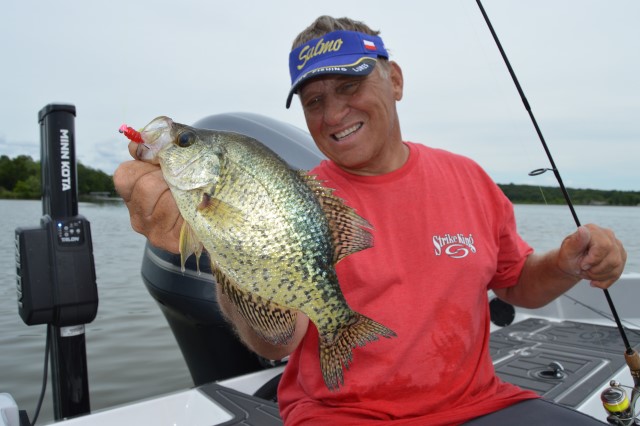
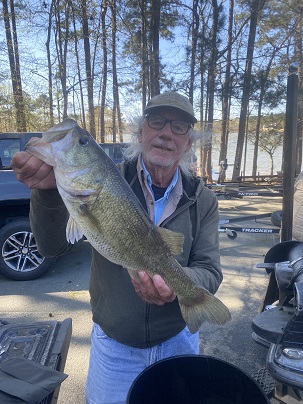
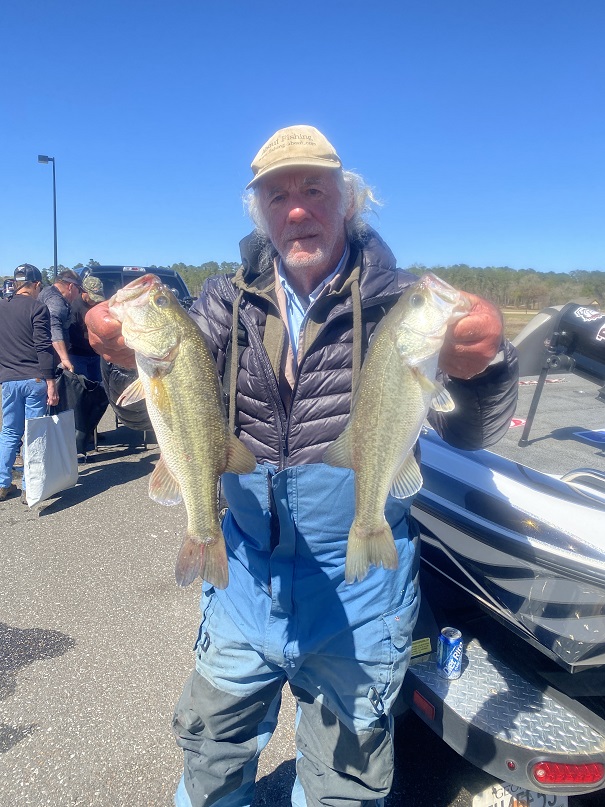
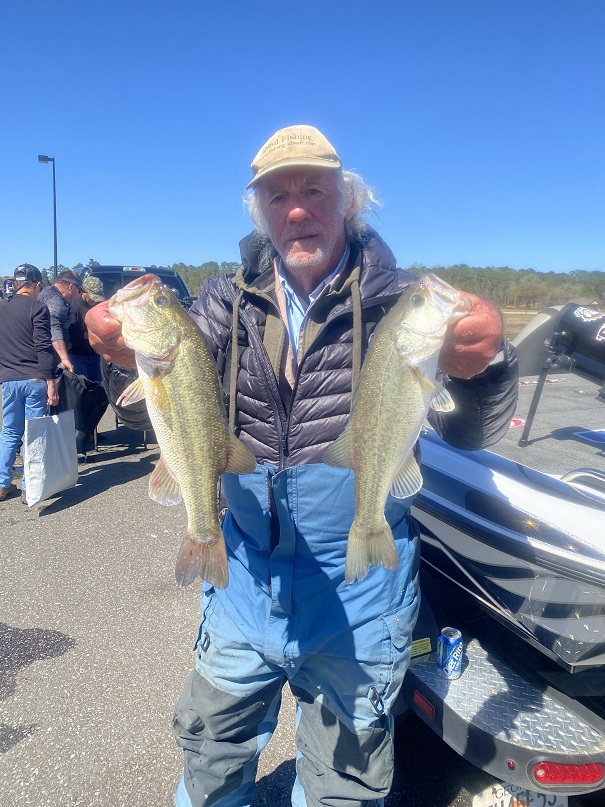
These two four pounders helped me win and get big fish at Lake Sinclair at the last minute!
Last Sunday, March 6, nine members of the Flint River Bass Club fished our March tournament at Lake Sinclair. The weather was beautiful for our casting from 7:00 AM to 3:00 PM but the bass didn’t seem to care. We weighed in 29 keeper bass weighing about 47 pounds and had three five-bass limits. No one zeroed.
My four at 10.63 won and I had as 4.19 pound largemouth for big fish. Chuck Croft placed second with five at 9.15 pounds, Don Gober had five at 9.02 pounds for third and Alex Gober, his grandson fishing with him, had five at 4.86 pounds for fourth.
Will Mclean fished with me and we headed to some grass beds near the dam where Ricky Layton, showing me around the same time of year two years ago for a GON article, caught five weighing 28 pounds. But after three hours and several different places, we both had two bites.
A good keeper bass hit my crankbait on a seawall and jumped and threw it. Then Will hooked and lost what looked like a keeper on a Texas rigged Senko. A little later Will caught a bass that just barely touched the 12-inch line, then I caught a similar one.
Club rules say a bass must be 12 inches long with its mouth closed on a keeper board to be weighed. I could make mine touch the 12-inch line, barely, but worried about it. Sometimes in the excitement of catching one I do not measure it correctly.
Around 10:30 I cast my bladed jig to a grassbed on a point and hooked a keeper out in front of it. At 11:30 Will cast to the middle of a shallow cove, said “I got one” and a huge fish swirled on top. He got it to the boat and I netted it, but it was a big blue catfish. Will’s new scales said it weighed ten pounds but it looked much bigger.
At 2:00, with about 45 minutes left to fish I was pretty disgusted. We went into one of my favorite small creeks. As we fished down a bank with a big grassbed on it, I told Will I had never caught a fish past the last small dock on it, it was very shallow. But Niles Murray caught a keeper back in it when we fished together a few years ago.
I cast my bladed jig back in it and my line started going sideways. When I set the hook the 4.19 pounder jumped, it was only a foot deep and it had nowhere to go but up! When I got it to the boat I let it go around the trolling motor but managed to pull the motor and bass up and Will got it in the net by lying down on the deck and reaching forward. That fish was just meant to get caught.
I caught another keeper on a shaky head on the next dock, then started around the other arm of the cove. Again I told Will I had never caught a bass way back in it, and he reminded me of what had just happened.
As luck would have it, way back in it I pitched my shaky head to a seawall about a foot of water and felt a tap and my line started moving out. When I set the hook a 4.13 pound largemouth fought hard but I managed to keep it away from the trolling motor and Will netted it.
We went back to the dock where I caught my keeper and Will got a 3.16 pounder off the seawall beside it, again about a foot deep. That was it, we had to go in.
I don’t know if it was time of day, location or what but I wish it had started earlier, or we had more time to fish before the time ended. This time of year fishing is often better late in the day after the sun warms the water some. It was 62 degrees in that creek at 2:00 and I am sure those fish were thinking about bedding.
While waiting for Will to back the trailer in, I checked my smallest fish and decide it had shrunk, so I just weighed in four.
The song “I’m A Girl Watcher” by the O’Kaysions hit the charts in 1968, the year I graduated from high school. It may have been appropriate way back then but I am sure it is politically incorrect now. But it really doesn’t matter. All my life I have been a bird watcher, too, and now that is even more appropriate.
I have always had bird feeders in my yard and have several books on bird identification. Pictures by John James Audubon draw my attention as does his information about different species. I think one reason I really like him is I found out he shot the birds he painted so he could get a better look at them!
One of my most unusual sightings was a Swallow-tailed Kite. Linda and I were driving back roads home from Jekyll Island a few years ago and I saw it soaring above a clear cut. Luckily there was no traffic because I slammed on brakes and got off the road to look at it!
A couple weeks ago, on February 18 – 21, the Great Backyard Bird Count was held. This year folks all over the world set records for the numbers of birds seen and submitted on a database. This information helps learn about bird populations and how they change over time.
Angling angst is peaking across the US. Open-water fishing throughout the north and much of the country’s mid-section has been stymied by Mother Nature for weeks or months. Depending on their location, many coastal anglers, too, are pining for the warmer water temperatures that bring increased angling opportunities. For most, this is the time of year when the angling itch is most persistent. The gear is prepped and there’s so much to look forward to. But will winter ever end?
Resourceful anglers know there’s always a way to scratch the itch, even during the waning weeks of winter. Steering for the nearest coast is a good bet. The fish are always biting somewhere, and our St. Croix pros in Florida, Texas and California are anxious to share three distinct inshore options for your angling consideration.
The Florida Keys
Laying claim to the southernmost geography in the continental USA, the Florida Keys are always open for the business of rewarding angling. “Key West will have the best permit fishing of the year in late February and early March,” says St. Croix stick, co-host of the popular Saltwater Experience TV show, and host of the uber-entertaining and informative Tom Rowland Podcast, Captain Tom Rowland. “Fish are active, aggressive and willing to play ball for the fly fisherman or the spin fisherman.”
Rowland says rising water temperatures bring fish that have been wintering offshore and in deeper channels back to the flats. “Cold fronts can negatively affect the fishing this time of year, so you are really looking for times in between fronts when the temperatures rise into the high 70’s and the permit and bonefish will respond favorably. Early-season tarpon will also flood in on nice weather.”
Rowland gets the best results free-lining live crabs to the permit, casting jerk baits for tarpon, and tossing small jigs or live shrimp to bonefish, adding that all of these species will also respond well this time of year to a properly selected and well-presented fly. His gear most often consists of a 7’ St. Croix Legend Tournament Inshore spinning rod – the medium power model (LTIS70MF) for permit, and medium-light (LTIS70MLF) model for bonefish – as well as a 7’ heavy power St. Croix Triumph Inshore spinning rod for tarpon. When casting flies, he selects a St. Croix Imperial Salt fly rod, typically an 8-weight for bonefish, a 10-weight for permit, and an 11- or 12-weight for tarpon.
When spin fishing, Rowland advises against the use of monofilament line. “Matching all the spinning rods up with a high-quality braided line is a must in my opinion,” he says, “because it allows for at least 40% farther casting and will result in more fish. I like 15-pound braid for bonefish, 20-pound for permit and 20-30-pound for tarpon.”
Rowland says sight casting from the bow of a skiff can be intimidating and often frustrating, especially when flyfishing. “Soft, accurate casts are often a must, and when the wind starts blowing it can be daunting even for experienced casters. Anglers without a lot of experience in this type of fishing should practice their fly casting before they go. Get instruction from someone in your area who knows about saltwater flyfishing and flyfishing from a skiff. Some good instruction goes a long way!”
Saltwater Experience co-host and St. Croix pro, Captain Rich Tudor, says anglers visiting the Keys during cold weather snaps can still find good fishing. “The water levels are really low and we have some of the lowest tides of the year right now. Combine that with cooler water temperatures and it really concentrates fish in the deeper holes and channel edges.” Tudor says those deeper holes can be anywhere from two to ten feet. “Those conditions can condense 100 acres of water into one acre,” continues Tudor, who often targets concentrations of redfish and snook at low tide. “Then, if the water warms up those fish will spread out onto the flats once the tide comes up,” he adds.
“In addition to numbers of fish, anglers can expect a lot of variability in size, both for the redfish and the snook,” says Tudor, who keeps rigging simple and universally appealing, typically casting light bucktail jigs tipped with shrimp on a 7’ medium-light power St. Croix Mojo Inshore or Triumph Inshore spinning rod with 15-pound braid and a 30-pound fluorocarbon leader.
Texas Coast
“Here in Texas, the hardcore anglers know this time of year is the time to catch big – and I mean really big – speckled trout,” says St. Croix pro, tournament angler, and Texas native, Joseph Sanderson. “Grab your waders, head for waist- or chest-deep water where you find any bait whatsoever, and you have a really good chance at a fish of a lifetime.”
Generally speaking, Sanderson advises wading anglers to look for a slightly muddier bottom because it may be a few degrees warmer than surrounding waters. “If you can find some grass mixed in, that doesn’t hurt anything either,” says Sanderson, who also urges anglers to be on the lookout for bait. “Bait becomes scarce this time of year, so if you see a mullet jump or a school of other baitfish scatter, that can be a really good starting point.”
Sanderson says Matagorda Bay and Baffin Bay are two legendary Texas spots where anglers can chase the “gator” trout bite at this time of year. “February through April is prime time, and the prize you’re after is a fish upwards of 28 inches. My personal best this time of year is 31.5″ and pushing ten pounds,” Sanderson adds.
A Corky is the bait of choice this time of year for Texas trout. It’s a soft plastic suspending bait that Sanderson says anglers should plan on working painfully slow. “The fish are lethargic this time of year and are looking for an easy meal, so the suspending characteristics of a Corky really shine,” he says. “It is a big, heavy bait, so this is the one time of the year that I put the medium-light power Mojo Inshore spinning rod down and pick up the casting rod. I like a 7′ medium power, fast action Mojo Inshore or Triumph Inshore for this bite. It helps having a little beefier casting rod for the bigger baits and also aids in landing some of the more powerful slot redfish you might also hook up with. In the summer, I like a medium-light power rod, but not this time of year. The bite can be really subtle – even from a big fish – so I like rigging with 30-pound braid for sensitivity along with a 17-pound fluorocarbon leader.”
Sanderson says late-winter trout fishing is anything but a numbers game. “You need to have patience to chase this bite,” he says. “It would be comparable to swimbait fishing for largemouth bass in freshwater. You go out chasing two or three bites per day knowing the potential rewards. A 30-inch speckled trout compares to a 10-pound bass in my opinion, both of which are considered the pinnacle of the respective pursuits. Don’t get discouraged if you have a few fishless days on the water, either. Those who are persistent will be rewarded.”
Sanderson’s final tip to late-winter speckled trout anglers is to stay mobile. “As the day warms, you might consider moving a little shallower,” he says. “It isn’t uncommon to catch these big fish in knee-deep water in the dead of winter. The shallow water warms quickly, and deeper fish will move up just as fast as the temperature rises. Keep your eyes peeled for any sign of bait or surface wakes. If there is surface activity, you are likely in a good spot.”
Southern California
Anglers who may not know his name or job title will likely recognize Morgan Promnitz’s smiling face, which is most-often seen peering from behind some massive saltwater fish he’s gripping aboard his Hobie kayak. The Director of Fishing Development for Hobie, Promnitz makes his home in San Diego and is also a world-class and well-traveled angler who serves as a St. Croix pro and advisor.
“Southern California has some really consistent fishing in the surf and bays in late February and March,” says Promnitz, who also regularly ventures offshore in his Hobie in search of the yellowtails that often remain off the coast of Southern California through winter and early spring.
“The barred surf perch and halibut bites can be great right off the beaches, and surf anglers can expect plenty of croakers and corvina to keep things fun, too. Flyfishing is also a good option,” says Promnitz, who adds area bays always have spotted bay bass, halibut and other species like corvina, croakers, and even bonefish, to name a few. “The halibut come into holes in the surf or patchy cuts in the reef to ambush baitfish that are in the shallow surf,” he says. “Check the schedule on the grunion runs, as this is when the halibut like to move in close and gorge on the stragglers. Try a medium-light to medium power Mojo Inshore spinning or casting rod in that 7’-to-7’6” range with 10-20-pound braided line and a 12-20-pound fluoro leader,” Promnitz advises. “That’ll give you a really versatile outfit that pairs nicely with the wide variety of fish you might encounter along the beach. A 3” soft-plastic swimbait paired with a ¼-ounce lead head jig will draw bites from almost anything around here. A Lucky Craft SW 110 jerkbait does a good job at imitating grunion and is a deadly choice for halibut in the surf.”
For perch, try fishing a 1.5-inch motor oil/red flake colored grub tail or brown/green gulp sandworm, Carolina rigged with a ¼-ounce egg sinker on an 18”, four-pound fluorocarbon leader,” Promnitz says. “Weight size and line size can go up depending on the conditions.”
Promnitz says the bays stay warmer in the colder months and the fishery remains steady and is more consistent in winter when it’s not too warm. “The bigger halibut come into the bays to spawn in the early spring, and larger barred sand bass hold on deeper structure in the mouth of San Diego Bay throughout the winter and can also provide some great action,” he says. “For the bigger halibut and sand bass, step up to medium or medium-heavy power Mojo Inshore or Triumph Inshore rods and use lures in the ½-ounce-to-1-ounce range, especially in deeper water.”
Promnitz says a 40+ pound fish in the bay is always a possibility. “There is plenty of bait in the bays during the early spring and water temps are ideal. They also provide shelter from winter storms and turbulent waters,” he says. “Bay fishing is fun and exploratory fishing. You can fish shallow or deep, over open water over rock, sand, or grass, or in tighter spaces like docks, harbors and marinas. Everything from livebait fishing or casting and retrieving artificials to trolling, jigging and flipping comes into play here. It all depends on the species you are targeting and the technique you have the most fun with or confidence in.”
Promnitz urges bay anglers hoping to target halibut, spotted bay bass or other larger species to remember that these fish are ambush predators. “Look at shapes of the fishery, the drop-offs, contours, grass beds and other structures, then consider tidal flow to try and locate where the predators will stage. A stop at a local tackle store or two will also pay dividends. Spend a little money in the store and you’ll usually get some great intel to go along with your fishing goodies or snacks,” he says. “You can also learn the better access spots. You can fish the beaches or bays on foot, but the bay can be more productive in kayak or boat.”
Parting Words
Springtime will be here soon, but for millions of anglers locked in by ice and snow, that knowledge doesn’t make the coming weeks any easier. What likely will make a difference is a trip to the coast – whether that’s Florida, Texas, California or somewhere else. So, take steps to improve your angling outlook. Gear up, then follow our pros’ advice on the whats, wheres, and hows.
I have lots of great hunting memories, some fun, some scary and many just happy.
Sometimes I shot odd things while hunting. One year Harold and I were easing along Dearing Branch headed to some oaks to set up for squirrels. Something ahead of us on a low limb caught our attention. It was big and brown and since both of us had .410s, so we planned to shoot it together.
Somehow I misunderstood Harold when he said shoot, and I did, alone. But the great horned owl fell. I have no idea why it was active during the day; it should have been roosted high in a big tree and hidden from us. It was huge, much bigger than I ever imagined. It is the only owl I ever shot and somewhat regret killing it, but that was 60 years ago!
The first year Linda and I were married she taught school while I finished my senior year at UGA. Money was tight and we ate anything I could kill, just like my family did growing up. Squirrels and rabbits were the main meat de jour.
One afternoon I saw a ball of fur up in a bare oak tree. If the leaves had been on the trees I would never have seen it. But with my scope I could tell it was a big raccoon.
I shot it, the first one I ever killed, and took it back to our trailer in town and cleaned it. I contacted the cook at my fraternity house and he told me to boil it for three hours then cover it with BBQ sauce and bake it.
I thought it was good but Linda not so much. Tasted like BBQ chicken thighs to me!
Years later I shot a beaver on my pond and just had to cook it. A Google search turned up a recipe for Mississippi Baked Beaver, a legitimate recipe. It involved boiling, sautéing and then braising it. It was the reddest meat I have ever seen, and the beaver was almost impossible to skin. I had to cut every inch of hide between meat and skin, there was no stripping it off.
Again, I thought it tasted pretty good but Linda did not like it. It was not delicious enough for me to clean another one, though.
A few years ago on-line I told the tale of shooting a killdeer (we always called them killdees) because ai wanted to see exactly what it looked like. They were common in our field but very spooky and I could never get near them. A few times shooting doves one would fly near my blind, but I definitely did not want to explain to the others on the field that I knew it was a kildeer not a dove if I took a shot.
I did sneak up on one and hit it with my .22, finally getting a good look at its brown and white feathers with golden highlights. It was very pretty and I never wanted to shoot another one.
When I told this on-line, a troll in the group threatened to sent the federal wildlife folks to arrest me since killdeers are federally protected birds. I jerked the jerk around a little on-line – everyone in the group made fun of him he was so out of it – and he got madder and madder, making all kinds of threats.
When I pointed out I had said up-front I had shot the bird when I was 12 years old and that was in 1962, long before the law protecting them went into effect in 1976, he shut up and disappeared from the group for as few days.
I did not cook the killdeer but I did cook many other birds I shot as a kid. They all tasted just like the doves we shot. Robins, bluejays, sparrows and blackbirds all tasted about the same roasted over an open fire in the woods or in my rock fort. And all were very tough, from my method of cooking or their age.
The only two birds I would not shoot were cardinals and bluebirds. They were off-limits, just too pretty to shoot. But stalking all others and getting close enough to kill them with my BB gun or .22 helped me learn a lot about hunting and shooting that was useful later in life.
Part of what makes the redfish so popular is their affinity to bite. They’re generally a willing predator, making them a favorite target for inshore anglers no matter where they live. From the Gulf Coast and north to the Atlantic, redfish have the hearts of many anglers due to their hard fighting ways. Texas Capt. Brett Sweeny of Matagorda and Ken Craig of Florida’s Nature Coast make their living because of the species and catch redfish with a plethora of different artificial lures, but each has one that they never leave at the dock.
Saltwater Swimbaits
Captain Brett Sweeny of Matagorda, Texas, guides over 200 days each year, focusing on wade fishing for trophy trout and inshore redfish. Redfish are a popular target and he says there is one lure that produces fish for him when fishing redfish tournaments up and down the Texas coast and also for his clients throughout the year: a paddle tail swimbait.
“It’s foolproof and always works for redfish around here,” he says. “No matter what the skill level of my client is, it works because it’s so simple to fish and catches fish year round. There’s no wrong way to fish it; throw it out and reel it back in.”
Most of the time, Sweeny will have three rods rigged up at all times and two of them will be swimbaits because of how well they work. He’s a fan of the 3 ¾” MirrOlure Marsh Minnow swimbait on a ¼-ounce jighead.
“That combination gives you long and accurate casts when you see fish, but it also works blind casting to areas the fish are using,” says Sweeny. “During low tide, redfish like to get in the ditches and the swimbait is perfect for fishing these areas. I’m always searching for the ditches and pinch points and places the fish can pull up on flats to feed.”
For colors, he also keeps it simple with some tried and true hues that perform day in and day out. The sun is the most significant factor for deciding which color to tie on.
“The brighter the skies, the brighter the bait,” he shares. “I like pearl white when the sun is out and go with something with a darker back when fishing on overcast days or during lowlight conditions. The water isn’t very clear here in most places, so it needs to be something that will stand out a little bit.”
Sweeny prefers 6’9″ medium heavy Waterloo Power Mag rods paired with a 7.3:1 13 Fishing Concept C2 baitcast reel spooled with 30 to 40 lb. Seaguar TactX braided line without a fluorocarbon leader.
The 30 lb. casts a little better, but sometimes you have to go to 40 lb. when fishing around those gnarly shell beds,” he says. “TactX casts great, holds up very well and has great abrasion resistance. The camouflage color is another big plus and blends right in with the brackish, stained water we fish around here. We don’t even need to add a fluorocarbon leader and they still bite it just fine.”
The Classic Weedless Spoon
Fishing lures for all species come and go in waves and trends, but some remain for decades. One timeless lure is the weedless gold spoon. It was once a very popular freshwater bass lure for fishing aquatic vegetation but it has remained a top lure for the inshore saltwater anglers. Captain Ken Craig of Ken’s Custom Charters in Homosassa Springs, Florida, believes the spoon is an underrated lure.
“It’s year round and versatile,” he said. “You can use the cheapest version you find at Wal-Mart or go and get the best quality spoon money can buy with 24kt gold plating and they all work great. There’s something about that flash and action that gets a reaction from big redfish.” Fishing the spoon is simple and Craig slowly retrieves it so it gently rocks, walking and flashing near the surface to entice redfish.
“Keep your rod tip high and just make sure it doesn’t start to spin,” he shares. “It will walk right under the surface and cause a reaction strike. During the colder months, the fish will stay right on the bottom to stay warm and you can also bounce it off oyster beds and hard bottoms to make some noise to get their attention.”
Capt. Craig prefers spinning tackle for fishing the spoon; a 7’6″ medium Bull Bay Rod paired with a 2500-sized Shimano spinning reel. Braided line is a must and he prefers a 10 lb. braided line with a leader of 25 lb. Gold Label leader material.
“The light braid is crucial for making long casts to spooky fish,” he shares. “Our water here is so clear that my clients often say it feels like we are floating in an aquarium. So getting the bait away from the boat is very important because the fish know when you are getting too close.” The gin clear water near Homosassa Springs and Crystal River is unique and produces big redfish, with many over 30 inches long and trophy fish up to 37 inches. In the past, using a heavy 30 or 40 lb. monofilament line was common due to the size of the redfish and snook living here.
“Gold Label is so thin and makes small, tight knots, and you get more bites,” he says. “We all used to use monofilament for abrasion reasons from these bigger fish, but Gold Label has outperformed it in every way because it’s thinner and stronger. Almost every Captain in my circle has switched over to it because of how well it performs in our waters.”
Redfish are a top species for the coastal crowd from Texas to Florida. They grow big and fight hard and keep anglers coming back for more. According to two popular inshore guides, they will bite many lures, but a paddle tail swimbait and weedless spoon are must-haves for any redfish angler.
Seaguar TactX Camo Braid is available in 10 to 80 lb. test on 150 and 300 yard spools.
Seaguar Gold Label fluorocarbon leader is available in 25-yard spools in 2, 4, 6, 8, 10 & 12 lb. test for fresh water use, complementing the 15, 20, 25, 30, 40, 50, 60 and 80 lb. test leaders available for saltwater.
Last Saturday 25 members of the Potato Creek Bassmasters fished our January tournament at Lake Sinclair. After eight hours of casting from 7:30 AM to 8:30 PM, we brought 73 12-inch keeper bass weighing about 112 pounds to the scales. There were eight limits and six zeros.
Robert Howell won with five weighting 9.04 pounds and Raymond English placed second with five at 8.67 pounds. Michael Cox came in third with five weighing 7.88 pounds and my four weighing 7.55 pounds was fourth. Stevie Wright had big fish with a 4.37 pound largemouth.
The water in Little River was very muddy but the Oconee River and creeks downstream of the mouth of Little River were a decent color. I just knew I could catch some fish on a crankbait in the 52-degree water in the clearer areas, but at 1:00 my two bites were a two-pound channel cat on a crankbait and a bream on a spoon, jigging it in brush 18 feet deep.
At 1:00 I met a boat going down the bank and they fished my favorite dock before I could get to it, then left. I started to leave, too, but noticed they threw just to the front post, not the back post. That dock has some rock behind it and is usually good for a keeper. I cast my shaky head behind the dock and sure enough it started moving out. But when I set the hook my line broke! That really disgusted me but I kept casting and managed to catch two keeper bass and a five pound flathead cat on a crankbait and two more keeper bass on my shaky head the last two hours of the tournament.
I was shocked but pleased to place but kept thinking if I had just landed that bass behind the dock and it weighed two pounds, I would have won! And if frogs had wings, they would not bump their butt every time they hopped!
St. Croix set to drop all-new Legend Tournament Bass Series at the 2022 Bassmaster Classic
PARK FALLS, Wisc. (February 28, 2022) – Having the blues is never a good thing, unless, of course, you’re a bass angler with a deck full of St. Croix Legend Tournament Bass rods. Introduced some 17 years ago and consistently refined and expanded over the past decade, this coveted collection of technique-specific casting and spinning rods quickly grew to become a favorite of performance-minded bass anglers seeking an elite combination of St. Croix materials and technologies.
The Rebirth of a Legend Building on its expanding and proprietary expertise with hybrid blank engineering and construction, St. Croix Rod announces its latest expression of angler-centric design, an all-new series of Legend Tournament Bass rods that are lighter, stronger, and poised to elevate the bass-fishing experience with improved balance, performance, and capability in any technique or presentation.
Scheduled to be unveiled at stcroixrods.com and in the St. Croix booth (#2231) at the 2022 Bassmaster Classic Expo in Greenville, South Carolina, March 4, these 24 all-new Legend Tournament Bass casting and spinning rods will feature next-generation hybrid SCIV+ carbon fiber blanks.
In addition to their unique combination of proprietary materials, all-new Legend Tournament Bass rods will also incorporate all of St. Croix’s top technologies. Handcrafted in Park Falls, Wisconsin, USA, new Legend Tournament Bass rods will come with a 15-year transferrable warranty backed by St. Croix Superstar Service and will retail between $290 and $345.
Get the Blues Learn complete details on the all-new technique-specific made-in-the-USA Legend Tournament Bass Series in the coming weeks. Plan to make them your own at stcroixrods.com and at St. Croix dealers worldwide on March 25.
Lake Burton and tidal Savannah River are about as different kinds of water you can fish in Georgia, but both hold bass. My retirement job took me to both in the past week.
Lake Burton is a beautiful 2775-acre Georgia Power Lake on the Tallulah River in north Georgia between Clayton and Cleveland. Its 62 miles of shoreline are lined with huge houses with big docks, and its steep banks are covered with rock. Views of mountains surrounding it are very pretty.
Crystal clear mountain water is the norm there unless heavy rains stain up some of the creeks. Moccasin Creek State Park is also the home of a fish hatchery where trout are raised, and many are released into the lake, both intentionally and accidentally.
Although it is a good trout fishery, its big spotted and largemouth bass are the main attraction there. It also produces many chain pickerel and crappie.
I fished on a cold cloudy Tuesday with Jeremy Eaton, a local tournament angler, and the fishing was tough. The January snows up in that area had melted and made the lake go up about five feet while dropping the water temperature more than five degrees. That combination gave the fish lockjaw.
I enjoyed the trip and could imagine easing around the backs of coves looking for big largemouth on the bed, especially around the full moon on April 16. And spotted bass will be bedding then, too, and easy to catch out on rocky points and humps. Jeremy marked ten good places to catch bass in April for my Georgia Outdoor News (subscription required) Map of the Month article.
The houses are amazing. Jeremy pointed out a huge house up on a high point at the mouth of Timpson Creek and said Nick Saban built it. He built it to see if he liked having a house on Lake Burton and he did, but rumor has it this one was too small, so he built a bigger one. Its only 9542 square feet with 7 full and two half-baths and the tax office appraised it at 2.6 million. And it is not the biggest on the lake, by far!
Go up to Lake Burton for a nice vacation and take your boat. Enjoy the lake and mountain scenery and catch some trout for dinner, and some big bass to stretch your string.
I fished the lower Savannah River last Sunday with Billy Robertson, a local club fisherman. The views were very different. No mountains in the background, just flatlands that extended forever. And cypress trees and live oaks with Spanish moss beards replaced the barren hardwoods of Lake Burton.
I am not used to fishing current, so when we fished on the river Billy kept the boat pointing upstream and ran his trolling motor on high to keep the boat slowly moving downstream I was surprised. I had to cast fast to hit eddies behind trees in the water and small pockets along the bank.
Back in the creeks where we spent most of our time the current was still strong from the outgoing tide. Although we were miles upstream, above the I-95 bridge most of the day, the tide still affected the river.
We did catch fish. Billy quickly hooked a four-pounder, and our best five of them weighed about 20 pounds. But they were bowfin, fun to catch but we were after bass.
We did catch about a dozen keeper bass that day by casting worms and small jigs to eddies in the creeks but they were small. Most were 12 to 14 inches long but they fought good in the current.
There are bigger bass in the river. A local tournament took off from the ramp we used and it took five weighing 14 pounds to win, 11 for second and 10 for third. Big fish was a four-pounder. But the rest of the folks had five weighing six or seven pounds, just like our catch.
A highlight of the trip was dinner at Loves Seafood and Steaks. Although very expensive, the gumbo was some of the best I have had and the fried scallops were tender and delicious.
Fishing the river is a fun change of pace for us lake fishermen. There are several ramps just north of Savannah in both Georgia and South Carolina. But one warning, if you get off the river itself and go back in creeks on the South Carolina side, you need a nonresident fishing license.
Details of my trip and how to catch bass on the Savannah River will be in the April issue of Georgia Outdoor News.
Go north or south for a fun change of pace for fishing this spring.
The ice fishing season is winding down. In some parts of ice fishing territory, the season has closed for a couple species of fish. However, there are still lots of fish to chase in the remaining weeks of ice fishing. Perch, crappies, and other panfish are fair game in most places, and so are some species of fish of which we might not think. Some of those types of fish that aren’t frequently targeted can provide lots of excitement in the next few weeks. They can also provide some outstanding table fare. Following are ideas for getting in on that action.
On an ice fishing trip with some friends in the late 70’s I was introduced to a fish that has become a much more popular fish for a good number of ice anglers. We were on Mille Lacs Lake in central Minnesota. Walleye season was still open, so we were after walleyes. This was before sonar use had been popularized for ice fishing. Finding fish was kind of a hit and miss thing. One of the anglers in our group took us to a spot on the west side of the lake where he caught walleyes in the summer. We drilled holes in the ice and started fishing. Walleye action was steady. I caught a couple and had become somewhat proficient in grabbing them behind the head as they came through the hole. Action slowed a bit, then I hooked another. When the fish’s head got into the hole, I casually grabbed it as I had the others. I lifted it from the hole. The fish felt slipperier than the previous walleyes, and when it wrapped itself around my arm, I knew that something was different. I wouldn’t say that I went into a full-blown panic, but I was certainly more excitable than I had been with the walleyes.
My friends told me that the fish that I had caught was an eelpout. I had never heard of an eelpout and had never seen in real-life a fish that looked like an eelpout. They told me that eelpout were not the most desirable fish in the lake. Nonetheless, it was a fun fight. In recent years, eelpout, also known as burbot, lingcod, and a variety of other names, have become very desirable to many anglers. They fight well, can be willing biters, and are outstanding on the table. Ice fishing expert John Crane uses Leech Flutter Spoons and Pinhead Mino spoons tipped with one minnow sometimes and loaded with several smaller minnows other times. He and many other pout chasers like their spoons to be in glow colors. If you’ve never fished for eelpout through the ice, find a way to give it a shot.
Another fish that’s gained popularity in ice fishing are whitefish. Again, I was introduced to whitefish accidentally. It was early March, and we were fishing for perch. We were spread out east to west across a not-so-well-known perch spot that an angler in our group had come across. Action was okay. We were getting ready to go exploring for another area when the eastern-most angler hooked a fish that felt larger than the perch that we had been catching. It was a whitefish. A minute later, an angler fishing twenty yards west hooked up. Another whitefish. They were going through the area, from east to west. Pretty soon everyone was catching. Then, action slowed for the angler on the east while those on the west continued to catch. Then the action stopped. The school had moved through. Had we known then what we know now, we would have moved around to relocate the school. Flashy spoons are good when the fish are active, Drop Jigs tipped with plastic or live bait will produce when the whitefish aren’t as active. Whitefish are also outstanding on the table.
On late ice, in addition to eelpout and whitefish, I or friends that I’m fishing with have caught lots of largemouth and smallmouth bass and some channel catfish through the ice. Even though some species of fish are off-limits now, there are still plenty of fish willing to bend an ice rod. The days are getting longer, the weather warmer, and the bite can be good. Make sure that the ice is safe, and if it is, get on it and see what you can catch.
Engineering a LegendThe designs and materials behind St. Croix’s all-new Legend Tournament Bass Series – available to anglers March 25PARK FALLS, Wisc. (March 3, 2022) – Building on its expanding and proprietary expertise with hybrid blank development, St. Croix’s latest expression of angler-centric design becomes reality in an all-new series of Legend Tournament Bass rods that are lighter, stronger, and poised to elevate the bass-fishing experience further with improved balance, performance, and capability in any technique or presentation.Unveiled this week at the 2022 Bassmaster Classic, these 24 all-new Legend Tournament Bass casting and spinning rods will be available to anglers at stcroixrods.com and at St. Croix dealers worldwide beginning March 25. New Legend Tournament Bass rods feature next-generation hybrid SCIV+ carbon fiber blanks. Select reaction bait models will feature all-new iACT Glass hybrid blanks. In addition to their unique combinations of proprietary materials, all-new Legend Tournament Bass rods will also incorporate all of St. Croix’s top technologies and premium components.Despite the all the improvements, some things will stay the same: new Legend Tournament Bass rods remain handcrafted in Park Falls, Wisconsin, USA with a 15-year transferrable warranty backed by St. Croix Superstar Service. They also retain their iconic Tournament Blue Pearl color.New St. Croix Legend Tournament Bass FeaturesNext-generation hybrid CARBON FIBER SCIV+ blanksTechnique-specific iACT SCIV+ and linear S-Glass hybrid blanks on specific modelsFortified Resin System (FRS) technologyAdvanced Reinforcing TechnologyTM (ARTTM)Integrated Poly Curve® (IPC®) mandrel technologyTaper Enhancement Technology (TET) blank designFuji® K-Series tangle-free guides with Alconite® ringsFuji® SK2 reel seat on casting models with ergonomic complimenting componentryFuji® VSS real seat on spinning models with extended foregripPrecision machined aluminum reel seat nuts and wind checks on spinning and casting modelsSplit-grip, super-grade cork handles customized per modelFull-grip super grade cork handles on select modelsModel specific hook keepers selectively placed per techniqueSingle coat sealer on blank with slow cure finishTwo coats of Flex-Coat slow cure finish on guides15-year transferable warranty backed by St. Croix Superstar ServiceDesigned and handcrafted in Park Falls, U.S.A. for bass anglers worldwide• Retail price $290 to $345
New St. Croix Legend Tournament Bass Spinning ModelsPINPOINT / LBTS68MXF – 6’8”, medium power, extra-fast action / Retail $290DROPSHOT FINESSE / LBTS610MLXF – 6’10”, medium-light power, extra-fast action / Retail $290VERSATILE / LBTS71MF – 7’1”, medium power, fast action / Retail $300POWER VERSATILE / LBTS73MHF – 7’3”, medium-heavy power, fast action / Retail $300DROPSHOT FINESSE XL / LBTS73MLXF- 7’3”, medium-light power, extra-fast action / Retail $300POWER FINESSE / LBTS73MXF – 7’3”, medium power, extra-fast action / Retail $300HAIR JIG / LBTS710MLXF – 7’10”, medium-light power, extra-fast action / Retail $335SWIMMING BAITS / LBTS710MMF – 7’10”, medium power, moderate-fast action / Retail $335A Look Behind the Park Falls Curtain“Recent launches of Croix Custom Ice, Legend Xtreme, Victory, Panfish and other series have proven the performance advantages that can be attained using hybrid blank designs,” says St. Croix Brand Manager, Ryan Teach. “We’re building rods for anglers today that are markedly lighter, stronger and better balanced than previous models, and these hybrid designs are also allowing us to dial in specific models within each series to possess the unique performance characteristics that allow them to excel in their intended applications. In other words, rods within the same series may look the same, but each individual blank contains a different and distinct combination of materials. In the case of these new Legend Tournament Bass rods, those materials are high modulus SCIV carbon, super-high modulus SCVI exotic carbon, and in the case of some of the reaction-bait models, linear S-Glass. The specific and proprietary percentages, locations, and combinations are based on exhaustive research and testing for each length, power, and action.” Teach says the exercise of designing, testing and building the new Victory Series opened the door to wider-ranging opportunities. “After we saw what could be accomplished with the hybrid SCIII+ material in the Victory Series, we knew SCIV+ would be next, and the angler-favorite Legend Tournament Bass Series was the logical place to deliver the exciting advantages of this new material to anglers.”While every new Legend Tournament Bass rod is special and distinct, St. Croix Engineering Supervisor, Gavin Falk, says the three iACT Glass models – specifically engineered for hardbait applications like crankbaits and chatterbaits – represent an even greater technological achievement for anglers. “These rods introduce a third material – our linear S-Glass – to the hybrid SCIV+ blank to produce rods with the softer actions reaction presentations demand. We call the combination iACT Glass. It stands for Internally Active, and it allows us to deliver those slower, parabolic actions while maintaining peak sensitivity in a blank that’s significantly smaller in diameter and lighter than a pure glass cranking rod,” Falk says. “Our anglers have asked for this and we’re always listening, not being reactive but addressing ideas and opportunities as they come forward.”
Teach says these three iACT Glass models deliver everything anglers have asked for in a reaction-bait rod and more. “You can even walk a topwater with complete control using one of these Legend Tournament Bass iACT rods,” he says. “That’s not something typically thought of or possible with a rod that has any type of glass in it. You can walk these baits with precision and never even think you have a glass rod in your hands until you’ve hooked up on a fish and the parabolic action takes over.”In addition to their distinct hybrid blank designs, new Legend Tournament Bass rods also feature all of St. Croix’s top technologies including IPC, ART, FRS, and TET. When combined with IPC (Integrated Poly Curve) mandrel technology, St. Croix’s new SCIV+ material has been lauded by rod engineers and beta-test anglers for its ability to transmit energy. IPC removes hinge points during the layup process for smoother actions, and ART (Advanced Reinforcing Technology) reinforces key transition areas. “Extremely lightweight, sensitive rods are worthless without durability,” says Teach. “ART and FRS (Fortified Resin System) combine to guard against rod failure in every new Legend Tournament Bass model, which is something that’s been proven on our Dynamic Analyzer and confirmed on the water by our test staff.”
“SCIV already delivered extreme lightweight performance and sensitivity,” says St. Croix Vice President of Research and Development, Jason Brunner. “Exotic SCVI carbon is too stiff and rigid to build a complete rod out of, but when added in the right amounts in the right locations to other materials – SCIV in this case – we can produce lighter and more sensitive rods that excel in technique-specific applications without sacrifice to strength or durability.” Falk adds that Legend Tournament Bass iACT Glass models are the first carbon/glass hybrid rods ever to be rolled on IPC mandrels.Teach says months of testing have gone into every single length, power and action offered in the all-new Legend Tournament Bass Series. “All went through multiple design and construction iterations and were repeatedly refined before our anglers and product team were completely satisfied,” reveals Teach, adding that anglers may notice the biggest difference in medium-to-heavy power LTB models. “All of these new rods are exceptionally balanced. In the heavier-power rods, we use a greater percentage of SCVI material and less SCIV to minimize tip weight and rod torque. All models have been sensitivity tested on our SC Dynamic Analyzer, which helped us determine precise placement and quantities of the SCVI material on each model.” All lengths, powers and actions in the new series are tailored to specific bass-fishing techniques. They’ll all have the same series name and cosmetics, but each is designed for its specific purpose. “Even the hook keepers are different,” says Teach, who adds the series includes never before seen lengths powers and actions to support emerging techniques and presentations. All models feature premium componentry and split-grip or full-grip super-grade cork handles.Plan to make the all-new Legend Tournament Bass rods your own at stcroixrods.com and at St. Croix dealers worldwide on March 25. Learn more.