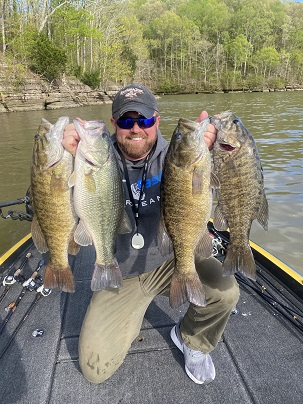
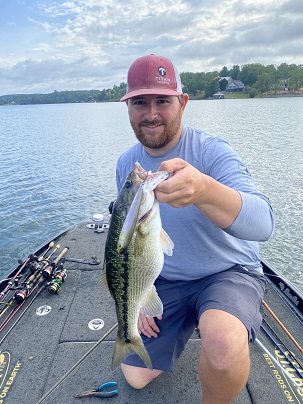
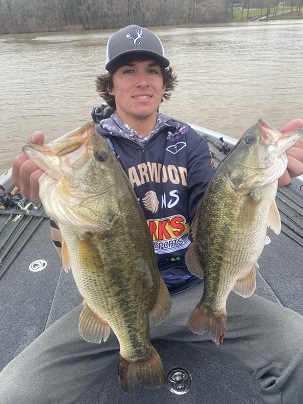
March Neely Henry Bass with Peyton Nance Including GPS Coordinates For Good Places

Pre-spawn bass in the grass and feeding on points leading to bedding areas, eating just about any bait you cast.  Neely Henry can’t be beat for March fishing, where those hard fighting Coosa spots are fighting with quality largemouth for your lure.

Neely Henry is an 11,235-acre lake on the Coosa River at Gadsden running 77 miles from its dam to the Weiss dam upstream.   The upper lake is mostly river, with some oxbows and sloughs. The lower lake has big flats and creeks to fish. The whole lake has extensive shallow grassbeds, docks, rocks and sandy bottoms that are important in the spring.

Peyton Nance grew up right on the lake in Attalla. His father and grandfather took him fishing as far back as he can remember.  His father entered them into a tournament on Neely Henry when Peyton was ten years old, and he fell in love with bass tournament fishing.

Peyton’s uncle, Brian Colegrove, was a well-known tournament fisherman in the area for years. He also taught Peyton a lot about bass fishing.

 He fished some high school tournaments but concentrated on playing football and made the Auburn football team. He has been on the football team and the fishing team at Auburn the past three years.

Peyton also fishes local pot and buddy tournaments on Neely Henry as often as his college schedule allows and does well in them.  As we fished, he constantly pointed to places and said things like “we got a limit there weighing 18 pounds,” or “thats where we won the tournament in the last hour, catching five weighing 19.5 pounds.”

Two days after Peyton and I fished Neely Henry, he and his dad won the big ninth annual Rat-L-Trap tournament at Guntersville with five bass weighing 22.79 with a 7.03 kicker!

“By the end of February, water is warming enough, and days have gotten long enough that both spots and largemouth are concentrating on spawning,” Peyton said.  They are positioning themselves near spawning flats and feeding heavily to get ready.  They may move some with changing conditions day to day, but they will be near the spawning flats all this month.

“I usually keep it simple in March with just five baits out, and three of them are crankbaits,” Peyton said.  He always has a DT 4 and DT 6 as well as a Little John squarebill in shad colors rigged.  Those baits cover the water depth he fishes this month.

To back them up, he has a white swim jig and a white and chartruese bladed jig ready to fish in the grass. Although those five baits will cover almost all situations, he will also be ready to pull out a rattlebait, bladed jig, shaky head and jig and pig if the situation calls for them.

Peyton and I fished the first Friday in February, the day after the flooding rain. The river current was ripping as the Alabama Power Company released water trying to get ready for all the new water coming in, and it was muddy everywhere.  The lake dropped four feet from Thursday afternoon to Friday morning, making it tough for us.

The following places are good all month long. You may have to adjust some based on daily conditions, but you can have great catches of both spots and largemouth right now.

1.  N 33 56.624 – W 86 01.221 – Going up the river just upstream of the Highway 77 bridges, a slough enters the river on your right.  AS you enter it splits to the left and right. To your left two small pockets are full of grass where March feed heavily. The point coming off the left bank at a blue pumphouse runs way out across the slough and holds staging bass.

Peyton eases into the slough and stops in the middle of the left side, out from the point between the two arms. But that is not the point he fishes; the point to fish comes off the left side across the mouth of the left pocket. It has big stumps on it the bass use for cover, ambushing shad moving into the coves.

Sit in about eight feet of water at full pool and make long casts across the point.  Depending on water level, you want to bump the bottom two to five feet deep, and Peyton chooses the DT right for that depth, a four for hitting up to four feet deep and the six for up to six feet deep.

After fishing the point, go into the grass and fish around both pockets with swim jig and bladed jig. Watch for birds in the grass, indicating baitfish is present. When we fished white cranes were feasting on shad that had gotten trapped in the grass by the rapidly dropping water.

This short pocket right on the river gives early bass fast access to the shallows.  There were a few bass chasing shad here, and a couple bumped Peyton’s bladed jig out in front of the grass, but the muddy water made it tough to hook up.

2.  N 33 57.048 – W 86 00.885 – Going up the river from the bridges, a roadbed runs right along the edge of the water on the left. Go to where the bank swings back to the right and leaves the roadbed.  There is a brown fishing dock with blue chairs on it, in front of two camping trailers. Start at that dock.

The river channel swings in right on this corner and largemouth, with a few spots mixed in, feed on the riprap alone the bank.  Cast your squarebill right on the rocks and bump them as you reel out.  Peyton likes a shad colored bait most days, but if the water is stained up bad, he will go with a red color.

Fish up to the first small point past the dock and fish it hard. It is rocky and worth a few casts with a shaky head or jig and pig after using your crankbait.  Sometimes fish on the point just want a slow-moving bait.

3.  N 33 56.846 – W 86 00.379 – Going upstream past the big pocket with the marina but before you get to the small island, a white wood fence is on a point on your left.  The point out from it is pea gravel and holds pre-spawn bass going into the cut behind it to spawn, but spots will spawn out on the point.

Peyton will fan cast it with his crankbaits, bumping the bottom with them. He will also try a rattle bait and likes a chrome with blue back Rat-L-Trap, buzzing it across the point. Some days the bass just seem to want that noisy vibrating action more than a wiggling crankbait.

4.  N 33 57.096 – W 86 00.453 – Go back into the big pocket with the marina in it.  The water in the mouth of it is very shallow but a channel is marked with poles to get into it. Big grass beds all around the back hold feeding fish all month, and some will spawn in here in March since the shallow water warms fast.

Peyton says he starts at the marina on the right side of it and fishes all the way around the back. He says if you hit every blade of grass in here with a swim jig like a three-eights white 6th Sense jig with a white Rage Craw trailer on it, you will catch a limit most days.  He normally uses a half ounce swim jig, but this shallow water calls for the lighter one.

You will be fishing shallow water, most less than two feet deep, and you will have to trim up your motor to keep it from dragging.  But the fish are hear even in the very thin water.  Toward the end of the month in warmer water, a frog like a Ribbet, reeled over and through the grass, will also catch fish here.

5.  N 33 56.101 – W 86 02.090 – Going back down the river under the bridges, a development with rainbow colored houses is on your left. At the end of them is the opening to the slough that runs back up parallel to the river.  The upstream point of the opening is a major staging area for bass moving into the slough to spawn.

Peyton says there are big logs and stumps on this point that the fish use.  Stop out on the end of it on the river side and fan cast it with crankbait, bumping bottom at different depths, then buzz a rattle bait on it.  Work upstream covering the end five or six feet deep all the way up to a foot deep at the bank.

Since this slough runs upstream, muddy water does not push into it fast and it will be clearer than the river when it first muddies up.  There was a definite mud line across its mouth the day we fished.  When this happens, shad and bass will often move back into the clearer water. 

Under those conditions, go back into the slough and fish the grass with swim jig and bladed jig.  We tried that, but the fast dropping water must have pulled the fish out with it. Under stable conditions, this pattern will work on tough days.

6.  N 33 54.707 – W 86 04.031 – Going down the river channel marker 12 sits on the downstream point of one of the islands in the string of them out from the bank.  Behind it is an old sand quarry and big spawning flats, and Peyton says the point is a place many bass hold on moving in during the month. Late in March there may even be some post spawn fish moving back out during a warm month.

Stop out on the river side. With the water down we could see the point of the island behind the marker drops down into a saddle that comes back up onto a hump with a big log on it. Peyton says that saddle is the key spot for holding fish.

Get your boat in close to the marker and cast toward the bank, across the tip end of the island in close to it in a foot of water.  Use both crankbaits, bladed jig and rattle baits. Work them all the way across the saddle, bumping bottom until you get to the log. Unless the water is real high you should be able to see them. Work a jig or shaky head through them.

Peyton chooses his jig based on water color, using black and blue in stained water and green in clear.  But with both he uses a green pumpkin chunk trailer.  Work the log carefully with it.

7.  N 33 51.527 – W 86 05.733 – Canoe Creek is a big creek on the right downstream where the river makes a sharp turn to the left. It is wide and shallow, so be careful back in it. Go in to where is swings to the right. Straight ahead is Permeter Creek and a bridge crosses near the mouth of it.

Peyton says bass hold on the riprap and move to the bank on the downstream right end of it to spawn back in the flat there.  Start at the bridge and cast your crankbaits along the rocks, bumping them from right on the bank down to six feet deep. Sun on the rocks will warm them and make the bite better, especially early in the month. And Peyton likes a little breeze in all the places he fishes, enough to ruffle the water and break up his baits silhouette.  That improves the bite.

Fish to the end of the rocks and the area at the end of them.  Bass bed back in here so later in the month, drag your shaky head and jig on the bottom in likely bedding spots.

8.  N 33 51.686 – W 86 05.678 – Just upstream  of the mouth of Permeter Creek a long shallow  point runs out.  If you have a good GPS map on your electronics, or a paper map, you can see how the Canoe Creek channel hits the bank upstream of it then turns and runs a long way along it. Fish hold all along the channel drop and move up it to spawning areas.

Leaving the riprap you have to swing way out, it is only a couple feet deep going across the point.  Get way out on the end of the point with your boat in the channel in 10 – 15 feet of water.  You will be a short cast from the top of the point that is three to five feet deep.  Cast your DT 6 up on top then bump it along the bottom until it clears the drop. Your bites will usually be right on the lip of the channel.

Also work your shaky head the same way. Peyton rigs a green pumpkin Big Bite Baits finesse worm on a three sixteenths ounce Spot Sticker head and crawls it along the bottom. When it gets to the drop, feed it line so it falls down the slope on the bottom.

This drop is long enough you can spend a lot of time fishing it, and going back over places you catch fish is worth it.

9.  N 33 51.768 – W 86 06.077 – Going up Canoe Creek a big ramp, Canoe Creek Park, is on your left.  There are a few houses downstream of it with a riprap bank in front of them. Stop downstream of the last house from the ramp and fish upstream to the pocket above the ramp.

This bank is an outside bend of the creek. The riprap and docks along it hold bass as does the wood cover along the bank. Just downstream of them there are a lot of blowdowns that are good to fish and there are stumps all along the bank, too.

Fish your squarebill crankbait, bumping rocks and wood, then follow up with your jig and pig, fishing it close to all the cover.  Released fish refresh this bank every weekend.

10.  N 33 52.343 – W 86 06.223 – Muscadine Creek enters Canoe Creek on the left a little further upstream. A big house with some big tall trees in front of it sits on the point between the two creeks. It is a big, flat, shallow point where spots and largemouth stack up pre-spawn moving into both creeks.

Peyton says you can have your best day ever for spots right here in March.  To prove his point, he hooked a spot that looked like it weighed about five pounds but came off right at the boat.

You should sit on the Muscadine Creek side in about seven feet of water just off the end of the point.  Fan cast it with your crankbaits, that is what the big spot hit.  Also try crawling your bladed jig on the bottom. We got a good three pound largemouth here on one.

There are some big stumps and gravel on the point. 
A shaky head will catch fish here, too.  Fan cast all over the point, hitting water three to five feet deep.

These places are producing spots and largemouth right now.  Check them out and catch some!

Shoreline and Wade Fishing In Florida Or Anywhere Else!

from The Fishing Wire

These tips on shoreline and wade fishing were provided by the Florida Fish and Wildlife Commission, but they apply pretty much across the country–with the exception of the cautions about alligators. Editors


Footwear

Tennis shoes are probably the most readily available bank and wading shoes — you probably already own a pair. With our mild Florida climate, “sneakers” can be quite comfortable, even when wet. But that’s their main problem: they’re not waterproof, and even during warmer weather having to change out of wet socks and shoes is inconvenient. During cooler weather, wet sneakers can be downright cold. No matter how hard you try to stay dry, it always seems like your sneakers still end up getting wet.

You might think that the extremely popular modern sandal comes next. They’re great on the boat, and I use them exclusively when kayaking (which definitely involves some wading). However, the open design is simply not safe for at least some of the terrain I see nearly everywhere I bank fish. For beaches, yes — but for partly-wooded lake shores, rocky canal banks, and brushy pond edges, no.

Rubber work boots are the next safe step up. They are dirt cheap, and you can even wade a bit into water almost a foot deep, while still staying dry! When you are limited to a brushy bank, being able to go out even a little bit into the water will often allow you to cast around or past bushes or other shoreline vegetation. You can also edge a little closer to offshore vegetation or cover that might be harboring big bass just out of reach of someone stuck on the bank. The disadvantages of plain rubber work boots, however, are several. They’re hot. They’ll fill with water like a pair of five-gallon buckets if you go too deep. They don’t fit your feet very tightly, which can leave a boot behind in deep mud, or cause heel blisters when covering harder terrain.

If you heed the unanimous advice of dozens of outdoors writers, you’ll eventually end up with a quality pair of waterproof outdoor boots. There are numerous options available, but I prefer knee-high, form-fitting rubber boots that lace up. If you duck hunt, then odds are high that you already own a pair. The close-fitting ankles and lacing on these boots make sure they stay put, even when sucking a foot back up out of two-foot-deep mud. For less muddy or shallower use, most anglers will be more comfortable in waterproof leather boots which are cooler than rubber with more “breathability.” These usually have rubber soles, with leather uppers of various heights (you’ll pay more for taller boots, as I did for my knee-highs). Normal rubber soles with a deep tread will handle most lakeside terrain; felt or studded soles designed for northern rocky lakes and rivers are useless down here.

While definitely easier on the feet, these boots require some maintenance, mainly of the leather uppers to keep them waterproof and supple. Even with care, they will eventually start to leak. Be aware that many boots come insulated or lined against the cold of northern climates; Florida sportsmen will want to make sure they buy uninsulated versions.Due to the potential presence of alligators in any of Florida’s waters, my “wade fishing” goes no deeper than my knee-high boots. I am pretty cautious about doing even that or just walking the shoreline. Anyone near water should stay alert and exercise due caution at all times. For more tips on staying safe, see FWC’s Living with Alligators page

.Other equipment

Unless you’re fishing obstruction-free waters, medium to heavy rather than light tackle will be best-suited for bank angling. In a boat, you’re usually working fish away from cover out into open water, but from shore you’ll often have unavoidable obstructions to deal with. I prefer longer rods, which give me more reach and better control when I don’t have the option of dashing from one side of the boat to the other.

You’ll need some way to carry your lures and other fishing gear. A small tackle box works well for a start; what I’ll do is transfer a basic selection of lures for whatever I’m after from my “main” tackle box into my “carry” box. However, I’ve come to prefer a roomy waist tackle pack that is hands-free. Spacious fishing vests are also available — but hotter to wear. Speaking of which, a water bottle holder on your tackle pack or vest is a lifesaver for long treks from the car.Note that wading staffs, a must for wade anglers up north, won’t provide much support in Florida with its soft, mucky bottoms. However, I carry a landing net and have found it’s long handle helpful for maintaining balance on canal banks.

A wading staff can help.

Tactics

Most of these principles will apply equally to bank or boat fishing. You’ll be targeting obvious structure, and ideally you’ll try to line up your casts so that your lure spends more time in the strike zone than it does in “dead” water. However, the latter can be hard to accomplish from shore. Wading out slightly past shoreline brush, or closer to the far edge of shoreline weeds, will often help you place a cast parallel to the shoreline that will cover likely territory. Bank anglers also need to keep stealth in mind, keeping a low profile and walking softly in order to get close to their quarry without spooking it.

Flipping-style casts can be very important. If the shoreline is fairly brushy and you can’t wade past it, the only way to get a cast out may be to stick your rod tip past the brush and swing-cast left or right to likely spots along the shoreline. This is another reason I prefer a longer rod — preferably seven feet — for bank fishing. Another helpful technique is bouncing a lure off the surface so it can skitter farther under overhanging cover.Weedless lures are more of a necessity when bank fishing. Shoreline structure and trees will be harder to avoid. And if you snag one, you’ll have a better chance of getting a weedless lure back than one with multiple treble hooks.

Playing a large fish will be more challenging from shore, because there will usually be more obstructions to deal with. Again, a longer rod will give more control, allowing you a bit more leeway in “steering” fish around or away from vegetation or shoreline brush. On the other hand, wading can put you closer to the action, and it can be quite exciting to have a large fish boiling the water right next to you before you manage to land it. A word of caution, however: yet another reason to make all your hooks barbless is the possibility of having a large fish brush you with a mouth full of trebles.

No boat needed to land big bass!

So whether you always fish from shore, or you’re just giving the bass boat a break, bank angling can provide some great rewards. These tips should help you to make the most of the experience!


St Croix Rods Win At ICast

ICast winner St Croix Rods


New St. Croix Legend Tournament Bass GRASP Swimbait rod recognized by the industry as Best New Freshwater Rod at ICAST 2022

PARK FALLS, Wisc. (July 29, 2022) – Advancing and showcasing its mission to handcraft the Best Rods on Earth® that give anglers the upper hand in any angling situation, St. Croix Rod of Park Falls, Wisconsin unveiled an unprecedented 12 new or completely reengineered rod series at ICAST 2022 in Orlando last week.

The 74-year-old family-owned American company was awarded Best of Category honors in the Freshwater Rod category of the ICAST 2022 New Product Showcase Awards for its three all-new Legend Tournament Bass GRASP swimbait models.

The International Convention of Allied Sportfishing Trades’ (ICAST) New Product Showcase Awards recognize the best new fishing products in multiple categories each year. Voted on by attending product buyers and members of the sportfishing media, these “Best of Category” awards represent the pinnacle of achievement in the fishing tackle industry and are fiercely competitive. Winning one of these prestigious awards isn’t easy; it takes good ideas and even better execution to develop a tangible product that helps anglers find more success on the water.

“We’re humbled and honored that those industry professionals who report on or sell fishing tackle for a living selected Legend Tournament Bass GRASP as the best new freshwater rod amidst a packed category, which included 34 other significant new rods from other manufacturers,” says St. Croix CEO, Scott Forristall. “St. Croix is built – top to bottom – to seek out, understand, and serve the needs of anglers; it’s what drives each one of our St. Croix team members every day, so everyone in the St. Croix family feels great pride and a real sense of gratitude for this recognition. Ultimately though, this award is for every angler around the globe who takes as much pride in using a St. Croix fishing rod as we feel in making them. It’s also for our retail partners who are on the front lines of helping anglers choose the Best Rods on Earth® to meet their specific angling needs and objectives.”

The trio of all-new Legend Tournament Bass swimbait models featuring St. Croix’s proprietary GRASP reel seat firmly establishes a new standard in heavy-bass-lure rod design and performance. Designed to excel in the presentation of swimbaits and Alabama rigs from ¾ to 8 ounces, these three all-new swimbait rods bring the newly reimagined Legend Tournament Bass Series to an expansive total of 27 distinct technique-specific high-performance models for the benefit of bass anglers worldwide.

New Legend Tournament Bass swimbait models (LBTC710HF LIGHT SWIMBAIT, LBTC710XHF MID SWIMBAIT and LBTC86XXHFT HEAVY SWIMBAIT) have the distinction of being the first-ever contemporary St. Croix rods released with proprietary St. Croix-designed componentry – in this case, the all-new St. Croix GRASP real seat.

“The angler-requested St. Croix GRASP reel seat helps give anglers the upper hand by delivering superior ergonomic control of Legend Tournament Bass swimbait rods during the cast, retrieve, and throughout fight,” says St. Croix Brand Manager, Ryan Teach. GRASP effectively combats the hand and wrist fatigue that commonly sets in when casting and retrieving heavy lures and doing battle with large, powerful fish. GRASP accomplishes this by always keeping the wrist properly aligned while affording the most comfortable and efficient grip on the rod and casting reel – straight and in line with the rod in the ultimate palming position, not canted back or forward which commonly happens with traditional casting-rod grips. The result is total control over rod and fish, with less fatigue so anglers can fish longer, harder, and earn more success.

In addition to GRASP’s ergonomic design, its angler interface is sweetened with an extremely durable and tactile SoftTouch coating. “The selection of the proper coating took years of discovery and trial and error, and it’s a big part of what makes GRASP distinct in the marketplace,” Teach says. “The SoftTouch coating we landed on is just as important as the refined geometries that make GRASP a complete and unique design. It is incredibly resilient yet remains slightly tacky when wet.”

New Legend Tournament GRASP swimbait models will be available to anglers at St. Croix dealers worldwide and at stcroixrodfactorystore.com in October. All 24 other new Legend Tournament Bass models which were announced earlier this year at the 2022 Bassmaster Classic are available right now.

New Legend Tournament Bass rods feature markedly lighter and stronger next-generation hybrid SCIV+ carbon fiber blanks. Select reaction bait models feature all-new iACT Glass hybrid blanks. In addition to their unique combinations of proprietary materials, all-new Legend Tournament Bass rods also incorporate all of St. Croix’s top technologies and premium components.

While every new Legend Tournament Bass rod is special and distinct, St. Croix Engineering Supervisor, Gavin Falk, says the three iACT Glass models – specifically engineered for hardbait applications like crankbaits and chatterbaits – represent an even greater technological achievement for anglers. “These rods introduce a third material – our linear S-Glass – to the hybrid SCIV+ blank to produce rods with the softer actions reaction presentations demand. We call the combination iACT Glass. It stands for Internally Active, and it allows us to deliver those slower, parabolic actions while maintaining peak sensitivity in a blank that’s significantly smaller in diameter and lighter than a pure glass cranking rod,” Falk says. “Our anglers have asked for this and we’re always listening, not being reactive but addressing ideas and opportunities as they come forward.”

Falk wants to remind anglers that these are not “composite” rods. “All three materials in Legend Tournament Bass iACT Glass models – SCIV carbon, SCVI carbon, and Linear S-Glass – are individually patterned and laid up to spec, then all rolled together,” he says, emphasizing that each of the materials are distinct, and adding that Legend Tournament Bass iACT Glass models are the first carbon/glass hybrid rods ever to be rolled on St. Croix IPC mandrels.

Teach says these three iACT Glass models deliver everything anglers have asked for in a reaction-bait rod and more. “You can even walk a topwater with complete control using one of these Legend Tournament Bass iACT rods,” he says. “That’s not something typically thought to be possible with a rod that has any type of glass in it. You can walk these baits with precision and never even think you have a glass rod in yours hands until you’ve hooked up on a fish and the benefits of that moderate, parabolic action kick in. St. Croix is the only company I’m aware of that’s been able to do this.”

The ‘deepest’ cranking rod in the series with iACT Glass is the POWER GLASS CRANKER LBTC74MHM. “This is a 4/5/6XD cranking rod,” Teach says. “We’ve got an 8XD/10XD/DD22 rod in the lineup, too – the LBTC710XHM – but it’s all carbon. This is a rod Dennis Berhorst and Stephen Browning have become quite fond of. The other iACT Glass models are the LBTC72MM FINESSE GLASS CRANKER designed for smaller squarebills and the LTBC72HM RIP-N-CHATTER, which is optimized for fishing bladed jigs and lipless crankbaits.”

Bassmaster Elite angler, Bob Downey says, “I was very impressed with the lighter weights and significantly reduced blank diameters of these new Legend Tournament Bass iACT rods when compared to a pure glass cranking rod. I’m not aware of anything else remotely like these rods on the market and I found their overall performance with chatterbaits and crankbaits to be in a class all their own.”

MLF angler and crankster, Jesse Wiggins agrees. “I’ve always been a huge fan of St. Croix’s Legend Glass rods – and I still am – but these new blue iACT rods have really impressed me, especially in any cranking situation where you need that extra bit of sensitivity.”

Despite the improvements, some things will stay the same: new Legend Tournament Bass rods remain handcrafted in Park Falls, Wisconsin, USA with a 15-year transferrable warranty backed by St. Croix Superstar Service. They also retain their iconic Tournament Blue Pearl color.

New St. Croix Legend Tournament Bass Features

Next-generation hybrid CARBON FIBER SCIV+ blanks
Technique-specific iACT SCIV+ and linear S-Glass hybrid blanks on specific models
Fortified Resin System (FRS) technology
Advanced Reinforcing TechnologyTM (ARTTM)
Integrated Poly Curve® (IPC®) mandrel technology
Taper Enhancement Technology (TET) blank design
Fuji® K-Series tangle-free guides with Alconite® rings
Fuji® SK2 reel seat on casting models with ergonomic complimenting componentry
Fuji® VSS real seat on spinning models with extended foregrip
Precision machined aluminum reel seat nuts and wind checks on spinning and casting models
Split-grip, super-grade cork handles customized per model
Swimbait models (3) feature GRASP reel seat technology
Full-grip super grade cork handles on select models
Model specific hook keepers selectively placed per technique
Single coat sealer on blank with slow cure finish
Two coats of Flex-Coat slow cure finish on guides
15-year transferable warranty backed by St. Croix Superstar Service
Designed and handcrafted in Park Falls, U.S.A. for bass anglers worldwide
Retail price $290 to $395

New St. Croix Legend Tournament Bass Casting Models

JERKBAITS / LBTC68MXF – 6’8”, medium power, extra-fast action / Retail $295
ALL-IN / LBTC71MHF – 7’1”, medium-heavy power, fast action / Retail $300
FINESSE CARBON CRANKER / LBTC72MHMF – 7’2”, medium-heavy power, moderate-fast action / Retail $315
CARBON CRANKER / LBTC72MHM – 7’2”, medium-heavy power, moderate action / Retail $315
FINESSE GLASS CRANKER (iACT) / LBTC72MM – 7’2”, medium power, moderate action / Retail $315
RIP-N-CHATTER / LBTC72HM (iACT) – 7’2”, heavy power, moderate action / Retail $315
POWER FINESSE / LBTC73HXF – 7’3”, heavy power, extra-fast action / Retail $320
WORKHORSE / LBTC73MHF – 7’3”, medium-heavy power, fast action / Retail $320
FLIP-CHAT-CRANK / LBTC73HMF – 7’3”, heavy power, moderate-fast action / Retail $320
SLOP-N-FROG / LBTC74HF – 7’4”, heavy power, fast action / Retail $325
POWER GLASS CRANKER / LBTC74MHM (iACT) – 7’4”, medium-heavy power, moderate action / Retail $325
WARHORSE / LBTC75MHF – 7’5”, medium-heavy power, fast action / Retail $330
FLIP’N / LBTC76HMF – 7’6”, heavy power, moderate-fast action / Retail $335
BIG CRANKER / LBTC710HM – 7’10”, heavy power, moderate action / Retail $345
*LIGHT SWIMBAIT / LBTC710HF – 7’10”, heavy power, fast action / Retail $350
MAG CRANKER / LBTC710XHM – 7’10”, extra-heavy power, moderate action / Retail $345
*MID SWIMBAIT / LBTC710XHF – 7’10”, extra-heavy power, fast action / Retail $360
POWER FLIP’N / LBTC711HMF – 7’11”, heavy power, moderate-fast action / Retail $340
*HEAVY SWIMBAIT / LBTC86XXHFT – 8’6”, extra-extra-heavy power, fast action / Retail $395
*New at ICAST 2022, available October, 2022

New St. Croix Legend Tournament Bass Spinning Models

PINPOINT / LBTS68MXF – 6’8”, medium power, extra-fast action / Retail $290
DROPSHOT FINESSE / LBTS610MLXF – 6’10”, medium-light power, extra-fast action / Retail $290
VERSATILE / LBTS71MF – 7’1”, medium power, fast action / Retail $300
POWER VERSATILE / LBTS73MHF – 7’3”, medium-heavy power, fast action / Retail $300
DROPSHOT FINESSE XL / LBTS73MLXF- 7’3”, medium-light power, extra-fast action / Retail $300
POWER FINESSE / LBTS73MXF – 7’3”, medium power, extra-fast action / Retail $300
HAIR JIG / LBTS710MLXF – 7’10”, medium-light power, extra-fast action / Retail $335
SWIMMING BAITS / LBTS710MMF – 7’10”, medium power, moderate-fast action / Retail $335
#CROIXGEAR

Like the rods? You’ll love our apparel. Shop now!

Where and How To Catch March Bass At Pickwick Lake with Roger Stegall Including GPS Coordinates

March Bass at Pickwick 

with Roger Stegall

     Many national tournament trails are drawn to Pickwick Lake because of the amazing smallmouth fishing.  The lake is known nation-wide for producing stringers of quality smallmouth.  Four and five pound fish are common and in many tournaments five-fish limits between 20 and 25 pounds are weighed in.  It has an excellent population of largemouth and some spotted bass as well.

     Pickwick is a 43,100 acre lake with 490 miles of shoreline.  The dam on the Tennessee River was completed in 1930 so it is a very old lake. Although its dam is in Tennessee and some waters back up into Mississippi, most of the lake is in Alabama.  Two locks at the dam provide barge traffic access as does the Tennessee-Tombigbee waterway that connects with the upper end of Yellow Creek.

     Roger Stegall has been fishing Pickwick for 31 years and guides there about 200 days a year.  He has been bass fishing all his life and got his tournament start in college. Roger and some of his friends started a bass club and he liked the competition.  He fished clubs for several years and has fished tournaments with prizes ranging from a trophy to $200,000.

Roger is well known on the tournament trails and has done well in the BFL, Stren Series, FLW and Bassmasters trails, especially in the Pickwick area.  He has won six BFL tournaments and at least that many second place finishes where he was within ounces of the winner.  He has many top ten finishes in all the trails he has fished.

In 1998 Roger won the BFL point championship for the Mississippi Division. In the Division Championship that year on Pickwick he set a record catch of smallmouth that still stands in the BFL. He brought in an incredible five-fish limit of smallmouth weighing 27.5 pounds.  His biggest smallmouth that day weighed 6 pounds, 5 ounces and he culled a 4.5 pounder.

Roger shared his knowledge of Pickwick with me on a very cold day in late January and showed me the spots where he will be fishing from late February through March.  His record catch came on March 18 so this is an excellent time to be on the lake.

     As soon as the water starts warming in late February both smallmouth and largemouth start moving toward spawning areas, according to Roger.  They will hold and feed in predictable area and will hit a variety of baits.  Roger firmly believes lake bass spawn on the lake and creek bass stay in the creeks to bed, but there are plenty of quality fish in both kinds of areas. 

     Bass will be on rocky points in creeks and on the main lake and you can catch them there during this time. They will also move up on grass flats to feed and spawn so that is another kind of spot to find them.  When the water temperature is between 49 and 59 he expects them to be feeding well in both kinds of areas.  Smallmouth will spawn when the water gets to 59 and the largemouth will follow when it hits 64 to 65 degrees.

     Most of the bass on Pickwick will be pre-spawn from now to the end of March.  Roger will fish rocky points with a Strike King Wild Shiner jerk bait, a Strike King spinnerbait a Series 5 crankbait and a football head jig. On the flats he will be throwing either a Red Eye Shad or Diamond Shad lipless bait and the spinnerbait.

     The following ten spots will all hold both largemouth and smallmouth this month and they will give you a variety of kinds of spots to hit on the lower lake and in Yellow Creek.  Fish them like Roger suggests and you will catch fish.

     1. N 34 59.515 – W 88 14.324 – If you put in at the ramp at Sportsman Boat Storage and One Stop on Sandy Creek you don’t have to go far.  Look down the creek to your left and you will see a small island sitting just off the bank.  Roger says he has caught the lunker in a bunch of tournaments off this island.  You will be sitting in 12 feet of water not far off the bank and there are rocks all around the island.

     Roger fishes this spot like a rocky point.  He stays out from the bank and makes casts in close to the bank. He will work his jerk bait back in short pulls at a right angle to the bank rather than getting in close and making parallel casts. He says he wants to cover the water at a variety of depths.

     If the jerk bait doesn’t draw a strike he will follow up with a spinnerbait, slow rolling it down the slope of the bottom, again working it straight out from the bank to deeper water.  Fish all the way around this island, covering all of it on both sides. 

Before leaving Roger will work a football head jig in the same area to find fish that are very inactive. Sometimes fish will not move up to chase either the jerk bait or spinnerbait so he wants to tempt them with something on the bottom.

2.  N 34 59.584 – W 88 14.249 – The point behind this island is also rocky and an excellent place to catch bass this time of year.  There is a sign on a tree that says “Cheerio” and Roger calls it Cheerio Point.  There is a dock on the point with two white poles holding it in place and it has blue floats under it.

You will see there are two pockets, one on either side of this point.  Both are good spawning pockets so bass hold on this point before moving in to them to spawn.  Fish all the way around the point with jerk bait, spinnerbait and jig.

Roger likes the Denny Brauer Pro Model football jig with the Rage Craw or Rage Chunk on it.  Natural colors like green pumpkin are best.  The football head does not hang up as bad as other shapes and it gives the bait a wobble the fish like.  Roger fishes the heavy football jig rather than a Carolina rig to cover water and keep in contact with the bottom.

3.  N 34 58.996 – W 88 14.170 – Start up Yellow Creek and you will see Yellow Creek Port on your right. There are usually some barges tied up along the left bank.  Upstream of them are some rocky points and Roger starts at the one with a small pine leaning over the water and two small old logs running from the bank out into the water.  There are stumps and chunk rock on this point and it holds bass.

Fish all the way around this point with all three of your baits.  Roger fishes Pflueger reels and All Star rods with all his baits and says the Pflueger best reel for the money on the market. They are two of his sponsors and he likes and uses their products.

The channel swings in close to the bank here and you will be sitting in 35 feet of water a cast off the bank.  Roger says some wind blowing in on the rocks helps as does some current. When water is being pulled at the dam there is often a noticeable current here. Sometimes there is a slight upstream current when the lock is operated on the Tennessee-Tombigbee canal upstream but it is inconsistent and you can not depend on it.

4.  N 34 57.764 – W 88 13.692 – Run upstream and watch for red channel marker 447.2 on a point on your left. This point has stumps all over it and is rocky.  There is a small gravel pocket upstream of the point.  Fish all your baits all the way around this point, from the pocket below it to the rocky beach upstream of it. The other points around this one also hold bass.

 The colder the water the slower you should fish. Roger works his Wild Shiner jerk bait in short pulls rather than jerks. He says that more imitates the action of an injured baitfish.  They don’t dart around, they move slowly then suspend or slowly move up. He wants his jerk bait to look like they do.

     5.  N 34 57.123 – W 88 13.299 – Upstream Goat Island runs way out from the right bank.  This was really a long point where the creek made a sharp bend before the channel was cut through near the bank.  There were some goats on the island the day we fished and that is how it got its name.

     On the upstream side there is an underwater point running out near the outside edge of the island.  The channel swings in right beside it and it looks like a bluff bank but the point is the key.  Watch you depthfinder as you fish along this bank and you will see it.  Keep your boat out in at least 20 feet of water and cast all three of your baits all around and across the point.

     6.  N 34 59.261 – W 88 13.448 – Head down Yellow Creek past the first spots following the channel and you will go through the narrow cut on the right. Downstream of it watch for red channel marker 449 on a rocky point on your right. The point with the channel marker and the one upstream of it are both good March spots since they run out to the old channel and have rocks and brush on them and there are spawning pockets behind them.

     Fish all around both points probing for rocks and brush. When you hit heavy cover make several casts over it with a jerk bait and run your spinnerbait just above it. Then work your jig through it. Roger says you will get bit on a jig here is you can fish it without hanging up, but you will lose a lot of baits in the rocks.

     7.  N 34 59.800 – W 88 12.355 – When you get to the mouth of the creek you will see a Spanish style house on the main lake point on your left.   There was a US flag on a pole in front of it the day we fished.   Roger calls this “YMCA Point” since there used to be a YMCA camp on it. On the creek side of the point you will see a steep rocky bank change to chunk rock and gravel then to flat rocks. 

     Roger fishes the creek side of this point from the steep bank to the flat rocks. He will use the same three baits as in the creek but will add in the Series 5 crankbait here. He likes the sexy shad color if the water is clear but will throw the bright chartreuse with green or black back if it is stained.  He stays way off the bank with the crankbait and makes long casts to the bank, fishing it back from shallow to deep.

     8.  N 35 01.267 – W 88 11.289 – Run across the river and go behind the big island. Head downstream but be careful until you find the deep water here. You will see a duck blind on your right near where there is a gap in the island on your left. Just downstream of the duck blind it gets very shallow and there are some big stumps and rocks so be very careful.

     This is a good example of the kind of grass flat Roger likes this time of year.  The water is fairly shallow way off the bank and grass grows on it. Right now the grass is just starting to grow so you won’t see a lot of it, but both largemouth and smallmouth will hold in the grass and feed.

     This is where the lipless crankbaits work best. The Diamond Shad has a good wobble and will flutter down when paused, but the new Red Eye Shad will swim down like a hurt baitfish when it is paused. Try both for different actions.  Roger likes shad and bream colors in both baits.

     Roger will also throw a spinnerbait here.  He likes the Strike King with either a single or double willowleaf and goes with the double willowleaf if there are shad present. White is his choice if the water is clear and he uses a white and chartreuse combination if the water is stained.

     Bass move in to feed up on these flats before the spawn and they will also spawn on them, so this spot is good the whole month of March and into April.   They will also feed here after the spawn.  Stay about two casts off the bank and make long casts, covering lots of water as you work this flat.

     9.  N 35 02.749 – W 88 10.756 – Go downstream, being very careful until you learn where to run since there are shallow flats on this side.  Go to the rocky point on the upstream side of Dry Creek and fish it with jerk bait, spinnerbait, crankbait and jig. The point is rocky and there are cedar trees on it.

Start on the upstream side and work to the creek side. Roger does not fish up the creek side. It gets very deep on the creek side but runs out shallow on the river side so stay way out and make long casts.  Two boat lengths from the bank the water will be only six feet deep and you want to cast to that depth, not sit over it.

     Roger likes Sufix Elite line since it does not have much stretch and he can feel his baits better with it.  He fishes the green line so he can see it and watches his line on every cast. Sometimes you will see a bite you don’t feel. Also the low stretch means he feels the lipless baits and crankbait vibrating better and knows to set the hook if the vibrations stop.

     On the lipless baits Roger uses 14 to 17 pound Sufix to feel it better and get the fish out of grass.  He throws his jerk bait on 10 pound clear Sufix Seige and fishes both jig and spinnerbait on 12 pound Sufix line.

     10.  N 35 03.079 – W 88 10.927 – On the downstream side of Pompeys Branch, just below Dry Creek, you will see a big shallow point running out to a flat on a good map.  This flat comes up to a hump on the end about 300 yards off the bank.  The hump is a ridge about 200 yards long and grass grows on it.  Bass feed and spawn here and hold here before moving back into the branch and creek to spawn, too.

     Stay on the outside of the ridge and make long casts across it with lipless baits.  Keep your boat in deeper water and cast to the top of the ridge, covering the slope back to you.  Fish it from one end to the other then go back along it with your spinnerbait.

     Roger likes the middle of the day on this spot and others. He says that seems to be the best time to catch fish on the flats.  On the points you can catch fish any time of day but the first three weeks of March are going to be best because a lot of the fish will move back into pockets to spawn after that.

     Check out these spots and see the kinds of patterns and places Roger fishes. There are many others all over the lake that are similar.  You can catch fish on these spots then find others after learning the pattern.

To get Roger to show you how he catches bass on Pickwick call him at 662-423-3869 or E-mail him at rogstegall@fishpickwick.com for a guided trip. You can see more information and pictures at his web site at http://www.fishpickwick.com

Review of Bass Pro Shops World Wide Sportsman Fishing Shirt

Jack caught fishing in Baja Mexico

Jack caught fishing in Baja Mexico

I like my Bass Pro Shops World Wide Sportsman fishing shirts like the one I wore in Baja while catching this jack.

I have about 20 fishing shirts and jerseys from a lot of different brands and manufacturers. Some of my favorites are the World Wide Sportsman short sleeve shirts from Bass Pro Shops. The are comfortable, come in a variety of colors and sizes. And they are reasonably priced. (disclaimer – I do get a discount on these shirts)

These button up shirts have big pockets, one on each side. The pockets have Velcro tabs to hold the flap closed. Sometimes the pockets are almost too big. A ball point pen can get lost in them, sideways down on the bottom. To solve this one pocket has a small opening in the flap for a pen – an important fact for an outdoor writer or tournament director!

The collars are button down, too. That is extremely important when running 70 mph in a bass boat. Collars that don’t button down can beat your cheeks and jaw uncomfortably.

The back of the shirts is ventilated with a mesh net the top half, covered by a flap to allow air in and heat to escape. The flap also has a Velcro patch to keep it down over the mesh, or you can loosen it to allow more air flow.

The shirts are 100 percent cotton except for the mesh, which is much more comfortable to me. It seems to wick the sweat away better than most materials. The only problem is they wrinkle, so they do need to be ironed to look their best, but for most fishing I just wash and tumble damp dry and hang them up to finish drying. That reduces the wrinkles.

At a price between $23 and $26, even less on sale, they are a good value.

https://www.basspro.com/shop/en/world-wide-sportsman-ultimate-angler-short-sleeve-shirt-for-men

World Wide Sportsman Nylon Angler Shirts for Men – Short Sleeve

The 2nd Amendment IS NOT About Hunting

 A popular meme on social media says “The Founding Fathers had not just returned from a hunting trip when they wrote the 2nd Amendment.” 

    That immediately came to my mind when reading Mona Charen’s emotional ”we gotta do something about guns” editorial in the June 8th Griffin Daily News.  I think was the fourth or fifth such editorial in the past two weeks. 

    Charen says “less than 4% of the population hunts.”  She uses that figure to call for eliminating a right in the Bill of Rights.  I wonder what other minorities she would restrict just because of low numbers. 

It’s ironic that the same folks that say hunters don’t need 30 bullets to hunt now try to say hunters guns should not be considered when gun bans are brought up. 

Among other proposed restrictions are so called “red flag laws” where someone can report a gun owner, claiming they have some kind of mental problem, and get the police to confiscate their guns.   

None other than a California congressman, Eric Swalwell, immediately claimed that would be great, he could report anyone he didn’t like and get their guns taken away. He was specifically talking about a conservative writer, but the same scheme would apply to any gun owner.  Most proposed red flag laws have no due process in them. 

Charen lists many mass shootings and shows all were committed by individuals that either met all the laws about guns to get one or broke current gun laws to get one.   

How rational is it to call for more of the same things that are not working?  If gun laws worked there would be no need for additional laws. 

As always, convince me new gun laws would help by showing facts on how they would have stopped any of the shootings. 

DO BACKLASHES CAUSE BREAKOFFS WITH FLUOROCARBON?

from The Fishing Wire and Sunline

Backlashes damage your line


The dreaded backlash in a baitcast spool can end the use of that reel very quickly. Whether it is an errant cast into the wind, or a skip cast that didn’t go as planned, a bad backlash can require a scissors to get you up and operational again. This video quickly shows you how to dial in a baitcast reel, to help you prevent this from happening. No matter how good you are, that errant cast still happens to even top-level tour pros. Protecting your line while removing a backlash will help your fluorocarbon last longer and prevent critical break offs.

Anglers choosing to use fluorocarbon line with a baitcaster reel may experience backlashes or loops in their lines during use. Those errant casts cause the spool to overrun and that creates loops, kinks, and tangles in your line. Those overruns can cause a kink in the line when they occur or when an angler is working to remove them. You pull on the line when it is stuck, and a kink is created in the line in that spot. Those kinks can damage your fluorocarbon line and lead to failure later during your usage of that reel and line. The more kinks you cause in your line the more damage you are doing to it and the more likely it is that your line will break when casting or during hooksets.

Kinks in backlashes can cause line breaks

You take the kink like the one above out of your line and it may seem ok, but the damage is often done by then. Sunline has 15+ employees that work in their R&D Department and they spend their days studying line and factors that impact the performance of line. The Sunline R&D team studied the impact that kinks can have on the performance of fluorocarbon line on a bait cast reel.

Below you can see a cross section image of two lines when viewed under an electron microscope. Line A is a normal fluorocarbon line that you can see has no defects. Line B shows an image of the same line where it had been kinked. You will see in image B that micro cracks are now visible inside the line at the spot where it was kinked. Those micro cracks weaken the line and lower the overall performance of the line.

Microscopic picture of damage from backlash

These lines were also tested for straight breaking strength before and after the kink. The line that had been kinked showed a measurable decrease in breaking strength. The micro cracks from the kink had caused the line to break at a 5% lower strength on average after repeated testing. More kinks are only going to continue to weaken the line causing it to fail below the rated level. This can often be seen when fluorocarbon line unexpectedly breaks in the spool on a cast. The kinks from backlashes in your spool have weakened it, so that it breaks inside the spool on a random cast.

The line damage from kinks is also magnified on powerful hooksets where higher stress is placed on the line, and it breaks at the weakest point.

Having your reel dialed in with optimum settings for that lure and technique is the best way to avoid backlashes. No matter what, backlashes and tangles happen when using baitcast reels, just make sure to remove the tangles as carefully as possible to avoid any kinks in the line which will decrease the breaking strength.

Hot July Tournament At Bartletts Ferry

 The first Sunday in July eight members of the Flint River Bass Club fished our June tournament at Bartletts Ferry. We also had one youth fish the tournament.  The club has a special category for youth; they fish with an adult club member or family member and there is no entry fee for them. If they catch a keeper fish they win a prize package of fishing lures. We do not give participation prizes! 

    After eight hours of casting, we weighed in 27 12-inch keeper bass weighing about 31 pounds. There were three five-bass limits and one fisherman didn’t have a keeper.   

Lee Hancock won with five bass weighing 7.87 pounds and Doug Acree placed second with three weighing 5.74 pounds. Doug also had big fish with a 3.41 pound largemouth.  My five weighing 4.96 pounds was third and Niles Murray placed fourth with five at 4.80 pounds.  

Fishing with Lee Hancock, Jett Collins won the youth division with four bass weighing 3.57 pounds, enough to place fifth in the regular tournament.   

I started out pretty good with a keeper spot on a buzzbait within five minutes of our start at 6:00
AM. Then just over an hour later I got a keeper largemouth on a weightless worm under dock. Two in the livewell in less than two hours gave me hope. 

At noon the hope was about gone. It was miserably hot with no breeze to cool me off. And the lake had gotten really rough from pleasure boaters by 9:00 and it was dangerous to sit out in open water fishing. Too many folks do not pay attention to where they are going when driving a boat.  

Even halfway back in coves I thought I was going to get run over twice, once by a pontoon boat full of folks cruising the shoreline and once by a big wake boat pulling two little kids. 

At noon I decided to go to an area with some docks that have produced some keeper fish in June for me in the past.  My first cast with a shaky head hit a post and I got hung. Rather then go in and get it and mess up the fishing, I put that rod down, picked up a rod with a whacky rigged Senko on it and skipped it under the dock. 

A keeper spot grabbed the bait as it sank and I was able to pull it away from the post and land it.  Then on the next dock my first cast produced a keeper spot then another keeper spot, giving me my limit.  Then the same dock produced a spot too short to weigh. 

That was it. I fished docks for the last two hours and caught a couple more short fish, but no more keepers.  

The hot summertime is not the best time of the year for bass fishing.  Many bass go to deep water to avoid the heat and bright sun, and others get as far back into cover like docks for the shade. They are hard to cast to and even harder to land. 

It can be dangerous, too. Way too many folks get in boats and run around without a clue there are rules on driving a boat, just like a car.  I can’t count the times I have been meeting a boat going in the opposite direction and they insist on going to my right to try to pass me, the exactly opposite of the law. 

I prefer fishing at night this time of year, it is more comfortable, the fish bite better and there are fewer boats out there. The clubs used to have night tournaments in the summer but some members don’t like them so they got them ended rather than just not fishing them. 

It can be dangerous at night, but no more dangerous than during the day, and with fewer boats there is less dangerous.   

Bigger lakes offer places to hide from the pleasure boaters.  Fishermen can go way up creeks and rivers where stuff in the water keeps some pleasure boats out.  But skidoos seem to thrill in running such places and making them tough to fish. 

There are a few ways to cool off. I try to fish shady banks as much as possible. And dipping a cap full of water and dumping it over my head helps. Riding on plane in my boat creates a nice breeze, but the water is often so rough that is no fun. 

Even with all the problems, I would rather be out there fishing rather than sitting at home at a computer wasting time! 

C. Booth Historic National Fish Hatchery and Archives Preserves History for the Future

By Craig Springer, USFWS
from The Fishing Wire

Channeling William Faulkner: “The past isn’t dead. It isn’t even past.”

The past is present here at D.C. Booth Historic National Fish Hatchery and Archives in Spearfish, South Dakota. The facility is dedicated to preserving images, documents and objects related to fisheries conservation. The archive is located at one of the oldest operating hatcheries in the U.S., which still produces trout.Barton Warren Evermann, Chief of Scientific Inquiry of the U.S. Fish Commission (the forerunner of today’s U.S. Fish and Wildlife Service created nearly 150 years ago in 1871) came to the Black Hills in the early 1890s to assess the area’s fisheries.On what now seems like a pittance, Congress granted Evermann in August 1892, “for investigation and report, respecting the advisability of establishing fish-hatching stations at suitable points in the States of South Dakota, Iowa, and Nebraska, $1,000, or as much thereof as may be necessary.”

We don’t have an accounting of what was spent, but he noted what streams he seined, the fishes he found, and with whom he traveled.And he didn’t waste time: “Oct. 6. Began work at Deadwood, S. Dak. Oct. 7. Drove to Spearfish and examined Spearfish Creek and numerous springs in vicinity,” states his 1894 Report upon the Fishes of the Missouri River Basin.

His field work ceased with the onset of winter and resumed in June 1893. Then over the next two months Evermann and crew examined not only potential hatchery sites, “but included an examination and study of the physical and biological features of the waters, with especial reference to the species of fish and other animal life they already contain, and their suitability for stocking with other species of food-fishes not indigenous to them.”The waters of the Black Hills were thoroughly vetted by the scientist. It was Spearfish to which Evermann returned.

And he tells Congress why:“Spearfish Creek—This is by far the most picturesque of all the streams of the Black Hills seen by us. We examined Spearfish Creek at the town of Spearfish where it was 30 feet wide, 1 foot or more deep, and with a swift current. The bottom was gravelly and there was considerable vegetation along the banks. From it we took brook trout, Jordan’s sucker, and western dace. The stream is a fine one, indeed. The bulk of its water comes from the hills, but even at Spearfish there are some fine springs. If fish-cultural work should ever be undertaken at any place in the Black Hills, the most satisfactory natural conditions could probably be found here.”And so it would come to pass. By July 1899, Spearfish National Fish Hatchery situated about a mile from the bustling downtown, was operational with 17 ponds and a handsome hatching house designed by U.S. Fish Commission Architect and Engineer, Hector von Bayer. It was neatly tucked in narrow Ames Canyon. The hatching house sat in a commanding position above the creek. DeWitt Clinton Booth, a New York native likely named for his home state’s former governor and U.S. senator, took charge of the new federal fisheries facility.Spearfish National Fish Hatchery produced trout.

Booth and crew, sometime attended by their families, made arduous annual forays into Yellowstone National Park to collect the spawn of “black-spotted trout,” as cutthroat trout were called at the time. The fertilized eggs were returned to Spearfish for raising and stocking in the Black Hills streams and beyond. These trips were made by rail and by wagon, hauling most of their physical needs, including boats and nets. Other species of trout would come from the Spearfish hatchery: brook trout, brown trout, rainbow trout, lake trout.

The quality of the spring waters that Evermann found did not last. The springs dried up about 1940 and the U.S. Fish and Wildlife Service looked for reliable water nearby and built the McNenny National Fish Hatchery a few miles west. The Spearfish site became a training center for work with fish diets and nutrition, adding a genetics research laboratory to the mix along Sand Creek in Wyoming, while the new McNenny station produced the bulk of the trout.

Spearfish National Fish Hatchery would go through another permutation when something else dried up: funding.In the 1980s the U.S. Fish and Wildlife Service divested of a number of facilities in the National Fish Hatchery System. McNenny was turned over to the South Dakota Department of Game, Fish, and Parks. The City of Spearfish took over operations of the Spearfish facility and changed its name to honor the hatchery’s first superintendent, D.C. Booth.In 1989, the past and the present would come to live on the same contour when the U.S. Fish and Wildlife Service established its National Fish & Aquatic Conservation Archives at Spearfish.Today, on the grounds of the 

D.C. Booth Historic National Fish Hatchery and Archives, Spearfish Creek batters downhill over rounded stones. Its silver music fades as you approach a preserved boat, “U.S. Fisheries 39,” a craft that operated on Yellowstone Lake in the 1920s. A railcar rests near the boat emblazoned with “Bureau of Fisheries.”  

Inside von Bayer’s hatching house, still in its commanding position, you’ll find a museum with old tools and artwork and photos that tell the fisheries conservation story. The superintendent’s home up the hill is as pleasant to look at as it is entertaining to tour. Appointed with period furniture and accessories—some of it original pieces—you’ll learn how the Booth family lived their lives.

Perhaps the greatest treasures are those most protected—housed in a climate-controlled collection management facility cared for by a professional curator. Some 1.8 million archival items and 14,000 artifacts related to fisheries conservation are preserved here.

A 1919 photograph of a now-extinct yellowfin cutthroat trout from Colorado is particularly moving. It may be the only known image of the fish. It seems appropriate to have a home here in a circularity of experience. Barton Warren Evermann described the yellowfin for science the year before he visited Spearfish, and the image now lives in a place that he deemed suitable to carry on conservation work.

Researchers of history and conservation are encouraged to send their queries to the curator, April_Gregory@fws.gov  

Craig Springer, U.S. Fish and Wildlife Service – Fish and Aquatic Conservation, Southwest Region

Bryozoans Look Like Jelly Blobs In the Water

“Jelly Blobs”  is a term often used for a type of single cell animals called Bryozoans. They are one of several strange critters you may encounter in lakes and rivers. Several varieties live in freshwater and attach in colonies to twigs, limbs, ropes and dock posts in the water. They look like brown blobs of jelly.  If you look at them closely they have small star-like structures that are different groups of the animals, called zooids

      Bryozoans Description  – Round or oval-shapped blobs of jelly-like material attached to things in the water.  Color is shades of mottled browns.  They feel solid but slimy to the touch.

          Bryozoans Size  – The balls can be as big as two feet across and contain 2,000,000 individual zooids. Most are smaller, with a one-foot across blob fairly big in most waters.

          Bryozoans Distribution  – Different kinds of jelly blobs are found in almost all freshwater worldwide. 

          What Bryozoans Eat – Normally, diatoms, green algae, bacteria, rotifers, protozoa, tiny crustaceans or nematodes are in their diet.   

          Bryozoan Reproduction  – Asexual reproduction is the norm, through budding to form new animals, but sexual reproduction does take place.

          Bryozoans Attraction to Light – none

          Bryozoans Life Cycle  – A single zooid can attach to something in the water and reproduce by budding, building a colony that looks like the blob you see. Some die off in the winter, with just a few individuals surviving to start a new colony in the spring.

          Bryozoans Problems  – These blobs may look and feel bad, but they actually indicate good water quality.

          Jelly Blobs or Bryozoans are common and do not cause problems.  They indicate good water quality.  These tiny animals that are similar to corals should not bother you unless they are on your dock ladders and ropes.