Catching Catfish After Independnce Day

Classic Catfish

Ichtalurids Beyond Independence Day

By Ted Pilgrim
from The Fishing Wire

Big summer cat

Big summer cat

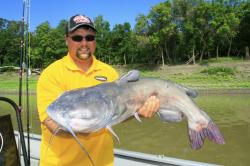
Captain Brad Durick clutches one of his pets, a dandy 25-pound channel cat.” Photo courtesy of Rippin Lips

Last time the U.S. Fish & Wildlife Service took the temperature of licensed anglers, 7-million savvy souls named the catfish their favored species. By comparison, 10-million anglers preferred bass, while a meager million liked walleyes. America’s love affair with catfish dates back decades, even centuries, with reports of 200- and 300-pound blues caught during the early 19th century. Mark Twain revered cats, too, frequently romanticizing the species in print, and once writing of “a Mississippi River catfish that was more than six feet long.”

Rockwellian portraits of Americana commonly depict summertime scenes of kids and crusty characters alike sharing a bank and a bucket of worms in hopes that a catfish might bite. Thank goodness all these years later, a visit to the local river or pond often reveals this same pastoral setting.

Meanwhile, on countless water bodies across the country, hot fishing for great big channel cats awaits any interested angler. Their abundance and potential size are just two among many reasons for the popularity of these barbel-faced fish. One other beautiful basis for a summertime catfish adventure: there are as many ways to catch them as your imagination can concoct. Not only do any of the 7-million anglers stand a fair chance of taking home a catfish dinner, they’re just as likely to land a whale today as during the days of Huck Finn.

Current Thoughts on Catfish

Carolina rig for cats

Carolina rig for cats

Simple three-way or Carolina-style rigging and fresh cutbait are key ingredients to successful catfishin’. Photo by Bill Lindner

Brad Durick, popular catfish guide on the famed Red River of the North, might not wear a straw hat nor clench a corncob pipe, but he’s as comfortable contending with current and catfish as Twain’s historic hero, Huck Finn. The channel cats Durick hunts daily, from May through October, are some of the biggest on the planet. On this crazy good catfish river, current runs bizarrely south to north-rather than dropping toward the Gulf of Mexico-and drains into Lake Winnipeg following a 550-mile northbound run.

Most years, water flows have stabilized by mid July. Catfish have fully finished spawning and patterns become predictable. While most anglers during this time continue focusing on obvious areas, such as visible wood snags, rockpiles, deep holes or dams, Durick has a whole other world of catfish spots to himself.

“Everything I do relates to current,” says the Coast Guard licensed captain. “The best thing catfish anglers can do for themselves is learn to read the water. Every key change in the river bottom is revealed by things happening on the surface.

“Catfish flock to current seams-where two currents come together. On the surface, it’s often a subtle sign. But once you know what it looks like, seams are as obvious as a downed oak tree. Current breaks and their underlying topography are incredibly overlooked, but they have everything a catfish needs-a break from current, oxygen and of course, food.”

Add on scents help

Add on scents help

Powerful new fish attractants like Rippin Lips’ Scent Trail have become increasingly important in the arsenals of many veteran catmen. Photo by Bill Lindner

Durick says that while a big gnarly woodpile might look great, if it lies out of the main flow, anglers will struggle to catch catfish there. Conversely, even a small bush or a subtle hole can gather multiple whopper catfish-if it’s associated with substantial current. One of Durick’s better midsummer spots is a 4 to 10 foot trench cut into the outside of a river bend. His best troughs are often the shallowest ones.

“I really like 3 to 4 foot holes with a trough-like effect. Food is dropping into these spots all the time. And even though there might be strong current flowing into it, there are always areas of reduced water flow where cats can hold and wait for food.”

Associated overlooked summer spots, Durick says, are small holes near a shoreline break, especially those with current seams running along their edges. In higher water years, he’s also had great fishing below dams all through summer.

In each instance, Durick baits with Carolina style rigs-a 2- to 5-ounce No-Roll sinker above a ball bearing swivel and a 10-inch leader of 30-pound test mono snelled to a 4/0 to 8/0 circle hook, depending on bait size and how catfish are striking. He prefers circle hooks by Rippin Lips and Bottom Dwellers Tackle. In heavier current, Durick says big cats routinely grab a bait and run aggressively, necessitating wider gap (larger size) hooks and shorter snells.

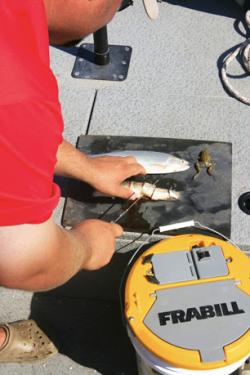
Use cut bait

Use cut bait

“Most of the time, I use suckers cut into small ‘steaks’,” offers Durick. “They’re abundant, inexpensive and catfish gobble ’em up.” When available, Durick also uses wild goldeye, fresh from the river. In wetter years, particularly during August and September, leopard frogs emerge en masse. The late summer frog bite can be exceptional, but prevailing dry weather sometimes eliminates this amphibious pattern.

Durick adds another observation about extra warm water. “In the hottest summer weather, for whatever reason, catfish often prefer to bite frozen bait over fresh cut specimens. I think maybe warmer water pulls the blood and oils out of fresh bait faster than frozen stuff. Regardless, I’ve found that marinating or dousing my cutbaits in an attractant called Scent Trail has significantly increased my bites. It’s powerful stuff.”

Catch big catfish

Catch big catfish

In most spots, Durick employs a special 20-pound Cat River Anchor, which he says holds in any type of bottom. He very rarely sits in a single spot for more than 15 minutes, unless he’s fishing after a front, or after a drop in water temperature, which slows catfish activity.

Still, most days produce electrifying action, with channel catfish in sizes you just can’t find anywhere else. If you’re in need of a serious string stretching, you might want to head to the Minnesota-North Dakota border right now, or for a quick fix, beeline straight for your neighborhood catfish river. Fun and big kitties await.

What Are my Odds of Getting Bitten By A Shark?

Sharky Odds = What are my odds of getting bitten by a shark?

By Frank Sargeant, Editor
from The Fishing Wire

Shark

Shark

Ever wonder what the odds are of being bitten by a shark on that Florida vacation?

The International Shark Attack File maintained by George Burgess at the University of Florida can give you a pretty good idea of which beaches around Florida’s coast are safest, and which are less so-though to be sure, the odds of anyone ever getting bitten in an unprovoked attack are almost infinitely small-there have been a total of 687 recorded attacks since record-keeping started in 1882. Considering the hundreds of millions who have enjoyed swimming at Florida’s beaches since then, you can see the chances of an encounter are not something to be greatly concerned about.

In fact, says Burgess, a person’s odds of getting killed by a shark anywhere worldwide are 1 in 3.7 million. (an animal group sent me this: “this figure has been updated to “1 in 4,332,817) To put that into perspective, the chances of being killed by another human, based on data from the UN Office on Drugs and Crime, are roughly 1 in 16,000. (Of course, only people who swim in the ocean or estuarine areas can be bitten, so when you take that much more limited universe, the odds are probably considerably higher, but not nearly so high as if you decided to take a walk on the wild side of Detroit on a Saturday night.)

Florida’s central east coast has by far the highest number of bites, with Volusia and Brevard recording many times the number of attacks in most other counties. The reasons are not difficult to understand–the water here is often at least slightly murky, the area is seasonally loaded with baitfish which attract sharks, and it’s also the favorite spot in Florida for surfers. Put lots of people in the water well offshore in a bait-rich and shark-rich environment where the sharks can’t clearly see their feeding targets and people get bitten.

It’s worth noting that most of these bites are not extremely serious as shark bites go, though even getting brushed with the open jaw of a shark of any size is going to mean stitches. The last fatality in the area was in 1934–the sharks that bite people here are very likely biting at sound and motion, and very few follow through in a serious feeding attack once they realize the target is not their usual food.

Palm Beach, with 64 bites over the recorded period since 1883, ranks high also because it’s an area where bait and predators swarm at certain times of the year. The water is much clearer in these southern areas, however, so the chances of a “mistake bite” go down. If you don’t do something stupid, like swimming at dawn or dusk or in the moonlight, your odds are minimal. St. Lucie and Martin counties, adjacent the Palm Beach “bump” towards near-shore deep water, also rank relatively high in bites, for the same reasons–great places to fish, particularly during the spring and fall mullet runs, but if you’re smart you’ll stay very close to shore as far as swimming at those times.

The rest of the state has such a smattering of bites–far fewer than 1 per county per decade–that it’s really not a consideration. Some places seem made for sharks to bite humans, like the beaches between Boca Grande Pass and Tampa Bay, where in spring and summer vast schools of tarpon lure giant hammerheads, bulls and lemons in right against the beaches to feed on them–and yet this area is very low in the number of bites. Clear water and shallow beaches are probably the reason–the sharks can easily see what they’re after, and the swimmers can easily stay shallow and still enjoy a good swim in most areas.

Are there any counties in Florida where sharks do not bite swimmers? Yes, there are: those in what’s known as the “Big Bend” of Florida’s west coast, from Pasco to Wakulla counties. There has never been a bite recorded in this broad area–probably because there are almost no beaches here–the vast shallow grass flats, in many areas dropping only a foot per mile from shore, keep big predators far offshore, and also do not offer attractive swimming spots. Great for trout fishing and wildlife watching, however, in relative peace from the crowds that swarm white sand beaches in the rest of the Sunshine State, and you can wadefish for miles without concern of sharks. Stingrays, however, are another matter.

Here’s a look at the statistics compiled by Dr. Burgess:

1882-2013 Map of Florida’s Confirmed Unprovoked Shark Attacks (N=687)

Florida shark bite chart

Florida shark bite chart

© International Shark Attack File
Florida Museum of Natural History, University of Florida

Bass Fishing Tournament Payback Increasing

Payback Plus-The Next Generation of Tournament Fishing?

Tournament promises maximized winnings for competitors.

By Frank Sargeant, Editor
from The Fishing Wire

In the early days of bass fishing tournaments, it was common for the tournament director to keep a healthy portion of the entry fees for himself to pay for his investment of time and energy, dividing up what was left with the competitors. Understandably, in the case of a few more tight-fisted promoters, this resulted in some pretty scant purses for the anglers.

Tournament blast off

Tournament blast off

Big money events can lure hundreds of anglers to compete in bass tournaments these days, and for those who come out on top, the rewards can be substantial. (Frank Sargeant photo)

Those days are for the most part long gone thanks to the amazing choice of tournaments anglers have these days; 100 percent payback has become common in well-run major events, and good anglers get a strong return on their entry fees.

But Morris Sheehan, head honcho of the American Bass Anglers headquartered in Athens, Alabama, goes these events one better with his new 100% Plus Team Tour, slated for the lakes of North Alabama as well as Tennessee and Kentucky in 2015.

“We’re actually making a total payout greater than the sum of the entry fees in each of these events thanks to our sponsoring participants,” says Sheehan. “The top team is going to take home a $20,000 Triton/Mercury/Motor Guide bassing rig, and since these are what we call “contingency” tournaments, those who fish with late model rigs from Triton and Mercury, T-H Marine, The Boat House in Athens (Morris Sheehan’s boat dealership) and two dealerhships in Tennessee can earn big bonus money from the companies on top of that–the total for the winning team could run as high as $32,000 for each event.”

Sheehan said there will be a North Alabama division with four events on Lake Guntersville and one on Lake Wheeler, and a Tennessee/Kentucky division with four events on Kentucky Lake, one on Old Hickory.

“The tournaments are slated on alternating weekends so a team could fish both divisions if they want to,” says Sheehan. “About 20 percent of the field at each event will get a check so it’s a really good payback.”

The first tournaments of the season are March 14 at Guntersville for the North Alabama division, March 28 at Kentucky Lake for the Tennessee/Kentucky division.

Top five teams in each division will not only go home with the prizes and bonuses, they’ll also earn a no-fee entry into the Ray Scott Championship at a location to be announced during the season. (This year’s championship will be Nov. 12-15 on Lake Wheeler.) Top boater in that draw team event will take home $100,000 in cash, top co-boater $50,000.

Entry into the tournaments is $250 per event, and anglers can fish as many or as few as they want–though having a shot at the Ray Scott event will require fishing at least one division fully. A $100 optional bonus pot entry will also be available, with top rods splitting the entry fees.

The schedule for the North Division is:
Guntersville Lake 3/14/2015
Wheeler Lake 4/18/2015
Guntersville Lake 6/20/2015
Guntersville Lake 7/18/2015
Guntersville Lake 8/29/2015

The schedule for the Tennessee/Kentucky Division is:
Kentucky Lake 3/28/2015
Old Hickory Lake 4/25/2015
Kentucky Lake 6/27/2015
Kentucky Lake 7/25/2015
Kentucky Lake 8/22/2015

For details on the ABA 100% Plus Team Tournament, visit http://www.americanbassanglers.com/ABANews.php?Newsid=1163 or call 256-232-0406.

A July Fishing Trip To Wheeler and A Tournament At Sinclair

I got to fish two different lakes this past week with different results. On Tuesday I went to Wheeler and met Dawson Lenz, a college fisherman from Peachtree City. He won a lot of youth and high school tournaments here then chose North Alabama College since it is right on a great fishing lake. He says he can be on the lake 15 minutes after his last class each day.

Dawson organized a college fishing team there and is its president. This year they are rated the number one College team in the US. They have 28 members and most of them have boats, and most are very good fishermen and they win a lot of college level tournaments and many of them plan on a professional fishing career.

A week ago last Friday Dawson fished Wheeler and landed five bass weighing 18 pounds. He caught them on one ledge in
Spring Creek. We started at daylight and I hooked and lost a nice three pound bass on a popping frog on top. A few minutes later Dawson had another three pounder hit and it, too, came off.

We fished hard until about 2:00 PM but never caught a keeper bass, even on the place he landed the great catch just a few days earlier.
There was no current on Tuesday, a death knell for bass fishing on many lakes like Wheeler, but there had been current on
Fridays when he caught them.

Dawson did catch a couple of throwbacks before we left by flipping shallow grass but that was it.

He is a good fisherman but some days are really tough. Friday was one of them.

Last Saturday night eleven members of the Spalding County Sportsman club fished our July tournament at Sinclair. We braved rain when we started at 5:00 PM and then heavy boat traffic when it got pretty at about 6:30. Fishing was tough, with only two limits and three people not catching a keeper in eight hours of casting.

I was luck and won fish a five fish limit weighing about 8.5 pounds and had big fish with a 2.75 pound largemouth. Brian Bennetth was second with the other limit weighing a few tenths of a pound less.

At dark I was real frustrated. I had fished some of my best spot in Little River and Rooty Creek without getting a bite. Just before full dark I decide to run to the dam and try to change my luck.

I stopped on one of my favorite places, a sea wall with rock that drops into deep water quickly. One of my first casts to the seawall with a Zoom Mag 2 worm got a hit and I landed a two pounder. I was excited, a good keeper in the boat at 9:00 with four hours left to fish.

I worked on around that bank and caught another keeper beside a boathouse on the same seawall. By now it was full dark and I saw three shoreline lights ahead of me. All three lit the water around them and I got a keeper off each. Two of them hit as soon as may worm hit the water. The big one hit in two feet of water between a dock and the bank at 11:00 PM.

I fished hard until 1:00 when we quit but never got another bite, but those five were enough.

Are Underwater Robots Used To Monitor Oceans?

Underwater Robots from Mote and USF Monitor Red Tide, Ocean Conditions in Gulf of Mexico

Robot Waldo

Robot Waldo

Waldo (top) and Bass (bottom) are two underwater robots launched by Mote Marine Laboratory and the University of South Florida, respectively, to monitor for Florida red tide and the ocean conditions that might affect it. (Photo credit: Capt. Greg Byrd/Mote Marine Laboratory)
Robot Bass

Robot Bass


Two underwater robots deployed Friday by Mote Marine Laboratory and the University of South Florida (USF) are helping scientists learn about the offshore bloom of Florida red tide in the Gulf and the ocean conditions that might be affecting it.

The bloom – first reported offshore in a statewide update issued July 25 by the Florida Fish and Wildlife Conservation Commission (FWC) – is presently offshore of Hernando and Pasco Counties and appears to be 80 miles long, 50 miles wide and 40-90 miles offshore, according to satellite images. (See the latest update from FWC.)

While satellites capture the bloom’s surface appearance, only underwater robots and water sampling crews can verify the presence of the red tide algae, Karenia brevis, and detect the bloom beneath the surface. While scientists on boats can return water samples to the lab for more detailed analyses, robots can stay in the environment much longer, work in challenging weather and gather more data per mission.

Mote’s robot, an autonomous underwater vehicle (AUV) nicknamed “Waldo,” carries a Mote-designed red tide detector called an optical phytoplankton discriminator, nicknamed the “BreveBuster.” This instrument examines microscopic algae in the water and tells scientists how closely they resemble K. brevis. In addition, Waldo’s equipment measures salinity and temperature – two physical factors that can affect blooms and help scientists develop better short-term forecasts of bloom movement.

USF’s AUV, nicknamed “Bass,” collects physical and optical oceanography data, including chlorophyll from algae, oxygen levels and water clarity. Data from both AUVs will support mathematical modeling of the bloom for short-term forecasts developed by the USF-FWC Collaboration for the Prediction of Red Tides.

“The team effort between our AUVs is crucial,” said Dr. L. Kellie Dixon, manager of the Ocean Technology Program at Mote. “The bloom is large and one AUV would have difficulty surveying all of it within a reasonable amount of time. Each AUV also has its own strengths – Waldo is equipped to sense the presence of red tide, important for ground-truthing the satellite images, while Bass is designed to make deeper dives further offshore.”

Waldo is programmed to move south along the shallower eastern edge of the bloom while Bass is set to move south along the deeper, western edge. Both gliders will dive up and down, collecting data at various depths and then surfacing every few hours to send updates to scientists using satellite transmitters in their tails.

Results so far: Since deployment on Friday, Waldo has been patrolling to within about 40 miles from the Pasco/Hernando border and has found red tide at the surface and to depths of about 25 meters (82 feet) in areas where it was indicated by satellites. Bass has been transecting the outer portion of the bloom and has found elevated chlorophyll associated with the red tide into waters as deep as 40 meters (131 feet).

Both gliders indicate stratified (or layered) water, with warmer and fresher water on the surface, and an abrupt transition to colder, saltier water at mid-depth.

Where are Waldo and Bass?

The public can see Waldo’s position by visiting: http://coolcloud.mote.org and clicking “Glider Operations,” and Google Earth users can see Waldo and Bass’ positions at: http://ooma.marine.usf.edu/CROW/

Through underwater robot missions and other monitoring efforts, Mote and USF are partners in a major environmental monitoring collaboration called GCOOS – the Gulf of Mexico Coastal Ocean Observing System. GCOOS provides timely information about the environment of the U.S. portion of the Gulf of Mexico and its estuaries for use by decision-makers, including researchers, government managers, industry, the military, educators, emergency responders and the general public. Both gliders are reporting data to GCOOS’s Data Portal (http://gcoos.org/products/) in support of these efforts.

“In the future, we’d really like to compliment satellite imagery in the Gulf of Mexico with our underwater robots’ findings continuously, so that we can see what’s going on below the surface before a bloom initiates and starts killing fish and potentially impacting our coastlines,” said USF’s Chad Lembke, recently named leader of the Gulf Glider Task Team organized by GCOOS to assist in the coordination of glider efforts in the Gulf region. (“Glider” is another name for these AUVs or underwater robots.)

Red tide resources:

Statewide red tide updates and info from FWC: http://myfwc.com/redtide
Statewide updates in the HAB Bulletin from NOAA: http://tidesandcurrents.noaa.gov/hab/
Red tide information from Mote, including FAQs and the Beach Conditions Report: a monitoring system for red tide impacts on multiple Florida beaches: http://mote.org/news/environment-updates#RedTide
Learn about red tide on Facebook from this FWC-Mote page about Florida’s harmful algal blooms: www.facebook.com/flhabs
Latest model forecasts from USF-FWC Collaboration for Prediction of Red Tides at: http://cprweb.marine.usf.edu/

Founded in 1955, Mote Marine Laboratory & Aquarium is an independent, nonprofit 501(c)3 research organization based in Sarasota, Fla., with field stations in eastern Sarasota County, Charlotte Harbor and the Florida Keys. Mote has 24 research programs and a variety of initiatives dedicated to today’s research for tomorrow’s oceans with an emphasis on world-class research relevant to conservation and sustainable use of marine biodiversity, healthy habitats and natural resources. Mote’s vision includes positively impacting public policy through science-based outreach and education. Showcasing this research is The Aquarium at Mote, open from 10 a.m. to 5 p.m. 365 days a year. Learn more at www.mote.org.

Kids and Pets Go Together

I had a lot of pets growing up. I guess you could say the 11,000 laying hens on our chicken farm as pets, but I never did. They were way too much work! Many of my pets were work, too, but they were fun.

I don’t remember my first dog but was told a lot about her by my parents. She was my best friend when I was about three years old and mom said she looked after me, barking like crazy if I tried to leave the yard. And she had a special talent in the fall when pecans fell from the trees in our yard. She would pick up a pecan, bring it to me and crack it with her teeth so I could eat it. And mom said the nut was never even wet.

Many of my pets were wild critters I caught and brought home, but my favorite was a flying squirrel that found us.. One summer the young squirrel came down our chimney and we caught it. It lived in a birdcage in the living room for years.

I named it Perry Mason after my favorite TV show. Perry was very tame and I would often sneak him into my shirt pocket and take him to school. He would sleep in my pocket all day during class and I would take him out to play at recess. He never got me into trouble.

Perry was very smart and figured out how to unlatch his cage door. One Sunday night we came home from church and when mom turned the lights on he came sailing off the top of a curtain and landed on mom’s head. I thought that was the end of Perry but when she stopped screaming she started laughing. It was funny – after she realized what got her.

Mom hated snakes and would not tolerate them in the house, but I often caught a king snake and kept it in a box in the barn, feeding it mice I caught in the feed bins. Daddy would always insist I let it go after a few days, saying it could catch rats and mice on its own.

I caught a “water moccasin,” what we called any snake around water, and brought it home. I was proud of myself. I had seen the snake trapped in the concrete overflow spillway behind the church. It was down about 20 feet from the top of the dam and I went home and made a noose on the end of a long pole to catch it.

When I got home I had to take it back to the pond and let it go immediately. It was not poisonous, I knew to look for the triangular head to tell me if they were dangerous, but mom and dad agreed it had no place around our house.

Every summer when the branch dried up I would have washtubs in the back yard with small bream and catfish I caught in the holes left by the receding water. I would work hard hauling them to the house in five gallon buckets of water and setting up a hose from our well to fill the tubs. But they always died.

Thinking back it is ironic that I worked so hard one day to save the branch fish and the next day I would go across the branch to Rodgers Pond, catch little bream and catfish clean them and have them for dinner.

In the spring I would often find baby bird that had fallen out of their nests. I tried a few times to put them back but quickly found out the mama bird would push them back out of the nest. I guess I tainted them by touching them.

I had many bought pets, too, from canaries to hamsters. Hamsters were my favorite and I actually had a hamster farm for a couple of years, breeding them and selling the young ones for a quarter. Many of my friends would surprise their parents by bringing one home from school after buying it from me with their lunch money. Their parents usually were not pleased!

Pets are generally good for kids and teach them a lot about loving something, being responsible taking care of it, and the sorrow of losing something you love since they live for such a short time.

Light Tackle Gives You More Fight

Go Light for More Fight
from The Fishing Wire

The Light Line Gamefish Challenge

Catching fish on light tackle requires skill and understanding. It’s also a lot of fun!

Use light tackle for fun

Use light tackle for fun

Returning to truly light tackle can add to the thrill of catching even medium sized fish.

The popularity of thin braided lines has resulted in anglers using line tests that far outstrip the fighting ability of many of the fish they catch. The simple fact that gel-spun braided lines offer all the breaking strength of monofilament, but at a fraction of the diameter, has created a strange trend. Many anglers who used to load a reel with 12-pound test monofilament are now filling it with 30-pound or stronger braid. Why? Because they are about the same diameter so the reel holds about the same amount of either line. For some, being able to use stronger line on smaller outfits is a benefit, but for many species of gamefish it poses a serious question. Does fighting a fish with such strong line require less skill on the part of the angler and, therefore, is it less sporting?

Saltwater fishing is a very diverse pastime and people participate for a variety of reasons. For many, catching a few fish for dinner makes for a great day on the water, while for others, catching and releasing fish on light tackle is the ultimate expression of the sport.

Fast Fish Are Great On LIght Tackle

Fast Fish Are Great On LIght Tackle

Ocean speedsters provide particular enjoyment on lighter gear.

Before the advent of super braids, many anglers used 12-pound test on medium weight outfits when casting for popular inshore gamefish like redfish and striped bass. Fighting a 20- or 30-pound fish on 12-pound test required a deft hand with the tackle. With the advent of high-tech braids, many anglers spooled those same outfits with 30-pound or heavier line. Is that an advantage an accomplished angler really wants? That means the angler is catching the same fish with the same gear, but now the line is as much as three times as strong as the monofilament used before. Making the switch back to light monofilament on some reels and catching a 30-pound striper brought back some of the challenge. It was the difference between using skill and patience to fight a fish that was pulling drag like no tomorrow, and just bending the rod as we reeled it in on stronger line with a heavy drag setting.

“It’s just more fun,” said Tim Surgent, owner of the popular website Stripersonline.com. “Fishing for bottom species like fluke and black sea bass with small bucktails and four- or six-pound test line on ultralight rods and reels not only requires a higher degree of skill to not lose the fish during the fight, it also generates more and frequently larger fish than typical heavier bottom tackle. It’s even more fun using the same outfits for bonito or false albacore.”

If you are fishing for food use heavier tackle

If you are fishing for food use heavier tackle

Powerful predators headed for the cooler might better justify heavier gear.

So just what constitutes light tackle? That varies with the fish you’re chasing. Light tackle for striped bass and redfish might be a medium/light outfit spooled with 10- or 12-pound line, while light for school-size bluefin tuna might be a light action jigging outfit filled with 20- or 30-pound line. You could say a general rule of thumb is to use line that is half the breaking strength of the average weight of the fish you expect to catch. But even that rule is just a generality since the fighting qualities of gamefish vary dramatically from species to species.

Battling fish on light line has been a hallmark of skilled anglers since the introduction of modern fishing reels with drag systems and dependable light lines. Not only does it require quality gear, it takes an understanding of how best to use it and some insight into the fighting abilities of the fish you are chasing. Your technical skills have to be honed, from knot tying to fighting technique, or you will break off a lot more fish than you’ll land. When the line is light, your drag has to be velvet smooth. When dropping down to two- or four-pound test for speedy fish like Spanish mackerel, ladyfish or bonito, even the slightest unevenness in the drag can break the line. Over matching these fish with heavier tackle tends to take the challenge out of catching them.

Light line requires a rod with a softer action to absorb shock, and many light tackle specialists prefer rods that are longer for the same reason. Setting the drag on your reel properly is extremely important because there’s so little room for error. Even with all the right gear and a properly set drag, when it comes time to fight a fish there are techniques that help you best apply what little pressure you’ve brought to the party.

Reds Are Fun On Light Tackle

Reds Are Fun On Light Tackle

Species like reds, which are frequently released, are particularly good light tackle targets.

When you first hook up and the fish takes off, do not lift the rod tip high unless you are fishing in very shallow water where a high angle between the rod and fish will help prevent break-offs on obstacles. Bonefish on the flats require a rod-high fighting stance at times, but in most cases keep the tip low, the rod lightly loaded and pointed in the direction it is running. High sticking doesn’t put any more pressure on the fish than pointing the rod directly at it, and the practice can put you at a disadvantage. By keeping the rod low, you can pick up slack quickly if a fish changes direction or turns toward you. Slack can allow the hook to back out, especially with light line that doesn’t give you much pressure to generate the initial hook set. And speaking of hooks, yours needs to be razor sharp.

If the fish is acrobatic, a slightly different approach comes into play. When the fish runs, keep the rod tip up a little so when it jumps you can dip it quickly to prevent the fish from landing on a tight line and breaking it. If your fish is making a long initial run, it is best to let it pull against the drag and tire. When the run ends, immediately begin gaining back line by lifting the rod and reeling it back down. If you need a little extra drag to budge the fish, now is the time to palm the reel. Cup the bottom of the reel with your cranking hand and gently apply pressure to the base or top rim of the spool. Be very careful. If the fish lunges, drop your fingers away and go back on the reel drag only. If the fish is particularly large and gaining line is difficult, use the boat to pick up line by running slowly in the direction of the fish. The same holds true if a fish’s initial run is so hard and fast that it might strip the reel. The boat can be an important fish fighting tool, part of your arsenal when needed. Most fish are lost on light tackle at the very end of the fight near the boat on a short line. If this is happening to you, try slacking off slightly on the drag setting when it is close, and palm the reel to pull the fish the rest of the way in. If it lunges, controlling the pressure with your fingers is faster than reaching for the drag knob.

The beauty of light tackle fishing is the fish don’t have to be huge to be an awful lot of fun to catch. Match the tackle to the quarry; keep it light and sporty, and you’ll add another dimension to your fishing adventures.

A Response to “Another View on Gulf Red Snapper Management”

In Response to “Another View on Gulf Red Snapper Management”
from The Fishing Wire

Recreational angling stakeholders recently released a joint one-pager on the potential impacts of bureaucratic decisions regarding the red snapper fishery in the Gulf of Mexico. As part of that release, the Congressional Sportsmen’s Foundation (Foundation) – not the Congressional Sportsmen’s Caucus – issued a press release on the current proposal before the Gulf of Mexico Fishery Management Council (Council) that looks to pit components of the recreational sector against one another. While coverage of the one-pager has been well-received, the release’s recreational angling outlook received a naïve assessment entitled “Another View on Gulf Red Snapper Management” as published in the July 24 edition of the Fishing Wire.

The author, a former representative on the Gulf of Mexico Fishery Management Council, criticizes the Foundation and its partners for suggesting that the Council has not done a good job of developing real solutions to the challenges facing red snapper anglers. He states that, “In reality, the Council has been working on red snapper management alternatives for decades by implementing various management tools, such as bag and size limits, seasons, and quotas.” Unfortunately, the “reality” we’ve seen is shorter and shorter federal recreational red snapper seasons, culminating in the shortest ever: nine days in 2014. If sector separation (Amendment 40) is successful, the average recreational angler will likely see zero days in federal waters despite snapper populations that are more abundant than ever documented. How can the trend of fewer and fewer days to fish for the healthiest population of red snapper in history be considered successful management?

It is clear the author subscribes to the theory that separating the two identifiable components of the recreational sector will solve the problems for recreational anglers, especially the charter-for-hire (CFH) component. If you are a charter captain who was given only nine days to fish this year, having your own quota may seem like the silver bullet you need to make a living. Any business owner could sympathize with looking for an alternative lifeline. But one must question if it is really the salvation of the industry?

Although he states there is no comparison between the commercial sector’s catch share program and sector separation, later on he says that “each new recreational sector would be responsible for their quota.” How can a small, finite number of charter captains not be allocated some form of individual shares or quota? Although an Individual Fishing Quota (IFQ) program for the CFH sector is not specifically part of Amendment 40, the 178-page amendment document makes several references where this form of catch shares would be an option for managing the new CFH sector if Amendment 40 is successful. That, combined with the current Head Boat Exempted Fishing Permit (EFP) and the proposed Alabama Charter-for-Hire EFP, suggests that is exactly where this is headed – Individual charter captains holding individual shares of quota.

Charter captains need only to take a look at other sector separation and catch share programs to be concerned. In all catch share fisheries to date, over 50% of all fishery participants exited the fishery. Ultimately, if you don’t hold an initial share, you are out of luck to begin with. That’s what catch shares are designed to do … to reduce capacity by getting boats off the water. There will be winners, yes. But there will be losers as well. More losers than winners. Is it worth the gamble? Just ask an Alaskan charter boat captain how sector separation in the halibut fishery has worked for them.

The author points out that since the commercial sector’s individual fishing quota went into effect, that sector has not exceeded their quota once, while the recreational sector has exceeded their quota most every year. This is the same argument used by the commercial sector to emphasize how great the commercial IFQ program is while labeling the recreational sector “unaccountable.” Despite what the commercial industry and environmental groups proclaim, recreational anglers (both private and CFH components) have been accountable and abide by the law and the regulations. It is the federal system of fisheries management that has been “unaccountable” and has failed the recreational fishing public as a whole.

Finally the editorial states that, “Currently, there are two distinct components of the recreational fishing sector…” According to section 407(d) of the Magnuson-Stevens Act, which deals specifically with red snapper, there is just one. Private recreational anglers and CFH are distinctly treated as a single component and rightly so. One has the means of accessing red snapper on their own, whether they own a boat or know folks who do, while the other provides a service for the rest of the American public who does not. The recreational sector of the red snapper fishery is intended for any American to be able to go to the Gulf of Mexico and catch red snapper if they so choose. All other successfully managed Gulf recreational fisheries have the same two components of the recreational sector, yet they are successfully managed as one. Why do we need to split the two for Gulf red snapper to provide relief for a minority of the CFH captains?

In short – we don’t. The Council needs to get serious about managing the fishery as a whole. Trying to apply that same commercial model to the recreational sector has proven unsuccessful. Holistic management will require some controversial, but appropriate, choices like that of true re-examination of allocations, not just above 9.12 million pounds. The current quota of 49% recreational/51% commercial has not been updated in nearly three decades and was established at a time when recreational angling for red snapper was at an all-time low using survey methodologies that have since been replaced because of gross inaccuracies. That, in and of itself, begs for a new look at where we are today. Red snapper, and all our marine fisheries resources, belong to us all. Good government mandates that we make the best use of our public trust resources for the benefit of the nation as a whole.

We need to take a hard look at how the states would manage red snapper. The states have successfully managed recreational fisheries for a century, but not based on how the Council or NOAA fumbles with fisheries management. States have been successful because they manage on a rate of harvest and not by trying to squeeze every pound out of the fishery as does federal fisheries management with its concept of maximum sustainable yield. The Council needs to implement alternative, harvest-based management of the fisheries, or simply give it to the states which have more experience and better data.

Red snapper can be managed to benefit both recreational and commercial fishermen. However, sector separation will only ensure that there are a few winners and a bunch of losers. Sector separation is not the answer.

Mike Nussman
American Sportfishing Association

Jeff Crane
Congressional Sportsmen’s Foundation

Pat Murray
Coastal Conservation Association

Steve Stock
Guy Harvey Foundation

Jeff Angers
Center for Coastal Conservation

Thom Dammrich
National Marine Manufacturers Association

Beating the Heat Growing Up By Going Fishing

One of my favorite ways to beat the hot weather when I was growing up was to go fishing. Weather like we have had the past few weeks always brings back memories of those days, back when we did not start school until after Labor Day and could fish and enjoy life for a full three months during the summer.

From the time I was about 10 until I got my driver’s license at 16 I spent many wonderful summer days at local ponds. I would ride my bicycle to them, often traveling five or six miles to fish. Most of the time one of my friends was with me and we would make a day of our fishing trip.

My bicycle had a huge basket up front, big enough for my Old Pal tackle box. I would hold my Mitchell 300 reel and rod across the handle bars and head off. Usually we packed a lunch, and it mostly consisted of saltine crackers and Vienna Sausage or Ritz crackers and potted meat. Sometimes we carried sardines, but they were not my favorite at that age.

Drinks were a problem. Back in those days cans were unheard of and all drinks came in bottles. We did not have the small ice chests that are so popular now, so we would sometimes wrap our drinks in newspaper to keep it somewhat cool. Most of the time we just took a Mason jar of water along since a hot Coke was not real good, even at that age.

Riding to the ponds would make us very hot but we solved that as soon as we got there. Jeans and tennis shoes were the uniform of the day and as soon as we parked the bikes and got our tackle rigged up we would start wading. Easing around the pond in the shallows, casting ahead of us, we would carefully fish every bit of cover available.

I can still feel the mud oozing around my feet and the cool spots we would sometimes hit. It was amazing how the water would be real warm but suddenly we would find a pocket of cool water. Those were probably springs but we did not realize it then. Those spots were favorites to stand and cast from for a long time, even if nothing hit. We leaned where they were in each of the ponds we fished.

Now I watch a depthfinder on my boat to find underwater stumps, ditches, rocks and other cover and structure. Back then it was more personal. My feet were my depthfinder. Over the summer I would locate stumps, rocks, brush and ditches with my feet then fish them the next time we made a trip to that pond.

We learned to slide our feet along slowly, mainly so we would not disturb the fish, but also so we would not step off into a hole. It was not unusual to wade up to neck deep, especially when crossing a cove or ditch to get to the other side. As often as not we would have to swim some, doing a kind of dog paddle with our feet while holding rods and reels over our heads.

In those days catch and release was unknown, we practiced catch and hot grease. We kept and ate just about everything we caught. A stringer tied onto a belt loop always received bass and bream that hit our lures and we had to be careful wading with some fish following us around. We always worried about snakes trying to come eat our fish, but it never happened. I am sure the snakes were more scared of us than we were of them.

I learned early on not to wade too close to stumps that came above the water in the ponds. They usually had a small bush growing on them, and we were afraid of snakes. But the biggest danger were the wasp nest built on them. It is hard to run from wasps when wading chest deep, and, unlike a snake, they will come after you if you get too close.

When we took a break for lunch our wet clothes provided air conditioning and the ride home on our bicycles was cool and comfortable. There was no air conditioning at home, but there was a mother waiting to make sure we left wet, dirty shoes and jeans at the back door. I always hated to take them off but it helped knowing they would be waiting on me the next day for another fishing trip.

Another View on Gulf Red Snapper Management

Red Snapper Catch

Red Snapper Catch

From William Teehan, Another View on Gulf Red Snapper Management

Here’s an alternate take on the current haggling over red snapper management in the Gulf of Mexico. We may not necessarily agree with it, but Bill Teehan has been around fishery management a long time and has a lot of useful knowledge on the topic-here are his thoughts:

By William Teehan
from The Fishing Wire

As a retired Florida Fish and Wildlife Commission marine fisheries manager who represented the agency at Gulf of Mexico Fishery Management Council meetings, a July 15, 2014, Congressional Sportsman s Caucus press release published in The Fishing Wire entitled re e Congressional Sportsman Commission marine fisheries manager who represented the agency at Gulf of Mexico Fishery Management Council meetings, I’ve built up a lot of information about this issue, how it came about and why the Council is considering it. Frankly, I found the press release and its additional signatories the American Sportfishing Association, the Guy Harvey Ocean Foundation, the Center for Coastal Conservation, the International Game Fish Association, the Coastal Conservation Association, the National Marine Manufacturers Association, and the Congressional Sportsman’s Foundation misleading. I would like to take this opportunity to debunk a few of the statements made in the press release.

Currently, there are two very distinct components to the recreational fishing sector, but the Caucus and its press release signatories do not want to recognize the differences. The recreational sector is comprised of anglers that hire federally permitted vessels to access the fishery and anglers that own private vessels and do not rely upon the for-hire fleet to go fishing. Under current management, these two distinct recreational angler groups share one red snapper quota.

The Caucus issue is with the Councils proposed Reef Fish Amendment 40, which will separate these two distinct fishing groups into their own sectors within the recreational red snapper fishery. Short story: Amendment 40 proposes looking at the catch histories of these two distinct components and making them their own sectors on equal footing with each other based upon their historical catches.

The Caucus states that Amendment 40 will divide the recreational quota e two distinct components and making them their own sfor-hire sectors. The Caucus is misleading this as the Council preferred alternative. In reality, the Council is considering establishing the private angler share as 54.1% and the for-hire share as 45.9% of the recreational quota. These allotments are based on average landings histories between 1996 through 2013. The Council has also requested new alternatives based upon different landings. All catch history alternatives exclude 2010 landings because of the broad closures resulting from the Deepwater Horizon Oil Spill. To see the full suite of allocation alternatives please see Council’s Sector Separation video.

The Caucus lays the blame for the red snapper situation squarely at the feet of the Council, going so far as to say that the Council is not working “to develop real solutions to the challenges facing the recreational red snapper management.a In reality, the Council has been working on red snapper management alternatives for decades by implementing various management tools such as bag and size limits, seasons, and quotas. The concept of separating the recreational sector components first arose in late 2008 when federal fishery managers, of which I was one, were required by the 2007 Magnuson-Stevens Act reauthorization to get serious about ending overfishing in marine waters.

Before the 2007 Magnuson-Stevens Acterfisauthorization, the red snapper fishery was severely overfished and substantial cuts were made to both commercial and recreational sector quotas to begin rebuilding the depleted stock. The commercial sector even adopted an individual fishing quota management tool to keep their fishermen on the water while protecting the red snapper resource. Since 2007, the commercial sector has not exceeded their quota once, while the recreational sector has gone over theirs every year, excepting 2010.

The Caucus attempts to compare sector separation to the individual fishing quota program presently used in the commercial sector. In reality, there is no comparison between the two sectors. The commercial quota program allots individual fishermen a share of the fishery based upon landings history; whereas, sector separation would split the overall recreational quota between private anglers and the for-hire sectors based upon landings histories of the sectors, not individual anglers. Each new recreational sector would be responsible for their quota, which will allow managers the flexibility the Caucus and its signatories ask for and allow the new sectors to use their quota as their fishery dictates.

The Caucus press release also suggests that sector separation will expand to other fisheries. But sector separation is only one type of management tool. In the case of Amendment 40, it is being discussed for the Gulf recreational red snapper fishery only. There are no plans to apply this tool to other fisheries at this time; however, it is available to use on as a species or a complex basis.

Finally, the Caucus press release would make you believe that sector separation is a done deal. It points the reader to the next two full Council meetings in August and October as the ock. hallenges frn the tide.r The reality is that the Council will be conducting public hearings in all of the Gulf States during early August to gather public testimony on a draft document, including suggestions for management alternatives. The Council will also be taking written comments on Amendment 40. Dates, times and locations for those hearings can be found here.