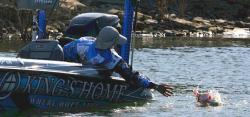
Crappie Fishing at Lake Walter F. George in September

Walter F. George has long been known for its excellent crappie fishing. In September night fishing is very good for them. Tie up under any of the bridges on the lower lake like the one in White Oak Creek, hang a light over the side and fill up your cooler while crappie fishing at Lake Walter F. George in September.

Areas of standing timber are also good, like the mouth of Bustahatchee Creek. Anchor near the old creek channel over the timber and put your light over the side. It is a little more difficult to position your boat than it is under a bridge and you need two anchors to hold your boat steady.

With a depthfinder you can usually see the fish and know what depth to fish. Without one, drop a minnow or Hal Fly jig down to nine feet and work it at that depth for a few minutes, then drop down another foot. Keep slowly changing depth until you start catching them.

Light line is the key. Four pound test fluorocarbon is best but you may have to go to six pound to land bigger fish, especially in the timber. Try different color jigs and different size minnows until the fish pick their favorite and then offer it to them.

How Do I Do Winterization and Ethanol Blended Fuels

Winterization and Ethanol Blended Fuels
from The Fishing Wire

The coming of cooler weather means an end to the boating and motorcycling season for many. Chiefly important in preparing these vehicles for winter is managing the potential for engine damage from the federally-mandated ethanol blend in our nation’s gasoline supply.

Ethanol in gasoline stored for long periods can damage marine and motorcycle engines: “phase separation” of the fuel can leave a corrosive water-soaked ethanol mixture at the bottom of the gas tank. Half of the respondents of a recent Boat Owners Association of The United States (BoatU.S.) survey reported that they have had to replace or repair their boat engine or fuel system parts due to suspected ethanol-related damage, costing an average $1,000 for repairs.

To prevent ethanol problems over the winter, boats with built-in gas tanks should have fuel stabilizer added and the tank left nearly full. E10 fuel remaining in small portable gas tanks (and not pre-mixed with 2-stroke engine oil) should be poured into your car’s gas tank and used quickly. Same goes for motorcycles – store full with stabilizer or drain completely.

So how did ethanol get into our gas? Signed into law in 2005 and expanded in 2007, the Renewable Fuel Standard (RFS) requires an increasing amount of biofuels such as corn ethanol to be blended into the gasoline supply. However, the ethanol mandate has failed to achieve promised consumer and environmental benefits.

In addition to winter storage and engine repair concerns, ethanol-blended fuel is actually worse for our air and water. According to research from the University of Tennessee, ethanol’s “clean alternative” record is “highly questionable.” The 2014 federal National Climate Assessment reported that ethanol production can require 220 times more water than gasoline.

Ninety-one percent of those surveyed by BoatU.S. prefer non-ethanol fuel for their boats. An AMA-commissioned poll found that 78 percent of all voters – not just motorcycle owners – have “very serious concerns about E15 use” and 70 percent oppose increasing the amounts of ethanol blended into gasoline.

But the Environmental Protection Agency ignores the public’s concerns and continues to increase the amount of ethanol required to be blended in our nation’s gas. Even though it’s illegal to use E15 (15 percent ethanol by volume) in marine engines, snowmobiles, motorcycles, lawnmowers, and any vehicle made before 2001, E15 can now be found in 24 states. Using E15 in many vehicles on the road today will void the manufacturer’s warranty.

With a recent $100 million USDA grant made available to subsidize the installation of blender pumps at gas stations throughout the country, access to ethanol-free gas may soon be more difficult, leading to even more cases of inadvertent misfueling and engine damage.

Thankfully, Congress is considering bipartisan legislation to repeal the ethanol mandate, but the question remains whether our legislators will protect consumers and our environment by eliminating the ethanol mandate.

###

Editor’s Note: Today’s feature was prepared by Rob Dingman, President and CEO of the American Motorcyclist Association, America’s largest motorcycling organization and Margaret Podlich, President of the Boat Owners Association of The United States (BoatUS), the nation’s largest recreational boat owner advocacy, service and safety group.

Why Do Some People Demonize Guns?

Every room in my house has a loaded gun in it. The guns range from a 12 gauge semiautomatic shotgun loaded with #1 buckshot beside my bed to a Colt 1911 .45 caliber semiautomatic pistol with full magazine and one in the chamber on my desk.

I have had those guns in those places for years, yet none of them have ever shot anyone. I would be more careful with loaded guns if there were ever any kids in the house but that is not a danger. The guns are only a danger to someone threatening me.

For some reason some people demonize guns and claim they somehow lead to crime and murders. They want to put all kinds of restrictions on guns, from the look and style you can buy to the way they work. And those restrictions are demanded by folks that do not know the difference between semiautomatic and caliber.

In Virginia last Tuesday there was an election for state senate. The liberal governor of Virginia, Terry McAuliffe, has been pushing for new gun control laws since elected two years ago. The senate, with two more republican members than democrat members, has refused to pass them.

To correct this great injustice to his plans, McAuliffe had liberal democrats running in all districts that had republican senate members. The anti-gun group lead by multimillionaire Michael Bloomberg, who wants to control everything you do from owning a gun to the size of soft drink you can buy, poured many millions of dollars into the campaigns of the anti-gun candidates.

They lost every race. The voters in those districts were smart enough to not believe the stuff the anti-gunners were claiming. The gun banners have changed from asking for gun control laws to calling them common sense gun safety laws, but most voters are smart enough to know there is nothing sensible about them and they have nothing to do with safety.

The biggest push right now is something they call universal background checks. Right now if you buy a gun from a dealer you go through a background check. But if you buy a gun from a friend you don’t have to go through the check. And it is a given that little gang bangers don’t go through a background check when they steal a gun or buy one on the street, and no law will make them since they ignore laws.

The Brady gun control Bunch like to cite numbers to show the background check is working. This is what US Senator Kelly Ayotte presented, as checked by Politifact: “On the numbers, Ayotte is on track. In one year, more than 80,000 background checks were denied at the state and local level and federal authorities pursued 44 charges in court, as the senator claimed.”

So of 80,000 violations only 44 were followed up? What possible good could extending a law that is nothing but an irritation for law-abiding gun owners and is only very rarely enforced against those breaking it do? It is not exactly “common sense” to do more of something that is not being enforced in the first place. Maybe those violating the law in place now should be prosecuted before asking for extending the law!

Supposedly gun crime in Chicago is extremely high because a bunch of folks go to other states to buy guns and take them back to the city where they are almost completely illegal and give them or sell them to their criminal buddies. So folks like Chicago mayor Rahm Emanuel wants to make new laws for other states. Nevermind that it is already against the law to buy a gun for someone else, something called a straw purchase.

Are straw purchase laws enforced? As noted in the November 2 issue of “National Review,” It takes a special kind of foolishness to call for new straw-purchase rules when Illinois, California and – notably – Oregon generally fail to prosecute the straw-buyers they identify.”

The same article of National Review talks about how laws now on the books are not enforced and states “It takes another special kind of foolishness to call for more gun control when a murder is committed by a man out on parole for aggravated assault with a firearm.”

Gun control laws do not affect criminals, only law-abiding citizens, and they are not enforced when violated by criminals. So stop calling for new laws to make it harder for me to get a gun when you are not willing to prosecute and punish severely those violating the laws currently on the books.

The anti-gunners keep saying they don’t want to take legal guns. But some statements give lie to that. Hillary Clinton recently said gun laws like those in Australia are worth looking at for us.

In Australia, after a mass shooting, the government instituted a mandatory buyback program. They would pay you for your guns that you turned in but if you didn’t turn them in they would lock you up and take the guns anyway. If Clinton supports that kind of law here, she and others are lying if they say they don’t want to take my guns.

Don’t take my word for this information. Look up the facts and truth for yourself. But especially don’t take what the gun banners say for facts. Check them carefully!

Don’t Forget To Get Your Boat Batteries Ready For Winter

Take Charge – Get your boat batteries ready for winter.

Don’t forget your battery when winterizing your boat

Prepping your boat for its winter hibernation is one of the best things you can do to protect your investment and ensure your fishing platform is ready to hit the water next season.

When it comes to “winterizing,” as it’s called, much attention is lavished upon the fuel system and outboard, and rightfully so. But there’s definitely more to the story if you want to truly prepare your boat for the harsh realities of cold storage.

“While gas and oil are important, the electrical system is also critical to preserving your batteries and getting off to a fast, hassle-free start in the spring,” says veteran angler and diehard boat prepper Scott Glorvigen.

He should know. Based in northern Minnesota, where Mother Nature brutally dishes out some of the continent’s harshest winter conditions, the veteran guide and tournament champion takes care to nurture his fleet’s electrical systems throughout the mean season.

“A lot of folks overlook their batteries, but doing do can be a costly mistake, in terms of dollars and time on the water,” he says.

Onboard charger

Onboard charger

Onboard chargers like Minn Kota’s four-bank 440PC make it easy to maintain batteries throughout the year, including during winter storage.

Neglected batteries can lose their firepower, suffer damage and even freeze up in bitter cold. In fact, run-down batteries can freeze at warmer temperatures than properly maintained power plants.

For example, while an absorbed glass matte battery might survive a blast of 50-below air temperatures when fully charged to about 12.6 to 12.8 volts, its ability to shrug off the cold declines when not fully charged. Standard flooded batteries are even more at risk when run down, because their sulfuric acid and distilled water won’t mix properly, allowing the water to freeze.

This can weaken or even totally destroy the battery’s ability to hold a charge and reliably dispense power, especially if the case cracks-leading to major replacement costs.

“Prevention is the best medicine,” says Glorvigen.

One option is removing the battery, moving it to a heated location such as a shop or basement, and maintaining it with a portable marine battery charger like the Minn Kota MK 210P, which offers two 5-amp banks for 10 amps of total charging power.

Portable Charger

Portable Charger

Portable chargers provide power wherever you need it.

“If you have multiple batteries, an easier solution is installing one of Minn Kota’s Precision Onboard Chargers in the boat,” says Glorvigen. “You don’t have to wrestle with heavy batteries or deal with complex wiring configurations and connections, just plug it in.”

In maintenance mode, the charger’s voltage is reduced once the battery reaches full charge. After 12 hours on duty, it automatically turns off, only stirring when the battery’s power dips below 12.6 volts.

“With either portable or boat-mounted setups, the charger keeps the battery full of life during the winter,” he adds. “Considering everything the battery will be asked to do next spring, from spinning the starter to running your trolling motor, electronics, bilge pump and more, it’s the least you can do.”

Glorvigen also offers handy tips on surefire charging.

“If you’re using an extension cord, make sure its plug’s pins match those on the charger,” he says. “Also choose a cord with a rugged jacket to guard against moisture, oil and chemicals. And don’t lay the cord anywhere you might drive over it, which could damage the wiring. Finally, above all, make sure the cord is rated for the charger’s energy requirements.”

Power draws differ by device. For example, a household lamp might require just .5 amps, while an air compressor or shop vac may need 15 to 20 amps.

Thankfully, Minn Kota simplifies the cord-selection process by recommending specific American Wire Gauge (AWG) ratings for cords used with each of its chargers.

Healthy batteries engender smooth sailing.
“From there, it’s a simple matter of choosing the right charge setting for your battery and letting the charger do its job,” he says, noting that while you’re tending to the battery, it’s a great idea to clean off the terminal connections with a wire brush and check the fuses on the charger.

While these precautions do add extra steps to the winterizing process, Glorvigen assures us that such simple and inexpensive maintenance goes a long way toward ensuring that you’ll enjoy worry-free boating next spring, without wasting time and money replacing neglected batteries.

CONTACT INFORMATION
Glorvigen & Glorvigen LLC – 29 County Road 63, Grand Rapids, MN 55744
sglorvigen@wired2fish.com – 218-301-9072

North Or South For Georgia Bass

Go North Or South For Georgia Bass in September

September is often a mean month for bass fishermen. Although there are hints of cooler weather and the days are getting shorter, the bass are slow to respond and start feeding consistently in shallow water. But you can catch a lot of bass, and some big ones, no matter where you live in our state.

If you live south of the Fall Line, Lake Walter F. George, usually called Lake Eufaula by fishermen, is a great place to catch September bass. It is at the top of its usual five year cycle right now, with a lot of quality three to five pound largemouth in the lake.

The Georgia Department of Natural Resources, Wildlife Division, Fisheries Department says you can expect to catch a lot of bass over the 14 inch minimum size with a good number of fish over three pounds. You also can catch some quality fish over six pounds, with the chance of a wall hanger over eight pounds.

Scott Montgomery and his father own Big Bite Bait Company near Georgetown and Scott has been fishing Eufaula all his life. Scott says bass are still in their summer pattern in September, with more migration toward more shallow water late in the month. But you can consistently catch them on two basic patterns.

When the light is low early in the morning, late in the day and on cloudy days the lily pads are a feeding area for bass. While the sun is bright some bass will still hold under the pads and be caught around them, but your better bet is get out on the many ledges where they hold and feed on bright sunny days.

The area around Cowikee Creek has all the cover and structure you can fish in several days and is one of the best areas on the lake for bass fishing. Big flats covered with pads are everywhere and the creek and river ledges in that area concentrate bass in key spots.

In both areas subtle changes can make all the difference between casting and catching. A small ditch running through the pad fields and a cut or sharp swing in the channel on the ledge are structure changes you want to find. The pads provide the cover in shallow areas but rockpiles, stumps and brush on the ledges are the type cover you want to fish.

Scott says your tackle selection is fairly simple. For the pads, have a weedless topwater bait like his company’s Top Toad or Floatin’ Toad tied on. A spinnerbait or jig and pig will also catch fish from the pads and you can fish them slowly when you find a concentration of fish.

On the ledges Scott likes a big plug like the Bomber Fat Free Shad or Norman DD22N for covering the depths quickly to locate fish. To slow down and work an area carefully switch to a Texas or Carolina rigged big worm like the ten inch Mangum Kriet Tail or Kriet Creature bait.

Since the water is clear this time of year use shad colored baits. A sexy shad or gizzard shad color in the crankbait is good and tilapia or green pumpkin with blue and purple flakes in the soft baits are good choices. And watermelon with red flakes is always a good choice for the worms.

If you put in at Lake Point State Park you don’t need to go far. The boat channel in Cowikee Creek is marked by poles leading from the launch ramp out to the river. Although these poles are not always right on the creek channel, they mark an area clear of stumps and standing timber you can run, some of them sit right on the creek ledge.

The second set of pole markers going out of the park are a well-known spot. It is well known since it holds so many bass and is a good example of the kind of channel ledge you want to fish. Just downstream of the green marker is a hump rising to about 13 feet deep at full pool. The channel makes a swing by it and there are stumps on the hump and drop into the channel.

Scott starts fishing here by sitting in the channel and casting toward the highway causeway. Try a big crankbait first then drag you soft baits along the bottom, fishing both from shallow to deep. Work all the way around the hump, bring your baits from deep to shallow, too.

You can work your way down the creek checking the ledges all the way to the river. A good depthfinder is invaluable to find the changes in the bottom and even seeing bass and baitfish. The presence of baitfish means bass will be close by and you should fish the area to find the key spot they are holding. Current makes these deeper spots a lot better as does some wind blowing across them.

When you get out to the Chattahoochee River channel it is marked by drum buoys and provides many good drops to fish. A good one that is an example of what to look for is just downstream of channel marker 100.7. Stop at it and idle downstream on top of the ledge, watching for a ditch that cuts across it. The top of the ledge is only six to eight feet deep but the ditch drops off to 18 feet deep then comes right back up and the river channel is much deeper.

When you find the ditch, start with your boat in the mouth of it and fish up the ditch, casting all your baits to both sides of it. When you hit cover like stumps or brush concentrate casts to that area. Current is very important here since it eddies across the drops and makes the bass feed.

For shallow pad fishing start at the second set of pole markers coming out of Lake Point and make a hard left if you are going downstream. Idle toward the point with cypress trees on it and lily pads all around it. Scott says this is an excellent place to find shallow fish.

Scott stops on the point and fishes toward the motel at the state park. Make long casts into the pads and fish across them, pausing when you come to holes in them. Keep your boat out from the edge of them and also pause when you get to the edge. Bass often hold right on the outside edge.

Look for other pad areas near the channel and try to find a ditch coming through them or where the form a point. There are dozens of similar spots all the way to the river to fish.
If you live in the north half of the state Lake Lanier is hard to beat for September fishing. The lake is loaded with big spotted bass and they are on predictable patterns all month.

State fisheries biologists say there is a good population of two to four pound spots in Lanier and most tournaments have a five pound plus fish weighed in. Some fishermen think there is a new world record spot swimming in Lanier and seven pound plus spots are reported fairly often.

Rob Jordan grew up fishing Lake Lanier and lives in Suwanee and fishes it several days a week. This year he won a BFL tournament on the lake with five fish weighing 19.5 pounds, and has weighed in a 21.5 pound five fish tournament limit, so he knows its spotted bass and their habits well.

“Lanier is not like other lakes since the big spots roam water 50 to 60 feet deep and you can not catch them by fishing like you do in other lakes,” Rob said. You have to fish where the big ones live, and September is a transition month on Lanier. But if you fish the right places and right baits this month you can catch some big ones, as the six pound, six ounce spot he caught in September while guiding a client last year proved.

Rob will have a drop shot and shaky head worm ready for fishing slowly this month. For catching more active bass he will fish a topwater bait and a swim bait. He is often sitting in 80 plus feet of water and casting to water 30 feet deep or deeper, so you have to fish deep for the big ones.

The main lower lake is the best area to fish, according to Rob and you can find key spots in a variety of ways. Shoal and channel markers are often near the places where big spots hold very deep and move a little shallower to feed.

A couple of good examples are near the dam. In the mouth of Shoal Creek green channel marker 3SC sits on the end of a long rocky hump right by the channel. There is a danger marker on top of the hump so it comes up very shallow but water 100 feet deep is not far away. Every point and hump in Lanier has brush on it fishermen put out, and the bass hold in it and roam out to feed so locating brush piles is important.

This hump is very rocky, something spots love, and there is brush all over it at different depths. Rob likes to start with his boat out in very deep water and cast a topwater plug like a big Zara Spook to the shallows around the hump and work it back fast. This will often draw a suspended spot up to feed. Also throw a big swim bait to cover the top and sides of hump.

For bragging size spots Rob likes a Bull Shad swimbait. He custom paints them, a skill he learned from his cousin Professional bass fisherman Jim Murray, Jr. Jim also taught him a lot about fishing for bass. His colors that resemble blue back herring work well since that is the baitfish big spots eat. Fish the swimbait at different speeds and depths to find what the big spots want.

Move your boat to more shallow water, around 35 feet deep, and watch your depthfinder for brush. When you see it use a drop shot worm to fish beside and in it. While you are looking for brush cast a shaky head worm to ten feet of water and work it back to 30 feet deep for spots feeding on the rocks.

Rob likes soft like a ZMan Finesse worm on his drop shot or jig head. Any watermelon color with flakes in it can be good, as are colors like morning dawn. If the fish want something bigger he will offer them a Big Bites Bait six inch Finesse worm in the same colors.

Another good place is the hump just off channel marker 1YD in Young Deer Creek marked with a danger marker. It also has rocks and brush with deep water nearby to hold magnum spots. Fish it the same way. Some wind blowing across these places makes them even better.

Always watch for surface activity. September is a good month to catch schooling spots. If you see swirling fish near you cast a topwater plug or swim bait to them. If you see splashes in the distance, or gulls diving, run to them, stop a long cast away from the activity, and catch the fish as they chase shad or herring.

There are dozens of similar places all over the lower lake to fish, and they are easy to find since channel markers near shoal markers point them out. Pleasure boat traffic gets extremely bad on Lanier, even in September, so weekdays or weekends before 10:00 AM are the best time to fish.

Whether you live north or south in Georgia these lakes are close enough for a one day trip. Or if you variety, head to the other part of the state from where you live to experience a very different kind of fishing. Decide which you like best.

What Is the Veterans Conservation Corps?

Veterans Conservation Corps Expands Again — Vets Learn Fisheries, Conservation Skills in California
from The Fishing Wire

The Veterans Fisheries Corps Program is growing again! As the program that trains veterans in fisheries restoration expands toward covering coastal watersheds state-wide in California, its next permanent home and launching pad will be the California Conservation Corps center in Ukiah, California. Here veterans will assist biologists with monitoring salmon and steelhead that span Mendocino County and the Russian River Watershed.

Veterans perform snorkel surveys

Veterans perform snorkel surveys

Veterans perform snorkel surveys to count juvenile salmon and nests of salmon eggs, known as redds, throughout the year. In this photo, the snorkel team surfaced under a patch of lily pads. Photo: California Conservation Corps

Veterans who participate in this program develop lasting skills and expertise in fisheries research and restoration to support recovery of endangered steelhead and salmon in California. Since the program started in 2012, it has expanded twice and can now support up to 10 veterans each year. Many veterans have found employment after the program and several have secured jobs in a natural resource field. Some veterans plan to seek a degree in a natural resource field. Veterans are eligible for college tuition after completing the program with an additional Americorps Education Award.

The work the veterans perform in the Corps is in high demand. To many of NOAA’s partners that implement habitat restoration in California, veterans fill critical gaps to make these projects successful. “I have resource managers calling me to ask about getting someone from the Veteran Corps program to help them with their restoration projects. The word about this program is spreading and we are constantly trying to meet the current demand with new candidates,” states Stacie Smith, a NOAA Marine Habitat Specialist.

A veteran conducting a habitat typing survey

A veteran conducting a habitat typing survey

A veteran conducting a habitat typing survey in North Fork Matilija Creek, in the Ventura River watershed. Photo: California Conservation Corps

The list of skills that veterans gain on the job is impressive, as are the statistics on work they have done to support habitat and the recovery of fish species. Veterans collectively have surveyed over 1,700 stream miles to monitor adult and juvenile endangered salmon and steelhead. They have supported more than 66 habitat restoration projects in various capacities including monitoring fish populations, restoring stream banks, measuring stream flows, removing fish barriers, and educating the public about habitat restoration.

Specifically in Ukiah, veterans will support efforts to track populations of salmon and steelhead along key freshwater streams. From October to March, they will survey the number of spawning adults migrating upstream. Then in the spring, veterans will learn fish trapping techniques to monitor young fish, called smolts, as they migrate downstream and into the ocean. This tracking helps NOAA understand population trends for key watersheds and provides a measure for these areas to gauge how our restoration efforts are contributing to the species’ recovery.

“We are so lucky to have these people who have served our country abroad and continue to serve our country by rebuilding our fisheries,” said Bob Pagluico, a NOAA Marine Habitat Specialist and one of the Veterans Corps Program founders. “To reach our goal of placing veterans in all of California’s coastal watersheds we need to secure ongoing funding. Every chance we get we are reaching out to private, government, and local sources for funding. We are very passionate about this program and how it has helped veterans who are looking to take the next step in their lives.”

Veterans in Ukiah will undergo extensive training and are expected to support restoration programs on-the-ground in October 2015. NOAA Fisheries welcomes this new group of veterans and appreciates their support for recovery of fish populations that are identified as a national priority for NOAA.

Watch for updates about the veterans and their stories on the NOAA Fisheries West Coast Facebook page.

Learn More, or contact Bob Paglucio in NOAA Fisheries’ Arcata office at 707-825-5166 if you are interested in applying for this program.

Gun Control Lies and Myths

A couple of weeks ago I tried to get someone to bet with me. I knew I had two sure things but no one would take me up on either bets. This happened as I heard the news about the shooting at an Oregon college.

The first bet was that politicians would be calling for new gun control laws based on this shooting before anything at all was known about it. And the other was that the Brady gun control Bunch would get a fundraising email out within hours of the shooting. I was right on both.

President Obama went on TV within two hours of the shooting to call for ‘common sense” gun control measures. The main one he pushed was extending the background check to all gun sales, even the ones between parent and child.

As usual, the shooter in Oregon used guns that had been purchased after a background check was done. Extending the background check would have made no difference. I always want to ask those calling for gun control laws one question – if your desired law had been in effect, would it have made any difference. The answer in every case is “no.”

Along those lines, I was disappointed in an editorial from the Brunswick News reprinted in the Griffin Daily News on 10/13/15 titled “Something Must Be Done About Guns.” As I said in a column a few weeks ago, calling for “something to be done” when the something can have no effect on gun violence makes as much sense as cutting firewood and leaving it in the woods. You are doing “something,” but it is not going to warm your house.

Politicians constantly tell gun control lies.

President Obama also said it was terrible that gun violence research is suppressed. In a 10/11/15 editorial in the Griffin Daily News, Dick Polman echoed this. Both claimed congress passed a law banning research on gun violence.

Unlike Obama, Polman did finally admit neither one of them were telling the truth. As he states, “Technically, the law doesn’t literally ban federal gun research, the language reads, None of the funds may be used to advocate or promote gun control.”

That’s right, the law keeps gun ban nuts from using federal tax money to push their agenda. If they are unbiased and willing to do real research, they can still do it. It only stops those going into their so called “research” with the goal of slanting it so it pushes gun control. Anyone doing research with a preset outcome is not doing research.

Hillary Clinton claimed gun manufacturers and sellers are not held to the same liability law as other manufacturer. Even the liberal media had to admit she was lying. She was whining about a law passed a few years ago saying gun manufacturers and sellers could not be sued if the gun was used illegally.

They can still be sued if the gun malfunctions, just like any other product. The goal of the gun banners was to sue the gun industry out of business. That is why the law had to be passed. If it had not been passed, frivolous law suits would bankrupt the industry.

Suing a gun seller for a gun used in crime makes as much sense as suing Walmart for selling a baseball bat used to beat someone. Justice is not the gun banners goal, the elimination of guns by any means is their goal.

Within a few hours after the Oregon shooting I got a fund raising email from the Brady gun control Bunch. They are like buzzard circling roadkill. They use any dead body to try to get money and further their cause.

They pushed the same old usless agenda of universal background checks and limits on the kind of guns law abiding citizens can buy. Again, nothing they are pushing would have any effect at all on any of the killings they are using.

President Obama also made the ridiculous statement that it is easier to buy a gun than it is to buy a book. Go to any store selling both and see for yourself how dumb that claim is.

It may be true that it is easier for a little gang banger to get a gun than a book. In a headline article in the Griffin Daily News this past Friday an article told how several kids younger than 18 were arrested for gang activity.

There were several guns in the group and some of them were charged with various gun related charges. Since it is illegal for anyone younger than 18 to have a handgun, and illegal for a felon of any age to have a gun, several of them faced those charges.

The only way to do “something” about guns is to go after those breaking the law with them. Catch a gang banger with an illegal gun. Lock him up for a long time. Someone commits a crime using a gun? Don’t plea bargain the gun charge away, make it mandatory they server a long time where they and their illegal guns can’t do any damage to law abiding citizens.

The most recent police officer murder in New York was by a gang banger with at least 23 arrests over the past 16 years. One arrest was for shooting an 11 year old boy. Why was he still alive, much less free on the streets to shoot a police officer?

Hillary called me a terrorists since I am a member of the NRA. Until we take action against criminals by putting them where they can’t use a gun illegally, gun crime will be blamed on me and you, by those pushing a gun control agenda.

Go after the criminals, not the law abiding citizens!

How Can I Catch More Tautog?

Yamaha Fishing Tip of the Week: Be Anchor Savvy to Catch More Tautog
from The Fishing Wire

Use two anchors to get on the structure and stay there!

Tautog

Tautog

Even though the hot days of summer fishing are a memory and fall is starting its march toward winter, mid-Atlantic anglers shouldn’t have to take their boats out of the water just yet. The best fishing of the year for blackfish, aka tautog or tog, is just getting started, and the season is open through January in most states along the mid-Atlantic and New England coasts. Open seasons, size and bag limits vary from one jurisdiction to another, so be sure to check your state’s marine fish regulations so you don’t run afoul of the law.

Tog are bottom fish that live and feed in and around structure. Likely places include mussel beds, wrecks and rocky outcroppings – pretty much any form of what is classed as “hard” structure. Regardless of whether it’s naturally occurring or manmade, if it’s been on the bottom in 25 to 100 feet of water long enough to be encrusted with mussels and other anchoring life forms and invaded by crustaceans like crabs, tog will inhabit it at some time during the year. The most productive depths to fish will change with the seasons and water temperature because tog will generally move from shallower to deeper environs as temperatures drop. In late fall and early winter, concentrate your efforts on hard structure in 40 to 70 feet. When ocean temps get down into the 40s, shift to even deeper spots. There are many artificial reefs found off states such as New York, New Jersey, Delaware and Maryland that provide prime tog habitat; further north your focus will be on naturally-occurring hard structure.

Fishing for tog requires a higher level of boat handling expertise and an understanding of how to use your depth finder, chart plotter and anchor(s) to position your boat. Your depth finder and chart plotter are the keys to finding and saving good structure spots to fish, but they will also be critical in helping you anchor directly over those spots to cash in on the tog they are holding. Private boaters will learn that some of the most productive pieces of structure consist of smaller wrecks and rock piles that are overlooked by larger head boats and charter boats. But to get on them you have to be able to anchor with pinpoint accuracy, and that’s an art form that requires a little practice.

Most serious tog fishermen keep two complete sets of ground tackle (anchor, chain and rode) aboard their boats and with good reason. One is typically kept in the boat’s bow anchor compartment, the second in a tub so it can be stowed when not in use. There are a number of anchor designs, but a Danforth-style is the most widely accepted for recreational fishing boats and works well for both sets of ground gear. When choosing an anchor, start by referring to the manufacturer’s application chart for the weight generally recommended for your size boat, but for fishing purposes go up one additional size. This will let you anchor more quickly and with less line between the boat and anchor, which makes deploying and retrieving less work. For a typical 20- to 27-foot boat, each set of ground tackle should consist of an anchor, 12 feet of 1/4-inch chain attached to the anchor with a shackle, and one cable length (600 feet) of 3/8-inch braided nylon line, which is called the “rode.”

Catch Tautog

Catch Tautog

If you’re new to this, you’ll probably want to have a marker buoy or two rigged and ready to drop on the structure as the boat passes over it. A buoy will provide you with a visible reference point when trying to get the boat settled over a spot. If you are well practiced with your GPS, you can forego the buoy and use the saved structure waypoints on the plotter screen for your anchoring reference point. Buoys can be purchased at marine specialty stores or websites, or you can make your own out of brightly colored commercial pot marker buoys wrapped with 150 feet of 1/8-inch nylon twine, marked every 50 feet with a permanent marker with a sash weight attached to the opposite end. Use stainless steel screws to attach a Velcro strap from the top to the bottom of the marker buoy, and use it to control how much line will pay off the buoy when it hits the water. If the water is 75 feet deep, release about 85 feet of twine before dropping the buoy to keep it above your spot, with enough extra line to keep the weight from being bounced off the bottom by waves.

One anchor might be sufficient for most boating needs, but for serious tog fishing two anchors spread approximately 90 degrees apart allow you to adjust the boat’s position by lengthening or shortening the rode for each anchor. By double anchoring, you can hit your mark quickly with some wiggle room to spare for adjusting position if the wind or current changes after you’re anchored. Nothing is more frustrating than getting on a spot and building a good bite only to have the wind change a few degrees and blow you off the spot.

Here’s how to do it. Once you mark a spot, either on your chart plotter or using a marker buoy as a visual reference, you have to determine how the wind and current are going to affect the way the boat will lay at anchor. To do this put the boat in neutral, and let it drift for a few minutes with your plotter scaled down to a very tight range setting (200-500 feet works fine for this phase) with the plot trail feature activated to record the direction of the drift on screen. That trail will be your guide to approximate how the boat will settle back on the anchor lines. The other thing you have to determine is how much rode you’ll have to let out for the anchors to set and hold the boat, because that will tell you how far away from the structure point you have to drop them. To get that number, simply multiply the depth of the water by five. For example, if the structure is in 70 feet of water, you’ll want to drop each anchor about 350 feet away from the mark. Don’t worry about being off by as much as 50 feet one way or another – that’s why you’re using an anchor one size larger than recommended.

Anchors

Anchors

Now that you’ve determined the direction the boat should rest at anchor and how far away the anchors should be dropped from the mark, get your anchors ready for deployment at the bow of the boat, and then slowly run the boat directly down current of the buoy or the waypoint marker on your plotter. Turn so it parallels the drift trail you just created, passing directly alongside the buoy or over the mark on the plotter screen. As soon as the boat reaches the mark, turn the boat at least 45 degrees to port of the drift line, and proceed at a slow speed until you are about 350 feet from the mark and drop the first anchor. Once it strikes bottom, carefully power backwards toward the buoy in reverse letting line out until you get close to the mark. Then hold the anchor line tight until the anchor sets in the bottom and pulls the line through your hand. Take a wrap on a bow cleat, let the boat settle back on the rode to be sure the anchor is firmly set, then loosen that line and repeat the procedure, but this time running the boat from the mark at least 45 degrees to starboard of your drift line. When you’re done you will have two anchors set 350 feet out from the mark, spread approximately 90 degrees apart.

Drop back both lines until you get close to your mark, and wrap them around a bow cleat and let the boat settle in. If the boat is positioned too far forward, drop back by letting out more rode from both lines to put it on the mark. If it’s behind the mark, pull up on both lines. If it is laying to the right, let out a little line on the starboard anchor and pull in some line on the port. Do the opposite if the boat is laying too
far to the left. It’s that simple.

If you want to move the boat while you’re fishing to cover more of the structure, you’ll find that adjusting the anchor lines will give you quite a bit of latitude to do so. This is important because you will encounter structure where you will only catch tog on specific areas and not on the whole piece. Sometimes bigger tog will show a preference for a specific portion of a larger piece of structure. For example, there are wrecks where they feed on the up-current side so anchoring over the up-current portion of the wreck will catch a lot of fish, while being off that spot might only produce a few bites or small fish.

Remember that anchoring accurately is an art that takes into consideration some scientific observations on your part and the smart use of the tools you have on your boat. It takes practice to gain an understanding of how sea and wind conditions affect your boat under different anchoring scenarios. Just remember that tog fishing is all about location, so with some good structure numbers, a compliment of well set-up ground gear and these techniques, you can get on even the smallest piece accurately and hold the boat there while you limit out. If conditions change during the day, you might have to reposition one or both anchors, but that’s the price you pay for great fishing. Anchoring might be the least fun part of the trip, but nine times out of ten it’s the most important.

Have You Watched Costa’s Geobass Shows?

I have been enjoying watching Costa’s Geobass series of videos posted online.

In this series, four guys travel to exotic destinations to try to catch bass. But they consider any fish named bass a bass, including saltwater species, so it is not just black bass, although they do go after trophy largemouth.

The videos are fast paced and fun to watch, and they do catch fish. They use fly rods only and tie their own flies to suit the situation. They are like any group of fishermen, picking at each other and having fun.

They go to such places as Christmas Island, Papua New Guinea, Brazil, and many others

Check out these videos – I think you will enjoy them.

Who Tags Paddlefish for Management Study?

MDC tags paddlefish for management study
from The Fishing Wire
Some natural reproduction found in Truman Lake and Mississippi River

Kansas City, Mo. – Missouri Department of Conservation (MDC) biologists will be on the water this fall and winter capturing and tagging paddlefish. The tags, with help from paddlefish anglers, are part of a five-year research project aimed at maintaining a quality paddlefish fishery for anglers. Biologists are also studying natural reproduction in some waters and have determined that some paddlefish spawning is occurring.

MDC crews will be netting and tagging paddlefish this winter for a five-year study to maintain Missouri’s high-quality fishery for the popular sport fish. This is the second year for the study at Lake of the Ozarks, Harry S., Truman Lake, Table Rock Lake and the Mississippi River. The study is aided by anglers reporting information from tags. These fish were netted and tagged in March, 2015.

Tagging Paddlefish

Tagging Paddlefish


Photos by Bill Graham, Missouri Department of Conservation

Missouri’s primary paddlefish waters are Harry S. Truman Lake, Lake of the Ozarks, Table Rock Lake, and the Mississippi River. Biologists netted, tagged and released 2,768 paddlefish in those waters prior to the spring, 2015, snagging season. The fish were weighed, measured and given ID jaw tags. Anglers reported tags to MDC, enabling biologists to track fish movement and survival. Anglers reported 234 tags last spring, and 129 of those fish were caught in the upper end of Truman Lake, said Trish Yasger, MDC fisheries management biologist.

The paddlefish snagging season during spring is popular with many anglers. The cartilaginous fish are also called spoonbill because of their long, flat snouts. They feed on plankton and can reach seven feet in length and weigh 160 pounds or more.

The fisheries in Truman Lake, Lake of the Ozarks and Table Rock Lake are supported by stocking young paddlefish hatched and raised in MDC’s Blind Pony Hatchery. Dams have flooded blocked spawning migrations and flooded natural spawning areas on the Osage River system that feeds Lake of the Ozarks and Truman Lake. Paddlefish were introduced by MDC in the James River arm of Table Rock Lake as a new opportunity for anglers. Paddlefish find ample food and grow well as they cruise the large reservoirs feeding on plankton. They make upstream spawning runs in spring, and anglers snag them where they congregate.

Research in 2015 included a study to investigate whether natural reproduction was occurring in Truman Lake. Biologists inserted small 4-inch transmitters into 100 large paddlefish netted and released in the lake. Stationary receivers monitored their movements in the lake’s upper arm and tributaries. In April, 84 percent of the monitored fish moved upstream of Osceola in the Osage River arm. The monitors showed 66 percent of them moving upstream of MDC’s Taberville Access in St. Clair County. Also, 52 percent of the monitored paddlefish moved further upstream and passed the MDC Old Town Access in Bates County on the Marias des Cygnes River, a primary tributary of the Osage system.

MDC crews sampled for paddlefish eggs and larvae at gravel bars in the upstream areas. A limited number of embryos and larvae were collected above MDC’s Taberville Access boat ramp on the Osage River. Several years ago, paddlefish larvae were also collected in the Marais des Cygnes River, Yasger said.

“We are not sure how much natural reproduction is occurring, if it even happens every year, or if the young actually recruit to harvestable size,” Yasger said. “We have a great paddlefish fishery and don’t believe that the limited natural reproduction is enough to sustain it, so we will continue stocking to maintain the population.”

Still, she said it is heartening that natural reproduction is still occurring in the Osage River system considering that dams block spawning migration paths, historical spawning grounds are flooded, land use changes have affected hydrology and water quality, and the Bates County Drainage Ditch built in the early 1900s cut miles off the Marais des Cygnes River’s channel.

“It’s amazing, the fish are still finding a way,” Yasger said.

MDC fishery crews on the Mississippi River using trawling to sample fish populations also have collected paddlefish larvae. Natural paddlefish reproduction is occurring somewhere along Missouri’s eastern border. In 2016, MDC crews will implant transmitters and track 70 paddlefish to monitor spawning in the Mississippi River and tributaries.

For more information on paddlefish in Missouri, visit http://mdc.mo.gov/discover-nature/field-guide/paddlefish.