Category Archives: Bass Fishing

Bass Fishing Information

West Point Night Bass Tournament

Night time did prove to be the right time for bass, at least for bigger fish, for a couple of us last Saturday night. Fishing was disappointingly tough at West Point though. Part of the problem was the wind. I have never fished at night with such a strong wind. The wind made it extremely hard to feel your bait and bites after dark.

Eleven members and guests fished the Spalding County Sportsman Club tournament from 5:00 PM to 1:00 AM. We brought 18 keeper bass to the scales weighing about 28 pounds after eight hours of casting. There were three limits but six people didn’t weigh in a fish. Three members left before weigh-in since they had one fish each and did not care about trying to get points.

I won with five at 8.36 pounds, Russell Prevatt had five at 6.51 pounds for second, Billy Roberts was third with five weighing 6.44 pounds and Niles Murray took fourth and big fish with one bass weighing 4.39 pounds.

Al Rosser fished with me and we started on a deep brush pile that I just knew was holding bass, but we never got a hit. After working it and some rock piles we started down a rocky bank at about 7:00 and Al got three small bass, too short to weigh, and I lost one small one.

Then at 7:30 Al got hung near the bank and as I moved the boat to try to get him loose I saw what looked like brush with fish in it about 20 feet off the bank. I turned and cast to it and landed a keeper spot, then threw right back and got my second one while Al was breaking off and retying his line. After 2.5 hours of fishing without a keeper I got two on back to back cast on a jig head worm. That is crazy.

About three hours later Al got hung up again and I cast a Texas rigged worm across a point the wind was blowing on and a two pound largemouth almost jerked the rod out of my hand. I landed it and kept fishing the point but the wind was too strong to really fish it effectively.

We went back to the rock piles to see if bass had moved into them in the dark but the wind was blowing right into them. I switched to a half ounce jig and pig trying to control my bait in the wind but even with it I could not really feel the rocks. We gave up and moved back to the deep brush we started on just as the small front blew through and the moon came up.

At 11:30 I felt a thump on my jig and pig and landed my biggest bass, a 3.32 pounder. After that the wind died some and we wore out the brush without another bite. By 12:15 we decided to try one last place and I got my fifth keeper, a spot bigger than the first two I caught, on the jig and pig.

I thought I might have big fish for the tournament but was shot down when Niles walked up with his bigger bass. Niles said he caught it on a spinner bait on the last cast he had time to make before heading to weigh-in.

So Niles caught the big fish after midnight and my three biggest all came between 10:00 and 1:00, so the bigger fish hit for the two of us late. Billy and Russell said they caught most of their bass before dark.

What Are College Bass Fishing Tournaments?

Blast off at a college bass fishing tounament

Blast off at a college bass fishing tounament

Today’s Collegiate BASS Fishing Angler, Tomorrow’s Leader

By Danny Blandford
from The Fishing Wire

As an angler that has been involved in college bass fishing since before there was truly organized college bass fishing, I find myself in awe of how far the sport and the participants have come. Likewise, I often find myself in awe at the public perception of college bass fishing among folks that don’t truly understand competitive bass fishing, let alone the value of it at the collegiate level. Only by being close to it since I was eighteen years old (closing in on half my life) have I really come to understand the role it is playing in shaping the future of our great sport.

Over the past year we’ve highlighted what it has meant to current and future professional anglers. Guys like Brandon Card, Justin Rackley, Miles Burghoff, and several other young aspiring professional anglers have recognized and capitalized on the opportunities to develop their competitive skills while fishing at the collegiate level. Fortunately for our sport, competing at the collegiate level is also producing an influx of a different kind of talent to the “other” side of competitive fishing, the industry itself. Many anglers are figuring out how to meld their talents and education, both on and off the water, into successful careers in the fishing industry.

We caught up with a couple of entrepreneurs who fully credit college bass fishing for where they are today and their path towards tomorrow. Brooks Woodward, the founding member of the Florida State Bass Fishing Club is a great example. Brooks rolled into Tallahassee, Florida in January of 2010. He had a passion for bass fishing and a desire to grow that passion into something more. Brooks channeled his energy into creation of the Florida State University Bass Fishing Club, a collection of anglers from across the country that shared his love of bass fishing, along with his competitive drive. Over the past three and a half years, the club has grown to approximately 25 members, competes in national events all across the country, and continues to grow in both membership and experience.

During that time, Brooks’ ideas and passion grew as well. According to Brooks, “It didn’t take me long to see that there was a huge community of like-minded anglers out there; which really opened my eyes to the potential in the fishing business and the size of the market. Once I started thinking about it, I knew it (the fishing industry) was for me and I felt like I had a few options. I looked at trying to land a job with an established company, I looked at starting a company from scratch, and I looked at what existing companies may be out there available to purchase. When it was all said and done, a purchase opportunity presented itself with Nichols Lures and I jumped on it.”

In regards to Nichols, Brooks went on to add, “The company was an established brand that had been producing good products since 1989 so I felt like it was a great place to start. At the time, my opinion was that things were just a bit stagnant and a lot of what was needed was creative work and fresh perspective, both of which I felt I could add. I’m a Graphic Design Major, so things like an updated website, updated packaging, and marketing collateral where all right up my alley.”

He started his journey as a fulltime student and part-time “tackle tinkerer”, and has transitioned into a part-time student and fulltime tackle company owner. When asked about the influence of college fishing and founding a club, Brooks went on to add, “I think college fishing is in large part the reason that I’ve chosen the path that I have. The relationships and camaraderie that I developed through the club made me want to stay in the industry and the contacts I’ve made along the way are helping me to succeed. As I look to grow the ranks here at Nichols, I’ll definitely be looking to likeminded collegiate or former collegiate anglers. I feel like college fishing teaches a unique set of skills and develops traits that I want to see in my own employees. I believe the more a person has been exposed to competitive fishing at this level, the more they can bring to future employers.”

After talking with Brooks I was left with the impression he was a traditional student that took a non-traditional route to pursue his passion, which I found to be a path I completely understood. With that said, it was the common thread of college, competition, and an entrepreneurial spirit that connected us and so many others.

For more content and a different perspective, I reached out to Berkley Product Manager, Stephen Britt. Stephen is what academia defines as a “non-traditional” student, and within minutes of being on the phone, it was clear “non-traditional” was a great adjective to describe Stephen and his passion for bass fishing. Academia uses the term because after high school Stephen spent four years in the United States Marine Corps; followed by two years at the University of South Carolina Salkehatchie, before enrolling in the Moore School of Business at the University of South Carolina’s main campus in Columbia, South Carolina.

Stephen’s story at South Carolina began with aspirations for a business degree with emphasis on management, insurance, and real estate. The “trifecta” for a young entrepreneurial businessman, but definitely “non-traditional” for a guy who had been thinking about life as a professional angler. Aspiration became inspiration when Britt learned that USC didn’t have a fishing team like the ones he had been hearing about at other schools. On January 26, 2009 Stephen hosted a callout meeting for a new bass club on campus and generated a total of five attendees, including him. Although small in size, that little meeting turned out to be a big step in the formation of the Anglers @ USC. The full story of their journey is an interesting one, and you can read it on their website here.

That meeting was important for the club, but it was also important for Stephen himself. It planted a seed that perhaps there are more ways to succeed in fishing other than casting for cash. The seed grew into something more when Stephen received a call from a friend. Apparently there was a guy from Pure Fishing standing in the lobby of the business school looking for people interested in angling and a potential internship. That call was all that it took for Stephen to head to the “B School” to see what was going on. That chance meeting led to an unpaid internship at Pure Fishing; the first internship at the new Columbia, South Carolina Pure Fishing headquarters to be exact. Although it was unpaid, Stephen found it very rewarding.

According to Stephen, “That internship really changed my path. I knew right away I wanted to work in the fishing industry and when it was over I changed up my courses to make me a better candidate for such work. I dropped my insurance courses, added marketing, and began looking for more ways to develop talents that could come in handy in the fishing industry. My time leading the Anglers @ USC was certainly a big part of everything.”

He went on to add, “As I wrapped up my courses and time at USC I started really pursuing Pure Fishing. I went to three different job fairs to keep getting in front of the Pure Fishing recruiter and doing my part to convince him I was the guy for the job. Ultimately, my persistence paid off. I landed the job as a Product Manager for Berkley and I oversee the fishing rods and rod and reel combo segments of our offerings, as well as some of our ice fishing products. I’ve been fortunate to spend the last two years working on something I really enjoy.”

“In summary, I’m excited to have landed where I belong. The subject of my work, the pace at which we do it here at Pure Fishing and my chance to remain involved in competitive fishing is absolutely awesome. I’ve got a career ahead of me…not just a job.”

Stephen and Brooks both spent a lot of time in the interview crediting their college bass club experience and being in the right place at the right time for where they are today. No doubt good timing was a pivotal part of their journey, but I’m convinced it was more than that which led to their early success. These young men “pushed” everything into place rather than waiting for everything to “fall” into place; which is a testament to who they are. With that said, it seems college bass fishing helped motivate them and provide a source of strength to keep moving ahead.

As someone that went through a long journey in academia, as well as the fishing industry, I can say with a fair degree of certainty that very few courses do what college bass fishing can do for a young impressionable man or woman. When coupled together, a passion for fishing and a sound education make a great recipe for success both on and off the water.

I think I can speak on behalf of everyone at the Association of Collegiate Anglers when I say we’re proud to be doing our part in making a difference in the lives of these anglers and the future of our industry.

Lake Wedowee and West Point Lake Club Tournaments

Lake Wedowee Club Tournament

Lake Wedowee can be a frustrating lake for a bass tournament, as members of the Potato Creek Bassmasters found out in mid-September. You can keep any size spotted bass there but the club has a 12 inch minimum size limit. And largemouth between 13 and 16 inches long must be released, so in club tournament a 12.5 inch largemouth counts but a 14 inch largemouth has to be released.

Niles Murray told me he landed several nice largemouth in the slot that had to be let go and he could not weigh them in. It can drive you crazy to have a 12 inch spot in the live well then have to release 14 and 15 inch long largemouth!

In their September tournament 12 club members fished eight hours to land 38 bass weighing 39.20 pounds. You can see not many fish over the slot were landed! There were three limits of five bass and everyone caught at least one keeper.

Michael Cox had a limit weighing 5.84 pounds for first place. James Beasley landed five weighing 4.98 pounds for second, Ryan Edge came in third with five at 4.82 pounds for third and Mike Gatlin rounded out the top four with four keepers weighing 3.97 pounds. Wesley Gunnels came in fifth with three fish weighing 3.87 pounds and his 1.76 pound bass gave him big fish in the tournament.

You can catch a lot of small bass to eat at Wedowee, and have fun catching some bigger largemouth, just be prepared to let them go!

West Point Lake Club Tournament

The last Sunday in September 13 members and guests of the Spalding County Sportsman Club fished our September tournament in the monsoon that afternoon. At West Point we can weigh in spotted bass over 12 inches long and largemouth over 14 inches long.

After eight hours of fishing we brought in 31 bass weighing about 48 pounds. There were four limits and four people didn’t have a keeper. Eight of the bass were largemouth and 24 were spotted bass.

Kwong Yu won with a limit weighing 11.68 pounds. I came in second with five weighing 8.36 pounds and my 3.41 pound spot was big fish. Third went to Niles Murray with five weighing 6.78 pounds and Sam Smith was fourth with four at 6.64 pounds.

My boat was still in the shop so Kwong let me fish with him. We ran to his favorite spot to start and cast for about 15 minutes without a bite. Then, for the next 20 minutes or so it seemed something hit our topwater baits on almost every cast. He landed four keepers and I got three in that time, and I missed over twice as many as I hooked. I guess my timing was off.

After about 30 minutes without a bite we left. I suggested a point I like to fish and Kwong got a nice keeper there on his first cast, but we got no more bites. From then till almost noon we caught some small fish including some little hybrids that came up schooling.

I landed my fourth keeper by a stump on a jig and pig that passed up Kwong’s Fluke. Then Kwong got two good largemouth of about three pounds each and I got my fifth keeper, a small spot, then the big spot hit.

It got real slow after the heavy rain started and we didn’t do much until Kwong got another three pound largemouth just before we had to head in. Kwong had four of the largemouth weighed in – half of them!

Catching Bass At NIght At Jackson Lake

Last summer on a Saturday night 12 members of the Spalding County Sportsman Club fished our August tournament at Jackson Lake. It was miserably hot when we started at 7:00 PM and still hot at 3:00 AM when we weighed in. A little breeze started at about 1:00 AM and finally dried all the sweat, but it was too little, too late.

After the eight hours of fishing we brought in 16 bass weighing about 24 pounds. There was one five bass limit and five people didn’t have a keeper. Only two of the bass weighed in were largemouth, all the rest were spotted bass.

Javin English won with a limit weighing 6.20 pounds. My one bass weighing 4.44 pounds was good for second and big fish. Third went to Chris Davies with two bass weighing 4.32 pounds and Niles Murray was fourth with two keepers at 2.52 pounds.

Lightning and pure luck helped me catch my one bass. I started fishing near the boat ramp and as it got dark started to run up the lake to fish some other spots. But lightning flashing off in the west made me stay near the ramp and the van. A phone call home to Linda confirmed it was storming here, so I stayed where I was. I wanted to be able to get off the lake fast since storms usually move west to east, from Griffin right to Jackson.

At about 10:30 the storms had not gotten any closer and I moved across the cove to fish another point. At 11:00 I went back to where I usually fish and another club member was fishing there, so I worked on around the point. That is where I caught the one fish I hooked all night, at 11:55 PM. I surely am glad it was the right one to hook!

That followed a pattern I have settled on the past few years. For years I would get upset and let it bother me, and affect my fishing, if a boat was fishing where I wanted to fish. But about three years ago I headed to a point on Lake Eufaula where I had caught several keepers the day before. I wanted to start there on day two of our tournament but a boat ahead of me stopped on it.

I went across the creek and started down the bank, and landed three good keepers on a spinnerbait. The boat on the point never got a bite. Then and there I decided to just go to another place and now worry about it, and that has worked well for me several times.

It was strange, the storms never moved toward us, and it never rained on us at all.

How Are Determination and Confidence Keys To Winning Tournaments?

Determination, Confidence Keys to Palaniuk’s Elite Tournament Win
from The Fishing Wire

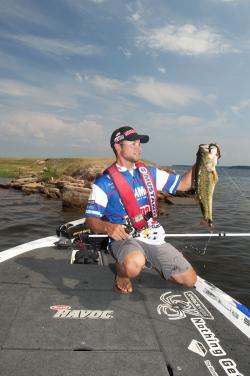
Brandon Palaniuk with largemouth

Brandon Palaniuk with largemouth

Brandon Palaniuk won big at the Bassmaster Elite on the St. Lawrence River by making round-trip runs of over 200 miles daily to connect with Lake Ontario’s big smallmouths. He’s also pretty good at catching largemouths, as shown here.

Palaniuk caught most of his fish at Chaumont Bay, which he located by map and internet study before the tournament.

Palaniuk said confidence and determination were as important in the win as his choice of lures and tackle.

The St. Lawrence win put Palaniuk in the Bassmaster Classic, where he’ll be chasing fat Guntersville largemouths.

Finding the right area

Finding the right area

Yamaha Pro Brandon Palaniuk knows that in professional bass tournament fishing, confidence and determination can often be as important as lure choice and technique when the final weights are tabulated. He demonstrated just how important by winning the recent Bassmaster Elite tournament on New York’s St. Lawrence River.

“It’s hard to define how important personal determination can be in achieving a certain goal,” explained Palaniuk, “but I know that in this win it was absolutely crucial to me. I don’t want to say that being determined means you have to gamble and take chances, but rather, the stronger your determination, the stronger you focus on achieving that goal, and sometimes that actually makes achieving it a little easier.

“One of my goals is never to miss the Bassmaster Classic,® but heading into the St. Lawrence River event I knew the only way I had to make the Classic was to win one of the two remaining tournaments. Because I’d made some bad decisions and poor execution during this season, I was so far behind I could never qualify on points.

“In my mind, I had no options, except to win, so that became my immediate goal. I was determined to achieve it. Once I put myself into that mindset, preparing for the tournament was actually a little easier. I began to study the St. Lawrence and Lake Ontario very carefully, and perhaps a little differently than the other competitors.”

Fish like this one helped him win

Fish like this one helped him win

The Yamaha Pro had never been to Lake Ontario before, so he studied past tournament results on the Internet and poured over maps of the 193-mile long lake, where one location continually stood out to him, historically as well as geographically. That area was Chaumont Bay, some 40 miles out into Lake Ontario, or just over 105 miles from the tournament launch area in Waddington, New York. Numerous previous events had been won there.

“I felt I had nothing to lose by going that far,” continued Palaniuk. “A lot of the anglers did not think it would be possible to run that far, more than 200 miles round trip, for four consecutive days because of the weather, so all of them stayed in the St. Lawrence.”

On the first practice day, Palaniuk trailered to Chaumont Bay and caught between 23 and 25 pounds of bass in shallow water, fishing a topwater lure and a jerkbait. He was so excited he spent the night in his truck right there at the boat ramp and used his second practice day fishing deeper water, 20 to 35 feet deep. He wanted a backup plan, and again he boated nearly 25 pounds of fish.

“I can’t tell you how good I felt after those two days and after I successfully made the long run the next day from the tournament launch ramp to map my route,” he added. “Even though I’d had eight-foot waves on the lake that day, I had made it safely down and back, and I really didn’t think I’d be facing anything worse. I think my determination made facing those waves easier, because in my mind I did not have any other options.

“I also knew I had found the quality of bass I needed to win, and that they were willing to bite.”

The Yamaha Pro brought 23 pounds, 9 ounces to the scales the first day of competition and took the lead. He’d caught the fish in just 90 minutes, and that’s when he realized the full potential of the area he’d chosen. The second day, with calm conditions, he added 21-15 and increased his lead; again, his confidence soared. The final two days he brought in catches of 20-9 and 23-5, giving him a four-day total of 88 pounds, 12 ounces. His winning margin was more than seven pounds.

“I think, if I could pass on any lessons from this experience to other anglers, it would be that prior preparation can be critical, especially when you’re choosing your fishing areas. Studying maps and previous tournament results can be invaluable and give you a solid starting point as well as help your confidence.

“At the same time, you can’t really be afraid of failure. In my case, in making the 200-mile round trip each day, I knew I had the equipment that could make that run, and after I completed the run that last practice day, I was absolutely sure I could make it every day.”

Fishing A West Point Tournament and Blowing Up My Motor

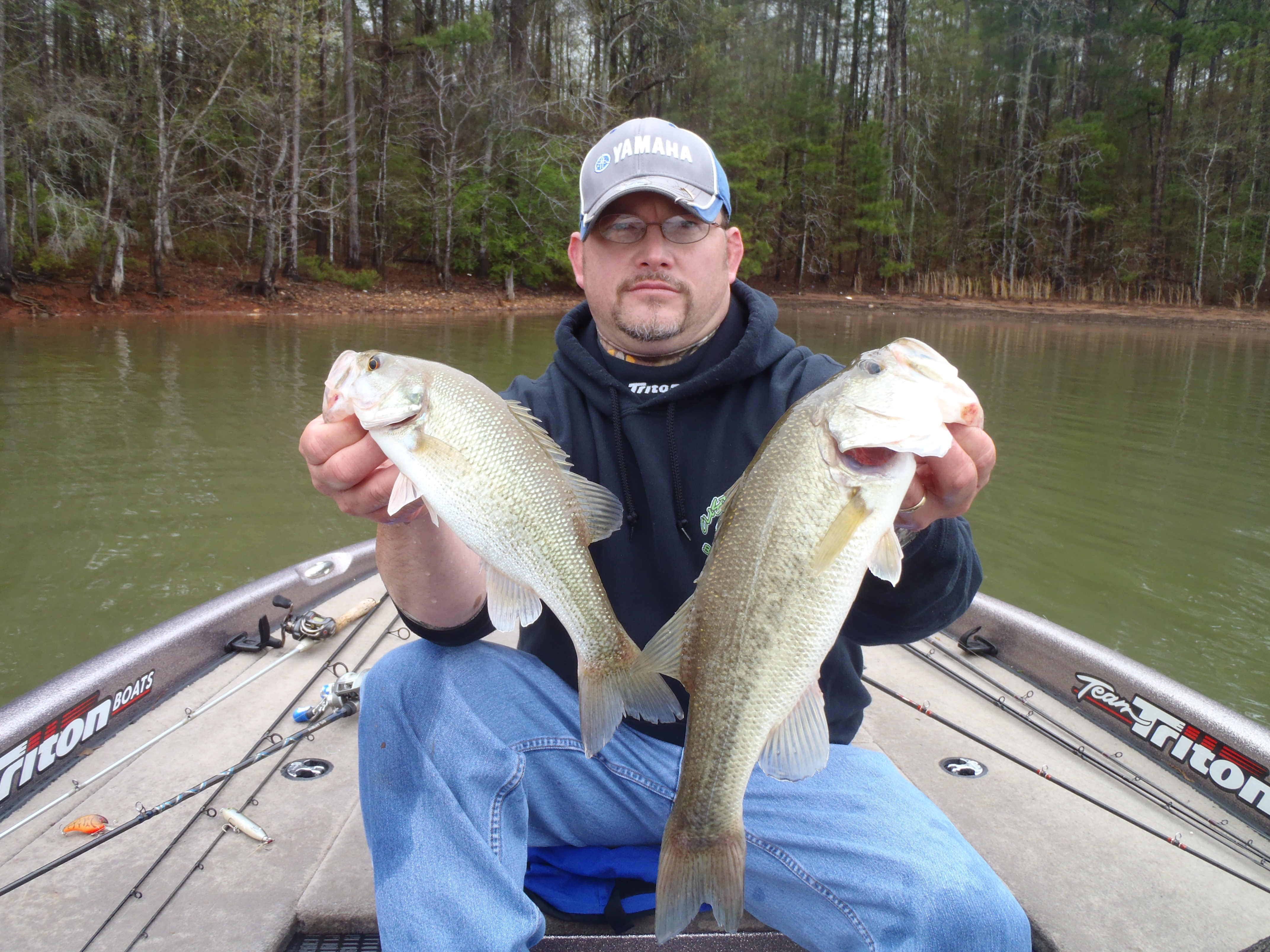
Bass like these helped me place third

Bass like these helped me place third

The Flint River Bass Club held its September tournament at West Point on a Sunday a few years ago. After fishing from 7:00 AM to 3:00 PM the nine members of the club brought in 24 keeper bass weighing about 34 pounds. There were two limits and one person didn’t have a keeper. There were 14 spotted bass and ten largemouth brought to the scales.

Bobby Ferris won with a five fish limit weighing 9.16 pounds. He also had big fish with a 2.91 pound largemouth. Lee Hancock came in second with the other limit weighing 7.46 pounds. My four weighing 5.90 pounds was third and Kwong Yu had three weighing 4.06 pounds for fourth.

My day started out pretty good. I left the Glass Bridge ramp and wanted to stop on a nearby shoal but there was a boat sitting there, so I ran on up to the Highway 109 Bridge. On my second cast to the riprap I hooked and landed a two pound largemouth. Putting one in the live well that quickly made me feel good.

After about an hour fishing around the bridge and catching a few short spotted bass I cranked up and ran to a point about half way to the railroad bridge. As I came off plane my 225 Yamaha made a strange rattling noise and shut off. When I tried to crank it there was a bad noise.

There I was, several miles from the ramp with about seven hours left to fish. I decided to fish my way back, working banks and points on the way. Since I was fishing by myself I didn’t mess up anybody else’s day.

I caught a few small spots then, near the highway bridge I got a keeper spot in the back of a pocket on a jig head worm. I would not have fished there if my motor had not died. At the bridge I caught a third keeper, another small spot, off a bridge piling on a small jig and pig.

By now it was noon and I had a long way to go, so I put the trolling motor on high and headed across the shallow flats in front of Pyne park. As I cruised along a school of fish came up and I grabbed my topwater popper and landed a two pound spotted bass. Another place I would not have been if my motor was running.

After catching a few more short spotted bass I got back to the ramp before the deadline.

How Can A Gamble Pay Off In A Tournament?

Rapala Pros Gamble and Win in New York Bassmaster Tournament

Taking chances paid off last week for three Rapala bass pros who finished in the top 10 in a Bassmaster tournament on New York’s St. Lawrence River.

They weren’t taking chances, however, on what to fish with, but rather where and how to fish. And their gambles paid off – Brandon Palaniuk won the tournament, Ott DeFoe placed third and Bernie Schultz placed sixth.

Palaniuk’s big run pays off
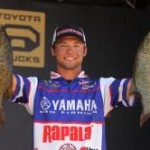
Palaniuk won the tournament

Palaniuk won the tournament

Rapala pro Brandon Palaniuk won the Bassmaster Elite Series event and $100,000 with a 220-mile daily roundtrip to Lake Ontario via the St. Lawrence River.

Because Palaniuk needed a tournament win to qualify for next February’s Bassmaster Classic – the so-called “Super Bowl of bass fishing” – he took a chance on a 220-mile round-trip run through waves as big as six feet to Lake Ontario. Depending on weather and waves, the gambit would afford him only 30 minutes to two hours of fishing time, and would not guarantee that he’d be able to get back to weigh-ins in time to score his catch.

“I was making such a huge gamble,” Palaniuk told Bassmaster tournament emcee Dave Mercer on the weigh-in stage Sunday. “I had all the confidence in the world that I was going to win that gamble, but it’s still a gamble – there’s so many things that can go wrong.”

But the gamble paid off. Palaniuk sacked consecutive bags of 23.9 pounds, 21.5, 20.9 and 23.5 to win the tournament and the $100,000 prize.

“I literally had nothing to lose,” Palaniuk told Bassmaster TV’s Mark Zona and Tommy Sanders in an interview webcast after the tournament on bassmaster.com. That’s because decent – or even good – finishes in the season’s last two tournaments would not earn him enough Angler of the Year (AOY) points to qualify for the Classic. Only a tournament win would qualify him. Bassmaster’s “win and you’re-in” provision awards a Classic berth to any angler that wins a Bassmaster Elite Series event.

Of the 99 other pros fishing the tournament, few others ran to Lake Ontario. And none ran as far as Palaniuk. One top contender proclaimed such a run not worth the risk.

“A lot of these guys were afraid to make that gamble out on the lake because of [AOY] points,” Palaniuk explained.

For those competitors, a conservative game plan would likely result in a good enough finish and enough points to maintain their places above the cutline for Classic qualification. Palaniuk, however, was below the cut.

“I literally had to win,” he said. “It made it a lot easier to gamble, I guess.”

After finding big fish in the Monday-Wednesday practice period before the Thursday-Sunday tournament, Palaniuk believed he had the winning strategy – provided weather and water conditions would allow a long, risky run four days in a row.

“I had such a good practice day on Tuesday that I knew I was going, no matter what,” Palaniuk said on the weigh-in stage after being crowned champion. “I felt like that was my only shot to win.”

You can follow Brandon Palaniuk on Facebook and Twitter.

Schultz gambles on shallow bite, when most others are fishing deep

Bernie Schultz took a gamble and it paid off

Bernie Schultz took a gamble and it paid off

Bernie Schultz used a Rapala Skitter Walk to earn 6th place in the St. Lawrence River event

Florida pro Bernie Schultz took a chance on a shallow bite, when most other top contenders were fishing deep with drop-shot rigs. The gamble paid off with a sixth-place finish, his best since Bassmaster launched the Elite Series tournament format in 2006.

“A lot of big fish were caught deep on drop shotting,” Schultz acknowledged last week in an exclusive interview. “I don’t mind drop shotting, but if they’re going to eat a reaction lure, you can bet that’s what I’m going to be doing… I guarantee I had more fun than [the drop shotters] did, because topwater is a blast.”

Schultz’s main pattern was fan-casting a Rapala Skitter Walk topwater bait over the tops of shoals and humps within a mile-long stretch of the St. Lawrence near the mouth of Lake Ontario.

“And that was fun!” Schultz gushed. “I had some big fish blow up on it… They weren’t really in a feeding mode – a lot of them would strike the bait in aggravation. But I did get a lot of those bites.”

And although he knew other anglers were mining the depth for leading limits, Schultz liked what he saw up shallow. “It was just ideal habitat,” he recalled. “And you could see the fish swimming around, on a calm day. There were ‘sweet spots’ in that mile-long stretch that I focused on.”

Some of his spots were as shallow as three feet, but he spent most of his time targeting shoals that topped out at six to 10 feet.

“Then they would drop off right into almost infinity,” Schultz said, only half kidding. “That river is deep. There was 50 feet of water right next to ten foot of water. There were breaklines related to really healthy… shallow habitat, so the fish had a chance to move up and feed or suspend off the drop in a matter of just 10 yards.”

When bass weren’t up and active on top of a shoal, “where the wind would let me work a topwater,” Schultz explained, he would throw a Rapala X-Rap along the shoal edge.

“It seemed like whatever the prevailing wind was at the time, the fish would act accordingly,” he said. “And generally, the windier [it was], they moved off to the deeper water.”

You can follow Bernie Schultz on Facebook and read his columns at Bassmaster.com.
Ott DeFoe changed his fishing place the last day

Ott DeFoe changed his fishing place the last day

DeFoe scuttles safe game plan, takes risk on long ride

Ott DeFoe used VMC Dropshot hooks in his finesse rig during the St. Lawrence event.

After a conservative game plan in the main river channel qualified Ott DeFoe for championship Sunday, he gambled on the tournament’s final day, making a long run to fish the Duck Island area in Lake Ontario. Not only had he not fished there in any of the first three tournament days, he had not practiced there either.

“I did something today that’s not really my style,” DeFoe said on the weigh-in stage. “Today I went for a boat ride… I said I’m in ninth place, I want to go up, I’m going to go for a ride.’ That’s generally not my style. I’m not that kind of a risk taker… Apparently it was a good decision today.”

DeFoe caught all the fished he weighed in the tournament on a VMC drop-shot hook.

The “neat thing” about the St. Lawrence River/Lake Ontario fishery, DeFoe said, is that “you can go out there and catch 18 pounds in five feet of water or you could do it 30 feet of water.”

Although good populations of smallmouth swim in the waters in and around DeFoe’s Knoxville, TN, home, he acknowledged that Yankee smallies and Southern smallies are practically a different breed.

“They are a different animal, there’s no question,” he said in an interview with the podcast Fantasy Fishing Insider. “The smallmouth where I live, you want a cloudy, rainy, nasty kind of day and that’s when they really bite. But up there – and it seems backwards – if you get a flat, slick, calm day, bright sunny skies… the fishing is just phenomenal.”

Northern smallmouth “really used to confuse me a lot,” DeFoe said Sunday on the Bassmaster weigh-in stage. “I don’t know if I’ve really got them figured out, but I sure am having a lot of fun with them.”

You can follow Ott DeFoe on Facebook and Twitter.
Fishing Lake Hartwell and Lake Wedowee

Josh Fowler with Hartwell largemouth and redeye bass

Josh Fowler with Hartwell largemouth and redeye bass

A few years ago on a Thursday I went to Hartwell to fish with Josh Fowler to get information for a Georgia Outdoor News article. This big lake on the Georgia/South Carolina line is at the headwaters of the Savannah River and is a deep upland lake. The water is clear on the lower lake and it has largemouth, spotted bass and red eye bass.

Topwater is usually the way to go in the clear water at Hartwell and blueback herring in the lake, the preferred food of bass there, will make them come up from deep water to hit on top. Josh and I fished many points and humps with brush on them and we caught a few small bass but saw other, bigger bass following our lures in the clear water but not hitting them.

There was no wind Thursday and the clear water allows the bass to see your lure too well. Bigger bass are wise to the “catch” in some of their food when they spot dangling hooks! Wind breaking up the surface really helps.

Josh tried a drop shot rig, saying it was a sure fire way to catch a spotted bass. We had landed largemouth and redeye and wanted a spot for comparison pictures. As fishing luck goes, he caught several largemouth but no spots. We never landed a spot.

The Georgia Bass Federation Nation held its Top Six at Hartwell in November then next April the Georgia Bass Chapter Federation was be there for its Top Six. A new mega ramp was put in near the dam in Gum Branch to attract tournaments so both groups are going to Hartwell. Griffin club fishermen fished both tournamnets. I did ok in both, placing 7th in the Federation Nation tournament in November and 17th in the other federation in April.

The Friday after the trip to Hartwell I went to Lake Wedowee for an Alabama Outdoor News article. It is about 30 miles west of the Georgia/Alabama state line. This pretty lake on the Little Tallapoosa and Tallapoosa Rivers is similar to Hartwell in the steep banks and clear water of an upland type lake. It too has spotted and largemouth bass, but no red eye bass or blueback herring.

Bass there were hitting on top, chasing shad most of the day. I was fishing with Bryan Morris and his family owns a marina on the lake. He caught the biggest bass of the day, a solid 2 pound largemouth, on top at 11:00 in the bright sun. We also landed several other smaller bass on top.

Fishing was tough there just like Hartwell. And we didn’t land a single spotted bass, all were largemouth. That is very unusual on that lake. We agreed the bright sun and lack of wind caused the spots and bigger largemouth to stay deeper than we were fishing.

Several people from Griffin bought lots and built houses on Wedowee when it was first dammed. It is not a long trip but you do need an Alabama fishing license there since it is totally in Alabama. A Georgia license is good on Hartwell since it is on the line.

Either of these lakes would be a good choice for a fall trip for bass – if you can stay out of the deer stand long enough to go fishing!

Bass Baits To Use On The Red River for the FLW Cup

Texans’ Top Red River Lures For The FLW Cup

By Abe Smith
from The Fishing Wire

Matt Reed is a bass pro on the Red River

Matt Reed is a bass pro on the Red River

Matt Reed says shad and bluegill imitations are likely to score on the Red in summer–crawfish patterns are less effective in the hotter months.

ARE THESE PREDICTIONS PROVING TO BE RIGHT????
Ronnie

The 2013 Forrest Wood Cup blasts off Aug. 15 on the Red River out of Shreveport, La. While the Red River is a popular bass tournament destination, most of those events are held in early spring when temperatures range from the 30s to 60s instead of 90s and 100s. Does this mean the anglers will be throwing different lures and fishing different areas than during those late-winter/springtime tournaments?

We asked three professional anglers from Texas who have a lot of experience on the Red River what they thought about the winning tactics and the challenges the FLW competitors will face. Here’s what B.A.S.S. anglers Alton Jones and Matt Reed, and B.A.S.S./FLW angler Zell Rowland (who will be fishing the Cup) had to say about winning on the Red in the summertime.

BACKWATER BAITS

In previous tournaments, backwaters always came into play as perfect areas for flipping jigs, pitching Dingers or creature baits and casting spinnerbaits, however, in spring, water quality is good and bass are positioning in those backwaters for the spawn.

During the doldrums of summer, though, water quality and temperatures can be questionable in some backwater spots. According to the pros, the presence of some current in those backwaters will be one of the keys to victory.

Zell Rowland knows the Red River well.

Zell Rowland knows the Red River well.

Zell Rowland is one of the contenders for the FLW cup, which gets underway Aug 15 on the Red River out of Shreveport, La.
“If we don’t have rain north of the river to get it to rise before the Cup we won’t have much current, and that will take a chunk of the river out of play simply because water levels will prohibit access or the water will be stagnant,” said Rowland.

Rowland visited the river in July with the heat index at 105 degrees and river running slow. He found that he couldn’t get into some of the backwaters he’s fished in the past because of silting with mud and sand. Water levels and the always-changing topography of the river make it difficult to fish on history.

In the backwaters available to FLW Cup anglers, Rowland said the presence of vegetation also plays a big part in success. Aquatic vegetation improves the water quality and holds better bass than those sloughs and pockets that only have wood cover.

“The Booyah Pad Crasher and Poppin’ Pad Crasher will be good for those areas with vegetation,” he said. “For flipping, I’ll be throwing a YUM Wooly Bug or Mighty Craw.”

Reed agrees with Rowland on his choice of flippin’ baits and said that smaller plastics are best. He said that lure color is as important as bait style on the Red in summer.

“Shad and smaller bluegills are the main forage during summer,” said Reed. “The fish don’t seem to have much to do with crawfish this time of year. Chartreuse patterns have always done best.”

MAIN RIVER CRANKS

Alton Jones, with two Classics on the Red River, knows it well–but he won’t be fishing in the FLW championship. He says small oxbows could be key with enough water to allow access.

B.A.S.S. Elite pro Alton Jones has plenty of experience on the Red River, including two Bassmaster Classics, but never in August. He says it’s the presence of current on the main river that makes it more productive.

“The tournament could be won in either a backwater or on the main river,” he said. “The main channel is 20 to 30 feet deep in some places and dredged for barge traffic, but in the backwaters, 8-feet is as deep and you’ll find. Either way, it will be won shallow – less than 5-feet of water.”

On the main river, Jones says that the XCalibur Xcs100 or Bomber 2A are top picks. If an angler wins the Cup on the main river, Jones says that running those crankbaits along a milk run of wing dams will likely be the pattern. Reed likes to work Red River wing dams with cranks that run a little deeper, something like the Bomber 4A or a Fat Free Shad BD5F, which dives to about 9 feet compared to Jones’ Xcs100 that dives to just 3 feet.

The FLW anglers can fish three pools of the Red River, but running to the third pool will leave only about 3 hours of fishing time. All of these pools feature main-river wing dams, wood cover and rocks, and if the water level or stagnancy eliminates many of the backwaters, each of these pools will get “small” due to the number of anglers pounding them.

Reed scored a top-10 finish in a tournament on the Red back in the late 1990s by cranking rocks on the main river. He once made a big, slow run to a distant backwater he thought would put him away from the crowd, and the pocket had everything a bass fisherman would want – vegetation, wood and a little current flow.

“It took me a while to get there,” he said, “and when I finally got there I found 15 other boats already in this little area about the as wide as three boats. We destroyed each other.”

PREDICTIONS

The three Texans agree that bigger bass will come from the backwaters on a hollow body frog or by flippin’ small plastics, but a more-consistent bite will be cranking the main river. If an angler can locate the right backwater without many other anglers horning in on it, he stands a good shot of taking the Cup.

“Those ‘Hidey Holes’ can really pay off for you,” Jones said. “One of my best days on the Red was the final day of the 2009 Bassmaster Classic when I brought in 21 pounds. That was from a secret backwater area that was hard to find and hard to access, and I had it all to myself.

“I also had one of my worst days ever on the Red River when I tried to get into a backwater and couldn’t. I got stuck for two hours on a sand bar.”

Fishing Lake Lanier with Rob Jordan

Rob got these two nice spots when I fished with him.

Rob got these two nice spots when I fished with him.

I had an interesting trip to Lake Lanier a week ago Friday. I met Rob Jordan, a young fisherman that guides on the lake, to get information for a September Georgia Outdoor News Map of the Month article. He showed me some great spots to fish and we caught several nice spotted bass on topwater, crankbaits and drop shot.

Rob paints lures, too. His custom painted baits look great and that is what we caught fish on. It takes real skill with an airbrush to make a plug come alive like he does. He had a great teacher, his cousin Jim Murray, Jr., a professional bass fisherman from south Georgia that also has a custom lure painting business.

Lanier can be a tough lake to fish. The big spots there live out in open, deep water. It is not unusual to be sitting in 80 feet of water in your boat and casting to a hump 30 feet deep. But that is where you catch the big ones. They are fat and healthy from eating blueback herring.

Rob said he had about 1400 brush piles marked on his GPS. Many fishermen put out the brush piles on humps and points 20 to 30 feet deep to draw the spotted bass in. That is where they feed, and locating them is the best way to catch fish.

We put in at Van Pugh park near the dam and fished in a big circle up to Brown’s Bridge then back down the other side of the lake, marking spots and catching bass. Rob assures me September is a good month to fish the lake. I hope so. The Flint River Bass Club has a tournament scheduled there early in September.

You can see and order his baits at extremelurecreations.com and contact Rob for a guide trip at 770-873-7135.

I get to fish with some really good bass fishermen doing magazine articles. In the past few years I have fished with five of the 41 pros that were in the 2012 Bassmasters Classic, and have fished with some of the top pros in the FLW tournaments, too. And I go out with many local fishermen that do well in smaller tournaments.

I love tournament fishing and am always amazed at how many more bass, and bigger bass, they can catch than I can. And they fish the same way I do, with the same baits. It is either magic or they have some sixth sense for finding and catching bigger bass. What ever it is I wish I had it!

Someday maybe I will learn how to catch bigger bass while fishing with the pros.