Category Archives: Bass Fishing

Bass Fishing Information

Thanksgiving Fishing

Most people are thinking hunting, not fishing, this time of year but fishing can be excellent right now. For many years I spent Thanksgiving Holidays at Clark’s Hill fishing for bass, hybrids and crappie. I often had the lake to myself.

Now fishing is more popular in the colder parts of the year but the lakes are much less crowded. There are almost no skiers and skidooers and far fewer fishermen are on the water since many are in the woods. But the weather is often beautiful and fish sometimes cooperate.

Friday before last I went to Bartlett’s Ferry to get information for a Georgia Outdoor News article. I met Tommy Gunn there and he showed me some of his favorite ways to catch December bass on the lake. We fished some of the ten spots that will be on the map in the article. Bass were already starting to feed on them.

Tommy lives just over the Alabama line in Cusseta and makes Jawbreaker Jigs to use and sell. One of his patterns in the winter is to flip and pitch a jig and pig to shallow water cover like docks and he caught a four and a half pound largemouth bass on that pattern.

We also fished points and drops with jig head worms and caught several spotted bass. None of the spots weighed over about two pounds, typical of lakes where the spot population has exploded. You can catch a lot of spots but they just don’t get very big compared to largemouth.

That trip gave me confidence in a jig and pig. The Flint River Bass Club fished Jackson Lake last Sunday for a November tournament. Al Bassett called me Saturday afternoon and told me his club had a tournament at Jackson that day and it was won on spinner baits, so I made sure I had one tied on, but I also tied on a jig and pig.

Al said they caught fish on wind blown points and it was real windy Saturday. Sunday dawned cold and calm and we never did get much wind. I started with a top water bait then tried crank baits and spinner baits but did not get any hits. At 9:00 I got a bite on a jig and pig and landed a 14 inch spotted bass, my first of the day.

That got me throwing the jig and pig a lot and a few minutes later I made a long cast down the bank across where an old dock used to be. There were still two posts in the water and I threw between them and the bank and got a hit. When I set the hook a nice bass came to the top but went back down. I pulled it up and down several times, thinking I was hung in brush.

About that time I remembered there is an old concrete and rock pier under the water there. I had thrown across it and the fish hit on the other side. I was pulling the fish to the top then it would go back down.

I finally got the fish over the pier and it came to the boat fairly easily. I guess I had knocked it against the rocks too many times and took the fight out of it. The fish was a 3.71 pound spot, a big one and they usually fight hard. I was lucky I was using 20 pound P-Line Fluorocarbon line. It was frayed for about eight feet but it held up.

A few casts later I got another keeper spot then cast onto the apron of concrete coming out of a boat house. When my jig fell off the end into about a foot of water I saw a fish swim off and thought I had spooked it. Then I realized it had my jig. I was lucky to land a three pound largemouth. That was my fourth bass by 10:00, in one hour.

The rest of the day was slower and I caught three more keeper bass, two of them spots and one largemouth. The rest of the club had a pretty tough day, too. Many said they had been catching fish on spinner baits up until Sunday but they did not hit them during the tournament.

We had ten fishermen in the tournament. My five fish limit weighed between 11 and 12 pounds and I placed first. The 3.71 pound spot was big fish. Tommy Reeves also threw a jig and pig and had a limit weighing between eight and nine pounds for second. I can’t remember who came in third but Tony Evans placed fourth.

If you get a chance, go fishing this winter. You might be surprised at what you can catch.

Why Do Some Fishermen Catch Bass When Others Can’t?

Sometimes I wonder why I go bass fishing in the winter and if a bass can be caught out of ice water. A Sunday in late January, 2011 at West Point really brought those thoughts on strong. The Spalding County Sportsman Club held its January tournament there and nine brave members showed up to fish seven hours. There were a total of two bass weighed in!

Sam Smith won it all with one keeper largemouth weighing 2.26 pounds, getting first place and big fish. As close behind as you can be on our scales, Niles Murray came in second with a spotted bass weighing 2.25 pounds.

The rest of us had stories of casting practice and one member told of losing a big one a the boat. I never had a bite all day although I tried everything I could think of to find a fish. A huge part of catching bass is confidence and when my surface temperature gauge showed 38 degrees at launch I lost all hope.

To show how much I know and how good we are, there was another tournament going on that day. West Georgia Bass Club is an buddy tournament trail open to anyone wanting to join and they fished the same day we were there with 93 teams in the tournament. I saw other bass boats all day that were probably in the tournament.

Almost one third, 33 of the teams, had a bass to weigh in. I was shocked to see the winning team had five bass weighing 19.08 pounds. It took 14.19 pounds for second, 13.59 for third and 12.98 for fourth. Those weights amazed me and I wonder how they caught such good stringers of bass under such bad conditions.

I have fished with several of the guys that caught fish in that tournament. They took me out and showed me how they fish for articles for Georgia Outdoor News. They fish just like I do, with much the same tackle and equipment. Yet they made decisions that day that allowed them to catch bass while I never got a bite.

Sometimes I think the ability to catch bass is almost a sixth sense or special ability. It is like playing baseball – anyone can learn to play. But no matter how hard most practice and work at it, they will never reach the majors. The same goes for concert pianists. Anyone can learn to play the piano but no matter how hard they practice only a very select few will ever go on tour.

Anyone, even me, can learn to bass fish. But no matter how hard I try I keep having days like that Sunday. And so far at that point that year it wass the only kind of day I had. I had not caught a bass in 2011!

How Can I Use Swim Baits To Locate Bass?

Using Swimbaits to Locate Bass
from The Fishing Wire

Smallmouth love big swimbaits

Smallmouth love big swimbaits

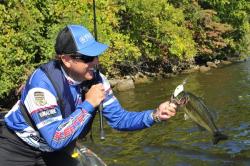
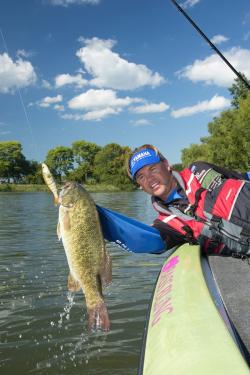
Cliff Pirch shows a whopper smallmouth from Lake St. Clair. He often uses big swimbaits as “locator” lures.

It may sound a little strange, but there are times when Clifford Pirch casts lures and knows bass won’t hit them. It doesn’t bother him, because the Yamaha Pro is using the lures simply to fool fish into showing their location, and when they do, he immediately throws back with a different bait to catch them.

“It’s not a technique widely used among the tournament pros,” confides Pirch, a veteran FLW® competitor who completed his first year on the Bassmaster® Elite Tour this past season. “I use a big, jointed swimbait that I just reel slowly around and over visible cover to make bass show themselves. Bass may actually come out of the cover and follow the lure, but most of the time all you see is a quick flash as a fish comes out and then darts right back into hiding.

Us a big jointed swimbait

Us a big jointed swimbait

Pirch says he likes large, jointed swimbaits best as locators–the swimming action often causes bass to reveal themselves, allowing him to follow up with a smaller lure they’ll eat.

“The key for me is using the large, six-inch swimbait and reeling it slowly. It looks injured, so it gets their attention. I know that sometimes a hard plastic jerkbait will also fool bass like this, but overall, I don’t think those lures are as effective as a swimbait because they don’t have as much side-to-side movement with a slow retrieve.”

After seeing the bass give themselves away like this, Pirch casts right back with a small plastic worm, often on a drop shot rig with a spinning rod, and frequently catches the bass. Using the swimbait allows the Yamaha Pro to cover far more water on a single cast than he could with the worm.

“I prefer the thinner jointed swimbaits because even with a very slow retrieve they still move from side to side and look completely natural,” continues Pirch. “In fact, I like to call them ‘glide baits’ because they don’t create a lot of commotion. They just seem to glide through the water. The smaller, hollow plastic swimbaits with the downward-turned tails don’t work because they do create too much action.

“I think this is largely a visual presentation, too, because it really works best in clear water. I have had success in slightly dingy conditions, but it’s not a presentation for muddy water.”

Some of Pirch’s favorite places to use this fish-finding technique include the edges of submerged grasslines, along the sides of boat docks, in stump-filled coves, and over the top of shallow points. It’s most effective in the spring and fall months, but also works well in the summer, too. During the final Bassmaster® Elite event at Lake St. Clair this past August, for example, Pirch worked the swimbait about a foot deep over the edge of a long underwater grassline where several smallmouth came out to look at the lure.

“I like to make fairly long casts and then retrieve very slowly,” he emphasizes. “I point my rod tip down at the lure and keep a slight bow in the line so the lure does not come back in a straight line. I think the side to side wandering is important in giving the appearance the bait is injured.

“I use a 7’11” medium action rod with 20-pound test fluorocarbon line because it’s a fairly large lure. Then I like to throw back with a much lighter, smaller bait because the bass have shown some interest but they’re not intimidated at all by the little worm.”

Because it is a visual presentation in clear water, Pirch recommends matching the swimbait color to the color of the lake’s primary forage, be it shad, yellow perch, bluegills, or some other baitfish. A number of swimbait manufacturers offer jointed models, and normally in a variety of colors.

“When the bass are active, they’ll even hit the swimbait, but most of the time I’m not really expecting them to,” concludes the Yamaha Pro. “Locating bass is a problem every angler faces each time he’s out on the water, and this is just another way that actually fools the fish into giving away their location.

Catch largemouth and smallmouth on swimbaits

Catch largemouth and smallmouth on swimbaits

Both big smallmouths and largemouths are attracted to the jumbo lures when wobbled slowly close to their habitat.

“I always have a box full of swimbaits with me in the boat just for this technique, no matter where I’m fishing.”

Cold Front Bass Fishing Tactics

I caught this bass after a bad cold front

I caught this bass after a bad cold front

It never fails. All week the weather has been unusually warm for this time of year so you plan a trip to your favorite bass lake for Saturday. Everybody you talk to say the bass are tearing it up, hitting spinnerbaits, topwater lures and crankbaits in shallow water just about anywhere you want to fish.

Friday night the winds howl and the temperature drops. You are on the lake the next morning at daylight and the brightening sky shows completely clear with no haze or clouds at all. And it is cold, the coldest weather of the year so far. Water temperatures have dropped several degrees overnight.

Yep, the dreaded high pressure cold front has hit. Is it going to ruin your trip? You know bass seem to hate high pressure and dropping temperatures. So what do you do?

Bass respond to cold fronts in several ways. Why do they respond? There are a lot of theories, from higher pressure to brighter sunlight. But some of them just don’t hold up.

Even with a drastic increase in barometric pressure a bass has to move only a foot or so up or down to equal the pressure from the day before. Bass don’t seem to like bright sun but feed even on the brightest days. A change of a few degrees in temperature is more important in the spring than in the fall. And the wind that accompanies cold fronts can actually make them feed better.

No matter what the reasons, bass do change. We may never know exactly why. But there are some proven tactics that help you catch bass after a cold front blows through. Try them and catch some bass after a cold front.

In simple terms you go small, go tight, go slow, go deep, go to the wind or go to current. Go to the spotted bass if they are in the lake you fish. The baits you choose will probably change after a cold front and the places you fish varies some, but bass can still be caught if you plan to adapt.

Bass usually slow down after a cold front and won’t chase a fast moving bait. But the big exception to this is when the wind blows across a point or hits a steep bank. The wave action stirs up the baitfish, making them easier prey. The moving water pushes algae to the wind blown banks and baitfish follow, and so do the bass. And the bass can’t see your bait as well due to the broken water surface and more murky water from stirred up sediment.

One of the best ways to catch bass under these conditions is to fish the wind blown banks and points with a spinnerbait. As long as you can control your boat in the wind and waves you can find and catch bass. Find a point or steep bank where the channel swings near and fish it.

Depending on water color, a white spinnerbait with two silver willowleaf blades is best. If the water is stained try a skirt with some chartreuse in it and one or two gold blades. A heavier spinnerbait helps you cast in the wind and fish faster to cover water until you find the fish feeding. A half ounce bait works well. When you catch one you can usually catch a lot more from the same place.

Keep your boat a long cast off the bank and cast with the wind, working water from a foot deep right on the bank back to about ten feet deep. Run the spinnerbait about a foot under the surface like a confused baitfish trying to head back to deeper water.

If reeling your spinnerbait fast doesn’t work try slow rolling it a foot off the bottom, keeping it moving steadily with a slight pause every two or three feet to make the skirt flare. Don’t spend a lot of time on one place, make ten or so casts with a fast retrieve and the same number slow then move on if you don’t catch a fish. Bass school up and are concentrated on some structure but not others so keep looking until you find them.

If the wind is too strong to control your boat or you don’t find the fish or just don’t like fishing the wind, go small. Downsize your baits. If bass have been hitting a big crankbait or spinnerbait try a small one-quarter ounce bait. You have to fish the smaller spinnerbait more slowly and that is good. Slow down with the crankbait, too, if that is your choice of baits.

Also drop down to a three sixteenths ounce jig and pig or one eighth ounce jig head worm with a short finesse worm on it. These baits fall more slowly and you have to move them more slowly to keep contact with the bottom, and that is good, too. Fish around cover near where the bass have been feeding.

Work any cover you find carefully. Many bass won’t move far. If they have been feeding around stumps or rocks in six feet of water they may still be holding there and a little deeper. They may also move closer to deeper water.

Bass move often move very tight to cover after a cold front. They may still be in the exact same depths and locations but are harder to catch since they are buried in the thickest cover and won’t chase a bait very far. Take advantage of this.

Find a dock and fish it. Docks always hold bass if they have water deeper than a couple of feet under them in the fall, and they are even better if they are near deep water. But the bass get way back under them after a cold front.

One of the best ways to fish a dock after a cold front is to skip a bait as far back under it as possible. A weightless four inch Senko rigged whacky style on a weedless hook gives you small and slow and you can get them into places it is hard to get other baits.

Rig your Senko on a spinning rod with eight pound test fluorocarbon line. It takes a little practice but you can skip that bait on the lighter line all the way to the back of a dock sitting a few inches off the water. Let the bait settle to the bottom without moving your rod tip or reeling in your line.

A Senko or similar bait falls with a slow, enticing wiggling action rigged whacky style. When it hits bottom let it sit still for several seconds. Watch your line carefully for any small tick or movement. Set the hook fast and get the bass out from under the dock as quickly as possible.

Also try the posts and any brush under the dock with a small jig and pig. Pitch or skip a three-sixteenths ounce jig with a twin curly tail trailer right to the posts or to the middle of the brush. The light jig and the twin tails make the bait fall slowly and the bass often find this irresistible.

Fish other cover the same way. Find stumps and pitch a small jig and pig to them, letting the bait fall right beside them. Pitch your jig and pig into the thickest parts of a blowdown, paying careful attention to where limbs join the trunk of the fallen tree. Work all the way to the end of the tree top.

Brush piles hold bass but they bury down in the very middle of them after a cold front and not move out to feed. But a small jig and pig or Texas rigged worm dropped through the brush and jiggled in their face will get them to hit. Use heavy line, 15 to 20 pound test fluorocarbon, so you can get the fish out of the cover.

In all this cover don’t expect the bass to pick up the bait and move off. They often suck it in and not move at all. So watch for that tick when they eat your bait. Also raise your rod slowly when you move the bait. If your line is tight set the hook if there is any doubt if it is a fish.

No matter how you are fishing the cover, fish slowly. Using small baits helps but let them fall and sit as long as you can stand it. Jiggle them a little in one place as long as you can. You want to make a bass hit that is not really in a feeding mode.

Out of the wind, small spinnerbaits and crankbaits work if you move them as slowly as possible and bump them into the cover. With a spinnerbait if you hit a limb pull it up and let it fall back without coming over the limb. With a crankbait hit the cover and let it float up to drive the bass crazy.

Bass live deep and there are always deep bass but a cold front may push shallow bass deeper. Find deep structure with cover on it and the resident bass are there as well as any that have moved deeper. Small, slow moving baits work best after a cold front even in deep water.

A dropshot rig is one of the best outfits to get these bass to bite. Deep is relative on different lakes. On a clear highland type lake you may need to fish 30 plus feet of water. On more shallow lake with more stained water deep may mean 15 to 18 feet deep.

Good electronics are critical for this type fishing. Ride creek channels and drops watching for brush and stumps. When you find the cover examine it carefully for the telltale marks of fish holding in it. Even if you don’t see fish, try the deeper cover since they may be buried in the cover.

Baitfish near the cover makes it even better. If you see balls of baitfish find the closest cover and fish it hard. Shad tend to move deeper after a cold front and bass will be nearby, so take advantage of this bass attracting food.

Rig a finesse four inch worm about 18 inches above a sinker heavy enough to allow you to fish the worm in one place. If the wind is strong you may have to go to a fairly heavy drop shot weight.

Drop the rig to the bottom in the cover and tighten up your line, making the worm hover off the bottom. Barely twitch your rod tip to make the bait wiggle in place. Nose hooking the worm gives you more action but you may need to Texas rig it since you want to get the worm into thick cover.

A small jigging spoon works well, too. Try a silver one half ounce spoon if the water is clear or a gold spoon if it is stained. Spoons seem to work better if the water is fairly clear. Jig the spoon up and down in one place over and over, pulling it up a foot and letting it fall back in the same place.

With drop shot and spoons get the front of your boat right over the cover and fish and hold there, fishing both baits straight down. Sometimes you can see the bass suspended off the bottom. If you do, drop your bait down to the level they are holding and keep it in front of them.

One trick with a drop shot is to tie your hook as far above the sinker as the bass are holding off the bottom. If they are suspended five feet off the bottom, have your leader five feet long to keep the worm right in their face. This works no matter how far off the bottom they hold since you reel the fish in before getting to the lead, and it gives you exact control.

Bass in current are more active and have to feed more. Run up the river or feeder creeks in the lake until you find moving water. Rains often precede a cold front and runoff may make the current stronger, or power generation at the dam above or below the lake does the same thing.

Find eddies and pitch a small jig and pig or Texas rigged worm to those spots. Look for rocks, logs, brush and pockets where the current breaks. The bass usually hold in the lower current and feed as baitfish and other things they like, like worms or crayfish, wash to them.

Fish up the current. This gives you more boat control and allows you to fish your bait with the current in a natural movement. Pitch ahead of the boat and let your bait fall with the current into the eddy. And if you don’t like wind, you are more likely to find protected areas in the more narrow river than on the lake.

Spotted bass don’t seem to respond to cold fronts as badly as largemouth do. Florida strain largemouth that have been widely stocked out of their native range grow fast but are notorious for not feeding after a cold front. Northern and southern strain largemouth also get lock jaw after a cold front. But fish for spots and you are more likely to catch some bass.

Spots love rocks so fish rocky points and steep banks. Smaller baits are usually best for them even without a cold front, so try the same small crankbaits, spinnerbaits, worms and jig and pigs. Spots are more aggressive than largemouth all the time so you can usually fish faster, too.

For some reason spots are turned on by chartreuse. Try chartreuse spinnerbaits and crankbaits. Dip your plastic worm or jig trailer in a dip and dye like JJ’s Magic. Spots tear up a jig and pig with a curly twin tail trailer with the tips of the tails dipped to turn them chartreuse.

Don’t let a cold front get you down. Be prepared for it and catch some bass. Try these ideas and they should work for you. But no matter, it is better to go fishing than work around the house!

Tip

Dip and dye like JJ’s Magic works all the time when you are fishing, but the added colors and scent may make even more difference when fishing after a cold front. JJ’s has a strong garlic scent and comes in four colors to allow you to vary your bait color quickly, and to add highlights to your plastic baits.

Dip the tails of a green pumpkin curly tail worm or jig trailer into chartreuse JJ’s and it instantly changes color and smells strongly of garlic. The wiggling chartreuse tails look exactly like the fins of a bream and makes the bass more likely to eat it. That can make the difference between a bite and getting ignored after a cold front.
Fishing Smith Lake, Alabama In the Winter

Last year in early December I drove to Smith Lake in Alabama to get information for a Alabama Outdoor News article. Smith Lake is a beautiful highland lake north of Birmingham with very clear water, steep rocky banks, beautiful houses and big spotted bass. It as windy that day, too.

I fished with Craig Daniel, a local bass pro that fished the national trails from 1990 to 2000. He made the Bassmasters Classic twice, the FLW Championship twice and has won over $450,000 in tournaments. He has also won four bass boats and a truck. Craig is a very good fishermen!

We fished only a few hours. I drove 4 hours over there and it took four hours to dive back, so I was glad we didn’t stay too late. In that time we landed about a dozen spotted bass on jig head worms.

The pattern was fairly simple. Find cover of any kind, like brush, rocks or stumps, in about 20 feet of water and fish around it. It was interesting that the 14 inch spots we landed were not even keepers. There is a slot limit there and you have to let bass between 13 and 15 inches long go.

Craig says Smith will just get better and better during January and the big ones will hit, too. He has landed 11 spotted bass weighing over six pounds each, so he knows about big bass!

Give Smith Lake a try this winter.

Are Crankbaits the Best Baits For Fall Fishing?

These Two Pros Agree: Crankbaits Best for Late Fall

Try crankbaits for fall fishing

Try crankbaits for fall fishing

Elite Pro Dean Rojas says crankbaits, thought of as deepwater summer baits, are equally effective into fall and early winter in the right spots.

All bass tournament pros have their favorite lure choices for each season, and rarely do they agree with each other. The exception comes now, during the late autumn and early winter, when crankbaits seem to be everyone’s first choice.

“Crankbaits offer a number of advantages, such as letting you cover a lot of water,” points out Yamaha Pro Dean Rojas, “which is important because bass are moving a lot during this period. The different models of crankbaits allow you to cover water depths as shallow as four feet or as deep as 20 feet, too, which certainly helps when you’re looking for fish.”

“Crankbaits are also effective around different types of cover, such as rock, vegetation, or wood,” adds fellow Yamaha Pro Brandon Palaniuk, “which is unusual for a single lure type. They also draw both reflex as well as feeding strikes, because they imitate baitfish so well.”

Palaniuk grew up fishing Lake Coeur d’Alene in northern Idaho where crankbaits were practically the only lure he could use efficiently along the lake’s miles of rocky shoreline. Today, rocks remain his first choice when searching for late fall and early winter bass.

“The best places often seem to be transition zones where the type of rock changes, such as from small gravel to larger chunk rock,” he continues. “Bass everywhere like edges because they give them an ambush point, and larger rocks provide that edge. These transition zones are nearly always noticeable along the shoreline so you can easily visualize them extending out under the surface, and they frequently attract schools of bass, too. That’s why I’m always looking for them.”

“I like rock, but I also look for vegetation and brushpiles, laydowns, and other wood cover,” notes Rojas. “Both types of cover attract a lot of baitfish, and they’re also easy to fish with a crankbait.

Yamaha pro’s Brandon Palaniuk and Dean Rojas are both crankbait fans as water cools, though they might prefer different terrain to try the versatile lures.

“With vegetation, I like to reel my crankbait down to the very top of the vegetation, then either rip it out with a violent jerk, or if the water is colder, I’ll stop reeling and just drag the lure slowly over the vegetation with my rod. This type of erratic action, which is so easy to do with a crankbait, is normally what brings strikes.

“The colder the water, the better this dragging presentation works, because you can still vary your speed according to how the bass are reacting.”

Both Yamaha Pros advise early winter fishermen to look for steeper breaklines where the depth changes quickly. Creek and river channels that swing close to a shoreline are among the best places to look for bass now, because it means the fish don’t have to swim as far to reach shallow feeding areas. Instead of moving long distances horizontally, they can simply move up and down in the water column.

The right lure in the right terrain has been the secret to many of Brandon Palaniuk’s highly successful finishes this season.

“They come shallow to feed, so what I like to do with a crankbait is cast to the deeper water and retrieve into the shallow water,” explains Palaniuk, “because it forces a bass that may be following your lure to commit to a strike before the lure gets away. If you retrieve from shallow water to deep, the bass can just swim back down into deeper water and disappear.”

When he’s fishing deeper brushpiles, the Yamaha Pro will retrieve his crankbait into the brush and stop it momentarily, then slowly crawl it through the limbs and branches. This is completely different from summertime tactics, when he’s retrieving much faster and trying to deflect the lure for a reflex strike.

“This is just another example of how versatile crankbaits can be,” concludes Rojas, who fishes Lake Havasu and the Colorado River near his home in the winter months. “This time of year, bass are not only feeding heavily in preparation for the colder months ahead, they’re already becoming less active as water temperatures continue cooling.

“Rather than keep changing lures, all I have to do is change my retrieve. When I go fishing this time of year, I still have three or four rods on my boat deck, but they’re all rigged with crankbaits.”

Does Catch and Release Bass Fishing Make A Difference?

When bass tournaments first started back in the late 1960s fish were often put on stringers and most were dead at weigh-in. But that didn’t matter, bass were kept to eat. When local fishermen blamed the tournaments for wiping out their bass in their lake, Ray Scott came up with the idea of “catch and release” as a public relations ploy.

At some of my club tournaments in the 1970s we would keep fish and have a big fish fry, especially on two day tournaments. No one really worried about releasing fish although we got dirty looks from local anglers. But that gradually changed so now almost all the bass we weigh-in are released alive.

When Linda and I got our first bass boat in 1974 we had a rule that any bass we caught over three pounds was released. Smaller bass were kept to eat. We let the bigger bass go mostly because they just don’t taste as good, but also to try to protect bigger fish. A three pound bass has survived for several years and we hoped they would continue to grow and we could catch them again when they were even bigger!

Catch and release is now almost a religious experience for many bass fishermen. Killing a bass upsets them almost as much as it upsets a PETA protester. They will go to extreme lengths to try to revive a bass that is dying.

Does catch and release really matter from a biology standpoint? The answer is a definite “Maybe.” A bass kept and cooked definitely does not survive to fight another day. Some that are released do. But catch and release has problems, too.

Releasing large numbers of bass in a small area like is done at boat ramps and marinas hosting a lot of tournaments can overcrowd an area, putting strain on the food the bass eat. Crowding can lead to spread of diseases. So the long term effects of catch and release can be bad for an area.

Delayed mortality of bass often hides the real numbers of fish that die. Bass that are stressed by being hooked, fought, landed, placed in a live well, ridden around in a boat then taken out, put in a bag, dumped on scales then dumped back into the lake may be alive when they hit the water but die hours or even days later.

The science behind catch and release is somewhat questionable. About half the 12 inch long bass in a big lake will not survive the next year of their life, regardless of fishing pressure. Nature takes care of them Heavy fishing pressure on a small body of water can hurt populations but what percent of bass on a lake measured in thousands of acres are harmed by tournaments?

There does seem to be some effect, but it is mostly anecdotal. In 1983 it was easy to catch a lot of 11 inch largemouth at West Point but it seemed hard to land 12 inch keepers, the minimum size at that time. Then in April a 16 inch size limit was imposed on that lake.

Within a few years we were complaining about catching a bunch of 15.5 inch bass but 16 inchers were very hard to find. Then the size limit was reduced back to 14 inches and, guess what. It seemed we caught huge numbers of 13.5 inch largemouth but 14 inch long bass were hard to find.

Now spotted bass have changed that completely because they don’t grow very fast and there is not size limit on them. Even with a 12 inch limit on spots in tournaments, a most of the bass by far weighed in at West Point are spots.

Releasing all bass can harm rather than help a lake. Spotted bass in lakes like Blue Ridge and Jackson where they are not native often overpopulate, crowding out native populations of smallmouth and taking the place of bigger largemouth. Spots are so aggressive that five one pounders may take the place of one five pound largemouth in many cases.

The catch and release mentality keeps fishermen from helping out managing a lake like Oconee. Biologists say we need to remove bass shorter than 11 inches in Oconee to keep overcrowding of smaller bass down since Oconee is an infertile lake. But very few keep those small bass, making it impossible for the slot limit to do its job.

It is easy to blame a lot of things for not catching bass on a fishing trip. If blaming tournament fishing or fishermen killing bass works for you, use it. But in reality the bass are probably there for you to catch. After all, those tournament fishermen had to catch them somehow and tournament results show someone will catch a lot of bass somehow almost every time.

Keep a few bass to eat if you want to. Release most of the bass you catch to make you feel good and as a PR tool. But don’t condemn anyone for enjoying a few bass filets.

Two Club Tournaments and A Top Six At Hartwell

Bass fishing is good in November but it does vary a lot, as three tournaments show. Two years ago the Potato Creek Bassmasters fished their November tournament at Oconee. Then the Spalding County Sportsman Club fished its November tournament at Lanier. And the Flint River Bass Club sent a six man team to the Georgia Bass Chapter Federation Nation State Championship at Hartwell.

At Oconee, 20 members of the Potato Creek club weighed in 24 keeper bass weighing 40.68 pounds. There was one five-fish limit and six members didn’t have a keeper bass after eight hours of fishing.

Bobby Ferris won with the only limit and his five fish weighed 8.44 pounds. Wesley Gunnels was second with three bass weighing 5.17 pounds, Michael Cox was came in third with three at 4.63 pounds and Bob Nash placed fourth with two at 3.03 pounds. Pete Peterson had big fish with a 2.48 pound largemouth.

Fishing was tough for bigger bass at Oconee and the 14 inch size limit makes it harder to land a keeper bass.

At Lanier the next Sunday 11 members and guests of the Spalding County Sportsman Club fished for eight hours to land 13 keeper bass weighing about 27 pounds. There were no limits and four fishermen zeroed in the tournament.

Javin English won it all with four bass weighing 9.84 pounds and his 3.66 pound bass was big fish. Jimmy Harmon came in second with two keepers at 4.93 pounds, Kwong Yu placed third with two at 3.66 pounds and Russell Prevette had two at 3.62 pounds.

There is a 14 inch limit at Lanier and the spotted bass just didn’t cooperate.

At Hartwell six Flint River club members fished for two days to try to qualify for the State Team. The top 14 fishermen in this tournament advance to the Southern Regional in Kentucky next April. The top man on that team will go on to the Nationals where one fisherman from each region will qualify for the Bassmasters Classic.

Although there are no team awards other than bragging rights, the six club members, myself, Bobby Ferris, Lee Hancock, JJ Polak, Charles Gaddy and Chris Lee worked together and tried to help each other out. All of us but Chris went up Wednesday or Thursday and practiced two days trying to find fish for the tournament.

It took ten bass weighing 24 pounds to win. I caught ten weighing 17.94 pounds and came in 8th. I was happy but disappointed at the same time since the top seven fishermen get to take their boats to the Regional and I missed that, so I will have to fish out of someone else’s boat.

JJ Polak finished in 10th and will also be on the team. He had ten bass weighing 17.53 pounds. JJ owns JJ’s Magic dip and dye and Ole Nelle bait company and is president of the Flint River Club.

In two days of practice I caught some fish but was worried. On Thursday I landed seven keepers but they were all small. Then on Friday it took me from daylight to 11:00 AM to catch a bass. That one was a good three pound fish and it hit back in a creek where I had caught fish before. I hooked several more in a few minutes before leaving the area.

In the tournament on Saturday we went there but in the first two hours I broke off a fish in a tree top and my partner landed one. We ran to another place I wanted to fish but another boat was already there. I stopped on a nearby dock and landed my best fish of the tournament, one close to four pounds.

After fishing several more docks in the area I told my partner I felt like we should go back where we started. Between noon and leaving at 3:10 to get to weigh-in on time we both landed our limit. I caught two keepers on my last two casts at 3:05, just a few minutes before we had to crank up for the ten mile run.

I was surprised to be in 14 place out of 90 fishermen after the first day. The second day my partner and I ran the small creek, shut down the gas motor at 7:10 AM and did not crank it until 2:45 for the run back to the ramp. I got another limit but it was slow. He caught three keepers.

I was happy to make the state team again. My partner from the first day got a limit the second day and also made the team, visiting in 12th place.

If club fishing and going to the Top Six sounds like fun, both the Flint River and Spalding County clubs are taking new members and everything starts over in January. The Potato Creek club does not send a team to the Top Six but have their own championship.

How To Catch Fall Bass On The Alabama Rig

How To Catch Shallow Fall Bass On Castable Umbrella Rigs Like the Alabama Rig

Fall brings many changes to a bass’s world. Cooling water temperatures prompts them to move to shallow water again, and concentrates the baitfish in big schools that move from the main lake to tributaries and coves. Bass follow these buffet lines, and there’s no better way to catch them than with a downsized castable umbrella rig (CUR).

Houston likes the Alabama Rig

Houston likes the Alabama Rig

Though umbrella rigs are usually thought of as deep water baits, some old pros like Jimmy Houston–and young ones like Jason Christie–have learned the right umbrella rig can be deadly in shallow water.
The bait-school look is a natural in the fall as shad and other forage come together. Schooling baitfish are what bass are feeding on. Mimicking a school is easy, but fishing shallow with a CUR is a new technique for bass anglers. Most rigs are big, heavy and nearly impossible to fish in water less than 6 feet deep without snagging on bottom, but several downsized, lightweight versions stack up shallow water bass.

Several factors affect the depth any given CUR will run: overall weight, the resistance it creates when retrieved, and external factors like line size and type, retrieve speed, and the angle you hold the rod. In general, the lighter the overall package, the shallower it is capable of running. Resistance refers to how easily the rig cuts through the water, and the pull created by any spinning blades and the swimming motion of multiple swimbaits. The more resistance from blades and baits, the higher in the water column the rig will run.

When external factors are considered, a braided superline is thin-diameter and prompts the lure to run deep. Heavy monofilament or copolymer line keeps it higher in the water column. To keep a rig as shallow as possible, use heavy monofilament, engage the reel immediately when the rig hits the water and hold the rod at the 12 o’clock or 1 o’clock position.

The YUM Flash Mob Jr. (FMJ) was the first version to see success on the bass tournament trail when fished in shallow water. Oklahoma’s Jason Christie used the FMJ to catch the winning bags in the FLW Tour event on Beaver Lake April 11-15, and said most of his fish came out of just 4- to 7-feet of water.

The FMJ features four willowleaf blades positioned halfway down each of the outer arms, and they aid in providing water resistance that keeps the rig shallower than others. When rigged with 1/8-ounce jigheads and swimbaits, it’s easy to keep it working the top portion of the water column.

Bass feeding on baitfish during fall may be holding in 20 feet of water, but when they’ve got the baitfish pinned against the surface the bass are only a few feet under the surface. Run a lure under the fish and you might as well be fishing on the moon. Any time you see schooling activity you can catch those fish with a lightweight CUR fished just below the surface.

Soft-plastic bait selection for the FMJ includes curly tail grubs and swimbaits up to 5 inches in length. When fishing for schooling bass in open water during fall, most pros suggest using swimbaits that match the size of the forage, but larger swimbaits slow the sink rate and allow anglers to fish the rig higher in the water column.

BOOYAH Bait Company’s new Boo Series of rigs are available in ¼-, 3/8- and ½-ounce weights, and feature a flexible lure arm that gives anglers something no other CUR can – the ability to use any lure they want on the business end. The flexible wire allows crankbaits and other lures with built-in swimming action the freedom to move as designed. A buoyant shallow-running crankbait keeps the rig closer to the surface than when used with a sinking lure such as a jig and swimbait.

The Boo Rig features four stiff outer arms with willowleaf blades attached surrounding the longer lure arm. The Boo Teaser is the same basic design, but with bait-keeper screws and teaser curly tail grubs instead of blades on the outer arms. The Boo Spin is a flexible spinnerbait that you customize with any lure as the body.

Rowland uses the Alabama Rig

Rowland uses the Alabama Rig

Zell Rowland likes rigging a single lure weedless on a castable umbrella rig for fishing around weeds and other snaggy cover.
B.A.S.S. Elite pro Zell Rowland was one of the first anglers to test the new rigs prior to introduction. On the small lake he was on, the fish were in shallow shoreline weeds, which posed several problems. In addition to needing to keep the rig just a foot or so deep, the shoreline vegetation meant the rig could not feature any open hooks.

“A lot of times in this situation I’ll go to a YUM Money Minnow on an unweighted or very slightly weighted Texas rig,” he said, “especially if there’s any ‘gunk’ up there with the weeds. If it was just clean weeds I’d throw a spinnerbait, but any moss fouls the bait.”

Rowland decided to combine the best characteristics of a spinnerbait and a weedless Money Minnow on the Boo Spin. He first Texas rigged the swimbait on an unweighted wide-gap hook before adding it to a ¼-ounce double willow Boo Spin. This lightweight combo fishes as shallow as a small spinnerbait.

Because the Boo Series features flexible wire, it’s possible to fish a buoyant crankbait behind one of the lighter Boo Rig or Boo Teaser Rig and get that effective bait school look while keeping it in the top portion of the water column. A square lip bait like the original Cordell Big O or XCalibur Xcs100 series keeps the rig up and allows anglers to slow down retrieves.

The rig/square-lip combo really shines when fishing for schooling bass in the fall. With the buoyancy of the bait fighting the natural sinking action of the rig, it’s possible to slowly work the school while keeping the rig in the upper portion of the water column.

What Is the Fishing Like On Alabama’s Lake Tuscaloosa

Each time I go to Alabama for an Alabama Outdoor News article I am amazed at their fantastic lakes and rivers. I drove to Tuscaloosa last Wednesday to meet Brandon Ligon, a young bass tournament fisherman that lives there. We fished Lake Tuscaloosa, a relatively small 5885 acre lake on the North River that provides the water supply for the city.

It is a beautiful river lake with steep rocky banks and the water was clear at the dam, although the upper river was muddy. Brandon caught a nice two pound spot the first place we tried and we caught a couple more keeper spots during the day. I wish it was not a four hour drive to go back!

There are dozens of well-known lakes in Alabama like Guntersville, Wheeler, Wilson, Pickwick, Wedowee, Martin, Logan Martin and Lay Lake. But there are dozens more small lakes I have never heard of all over the state. All seem to have an abundance of big spotted bass and largemouth. Many of the north Alabama lakes have smallmouth, too.

Folks in Alabama even consider West Point and Eufaula as their lakes, but I claim them for Georgia. They offer great fishing but don’t produce the big spotted bass like others do. I am not sure why the bass don’t grow in them like they do in other lakes nearby.

If you get a chance, explore our local lakes, but for a change drive over to any lake in Alabama and check it out. You will be pleasantly surprised at the scenery and big bass you can catch.