Category Archives: Bass Fishing

Bass Fishing Information

Can I Catch Bass In the Late Spring Swimming A Jig?

Swimming the Jig for Bass In Late Spring

A great postspawn tactic.

By Frank Sargeant
from The Fishing Wire
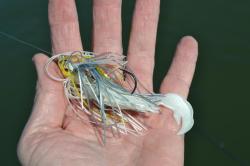
Swim JIg

Swim JIg

Most of us think of jigs as deepwater baits designed for fishing bottom, but for a short time in spring, jigs become topwater baits that are hard to beat, and they often produce some huge fish that are hard to catch with other lures.

Swimming a jig is basically a postspawn tactic; the fish that have spawned in the pads, primrose vines and other emergent weeds remain in the shallows for days or sometimes weeks after leaving the beds, and they’re typically very hungry. The places they prowl may be anywhere from a foot to 4 feet deep, typically in the backs of the feeder creeks that make up the bays around the larger lakes across much of the southeast and west into Texas.

The jigs that work best are not the heavy, fat models that work so well on the ledges. Swim jigs are flat-bottomed to help them scoot across the weeds, and are typically lighter in weight than those used in deep water, from 3/16 to ½ ounce, with large hooks designed to hold large soft plastic crawfish or swimmer tails. A nylon weedguard is also standard, helping to keep the single-hook lures from catching the cover.

These lures are cast into cover near spawning areas-sometimes the shadows of the beds can still be seen in the cover. However, the fish may be some distance from the nests-they no longer guard them after the fry swim off on their own, but they do hang in the area to feed for a time.

The trick in working a swim jig is to put the reel in gear instantly at the end of the cast, keep the rod high, and start the lure moving, slowly but steadily, just fast enough to activate the soft plastic swimmer legs or tails. Most anglers use either heavy mono, 25 pound test, or braid of 30 pound test or heavier, to allow pulling the lure free when it snags-and also to give them a chance to derrick large bass out of the thick stuff.

The strikes tend to be sudden and explosive-it’s just short of the blow-ups inspired in fall by crawling a frog over the moss beds. The nice advantage of swimming the open hook jigs is that the fish more often than not actually get hooked, not the case with the weedless but sometimes also fishless frogs.

Once a fish strikes, the tactic that works best is to set the hook hard, then crank as fast as possible with the rod high-ideally, you pop the fish up on top of the weeds and scoot him across them to open water. Of course, this plan is not always effective-they often bog down, and then the only way to get them out is to ease in on the troller, follow the line down and get a liplock on them.

It’s also common for fish to blow up on the lures and miss them completely. When this happens, a second cast back to the same spot immediately often gets a second strike, but if not it can be useful to keep a Texas-rigged worm handy on the front deck. Cast the worm to the spot of the blow-up, bounce it up and down in the cover a few times, and you’ll often coerce the fish into taking.

All colors of swim jigs work, but the ones that are easiest to see are the brighter colors-white, pearl or chartreuse are easy for you and the bass to spot.

Fishing the swimjig is a short window in the fishing spectrum, but it’s one of the more interesting and productive tactics for big fish when the bite is on-give it a try this spring.
Club Tournament at West Point Lake In April

An early April Sunday 19 members of the Flint River Bass Club fished our April tournament at West Point. After all the rain on Thursday and Friday the lake looked like coffee with cream in it
and the water temperature dropped from 63 degrees on Thursday to 56 Sunday morning. My truck thermometer showed 34 degrees when I launched my boat at 6:30 AM.

Even with those bad conditions there were five limits of bass brought in. We had a total of 47 keeper bass weighing right at 77 pounds. Most were spotted bass which I think hit better under bad conditions than do largemouth.

I managed to win with five weighing 9.79 pounds, Kwong Yu was second with five weighing 8.68 and his partner Steve Blackerby was third with five weighing 8.48. Toney Roberts placed 4th with five weighing 8.01. Dan Riddle had just one keeper, but it was a big one. His 5.91 pound bass was big fish for the tournament.

Bass were caught on spinnerbaits, crankbaits and Carolina rigs. The largemouth bass Jim Berry and I found in shallow water before the tournament had mostly moved back out with the dropping temperatures and were harder to catch.

The next Monday and Tuesday the Georgia BASS Chapter Federation Top Six tournament was at West Point. The three Griffin clubs, Flint River Bass Club, Potato Creek Bassmasters and Spalding County Sportsman Club each had six man teams fishing this tournament.

Griffin fishermen had a tough time at the Top Six last week. Although everyone caught a lot of bass, 14 inch keepers were not easy to find at West Point for some of us. It seems easy, in theory, to catch just five keeper bass in 6 to 8 hours of fishing, but it isn’t always so.

It took 10 bass weighing 30.64 pounds to win this tournament and 23.57 pounds to earn 12th spot on the state team. If you had 19.12 pounds you came in 25th and got a check. There were 86 clubs with six man teams in the tournament, so about 516 of us were beating the waters trying to catch bass Monday and Tuesday.

Lee Hancock, fishing with the Potato Creek Bassmasters, was the highest Griffin area fisherman. He weighed in 13.76 pounds of bass in two days. Kwong Yu and Javin English, fishing with the Flint River Bass Club, had 11.74 and 11.69 pounds respectively, to lead that team. Jimmy Waddle lead the Spalding County Sportsman Club with 11.30 pounds and I had 11.19 pounds in that club. I finished 139th!

The Top Six Tournament is quite and experience each year for the fishermen that qualify for it. I have been to 26 of them, missing only one since 1979. I was too sick to go to one in the early 1990s and hate missing that one.

Members of each club are fishing now for points in club tournaments to qualify for the Top Six next year. It is not too late to join a club and try to make it. Maybe you can show us how to catch fish in that tournament next spring.

How do you fish in muddy water in the spring? Share your thoughts in them comments section

Does BassMaster Still Send Out Unsolicited Books?

A few years ago on a Wednesday I received a book “Advanced Bass Fishing Skills” in the mail from BASS. There was also a cute little medal of some kind with it. The letter with the book starts out “You must be wondering why we sent you this book.”

NO, I know exactly why BASS sent it – they hope I will send the requested $9.95 for this book, which also signs me up for a book club. They will keep sending me books every month or so and charging me an unspecified price. It is amazing how fast those book club books build up and how much you will end up paying for them.

I will not pay for it, nor will I return the book. The letter does state that I do not have to pay for the book or return it, which is nice for them to admit since that is the law. You do not have to pay for or return anything sent to you that you did not request.

I have received something like this from BASS for the past five or six years and I refused to pay for any of it or send it back. Looks like they would learn, eventually.

Do you ever received unsolicited material like this from BASS or other fishing groups? If so share your experiences in the comments section

How To Set Up An Umbrella Rig

Tips on Setting up Castable Umbrella Rigs

By Brad Wiegmann
from The Fishing Wire

Fishing is complicated. There are thousands of lures and hundreds of jig heads to rig them on. It’s frustrating.

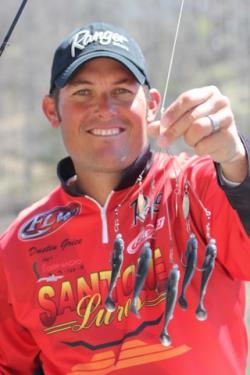
Dustin Grice and A-Rig

Dustin Grice and A-Rig

Pro Angler Dustin Grice likes A-Rigs for targeting suspended fish, as well as those around structure.

Selecting the best lure and jig head for the right technique can be overwhelming, in addition to figuring out the right weight of the jig head along with hook size and style.

Jig heads don’t look complicated, but they are all different and made for specific techniques. Those designed for swimbaits are commonly used on castable, multi-lure rigs or combined with a soft plastic lure. FLW Tour angler Dustin Grice has put a lot of thought into what works best where and when.

“Prime time to fish with the Alabama Rig, A-rig or castable umbrella rig is during the prespawn. Once the water temperature gets 50 degrees in the early spring it’s hard not to cast because of how many big fish it catches. The next best time is later on in October when the water temperatures begin to fall, however, you can still catch bass on it during the summertime offshore fishing ledges,” said Grice.

When selecting lures to rig on his castable umbrella rigs, Grice matches the bait size. During the spring, he uses small-bodied swimbaits and changes to a larger profile as the bait grows during the year. Once Grice finds the right size, he will rig all of the jig heads with it.

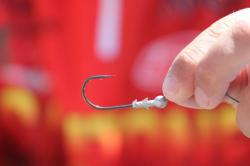
Double Barb Jig

Double Barb Jig

The double barb on this type of jig helps to keep the soft plastic tail in place during repeated casting.

“Really, jig heads may be more important than lure size when it comes to catching fish on castable multi-lure rigs. The weight of the jig heads determine how deep the lure will run. Hook size will determine what size lure to use. A castable umbrella rig has to be down in the strike zone to get a bite,” said Grice.

Right speed and presentation can also make a difference with the number of fish you catch when fishing a castable multi-lure rig. “It’s great for catching suspending bass. I just count it down to where the bass are and then start a slow retrieve. Sometimes, I will pause it when its coming back in and that will trigger a strike,” said Grice.

“I think bass like to bust up a school of baitfish then come back and eat them. I call that a “swim through.” It’s great because you know that any second after that happens you’re going to get a bite,” said Grice.

Grice acknowledged a large percentage of the time he uses 1/8-ounce Th’ Rig Head by Santone Lures on all five of the wire arms. Other times he will put 1/16-ounce jig heads on the top two wire arm and three 1/8-ounce heads on the remaining wire arms. He believes this keeps the castable multi-lure rig running true.

“95 percent of all the hits on a multi-lure rig are on the bottom three jig heads,” said Grice.

For Grice the gap between the hook point and hook eyelet is the key to catching fish when using a castable multi-lure rig. He also wants a jig head that lets the water move around it better creating a lifelike swimming action.

Another FLW Tour pro, Jim Tutt, also fishes castable multi-lure rigs. “It’s a lure just like any other lure, but when that bite is on you had better be throwing it as long as it’s legal in the tournament and state you are fishing in,” said Tutt. The Kellogg’s Rice Krispies pro is no stranger to the castable multi-lure rig having caught his biggest bass on it weighing over 11 pounds.

A large percentage of the time, Tutt will rig 1/8-ounce jigs with 4/0 hooks on all the wire arms. “I really don’t think hook size matters when a bass is going after a castable multi-lure rig. A bass is just trying to bust up the school,” said Tutt.

His favorite presentation is just casting out and letting the castable multi-lure rig fall to the bottom then slow rolling it back in. If the bass are suspended, Tutt will count down to where the fish are suspended then start reeling in slowly.

What’s important to Tutt when fishing a castable multi-lure rig is his jig heads.

“I use the Santone Lures Th’ Rig Head. These jig heads feature a drop weight system that keeps the jig heads from wrapping up or tangling, round ball head giving the lure great side to side motion and a double-barbed model or over-sided screw lock model for keeping the lure in place,” said Tutt.

Tutt added on solid bodied swimbaits the double-barbed model lures will stay on even without using super glue. On hollow bodied swimbaits, Tutt will put a drop of super glue to keep it in place.

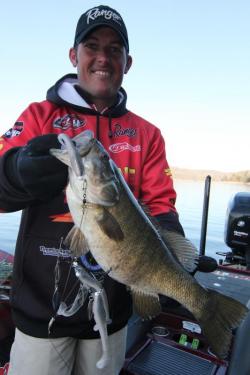
Smallmouth On Umbrella Rig

Smallmouth On Umbrella Rig

Both smallmouths like this one and largemouths are susceptible to the swimming “school” of bait represented by A-Rigs.

“I use these heads because they have heavy duty hooks and when you are fishing with a castable multi-lure rig it’s not little fish you’re catching on it,” said Tutt.

Th’ Rig Head double-barbed model is available in 1/16-ounce with 3/0 Mustad hook, 1/8-ounce with 4/0 Mustad hook, or 1/8-ounce with 5/0 Mustad hook and over-sized screw lock model in 1/8-ounce with 4/0 or 1/4-ounce with a 5/0 Mustad hook.

As for gear, Grice uses a 7 foot, 6 inch flipping stick with 65 pound braid on a 6.3:1 reel. Tutt uses 65 pound braid, 7 foot, 2 inch heavy action rod with a 6.3:1 Shimano Calais reel.

In addition to using these heads on castable multi-lure rigs, Grice uses swimbaits rigged with them almost year round. His favorite targets with this combination are rocky areas and points.

“On reservoirs like Beaver Lake and Table Rock, I will put on a 1/8-ounce head rigged with a swimming fluke Jr. and fish it everywhere there’s rock. I will tie on 6- to 8-pound test and fish it on a spinning rod. The spotted bass and smallmouth just love it when it’s reeled back in slowly,” said Grice.

He changes to baitcasting equipment and heavier 15 pound test fluorocarbon fishing line when fishing Lake Sam Rayburn, Kentucky Lake, or Toledo Bend. Grice will also switch to a full sized swimbait. Again, Grice likes to reel it back in slowly after it falls to the bottom.

April Fishing At West Point and Oconee

Jim Berry and I planned on fishing West Point on a Friday in early April but the awful weather that morning made us wait. We left my house at 12:15 and finally started fishing a little after 2:00 PM. It turned out to be a pretty good day even if short.

We put the boat in the water and started fishing at the ramp since there were loons feeding on baitfish in the area and we saw activity. Anytime baitfish are in a cove there is a good chance bass are nearby, and they were. Jim caught a bass on a crankbait then I landed a 3 pounder on a spinnerbait.

On a small point in the cove Jim caught two bass on a Carolina rigged Baby Brush Hog and I missed several bites. When I threw a Shadrap across the point I caught a small hybrid. That was probably what was hitting our Brush Hogs. Further down the bank Jim had a good bass hit and miss a buzzbait, then caught a keeper largemouth on the buzzbait.

We went across the creek to another cover and Jim landed a nice keeper on the buzzbait. I hooked a strong bass by a stump but it jumped and threw my spinnerbait. I thought it was about 5 pounds but Jim said it was bigger, maybe 6 or better. As we fished into the next cove we started catching spots on our Carolina rigs and caught several.

Around another point I caught two good spots, one about two pounds, on a Carolina rig then Jim pointed out some activity back in the cove. We went to it with the trolling motor and Jim started throwing a #5 Shadrap and immediately hooked a two pound hybrid.

For the next half hour Jim hooked a hybrid almost every cast. I did not have as much luck throwing my #7 Shadrap – I think it was too big since the hybrids were feeding on small shad, but I caught four or five while Jim landed at least 15. That was fun while it lasted.

Back out on the point Jim landed two spotted bass. Those were the last two fish of the day although we fished until dark. Not a bad afternoon, in five hours we caught 10 keeper bass, several throwbacks and about 20 hybrids. And the weather got nice, with no rain or wind while we fished.

I owe Andy Lee an apology. After our trip to Oconee a week ago Friday I wrote about it that night. I guess I was too tired to think and for some unknown reason called Andy the wrong name. I am sorry for that mistake and below is the corrected information about our trip.

Friday before last I took Zane Lee and his son Andy to Oconee for a bass fishing trip. Zane had bought the fishing trip at the Friends of the NRA Banquet, and I hoped we would have a really good day. And it started out that way. Andy caught two small bass on a spinnerbait the first cove we fished.

At the second spot, I caught a small bass on a crankbait then Andy hooked the biggest bass of the day, a nice 3 pound fish. A few minutes later he hooked a bigger bass, one the looked to be about four pounds, but it came off the second time it jumped.

A little further down the bank Andy caught another keeper fish on his spinnerbait, then added a throwback. At the next place we stopped I caught a small keeper on a Carolina Rigged Baby Brush Hog but then we went for about an hour without a bite before I caught two more keepers on the Carolina rig. By now it was after lunch and the morning cloud cover had blown away.

Although we fished until 5:00 PM we did not hook another fish. I had lots of excuses, the clear skies made them stop biting, the crowds of jet skies and pleasure boaters made them quit biting, or I was wearing the wrong shirt. It must have been one of those things.

We had a beautiful, if somewhat frustrating day. On the way home Andy was making his plans for killing a turkey Saturday morning. If he hunted as well as he fished Friday morning, he should have gotten at least two gobblers!

On Saturday I got a call from Al Bassett, full time guide on Oconee. He had a trip that morning and they had similar luck to ours. Al said they started fishing in heavy fog and caught six or seven bass, then the sun burned the fog off and they did not catch a bass the last two hours they fished. Bass just don’t like bright sun sometimes!

Should I Use Plastic Worms To Catch Spring Bass?

Plastic Worms Offer a Good Alternative Throughout the Spring Months

On heavily-pressured waters, Yamaha pro Russ Lane chooses plastic worms instead of jigs or crankbaits

Small, lightly weighted plastic worms are effective in hard-fished waters where power-fishing with fast-moving lures can be tough, says Yamaha pro Russ Lane.
When Russ Lane gave up a promising baseball career to become a fulltime professional bass fisherman, he quickly realized he had to change his normal fishing strategies if he wanted to compete successfully against the best bass anglers in the world. The Yamaha Pro’s initial decision-looking for alternative lures-turned out to be one of the most important he’s ever made.

“Not only was I fishing against excellent fishermen, but we were all competing on heavily-pressured lakes where the bass had apparently already seen all the lures in my tackle box so they ignored them,” laughs Lane, who has since qualified for four Bassmaster Classic® championships. “I had always enjoyed fishing small plastic worms, so that lure became my alternative bait, and it’s really effective now during the spring months because very few other anglers use them.”

Lane likes a little 4 ¾ inch worm that features a ringed body design but with a slightly larger tail. It has practically no action of its own, but the worm is still bulky enough he can rig with a larger 4/0 hook, quarter ounce slip sinker, and 22 pound fluorocarbon line.

He uses a worm under 5 inches long on a size 4/0 hook, with a quarter-ounce slip sinker for casting weight.
“It’s a finesse-type lure I can power fish with stronger tackle,” explains the Yamaha Pro, “and while it’s a great alternative lure throughout the spring months, it’s actually a very good lure throughout the year. I can pitch and flip it to boat docks, brush, stumps, practically any form of cover in water less than five feet deep.

“I nearly always use the very same presentation, too, regardless of what I’m fishing. I like to pitch the worm to the cover, let it fall to the bottom, then just let it sit motionless there for several seconds. When I do move it, I barely raise my rod so the worm only glides a foot or two before settling back to the bottom. It’s during that slow, subtle glide that the bass hit it.”

Lane’s realization he needed to find an alternative lure to use when fishing “used water” behind other pros isn’t unique, but his lure choice is certainly unusual. Most of his contemporaries change to fast-moving crankbaits in hopes of generating reflex-type strikes, so his ultra-slow retrieve-he rarely even hops the worm-truly is something the bass don’t see that often.’

“I think it’s effective because the worm looks extremely natural in the water,” continues Lane. “Bass aren’t spooked by it because it’s not an intrusive or aggressive movement. I know bass hear the worm as it hits the water and then sinks to the bottom, but instead of darting away, I envision them swimming up to within a few inches of the worm while I’m letting it sit there motionless.

An assortment of dark colors can be effective for spring fishing around beds where fish have recently spawned.
“When I slowly lift my rod and move the worm, it just slowly rises off the bottom and glides a very short distance. For a bass, that type of movement represents a very easy target, and I think that’s why they hit it so well, even during the post-spawn season when fish typically are not very active.”

Lane also likes fishing the small worm because it catches all sizes of bass throughout the day. He’s caught numerous fish in the six pound range using his slow presentation, and he credits the worm with helping him qualify for the 2013 Bassmaster Classic.® He used his technique in all eight Elite Series qualifying tournaments, from Florida to Arkansas to Wisconsin, and ranked 28th in the B.A.S.S.® Angler of the
Year standings.

“I don’t believe there’s a lake or river system in the country where this little worm and my slow presentation won’t catch at least some bass,” concludes the Yamaha Pro. “I really started fishing this worm as an alternative bait, but now it’s become one of my favorite lures, and I use it wherever I go.”

Can I Catch Southern Smallmouth On Swimbaits?

Giant Southern Swimbait Smallies

By Jimmy Mason
from The Fishing Wire

Southern smallmouth bass can be tough to figure out. One day they’re here, the next they’re gone, but there’s one area where you can count on finding them almost year-round, the current-laden water that rushes through the dams of riverine impoundments.

Jimmy Mason with big smallmlouth

Jimmy Mason with big smallmlouth

Captain Jimmy Mason shows a pair of enormous smallmouths taken in fast water below a TVA dam this spring.Mason says a swimbait tapping bottom now and then is the prime lure for catching bass of this size.

I’ve been guiding on Tennessee River impoundments for quite a while now, and have seen new lures and techniques come and go. One that’s here to stay for this moving water is a swimbait. I’ve never caught so many trophy smallmouth bass like the ones in the accompanying pictures as I have on a soft plastic swimbait.

Specifically, I most often use a 5-inch Yum Money Minnow in Foxy Shad color. It perfectly imitates our native forage, the threadfin shad. It is a simple lure and technique, but really catches bass in the kind of current we have in the Tennessee River and the upper reaches of my home waters, Pickwick and Wilson Lakes.

I prefer fishing the swimbait on a ¾-ounce jighead with a weedguard to keep it from snagging. In fact, I’ve been using a Booyah Boo Jig and just removing the skirt. We’ve had abnormally cold water this winter and bass can’t fight heavy current in those temperatures, so they often sit in eddies behind boulders. I bring the swimbait right to the front of the boulder and pop it over, making it sink right on the fish’s nose.

Sure, soft plastic swimbaits have been around for five or six years, but you don’t hear anglers talk much about fishing them in current. Even though it sounds simple, there’s more to being successful than meets the eye.

Smallmouth on the Tennessee River or any big river or tailwaters often scatter out over broad boulder-laden riverbeds. When I’m fishing swimbaits over these areas, I’m not fishing a specific spot. I’m letting the current carry the boat downriver and fishing multiple boulders or the bottom of the run-of-the-river section of the lake. You are fishing multiple low spots, high spots…anything that breaks the current, anything that these fish can pull in behind and set up in a current break.

Current can undermine your presentation if you let it. I like to cast out and, much like I do when I am fishing an umbrella rig, let it “parachute” to the bottom. By that I mean I want to execute a controlled fall. To do this I turn my reel handle only slightly after the bait hits the water. I want that bait nose-down but under control as it falls to the bottom.

As soon as I make bottom contact, I speed up my retrieve. I want to keep it just off the bottom. During the retrieve itself, I want to feel the bait bump bottom three or four times. I don’t want to bang bottom constantly, but I don’t want my bait to swim too far up either, because the fish are using the boulders and pockets for protection from the strong current. Feeling the bait bump three or four times lets me know that I am within a foot of the bottom as we drift.

Boat control

When I’m fishing these areas, I point the boat directly into the current and let it drift while I cast straight out. Keeping the bait in the strike zone during the retrieve is very important, and by casting directly in front of the boat and drifting straight downstream I’m able to fish the swimbait more effectively.

Drifting in this manner, I can pretty much keep my foot off the trolling motor except to adjust the boat position. The objective is to keep the nose of the boat forward, pointed into the current.

I want my bait and my boat moving backwards at the same speed. My casts are all perpendicular to the boat – at a straight 90-degree angle with the craft. I am not throwing upstream. I am not throwing downstream. I want to cast straight out so that my retrieve brings the bait straight back to the boat.

High waters and weighty matters

Big smallmouith caught on a swimbait

Big smallmouith caught on a swimbait

The 5-inch Yum Money Minnow is large enough to whet the appetite of jumbo smallmouths like this one.

As I said, my go-to bait for fishing in the current is the 5-inch YUM Money Minnow, more often than not, in the Foxy Shad color on a ¾-ounce jighead. This past December, however, I fished in heavy current following three or four inches of rain, and conditions forced me to adjust.

Heavier-than-normal current calls for a heavier presentation. In situations like that, I will take a lead slip sinker – say a 5/16-ounce bullet-nose sinker, and put it ahead of the lure. The water is dirty after a heavy rain, and in that faster current the fish get just a quick glimpse of the bait as it rushes past them. The weight and extra bulk doesn’t hurt the presentation at all. It does, however, help me get that swimbait down and working in the fast current.

Gearing up

Fishing across large flats on big rivers and below dams calls for long casts. It requires equipment that not only enables you to make those casts but to set the hook successfully even with all that line and current between you and the fish.

I use a long rod with muscle, a 7′-4″ Dobyns DX in heavy action. It has a good flexible tip that helps you make long casts, but at the same time it has the backbone to drive the hook home even with the heavy diameter wire on my jigheads.

My line choice is 15- to 17-lb fluorocarbon. That fluorocarbon helps me get down in the current better because it sinks, and the low stretch helps me get a good hookset. My reel is a Lew’s Tournament Pro with a 6.4:1 gear ratio. It also aids in casting long distance and the high-speed gear ratio helps me stay in contact with the swimbait.

The Tennessee River and its fabled impoundments have a lot of challenging current areas that are loaded with big smallmouth. Try these tips for rigging and working the Yum Money Minnow for the fast water. When it comes to big smallmouth, I probably catch more 5- and 6-pounders on this bait than on anything else!

Fishing In March at Lake Oconee

March was certainly going out like a lion last week.

From very cold at night to wind that blew my boat and van all over the road, then rain Saturday and Sunday, the weather made fishing tough. But for the state Top Six at Lanier Monday and Tuesday the weather guessers said it would be nice. I will believe that when I see it.

Bass seem confused, moving shallow to get ready to bed then backing off when the temperature drops. But the crappie are biting good. Every report I got from West Point, Oconee, Clarks Hill, Jackson and Lanier was about big catches of good sized fish.

The wind makes crappie fishing tough, too, but you can troll or drift with the wind and catch them if the wind is not too strong. Thursday afternoon it was too strong, but by now it should be calm enough to catch your limit of those good tasting fish.

I always looked forward to this time of year when my parents were alive. We would go in our big ski boat daddy had set up for fishing, with a trolling motor on front, and tow our jon boat behind it. We would pick our favorite cove – Carp Cove, Beaver Cove, Turtle Cove or some other place we knew the crappie would be bedding, and fish all day.

Mom and dad would stay in the big boat, tied up in the bushes where the crappie were feeding, and I would get in the jon boat and fish all around the cove. They usually used shiner minnows but I tied a Hal Fly jig under a cork on my fly rod and dabbled it around button bushes. The cork seldom settled on the water surface long.

After getting three limits – 90 crappie – we would go in and set up a cleaning line. Mom and dad would scale the fish and I would gut them. I made a diagonal cut behind the head to the vent and pulled everything out with one motion. I could keep up with them.

I miss those days. It is just not the same without them.

Fishing was good for some at Oconee last Sunday. In our March tournament 21 members and guests of the Spalding County Sportsman Club brought in 72 bass weighing about 142 pounds. There were eight five-fish limits and only one member did not catch a keeper in the eight hours we fished.

Russell Prevatt had a good day, winning with five at 14.74 pounds and his 6.10 pound bass took daily and cumulative big fish honors. Raymond English also had a good day and placed second with five at 13.65 pounds, Sam Smith had a limit weighing 12.15 for third and fourth went to guest David Weitgrefe with five at 10.72 pounds.

Russell said he caught his bass on a jig and pig on rocks. Bass were also caught on spinner baits and crankbaits, mostly around rocks. The water was stained to muddy and from 57 to 64 degrees. It rained on us for about half the tournament.

I wish I had known the pattern before the tournament. I ran to Double Branches first thing, to an area where I have won a couple of tournaments in March the past few years. And within five minutes I caught a keeper on a chatter bait on a rocky point. I thought I was going to have a good day.

After an hour without a bite I was beginning to wonder.

Then a fish hit my jig and pig on a point, almost under the boat. I set the hook too hard with such a short line and broke it. That really made me feel bad.

I was fishing back in a cove and it was very quiet and peaceful. Then someone shot a turkey about 100 yards up in the woods from me. I almost jumped out of the boat! I was not in any danger but that shot was loud!

A few minutes later I had tied on another jig and pig and pitched it to some brush on a steep bank. The creek I was in was very narrow and I was only about ten feet from the bank. When my line jumped, indicating a strike, I set the hook as fast as I could, but it was not fast enough.

I got the terrible reaction of pulling loose line. The fish had run back under the boat and you can not set the hook on slack line,. I reeled as fast as I could and got the bass, a three pounder, to the top of the water right beside the boat, but it came off.

I fished a wide variety of baits in a lot of places in Double Branches until the end of the tournament but caught nothing but short bass after that. I wish I had tried different areas of the lake, but the water color and temperature were good in that creek and I have done well there in March. Also, I didn’t want to make a run in the rain.

As soon as I send this in I am headed to Lanier for the Top Six. I surely do hope I do better.

Maybe I should be going crappie fishing.+

Top Six Tournament at Lake Lanier

Don’t forget to renew your Georgia fishing license. Most of us have licenses that expire in early April each year since, for many years, annual licenses expired on April 1st. So when the law was changed to make them run for one year from the date of purchase, we bought them around April 1st since the old one expired then. Now we need to renew before they run out. Don’t get caught without one.
———————————————————–
The Georgia Bass Chapter Federation Top Six was last Monday and Tuesday at Lake Lanier. Both the Spalding County Sportsman Club and the Flint River Bass Club sent teams but we did not do well. We just do not fish Lanier very often and it is a tough lake to catch bass if you don’t fish it often.

The Marietta Bass Club sent two teams and they finished first and third. The top Marietta team won by almost 30 pounds above the second place team, and five of their six man team placed in the top 12. That is an incredible result but that club fishes Lanier a lot and most of them live near the lake.

The Sportsman Club finished 26th out of 36 teams and the Flint River Club was 33rd. The winning team had 54 keeper bass in two days weighing 140.57 pounds. The Sportsman Club team had 33 bass weighing 66.27 pounds and Flint River had 27 bass weighing 51.06 pounds.
The winner was a no boater, meaning he had to fish in someone else’s boat on another team, but he got to run the trolling motor and choose the fishing spots for half each day. He had 10 keepers, a limit each day, weighing 31.4 pounds. It took 10 weighing 24.53 pounds to make the state team in 12th place.

Chuck Croft fishing with Flint River had the best catch in either of those two clubs, with eight bass weighing 18.39 pounds for 53rd place. Mark Knight on the Sportsman Club team came in 82nd and I came in 98th with seven keepers weighing 12.90 pounds out of 216 fishermen in the tournament.

I went up to Lanier last Thursday and fished up the Chattahoochee River all day Friday in the rain. I caught some fish but not the size needed to do well in the tournament. The best place I fished was a small creek off the river where my partner and I caught 14 keepers weighing 33 pounds in the 1991 Top Six, so I knew it held the possibility of good fish but they would be largemouth, and we needed some warm, sunny days to make them bite.

On Saturday I again fished all day in the rain but stayed on the main lake, trying to figure out how to catch the big spotted bass there. I never had a bite! That was frustrating. I planned on trying something different on Sunday but when I woke up in the campground with my van shaking from the wind I went back to sleep. I never got on the water on that cold, windy day.

It was “fun” Saturday night trying to grill chicken and having stuff blow off the table if it was not nailed down. And it was getting colder fast. So when I went to bed Saturday night I knew Sunday would be a bad day. And that I was not going to get the kind of weather I wanted. Wind stirs up the deeper, colder water and I needed warming water to do well.

I drew a 16 year old partner for Monday and he had no idea what we should do, so we gambled and went to the small creek up the river. After catching just a couple of small bass in two hours I said we should go, then he caught a three pound largemouth, I caught a fish just under the 14 inch limit and he caught a 2.5 pound largemouth on three casts!

Those fish were on a rocky point leading to the back of the creek so I hoped the quality largemouth were moving in. The day was getting warm and the sun was warming the water. After another hour we were ready to leave again but we caught nine bass off one small spot on a channel bend near the back of the cove in a few minutes. Although only two were big enough to keep that was another sign they were moving in so we decided to stay the rest of the day.

I got one more keeper, then caught a three pound largemouth right in the back of the creek not long before we had to leave. The water there had warmed from 57 to 62 degrees during the day but it was too little too late.

My partner for the next day had no places he wanted to fish so we went back to the small creek on Tuesday. We had fun catching fish but they were mostly small. At the small creek bend we landed 11 bass in 30 minutes in the morning but only two kept. With an hour left to fish he had two and I had one. Then back at the creek bend I made three casts and caught three keepers, two of them 2.5 pound largemouth. Again, too little too late.

It was a fun but very tiring trip and the weather was beautiful Monday and Tuesday. I just wish it had warmed up on Sunday, not Monday.

Fish should be biting real good at West Point today for the Flint River March tournament, but only time will tell.

Fishing West Point and Oconee In the Spring

Don’t forget to renew your fishing license. Until last year new fishing licenses were always due on April 1st, but starting last year they are good for one year from the day you got them. So, if you renewed early last year, they will expire early this year. Don’t get caught fishing without a license.

Fishing is getting better with the nice spring weather like we had Friday. I fished at West Point and Oconee last week and the bass fishing was fair. Based on the number of boats on the lake fishing for crappie, that fishing must have been pretty good.

In a Spalding County Sportsman Club tournament last Sunday at West Point 18 members and guests fished for 9 hours to bring in 44 keepers weighing about 75 pounds. All but 7 of those keepers were spotted bass, the largemouth were much harder to find.

Butch Duerr won it all with a 5 bass limit weighing 14.62 pounds and had big fish with a 6.16 pound bass. He said he caught them on spinnerbaits in wind blown pockets. Although Butch had a great catch he was still disappointed since a much bigger bass had broken his line. Butch said the one that got away looked twice as big as the six pounder he landed. It jumped trying to throw his spinnerbait and he got a good look at it.

Gary Hattaway placed second with a limit weighing 9.54 pounds and he said he caught his fish on plastic baits. Gary also said he had lost a good bass, one around four pounds, when it pulled off from his hook. Billy Roberts placed 3rd with five bass weighing 7.59 pounds and I placed 4th with 3 bass weighing 6.59 pounds.

I started the morning by hooking and losing a bass that looked like it weighed about 4 pounds. It fought to the surface and then just pulled off. About an hour later I cast a different crankbait to a shallow point and something thumped it. When I set the hook it fought hard, running like a bass. Then my line went slack. I almost threw my rod and reel in the water.

When I reeled in my plug, it had a big scale stuck on one of the hooks. The scale had a definite red edge – I had hooked a carp. Fortunately for my mental attitude, I hooked and landed a largemouth weighing a little over 3 pounds a few minutes later. I have to admit, when the fish jumped, my heart stopped. I was afraid I would lose it.

On Wednesday Jim Berry and I went back to West Point. He started out by catching the first four or five bass to come in the boat, all on crankbaits, then I finally caught a spotted bass on a Carolina Rigged Baby Brush Hog. Jim caught a couple more bass then I had a streak of catching about five in a row. We ended the day with 14 keeper spotted bass and several largemouth.

On Friday I took Zane Lee and his son Andy to Oconee for a bass fishing trip. Zane had bought the fishing trip at the Friends of the NRA Banquet, and I hoped we would have a really good day. And it started out that way. Andy caught two small bass on a spinnerbait the first cove we fished.

At the second spot, I caught a small bass on a crankbait then Andy hooked the biggest bass of the day, a nice 3 pound fish. A few minutes later he hooked a bigger bass, one the looked to be about four pounds, but it came off the second time it jumped.

A little further down the bank Andy caught another keeper fish on his spinnerbait, then added a throwback. At the next place we stopped I caught a small keeper on a Carolina Rigged Baby Brush Hog but then we went for about an hour without a bite before I caught two more keepers on the Carolina rig. By now it was after lunch and the morning cloud cover had blown away.

Although we fished until 5:00 PM we did not hook another fish. I had lots of excuses, the clear skies made them stop biting, the crowds of jet skies and pleasure boaters made them quit biting, or I was wearing the wrong shirt. It must have been one of those things.

We had a beautiful, if somewhat frustrating day. On the way home Andy was making his plans for killing a turkey Saturday morning. If he hunted as well as he fished Friday morning, he should have gotten at least two gobblers!