Category Archives: Bass Fishing

Bass Fishing Information

Global Warming and Poor Fishing

I have heard claims that the early hurricanes and tropical storms this year are because of global warming. That has caused a lot more rain, and all our lakes are full. Seems I remember during our drought when all our lakes were low that the drought was cause by global warming, too.

In January, 2005 Linda and I went on a cruise in Antarctica. We met the ship in what is called “The Last City On Earth,” Ushuaia, Argentina, right on the tip of South America. While touring that city we noticed a hillside covered in grass and the tour guide told us it was their ski area. Since we were there in the middle of their summer we were not surprised it was not covered with snow, although most of the surrounding mountains were snow capped.

The tour guide explained that they were not getting as much snow as normal because of global warming and did not get to ski much, even in the winter. Then a couple of days later while on the ship in the Drake Passage it was snowing on us. One of the guides on the ship said snow was unusual there in the middle of summer, but because of global warming they got a lot more snow than they used to.

So, it is dryer and wetter here because of global warming. It snows more and less in South America because of global warming. That seems to be a great catch all to blame weather problems on.

I bet the reason I didn’t catch many fish in the Lanier tournament in May was due to global warming. From now on, if the fish don’t bite I have something to blame it on, global warming. I used to say it was too hot or too cold or too windy or too calm or too cloudy or too sunny when I could not catch bass. Now I can simplify things. No matter what is going on, I can blame not catching fish on global warming.

That should work for hunting, too. Not seeing deer today? Global warming. Doves not flying? Global warming. Doesn’t matter that other guys in the hunting club are killing deer and shooting doves on their fields, that is a great excuse.

Good luck fishing this weekend. Hope global warming doesn’t get you and ruin your trip!

Great Lakes Cold Water Smallmouth

Icewater Bronze – Great Lakes Smallmouth

Great Lakes bite off to chilly start

By Dan Johnson
from The Fishing Wire

STURGEON BAY, WI–Lake Michigan’s Sturgeon Bay offers bass fans some of the finest smallmouth fishing on the planet. Routinely producing behemoths topping 6 pounds, the bay’s storied waters rank high-even atop-more than a few top fisheries lists.

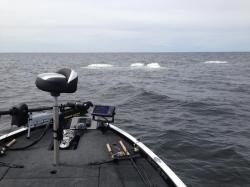
Ice floes still dot sections of Sturgeon Bay.

The Great Lakes are still col

The Great Lakes are still col

But even paradise has a downside. And on Sturgeon Bay, that just might be the first few days of the open-water season. Anglers prepping to compete in a pair of high-profile early season tournaments are finding slow going, as a late spring and frigid water temps have the fish in a funk.

As of Wednesday, May 7, the main bay was a chilly 38 to 40 degrees, with surface temps in the backs of coves barely pushing into the upper 40s. Overcast skies and 45-degree air temps were doing little to warm the water.

“Everything is a little behind schedule this season,” said Scott Bonnema, a veteran competitor from Zimmerman, Minnesota, who is signed up to fish the Cabela’s North American Bass Circuit’s qualifier May 10, and the Sturgeon Bay Open May 16-18.

Dodging the occasional ice floe with his Ranger, Bonnema was on the hunt for the warmest water he could find. “The fishing is really slow,” he said. “The main thing is not to get frustrated and panic, but to keep your head down and focus on finding areas that have fish now, as well as spots that will hold fish once the water warms up.”

For Bonnema, that means scouting hard-bottom shallows featuring rocks averaging a foot in diameter. The backs of coves are prime targets, but he’s also checking the outer edges of points leading into such hot zones, knowing that inbound smallies will funnel along this structure first.

Once waters warm, smallies in Sturgeon Bay and elsewhere will hit a variety of presentations.

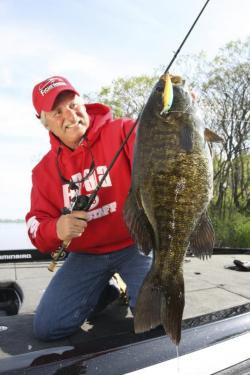
Big Smallmouth from Cold Water

Big Smallmouth from Cold Water

A few bass have already moved shallow, but they’re sluggish and playing hard to catch. “I’ve seen a few fish in three feet of water, but they’re really lethargic,” he noted. “I’m fishing a downsized 2½-inch tube on an 1/8-ounce jighead, dragging it s-l-o-w-l-y across the bottom. Bites are mushy, so I’m using low-stretch Sufix 832 superbraid for sensitivity.”

Given the bay’s gin-clear waters, which enable anglers to see the bottom in 25 feet of water, Bonnema said a 7-pound Sufix Invisiline fluorocarbon leader is critical to keep the fish from seeing the line.

Looking ahead, Bonnema predicted that Sturgeon Bay’s smallies wouldn’t stay dormant for long. “We’re supposed to get warmer weather this week, so more fish should move in and the bite should pick up,” he said. “Before you know it, everyone will be catching them.”

As the bite picks up, he expects reaction lures like Rapala X-Rap jerkbaits and Alabama rigs to come into play. “Even then, the fish will be pressured and spooky in the clear, shallow water,” he said, noting that he uses a Humminbird 1199ci HD SI sonar-chartplotter combo unit to locate and return to prime structure. “The 1-foot contours on its LakeMaster mapping program also make it easier to dial in specific depths everywhere in the system,” he added. “It also helps me keep the boat far enough from the fish so I don’t spook them.”

Once Bonnema finds a key area, he says a great strategy is locking the boat in place with a shallow-water anchor like the Minn Kota Talon and waiting for other boats to push fish to you. “It’s almost like deer hunting,” he laughed.

When the bay’s bass fishing does catch fire, it’s not unheard of for tournament anglers to weigh in 30 pounds with five bass. But such epic catches are still a few days or more away. For now, Bonnema’s biding his time, playing the finesse card as he patiently prepares for the upcoming NABC and Sturgeon Bay Open events.

Does Practice Sometimes Hurt You In A Tournament?

Last Sunday members of the Flint River Bass Club had a tough tournament on Lake Oconee. Fishing from 6:00 AM until 2:00 PM the 19 members and guests landed 33 keeper bass weighing 56.94 pounds. There was only one five-fish limit and five members did not catch a keeper during the tournament.

Doug Kohn had the limit and his 7.94 pounds won the tournament. Lee Hancock had three bass weighing 7.17 pounds for second and his 4.30 pound bass won the big fish award. Bobby Ferris places third with 6.80 pounds and Jack Ridgway was fourth with 6.73 pounds.

Doug said he caught some of his fish on topwater plugs. Lee said the big bass hit a crankbait and his others were caught on a Texas rigged worm. Bobby said he caught his fish on a jig and pig. Fish were caught on a lot of different baits so no one pattern really worked better than others.

We lucked out on the weather. It was cloudy and windy all day, which usually makes fishing better. As I pulled out of the parking lot at 2:30 PM to head home a few drops of rain hit my windshield. By the time I got to the main road it was pouring and it rained hard all the way back to Griffin. I surely am glad the rain held off until the end of the tournament!

I had gone to Oconee on Saturday to check some deep water holes where I have caught fish this time of year in the past. I also wanted to try a pattern I was told was working there. I thought I had found something that would help me in the tournament but it may have actually hurt my fishing.

I rode over a point with some brush down in 20 feet of water and saw baitfish and bigger fish around the area. This was the brush where I caught a 7-7 bass and several other keepers in a July tournament a few years ago so I felt good about catching something there and did not even cast to them, not wanting to bother them the day before the tournament.

The second point I went to and checked I also saw brush with baitfish and bigger fish around it in 20 feet of water. I threw out a marker and cast a Carolina rig a few times, but nothing hit. I picked up a Mag 2 worm Texas rigged and the first cast produced a hit. When I set the hook the back half of the worm was torn off.

I quickly rigged another worm and cast back to the same place. When I felt a fish I set the hook and this time was rewarded with something pulling back. It was a 3.5 pound bass and I marked that spot to fish the next day.

For the next few hours I rode over points and found three more that looked just like where I had caught the bass. Brush, baitfish and bigger fish seen on a depthfinder is usually a good indication you can catching something this time of year so I planned on fishing those spots. I had caught one of my five keepers off one of the places two weeks before in the Spalding County Sportsman Club tournament so that also gave me confidence.

Brent Terry fished as my guest in the tournament and we stopped on a main lake bank with docks on it first thing Sunday morning. I started throwing a spinnerbait and Brent chose a buzzbait. On the first pass I hooked and lost a bass that looked like it would be a little short of 14 inches long, then caught three more short bass before we left.

Fishing similar places I finally landed a good keeper on the spinnerbait and then another one on a Texas rigged worm. After a couple more hours without a fish in the shallows I told Brent we should start hitting the deeper holes. I felt sure in the four hours we had left to fish we could catch some keepers.

That feeling was bolstered when Brent got a keeper on the first point we fished, the place I had landed a keeper two weeks before. Although we fished all the places that looked good the day before, and we caught some short fish, we did not catch a single keeper the rest of the day.

My two keepers weighed 3.76 pounds and put me in 9th place. That just goes to show the best laid fishing plans often go astray! Now I wonder if I had kept fishing shallow water if I would have done better. Sometimes practice for a tournament may be counterproductive. Who knows?

That’s why we call it fishing, not catching!

Fishing A June Tournament At Lake Oconee

Last Sunday 16 members and guests fished the Spalding County Sportsman Club June tournament at Oconee. We lucked out and it was a rainy, cooler than normal day for late June. Fishing from 6:00 AM until 3:00 PM we brought in 43 keeper bass weighing about 72 pounds. There were six 5 fish limits weighed in.

Mike Dalton brought in a limit weighing 12.25 pounds to win the tournament, and his 3.57 pound bass took the big fish pot. I had five weighing 10.35 pounds for second and my 3.54 pound fish, just 3 hundredths of a pound smaller than Mike’s big one, didn’t win anything!

James Pilgrim, Jr. had four bass weighing 7.66 pounds for third, Butch Duerr had five weighing 7.22 for fourth and Ben Puckett had 3 bass weighing 6.53 pounds for fifth.

Mike said he caught his fish on crankbaits. Butch said he caught his on buzzbaits. There were a good many fish caught on worms and spinnerbaits, too. The cloudy weather made the fish bite pretty good.

I used all my bass fishing skill to land my five keepers. I headed to a favorite point to start but there was a boat on it, so I went to a nearby point to wait and see if they left. My second cast with a spinnerbait to a dock there produced my biggest bass of the day. After the boat finally left I went to that point and caught a second keeper on the spinnerbait.

Linda fished with me and needed a break so at about 9:30 I went to a nearby marina. While she was inside I cast a Texas rigged worm to the gas dock and landed a 16 inch keeper. When I headed back to my favorite point there was a boat on it again, so I went to the other side of them and caught my second biggest bass of the day on a worm from a dock there.

My fifth keeper came on a Carolina rig on a point. So, of the five keepers I landed, three came from places I did not plan on fishing. Maybe I should plan where to fish then change my mind at the last minute from now on.

Linda and I caught a bunch of bass. We probably had 30 with many in the 13.5 to 13.9 inch range, just under the 14 inch minimum. Linda had one 16 inch keeper and placed 11th in the tournament. She also caught three channel cats of a crankbait. I have caught them on crankbaits before but never three in one day!

June Club Tournament at Lake Weiss

Lake Weiss proved to be an interesting lake for a club tournament in early June a few years ago for the Flint River Bass Club. Although the weather did not treat us very good, with rain all day Saturday and strong winds on Sunday, most of the members managed to catch some bass.

Bobby Ferris had an outstanding catch on Saturday bringing in a limit of 5 bass weighing 17.64 pounds. That is the kind of catch you see in pro tournaments. He had five more on Sunday and his ten keepers weighed 26.14 pounds and gave him first place. He also had big fish in the tournament with a 4.74 pound largemouth.

I thought I had a real good catch until I saw what Bobby had. My ten bass in the two days weighed 22.13 pounds and gave me second place. Gary Blackmon had limits both days and came in third with 15.95 pounds. Roger Morrow had 9 bass in the two days and placed fourth with 15.52 pounds.

The 17 fishermen brought in 76 bass weighing 135.98 pounds. Half of them were largemouth and half were spotted bass. There were nine 5 fish limits weighed in during the two days.

I went over on Thursday and met state fisheries biologist Kevin Dalmier at the lake. He has a cabin on the lake and not only studies fish, he loves to bass fish. We fished together in practice but a family illness kept him from fishing with me in the tournament.

On Thursday afternoon we fished the lower lake, about 20 miles by water from where the tournament launched. Kevin showed me some great places we planned on fishing in the tournament, including a hump near the dam. He told me as we approached it he had never seen another fisherman on it but had always caught bass there and we should catch some big spotted bass.

Sure enough, I hooked a 2.5 pound spotted bass almost as soon as we started fishing there. Mine got off but then Kevin hooked and landed a 3 pound spot, then a 2.5 pounder. I landed one about 2 pounds before we left the spot, and I was sure we would catch fish there in the tournament. Unfortunately, the wind and rain kept me from returning during the tournament.

While fishing Thursday Kevin at one point made the statement that “I am no expert but…” I stopped him, saying if he was not an expert on fish, who was? He explained just knowing fish biology was not a guarantee of catching them. That made me feel real inadequate – if he is not an expert after going to college and studying fish all his life, how could I ever hope to be one?

I did see how great fishermen are during my trip. On Saturday morning Bobby told me some lowlife had stolen the tail lights off his boat trailer while it was parked in the marina lot on Friday. I had not locked my trailer to my van that morning and was worried about it.

By 8:00 AM I had a limit of fish in the boat and decided to go to the ramp and lock my trailer. As I got out of my boat at the ramp a father and son idled up to leave. We talked as I walked toward my van, and when I reached under my rainsuit pants for my keys they were not in my pocket. I was afraid I had missed my pocket in the dark that morning and dropped them down the pants leg of my rainsuit.

The man I had just met helped me look for them, then took his boat out of the water and went to a nearby store to get the number of a locksmith for me. While he was gone I found my keys in the boat, I had dropped them when taking my cell phone out of my pocket.

He returned with the phone numbers and I thanked him. He went out of his way, in the rain, to help a stranger out.

On the way home I had a blowout on my van and pulled over to fix it. Club member Dan Riddle stopped behind me and helped me change it in the miserably hot sun. Without one of his tools I would not have been able to get my hubcap off. That is another good example of how great fellow fishermen are. Thanks, Dan!

During the tournament I made a dumb mistake and broke a club rule. I was fishing a buzzbait and a fish hit at it and missed it. I quickly threw a worm to where the fish hit and sure enough, as soon as it hit the water the fish grabbed it. I fought the three pound bass to the boat then got a sick feeling. I had not stopped and reeled in my buzzbait before casting the second bait.

A club rule says you can use only one rod at a time, so I broke the rule. It made me feel awful to let the bass go, but rules are rules even if I don’t like them. As it turned out that fish would not have helped my weight enough to catch Bobby, but I did not know that at the time.

May Fishing Tournaments At Lake Lanier

Tom Perdue and I fished Lanier on a Wednesday in early May a few years ago, trying to find some bass and a pattern for me to fish in the Spalding County Sportsman Club tournament that weekend. We had only three keepers so I am not sure we were successful.

Tom was determined to catch a fish on a jerkbait and he threw one a lot. He accomplished his goal when a pretty 2.5 pound spotted bass hit his jerkbait and he landed it. Several hours later we were near a dock and I cast a Trick worm under it when I saw a bass hanging there. It hit and I landed a 3.5 pound spot, one of my top four I have ever caught.

Although we caught a lot of bass shorter than the 14 inch limit, I landed only one more keeper just before we quit. It hit a tube bait near the bank and probably weighed about 2.5 pounds. I hope I catch two as big as the two I got Wednesday in the tournament today!

Lake Lanier was good to Donnie Willis the past few weeks that year. He won both the Potato Creek Bassmasters’ April tournament and the Flint River Bass Club’s May tournament there. Winning back to back tournaments in two clubs is hard to do, even on the same lake.

On April 16th 25 members of the Potato Creek club fished Lanier for nine hours. They brought in 48 bass weighing about 93 pounds. Lanier has a 14 inch minimum size limit on bass and a 14 inch keeper will usually weigh at least 1.5 pounds.

Donnie had a five fish limit weighing 13.34 pounds for first. Chris Corley had five weighing 12.21 for second and had big fish in the tournament with a 4.99 pound bass. Raymond English had five weighing 8.44 pounds for third and Brian Lee placed fourth with 4 bass weighing 7.94 pounds.

Two weeks later on May 1st the Flint River Bass Club fished Lanier and Donnie won with five bass weighing 9.35 pounds. Gary Morrow was second with 8.76 pounds, I placed third with five weighing 7.97 pounds and Tony Roberts was fourth with 7.95 pounds.

There were 16 fishermen in the Flint River tournament and we brought in 40 bass weighing 75.21 pounds. Donnie said he caught his fish on jerk baits and Carolina rigs. I did not have a bass at noon that day after fishing docks and shallow water all morning. At noon I decided to move to main lake points and caught my five in less than an hour on a spinnerbait.

Fishing In the Wind at Clarks Hill

It was windy the last weekend in April a few years ago. If you were on an area lake, like 19 members of the Spalding County Sportsman Club, you know what an understatement that is! The wind had Clark’s Hill white capping as far as the eye could see, and waves breaking on the riprap at Price’s Bridge threw spray up on the road.

Wind can make lakes dangerous, and there was a wind advisory for lakes in Georgia last weekend. Four times in my life I thought the waves might sink a boat I was driving, and two of them were at Clark’s Hill. One of the other one was at Eufaula in a Top Six tournament and the other was at Lake Lanier in a club tournament.

When I was a teenager my family had a 18 foot outdrive with a 120 hp motor. I ran all over Clark’s Hill in that boat, skiing, fishing and just having fun. We often ran from Raysville Boat Club down to the dam to meet friends and enjoy the lake.

When you come out of Germany Creek where Raysville Boat Club is located, you can look east and see Price’s Bridge about 13 miles away. That is a lot of water for the wind to blow across, and wind out of the west doesn’t have much to slow it down other than a few islands.

That weekend four of us had gone to the dam to a picnic and the wind got up. We headed back up the lake and the waves were awful. We would go down into the trough of one and not be able to see the banks the waves were so high. I was younger and dumber and didn’t really get scared, but looking back, if the motor had died I am sure the waves would have turned the boat over.

Years later Linda and I had run down to a cove we liked to fish in April, and stayed there most of the day. We knew the wind had gotten up, but did not realize how much until we came out across from Mistletoe and hit the waves coming down the lake. They were so big all I could do was keep the boat at a high idle and break through them.

We were in our brand new 17.5 foot Procraft bass boat with a 150 hp motor. I got really scared when I looked back and the waves we crashed through would come back together and almost cover the engine. I was afraid it would drown out and we would capsize. We finally got near a bank where it was more protected and made it back safely.

The waves were different this past weekend. They were shorter and more choppy, but even so while trying to fish in the wind and hold the boat, every few minutes a series of big waves would come along and make the front of my 20 foot Skeeter bass boat dip water. It was not real dangerous but it was hard to fish.

Gary Hattaway battled the wind and had a great catch Saturday. He brought in a 7.13 pound bass and had five weighing 17.69 pounds. He added two more keepers Sunday and got first place with 7 bass weighing 23.27 pounds, and his seven pounder was big fish for the tournament.

I got a limit each day and had 10 bass weighing 22.36 pounds for second. I did not catch a bass weighing over 3 pounds, I just could not find a kicker bass. I had a feeling I could catch a big fish off the riprap if I could fish it with the wind blowing into it, and I did. I landed an 11 pound channel cat on a crankbait. It gave me a great fight but I could not weigh it in.

Billy Roberts battled his brother George both days and managed to beat him, barely. Billy had 8 keepers weighing 14.52 pounds for third and George had 9 weighing 14.36 for fourth. Wayne Gibbs had 8 weighing 13.69 for fifth place.

The wind was so bad, and it was so cold Sunday morning that eight of the 19 fishermen didn’t show up for the second day’s fishing. There were 7 five fish limits on Saturday but only two on Sunday. We weighed in 89 bass during the two days.

I caught bass on Carolina rigged Baby Brush Hogs, crankbaits, spinnerbaits and Trick worms. Most of my fish hit on wind blown points and humps and my best bait there was the Carolina rig. With the full moon I thought bass would be bedding, but the cold and wind turned them off, I guess.

Water temperatures on Saturday ranged from 60 to 68 degrees but areas that were 68 degrees Saturday afternoon had dropped to 62 by Sunday morning. I could not believe I needed to wear a snowmobile suit on April 25 here in Georgia, but I kept it on all day and it felt good!

Ott Defoe On Using Electronics To Catch Bass

The View from Ott’s Boat

Advice from Bass Fishing’s ‘High-Tech Redneck’
from The Fishing Wire

Admit it. Our eyes are drawn to fancy, new-fangled objects. It’s all over pop culture: Pimp My Ride. The Bling Ring. Tricked Out TV. Every time we turn around, it seems, someone’s flashing another superficial doodad or device. In fishing, it’s a slightly different story.
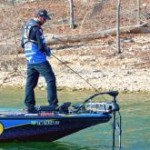
Ott Defoe studies his electronis

Ott Defoe studies his electronis

“The high-tech redneck himself, Ott DeFoe angles from the helm of his tricked-out office.” (Courtesy of Ott DeFoe)

“Man, the front of your boat looks like an aircraft carrier!” quipped a Bassmaster fan, studying Elite Series angler Ott DeFoe’s ride at a recent event. Flashing his trademark grin, the affable bass pro nodded and casually replied “Yessir, I’m a high-tech redneck.”

DeFoe, who in a short span of four years has racked up some impressive credentials on the B.A.S.S. tournament trail, has also emerged as one of the more techno-savvy anglers on tour. In a game that’s increasingly driven by technology, however, competitive fishing for DeFoe is still mostly about dropping the trolling motor and zinging casts down the bank.

But even the trolling motor’s a techno-tool. Albeit after decades of routine use, the common bow-mounted device has become as synonymous with bass fishing as a plastic worm. Like a rod and reel, livewell or crankbait, the trolling motor serves a purpose; has a singular function that helps put more fish in the boat. So while DeFoe speaks with many folks each year who puzzle over his vast network of electronics, he’s comfortable saying that each and every device plays a critical role in his success on the water.

As one of the nation’s top bass anglers, DeFoe freely admits he’s in an enviable position that gives him access to all the sweetest stuff. (Admit it, you would too.) And if the ‘bling on his bow happens to carry a certain “cool” factor, that’s just fine with him.

“These days, no matter where I go, I probably get more questions from folks wondering about electronics than any other topic or piece of equipment,” says the Knoxville, Tennessee based angler. “Specifically, they want to know how electronics can help them catch more bass. That’s the main reason we spend the money and put ’em on our boat-trolling motors, Side-, Down- and 360 Imaging, Talons, GPS mapping and underwater cameras. If they don’t help us catch bass we’re not going to use ’em for very long.”

Shallow Water Scouting

For years, many anglers neglected their sonar-fish finder units. The reason was simple. Most bass anglers spent most of their time in shallow water, casting to visible cover along the bank, where sonar beams couldn’t “see.”

Last season, DeFoe and a few other anglers on tour began using a new sonar tool that unlocked the unseen shallows. Not only was it now possible to see structure below the boat, but the new 360 Imaging device also revealed the water in front of and on all sides around the boat-even in 10 feet of water and less.

A breakthrough occurred for Ott at the 2013 Elite Series event at Lake St. Clair. “On day one, there were three of us fishing this 8 foot point. Little wolf packs of big smallmouths were working all around it, but the point didn’t seem to have any cover to actually concentrate fish.” DeFoe and several others had taken numbers of 3 to 4 pounders off the point, but at day’s end, it seemed to have dried up.

On the second morning, after a few bites, the fish again appeared to vanish. “After the other boats left the area, I decided to hang around a little longer. I felt the fish were still close by, so I returned to my waypoints on the spot, and just moved along studying the screen of my Humminbird 360 Imaging unit.”

Finally, DeFoe spotted a single object on screen-a moderately sized boulder lying on the otherwise clean point. Set to search 100 feet all around the boat, the 360 unit allowed him to determine that the boulder was approximately 75 feet ahead of his position. “I picked up a tube,” said DeFoe, “cast toward the target and immediately got bit. As I fought the 3-1/2 pound smallmouth, I spotted a bunch of his buddies following him to the boat.

“DeFoe calls his underwater camera an ‘awesome time management tool,’ confirming fish species seen on sonar, as well as bass size and their position relative to cover.”

“In my head, a light switch went off. The bass hadn’t left at all but had simply moved away from the boat traffic and repositioned around this single insignificant boulder. Without 360, I would have never seen or caught this fish without spooking him first. Nor would have I stayed and caught several more good fish off the same rock on day 2 and day 3.”

Classic Conditions

At the 2013 Bassmaster Classic, DeFoe cashed a sweet 4th place check, riding the same 360 Imaging unit to success. “Worked awesome for identifying the sweet spots on offshore structure. I could quickly zero in on the stuff that looked good and fire casts right to targets that held bass.”

DeFoe indicated that ultimately, his specialized “full-circle” sonar guided him to key little ditches that cut across main river bars. “Fishing new water on Guntersville, the 360 showed me stuff all around the boat that I couldn’t have found in days or weeks of random casting. At the Classic, you don’t have time to scout. But if you can scout while you’re casting, that’s huge.”

“The coolest thing about 360 was that while I fished, it helped pick out targets-stumps, small patches of emerging grass-before my boat reached them and potentially spooked fish. It showed me these little low spots on the bar, where I eventually caught most of my fish. Got to where I could come pretty close to hitting on-screen targets on the first try. Often, I’d get bit right away.”

Camera Confirmations

Strategically placed among two giant 10-inch Humminbird LCDs, a Minn Kota-mounted 360 Imaging unit, and a HydroWave sound attractor, DeFoe’s boat also houses an Aqua-Vu Micro underwater camera. Underwater viewers, he says, help solve mysteries, yet can also be tremendous time management tools.

“In practice, we’re always trying to find active fish, but not necessarily catch too many of them before the tournament starts. Last year on the St. Lawrence River, which has really clear water, I pulled in to a spot, made a few casts and finally started catching them on a dropshot with a Berkley Gulp Fry. I was marking a few fish on my sonar, but it was hard to tell how many were there. I dropped the Aqua-Vu and immediately saw a nice looking rockpile and probably several dozen smallmouths cruising around. It gave me the confidence to leave the area alone, so it would be fresh come tournament day.”

At the recent Elite Series event on Table Rock Lake, DeFoe’s 2-D sonar identified a massive school of sizeable fish, suspended in timber 20 feet down over 35 feet of water. “It looked like the mother lode. So I spun around and threw a swimbait through the zone. Fished this way for 20 minutes without a bite. I could see fish on sonar, grouped so tightly they almost cluttered out the screen. Finally, I dropped the Aqua-Vu, and saw . . . Gar. Piles of ’em.

“For that reason alone-fish identification-I always keep the camera in the boat. Imagine how much time over the years we’ve spent fishing for the ‘wrong’ species, and wondered why they wouldn’t bite.”
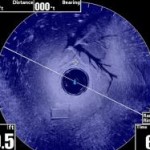
A 360 Degree Sonar helps find fish and cover

A 360 Degree Sonar helps find fish and cover

“At the 2014 Classic, meticulous use of 360 Imaging sonar lead to a 4th place limit, anchored by Ott’s final day 8-pounder.” (Courtesy of Humminbird)

DeFoe adds that he often simply uses the camera to confirm or disprove what he’s seeing on sonar. “It’s awesome for showing bass that get lost in cover-grass, brushpiles or under docks. I like to watch how they’re relating to the cover; how they move around and alongside it. Fun to watch all this on screen. My kids love it. But it’s also a great learning tool that can help determine patterns or even indicate what type of presentation will work best.”

Whether your rig resembles a tricked-out tournament battleship or not, the game’s the same. Find bass. Catch a few. Look cool . . . well, who really cares? Just have fun. So says bass fishing’s high-tech redneck.

–Ted Pilgrim with Ott DeFoe
How Much Fishing Is Enough?

I almost got enough fishing during the past two weeks a few years ago in early May. After fishing the two day Spalding County Sportsman Club tournament at Clark’s Hill April 23 and 24 I left for Center Hill Lake in Tennessee on Tuesday. I fished there four days in a row, and it rained all day each of them.

Although I caught a lot of spotted, smallmouth and largemouth bass and was in second place and had big fish in a tournament there on Friday, it was a two day tournament and I did not catch a keeper on Saturday. To add insult to my zero, my big fish the day before was beat three times on Saturday.

I left Center Hill at midnight Saturday and drove five hours to Lanier, arriving at the ramp in time to get a 30 minute nap before launching the boat. I decided the lack of sleep was my problem when I lost six bass early that morning, but then caught a limit just after noon. The fish that morning hit flukes and I broke my line on one, had two more hit and get off, and I just did not get a good hookset on three more.

After that tournament I drove home and got a little sleep, then got up at 4:30 Monday morning to drive to Oconee. I picked up a couple at the Ritz Carlton and took them fishing for a four hour tournament their business group was hosting. They placed 3rd in their group with the three keeper bass we caught weighing 6.25 pounds. One of them hit a Rat-L-Trap and the other two hit a spinnerbait.

It was fun that morning trying to help the couple learn to cast. Neither of them had ever been fishing. The woman caught a 12 inch bass on her first few casts, the first fish she had ever caught. I think she was thrilled and kept casting hard the rest of the morning.

In that stretch I fished 8 days out of 10 and was on 4 different lakes. I also drove just over 1100 miles in those ten days. I could not stand it when I got home last week so I went to my pond and fished on Tuesday and Wednesday, then went to Bartlett’s Ferry and fished Thursday.

Bass were biting good at Bartlett’s Ferry. I met Randy Duncan there to get information for a Georgia Outdoor News article and we caught about 15 bass in five hours. Most of them were small, but they were fun to catch. To round out the week I fished in my pond on Friday and Saturday.

I love being retired!

My love of fishing came from my mother and her mother. Some of my best memories are of fishing with mother and grandmother on ponds around the house. Mother’s Day always makes me think about those trips and how much they influenced my life. I wish I could thank them again for the time they spent with me and the ways they influenced me, but both are gone now.

May all mothers, fathers and children get to go fishing together any time they can, and make some memories that will last a lifetime. All too soon the chance to go fishing with each other will end.

Should I Use A Big Worm for Post Spawn Bass?

Big Wormin’ During The Postspawn
from The Fishing Wire

Use a big worm for postspawn bass

Use a big worm for postspawn bass

“I always have a 10″ Power Worm tied on during the postspawn because it’s just one of those baits that the bass will eat.” – Scott Ashmore

Broken Arrow, OK – Elite Series pro Scott Ashmore lists a 10″ Berkley PowerBait Power Worm as his confidence bait when it comes to targeting postspawn largemouth.

“The big worm really starts to shine when the water temperature approaches 80-degrees, regardless of where you’re fishing across the country,” explains the Oklahoman, who has amassed over $120,000 in career earnings. “After spawning, the bass begin migrating to main lake points and ledges, and a 10″ Power Worm is the best bait that I’ve found to intercept bass during that transition period.”

Ashmore begins his search for schools of postspawn largemouth by looking at prime spawning areas in the backs of creeks or pockets. “Bass will use the same routes to leave the spawning areas that they used to enter the spawning areas earlier in the spring,” states Ashmore. “If you can identify where they spawned, you have a starting point where you can slowly begin working towards the main lake, combing classic postspawn areas like secondary points and subtle ledges.”

Another key underwater feature that Ashmore likes to target when searching for postspawners on manmade fisheries is ditches or creek beds running into pockets that were created before the lake was filled. “They’re natural migration routes that the bass use year after year,” he points out.

Covering water is a key component to success during the postspawn, and Ashmore believes that there’s not better tool for the job than a Carolina-rigged 10″ worm fished with a 2′ to 3′ leader and ¾ oz. tungsten weight. “In the heat of the summer, I’ll throw a Texas-rigged 10″ worm with a ½ oz. bullet weight and catch fish all day long out of isolated brushpiles,” he explains. “But during the postspawn when the fish are not as target oriented, a Carolina-rig allows me to cover more water and find those groups of cruising bass that are in transition.”

The majority of the time, Ashmore relies on 20-pound-test Berkley 100% Fluorocarbon line for both his main line and Carolina-rig leader. “I like 20-pound-test fluorocarbon because most of the time my line is dragging across rocks and the weight is bouncing on the line,” he states. “If I’m fishing in really clear water, I’ll drop down to 15-pound-test 100% Fluorocarbon for my leader.”

As a general rule, darker colors like Red Shad and Plumb get the nod. “Red Bug seems to work well on some of the southern fisheries like the St. Johns River, and Blue Fleck is probably my favorite color on Oklahoma lakes,” explains Ashmore.

When it comes to hook selection, he pairs the meaty 10″ worm with a light wire 5/0 or 6/0 wide gap worm hook. Ashmore believes that the light wire allows for easier hook penetration when setting the hook at long distances, and it also gives the worm a more realistic action and allows the bait to flow naturally through the water.

On the topic of a natural appearance, Ashmore has difficulty explaining exactly why bass have an affinity for 10″ worms. “All I can say is that I guess a 10″ worm puts a little mystery in the ballgame,” he states with a chuckle. “I don’t think the bass really know what they’re looking at when they see a big worm, so it generates a reaction bite. All I know is that they eat the bait and that I have a lot of confidence in it. Beyond that, I don’t try to over think it.”