Category Archives: Bass Fishing

Bass Fishing Information

What Is A Game Plan for Tournament Success?

Game Plans

Smart Prep For Tournament Success

By Dan Johnson
from The Fishing Wire

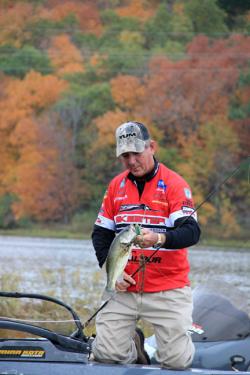
:Plan to catch big small mouth like these

:Plan to catch big small mouth like these

Loading up on smallmouth like these takes pre-planning and lots of scouting.

Anyone who’s fished a tournament knows there’s more to competing than simply showing up on game day and relying on sheer luck to put fish in the boat. Especially if you want to win. Serious runs up the leaderboard require a dedicated blend of research, practice and preparation.

“Given the level of competition at everything from local club tournaments to larger regional events, you really have to do your homework,” says veteran bass tournament angler Scott Bonnema. Following are his thoughts on gearing up for success.

Discovery Phase

When fishing new waters, research is a great ally in the quest for victory. “It’s all about identifying where catchable fish will be during the tournament,” says Bonnema. Fortunately, a variety of sources offer intel.

Naturally, the internet is an amazing tool. Everything from angler forums and fishing reports to Google Earth and state fisheries departments can provide insight into specific fisheries. Tournament results from events held on the lake you’ll be fishing-especially during the same time of year-can also be golden. “Websites like ClassicBass.com, which post results and tournament news, can give you an idea of top locations and presentations, along with what kind of weight it may take to do well in an event on that body of water,” says Bonnema.

On-Site Recon

Bonnema is a big believer in on-the-water reconnaissance, and credits extensive scouting for his recent top-five finish and big-bass honors at the recent Sturgeon Bay Open, which saw 150 teams battle on Wisconsin’s legendary Sturgeon Bay.

“I arrived two weeks ahead of the tournament, and also fished a Cabela’s North American Bass Circuit event the weekend before, which gave me a great idea of where and how to fish during the Open,” he explains.
Where you position your boat is critical

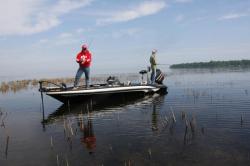
Where you position your boat is critical

Pinpoint boat positioning is critical to properly fishing prime lies. Often, this is impossible in crowded “community” holes.

He cautions, though, that early recon must be tempered if you expect the fish to move between then and the tournament. “When fishing partner Mark Fisher and I started breaking down Sturgeon Bay, the water was cold and most of the bass were still in deep water,” he says. “We knew that warming water would bring them in by game day, so we focused on areas we thought would hold fish during competition.”

Given the likelihood that waves of sag-bellied smallmouths would swarm the shallows once water temperatures warmed, that meant looking for fast-warming bays with ample depths in the 2- to 6-foot range. “We focused on large bays that allowed the fish to be in seven or eight spots instead of one or two, which gave us better odds of being able to fish at least one of the areas properly,” he noted.

Which brings up a key point in Bonnema’s pre-game planning. Knowing that 150 tournament boats and countless recreational anglers would descend upon the bay’s prime lies, he focused on spots that could handle the pressure, while providing an opportunity to thoroughly fish productive areas. “Boat positioning is critical,” he explains. “So we ruled out small spots that could only be effectively fished by one or two boats.”

To find potential hot zones, Bonnema cruised the shallows, both visually scanning with polarized glasses and using the side-imaging feature on his Humminbird 1199ci HD SI sonar-chartplotter combo to pinpoint and map prime structure. “We looked for anything that would attract bass or funnel their movements, such as subtle depth changes of six to 12 inches, or the edge where a line of rocks transitioned to sand,” he says. “Such spots may vary by species and from lake to lake, but there will always be key features that concentrate whatever fish you’re after. Finding them before the tournament is critical.”

Mapping is a matter of marking points of interest with icons that enable instant recall, even months or years after the initial scouting run. “Take time to choose symbols and names that mean something, and will help you remember what the waypoint is for,” he says. “For example, I use a Red Cross medical symbol to mark hotspots where I can ‘get healthy’ in a hurry if I’m struggling in a tournament. I also use small symbols for boat position, and larger icons for structure.”
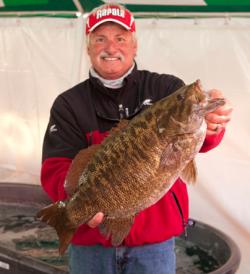
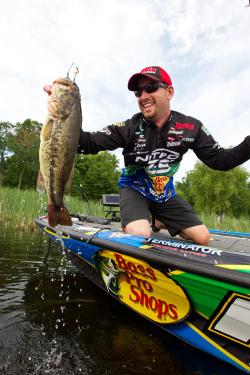
Plan to catch tournament winning bass

Plan to catch tournament winning bass

Solid pre-tournament scouting helped Bonnema bag big-bass honors at the 2014 Sturgeon Bay Open with this 8.29-pound smallmouth.

When charting a choice piece of cover or structure, Bonnema advises highlighting both the area you expect to hold fish, as well as where you should position your boat to work the spot. “In clear, shallow water, long casts can be key, so keep your boat as far from the fish as possible,” he adds. “Humminbird’s side-imaging makes it easy to mark waypoints on structure 60 to 100 feet from the boat, without ever driving over the fish.”

Lure Selection

While some anglers pare down tournament tackle to a handful of rods, reels and baits needed for a few pet presentations, Bonnema brings a complete arsenal on the road. “I’m not saying you need to spend a fortune on tackle,” he says. “But, you’re already spending hundreds of dollars on gas, food and lodging. You don’t want to lose because you don’t have the right size or color spinnerbait.”

At Sturgeon Bay, for example, Bonnema and Fisher dialed in a very specific combination of rod, reel, line and lure to fool the system’s biggest bass-including the monstrous 8.29-pound bronzeback Bonnema landed during competition, and another 8-pound behemoth taken during practice.

“After much experimentation and tweaking, we found that light-green, 3½- and 4 ½-inch, paddle-tail Trigger X Slop Hopper produced better fish than standard grub bodies,” he says. The softbait was threaded on a 3/16-ounce VMC Darter Head Jig. “Having the line tie stick straight up on the jig head was key, because we were moving it very slowly, barely ticking the tops of the rocks,” he says.

A 7-foot, medium-light Team Lew’s spinning outfit engendered long casts and solid hooksets, while transmitting details on bottom ticks and subtle takes alike. Bonnema spooled with 10-pound Sufix 832 superbraid mainline and added a 5-foot, 7-pound Sufix Invisiline leader for added stealth. “Swapping out any one of these components completely changed the presentation and resulted in fewer big fish,” he adds.

As a final tip to budding tournament competitors, Bonnema recommends building a game plan with multiple fallback strategies. “After figuring out the best locations and right equipment, put together a few ‘Plan B’ options to allow for wind and weather changes, fishing pressure and other factors that cut shut down your main program,” he says. “That way, you won’t be scrambling when the bite changes on game day.”

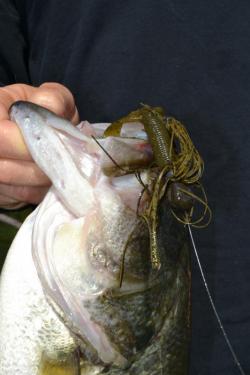
Fishing Jigs I Use and Like

I like these jigs for bass fishing:

Strike King Bitsy Bug Jig

Strike King Bitsy Bug Jig

Smallmouths love these downsized Bitsy Bug Jigs from Strike King! Premium silicone skirts and fiber weedguards.


Strike King Tour Grade Football Jigs

Strike King Tour Grade Football Jigs

Strike King’s Tour Grade Football Jigs are the ultimate deepwater, big-bass jigs! A wide football shaped head gives the Tour Grade Jig a superior feel and helps the jig stand-up and tantalize on the bottom. The flat eye line tie helps keep the line, knot and jig in the proper position, while an extra-sharp Gamakatsu 60 round bend hook promotes true hook sets. Featuring durable powder-coated paint jobs and color coordinated weedguards, the Tour Grade Football Jigs sport premium skirts that produce a lifelike look and action.


Strike King Rattling Pro Model Jigs

Strike King Rattling Pro Model Jigs

This double-barrel Strike King Rattling Pro Model Jig packs twice the fish-attracting sound other lures have. A fiber weedguard should boost your confidence by allowing you to run this lure through thick cover you wouldn’t dare cast before. Strike King’s proven Pro Model Jig features Mirage silicone skirts and an ultra-sharp black nickel hook


Clarks Hill Fishing Memories

On an April weekend members of the Spalding County Sportsman Club were fishing our April tournament at Clarks Hill. This is something of a tradition, we fish it almost every April and have missed very few years since I joined the club.

It is almost unbelievable to me that this is the 40th anniversary for me in the club. Jim berry and I fished the Sportsman Club April tournament at Clarks Hill in 1974. That was the first tournament I ever fished and I have been in the club every year since then and have missed very few club tournaments.

In 1975 I was elected Secretary/Treasurer of the club and have held that office most of the years since then. The first bulletin I sent out in 1975 had Vol. 11, no.1 at the top and I have kept that running since then. The April bulletin this year was Vol 50, No. 4. I assumed that meant the club had been in existence for l0 years when I joined but now think it was just the bulletin that has been around since 1964. I have been told the club started in the 1950s.

Gary Hattaway was in the club when I joined and is still in it, although he was not a member for a few years when he lived in Alabama. So, I am the only member left that has been in the club every year, and Gary is the only one left that was around way back then. I have made some great friends through the club but far too many of them are no longer around.

I moved to Griffin in 1972 and lived at Grandview Apartments while teaching at Atkinson Elementary. Each morning I drove College Street to 6th, turned right and went out to where it ends at Hill Street, then on to Atkinson. I reversed that in the afternoons which meant every afternoon I passed by Berry’s Sporting Goods that was located on 6th Street for many years.

Few afternoons passed that I didn’t stop and spend way too much of my princely teacher’s annual salary of $5600.00. But I got to be friends with Jim and we started fishing together some. He and Emmett Piland took me to the Flint River wading the first time, and we fished many local ponds, too.

In March, 1974 I bought my first bass boat and joined the Sportsman Club the next month. It was a big club back then, with about 75 members, and at the tournament we had 44 fishermen, many more than now. The Sportsman Club had just started fishing bass tournaments a few years before I joined and the club tournament rules still reflect that early start, with few rules and restrictions that most tournament have.

Back then there were two divisions in the club and newer fishermen went into “B” division since they were based on points from previous tournaments. We were more relaxed, with camping and fish fries more important than the actual tournament. There was a card game by the campfire most nights and we had a great time. I still do have a great time at tournaments, but it is a little more intense.

In that first tournament I just knew I would do well since I grew up on Clarks Hill and expected to catch a lot of fish. But that tournament taught me how different tournament fishing can be. Jim and I caught six keepers each day, far short of the ten fish limit back then. But many in the club had limits both days and I was surprised at the size of fish brought in.

That taught me real fast that someone would catch bass no matter what the conditions, and they could catch bigger bass than I thought possible. In that tournament Jim Goss had a bass weighing over six pounds and several five pounders were weighed in. My l2 in two days weighed about 14 pounds! But I still finished third in my division, but my catch would have been 15th in the other division.

Tackle, electronics, boats and expenses have come a long way in 40 years. My first boat was a 16 foot Arrowglass with a 70 horsepower Evenrude motor. And it was pretty top of the line, there was only one boat in the club with a bigger motor. My last boat costs over $30,000 used and the electronics I have on it cost more than my first boat!

I fished back then with two Mitchell 300 spinning reels, presents from my parents when I was 17, and an Ambassadeur 6000 casting reel, a present for my 21st birthday from Linda. Now I have 15 to 18 rods and reels on my deck in a tournament, with at least ten more in the rod locker. Line is much better as are plugs and plastic baits. And trolling motors and batteries are much stronger and last longer.

The biggest change is knowledge of what the bass do. Back then we pretty much fished shoreline cover and that still works, especially in April, but many bigger fish are caught from offshore structure like humps, and are caught much deeper than we used to think they lived.

Even with all the changes I still love it and it is great fun.

Fishing A Tournament At West Point in August

In 2004 Ronnie Gregory showed me around Lake Eufaula before the Top Six Tournament and the places and patterns he put me on helped me place 7th.

On a Friday in August the next year Ronnie and I went to West Point. He fishes there a lot, and he helped me get ready for a Flint River club tournament we were fishing on Sunday. Ronnie’s knowledge of the lake was impressive, and he took me to some spots that I never fished before, even though I have been fishing that lake since it was built.

In five hours of fishing from 6:30 AM until 11:30 AM we landed five keeper bass and several under the legal size. Ronnie started the day right with one weighing about 4.5 pounds and it was the only largemouth keeper. The others were all spotted bass.

Most of the fish hit in brush down about 12 feet deep and I hope that pattern holds up for the tournament today. We are fishing until 3:00 PM and Ronnie showed me some places he says the bass bite better after noon. We did not catch anything there but I will try them. That is detailed knowledge of a lake when you can predict what time the bass will probably hit.

Then on Sunday 20 members and guests fished the Flint River August tournament at West Point Lake. Fishing was very tough and there were only 28 keepers weighing 47.13 pounds brought to the scales. There were eight largemouth and 20 spotted bass weighed in.

Kwong Yu won the tournament with 3 bass weighing 7.23 pounds, Tom Tanner was second with 4.66 pounds, Roger Morrow placed third with 4.41 ponds and Tony Roberts came in fourth with 4.40 pounds. Bobby Ferris had big fish with a bass weighing 4.20 pounds and placed fifth.

After Ronnie Gregory showed me some brush piles on West Point before the tournament I was fairly confident about this tournament. Ronnie and I fished for five hours and landed five keeper bass weighing about 10 pounds. Those five would have easily won the tournament, but they hit too early.

The brush piles that produced keeper fish on Thursday morning had nothing but short bass in them during the tournament. I did manage to land one barely legal spot weighing right at a pound and placed 14th. Linda fished with me and although she caught more bass than I did, all her fish were too short to weigh in.

Sometimes it seems practice before a tournament hurts rather than helps!

All Star Rod

I have a variety of rods and reels that I use all the time and some are favorites. Often when I get a new outfit it never feels just right and it becomes a secondary rod and reel that I usually keep in my rod locker. It is often hard to tell how an outfit will perform until actually fishing with it.

At the Georgia Outdoor Writer’s Association meeting in May a few years ago I purchased an All Star rod with a Pflueger reel. Both those companies are now owned by Shakespeare and they had sent us some equipment for the organization to raffle off to raise funds. I got the outfit at a very good price.

That outfit quickly became a favorite of mine. It worked well for jerkbaits and I landed a three pound spotted bass in a club tournament at Lanier in late May on it. Then I started using it for Texas rigged worms and caught several of my bass at Weiss on it, including a four pound largemouth.

At Oconee in June I set the hook on what I thought was a bass beside a boat dock, but it was probably the dock piling. When I set the hook the rod broke at the first guide up from the reel, breaking so hard it also broke my line. I grabbed the end of the rod before it could sink and put it up.

I mailed the broken rod back to All Star and a couple of weeks later I got a brand new one just like it in the mail. Their warranty service was excellent and they made my rod good even though I had not sent in the warranty card.

I like the rod even better now. I got it back just in time to use it at the Jackson night tournament and I landed four of my five keepers on it while fishing a jig and pig. The seven foot rod is pretty stiff and handles 15 pound line easily. The rod is a TAS 826c and All Star says it is a soft jerkbait rod. To me it is much more. I am glad I got that outfit – it is already one of my favorites.

Can I Catch Bass At Night?

on a Saturday night in July a few years ago 14 members of the Spalding County Sportsman Club fished our July tournament at Jackson. We fished from 7:00 PM until 2:00 AM trying to avoid some of the heat, and it was slightly cooler after the sun went down. Fishing was tough in the heavily stained water, with seven members not bringing in a keeper fish.

We landed 23 bass over the 12 inch minimum size and their total weight was about 35 pounds. I had the only limit and my five weighed 8.22 pounds for first place. James Pilgrim, Jr. had four weighing 7.99 pounds for second and his 4.04 pound largemouth was big fish for the tournament.

Butch Duerr had four keepers weighing 7.31 pounds for third, David Pilgrim had 3 weighing 4.54 for fourth and Jason Wheeler’s 3 weighing 3.09 pounds rounded out the top five. Of the 23 keepers brought to the scales, 13 were spotted bass and 10 were largemouth.

I was on some kind of strange schedule. For the first two hours I caught about four bass too small to keep, and a 3 pound catfish. Then I caught a keeper every hour, just about on the hour, from 9:00 PM until 1:00 AM. Each fish got a little bigger than the one before it, but I started with one just barely 12 inches long. The second one was 12.25 inches and the third just a tad bigger.

My last two fish were decent keepers, with a 2.5 pound spotted bass just after midnight and a 3.31 pound largemouth just after 1:00 AM. The first fish I caught hit a Zoom Mag 2 worm and the last four hit a Rattleback Jig with a Zoom Fat Albert twin tail trailer.

Night fishing is a lot more comfortable this time of year, and the bass do feed in the dark. Give it a try one of these warm summer nights. You might like it.

How Did Zell Rowland Weigh In 25.5 Pounds of Bass At Dardanelle?

How I Weighed In 25.5-Pounds At Dardanelle

By Zell Rowland
from The Fishing Wire

Zell Rowland

Zell Rowland

Zell Rowland didn’t manage to win at Dardanelle, but his 25.5 pound sack was the heaviest landed during the event thanks to his jigging expertise.

I didn’t win the B.A.S.S. Elite tournament on Arkansas’ Dardanelle May 16 through 19. I placed 17th in the final standings, which is disappointing, but I did bring in the biggest sack of the tournament on Day 2 – 25.5 pounds! Anytime you have a bag like that it’s worth talking about.

Conditions made fishing tough. Rain beat our butts every day on that Arkansas River impoundment, and conditions changed daily. Water levels shifted – up 4 or 5 inches one day, down 4 to 6 inches the next day – every day.

Drawing water or a water level change for any reason alters what the fish do daily, and sometimes even hour-by-hour. That made for tough fishing at times. Subtle changes in conditions could take place, and they weren’t always immediately evident. We had to make adjustments every day.

Heavy Booyah jig

Heavy Booyah jig

A heavy Booyah jig was a big part of Rowland’s secret at loading up on quality fish offshore.

I did much of my fishing on Lake Dardanelle flipping a Booyah jig and YUM Chunk trailer. I used two main colors, black-and-blue and green pumpkin. I fished black-and-blue much of the time in muddy water and green pumpkin in situations where there wasn’t so much stain.

During practice I’d found a good fish and knew it was still there, so that’s where I started on Day 2, hoping to improve on my 11-pound total from the first day. I pitched that jig to the laydown, and, sure enough, the fish was still there. But I lost him! As I stood there staring at the laydown, however, I noticed the water level was lower than it had been.

So I played a hunch. I moved to another spot with deeper water up along a rocky ledge. It didn’t have a laydown, but that didn’t matter. I caught a fish between 5 and 6 pounds right away.

Zell Rowland and Bass

Zell Rowland and Bass

Rowland chose a jig to score at Dardanelle, but he’s also well known for loading up with a variety of topwater lures.

The spot reminded me of another – a spot that hadn’t received much fishing pressure to my knowledge. I arrived there at 11:00 A.M. It took me two or three hours to fish the entire area, working up one side and down the other. Wherever I found the right scenario – where the water dropped – the fish would bite me. I didn’t get a lot of bites, but every one was a big one.

I could almost call my bites that day!

The fish were on wood and in front of boulders. But with the water falling, they had pulled to slightly deeper water than they had been for the past few days. The key to flipping the wood was to pitch to the middle of the tree and work it on out to deeper water instead of pitching all the way up to the bank.

Working the current was also a key factor. The fish that were holding near boulders were always positioned at the front of the boulder – not on the side, not behind it. They were right out front.

And they were extremely aggressive! You had no doubt when one bit. That made it a lot of fun. I would pitch in front of the rock and let the current flush the bait toward the boulder. The bass wouldn’t hesitate. They came up to get it. I would pick up the line and instead of the jig being up on that boulder, it would be 3 feet out front – with a fish on it!

My Booyah jig and YUM craw presented a large profile, and the dark silhouette was something the bass could see even with limited visibility. Determining how the fish were reacting to the changing water levels was equally important in pinpointing the fish.

It’s not often you get a sack of fish more than 25 pounds on Dardanelle – or anywhere else, for that matter.

Does Plano Make A Solution for Tangled Spinnerbaits?

New Solution for Tangled Spinnerbaits
from The Fishing Wire

Plano, IL – If you read today’s fishing magazines, you’d think the spinnerbait was dead. Yet, while everybody’s throwing swim jigs in lieu of the old standby, blades are looking pretty new again to conditioned fish. Just ask KVD. He still carries dozens for running and gunning, burning over and through cover and commanding big aggression strikes.

And if bass anglers across the country were honest, they’d tell you the same thing: spinnerbaits rock.

The Plano 3505 Hydro-Flo is a great solution for storing spinnerbaits without tangling, keeping them rust free and easy to locate by size and color.
But storing them and other baits sporting treble hooks – crankbaits, chatterbaits and the like? Not so much.

Truth be known, the ubiquitous A-rig was actually inspired by a neglected chandelier of spinnerbaits found in the bottom of a flea market tackle box.

Sure, binders are an option but they’re a pain to access in the heat of the moment and also have a tendency to fatigue wire frames. And while most hard boxes designed for spinnerbait storage succeed at simple consolidation, they can’t vent moisture, resulting in rust and skirt damage.

Addressing these issues and more-Plano introduces the 3505 Hydro-Flo™ Hanging Bait StowAway, a storage solution that’s 100% easy access and common sense. For starters, you won’t find any fancy gadgetry for orienting heads, hooks and blade arms; instead, baits are easily placed and retrieved from generously spaced grooves that prevent baits from tangling. Plus, wire blade arms are kept in proper shape so that bait’s guaranteed to fish like it’s supposed to. And you’ll have plenty to choose from-the 3505 features three adjustable bait racks that will hold a maximum 72 baits at full occupancy! Group baits together by color, blade type, size or weight for easy visual assessments.

Spinnerbaits have long been a favorite tool among pro anglers for extracting big bass from difficult cover.
Originally concepted to manage spinnerbaits, the Hydro-Flo Hanging Bait StowAway effectively houses and keeps untangled casting and trolling spoons, chatterbaits, crankbaits, buzzbaits, in-line spinners and bucktails.

And now, for the first time ever in hanging bait organization history, Hydro-Flo™ ports allow wet baits to dry naturally, virtually eliminating rust and extending the life of synthetic skirt materials. That means no discovering at the worst possible moment-like when a school of bass bust bait off the bow-that your favorite bait is a lifeless heap of mangled, stuck-together rubber.

At roughly 10 inches wide by 8 inches deep and 6 inches high, the 3505’s footprint will store in larger boxes and bags, as well as nestling into various boat compartments. Plus, when it’s time to boogie with your collection of bug-out bag baits, a swivel carry handle makes transport easy. All that and construction that promises set-it-and-forget-it, like secure Plano’s renown Pro-Latch closure that promises your baits are tucked in and tidy … no chandeliers at the bottom of the box.

Why Does Terry Scoggins Always Have A Big Worm Rigged and Ready?

Yamaha Pro Terry Scroggins Always Has Big Plastic Worms Ready
from The Fishing Wire

Bass May Hit These Lures When They Won’t Touch Anything Else

Catch big bass on big worms

Catch big bass on big worms

Elite pro Terry Scroggins always keeps several rods rigged with giant plastic worms, which he says produce big fish almost year around.

Terry Scroggins has a rod box on his boat filled with more than a dozen different styles of fishing rods, just like every other tournament angler, but what sets him apart is that several of his rods are always rigged with big, oversized plastic worms. The Yamaha Pro fishes 10-inch plastic worms year-round, something few of the other pros do.

“I’ve been fishing big worms like this my entire professional career, and I know there are times bass will hit a big worm when they won’t touch anything else,” notes Scroggins, whose single best day with the lure included five bass weighing 44 pounds, four ounces.

“I think the best way to fish big worms is to work them very slowly, which may be the reason bass hit them so well. It’s probably also the reason more pros don’t fish them, because it’s hard to make yourself fish slow in tournament competition.”

Scroggins does the majority of his worm fishing on offshore structure, often 20 to 25 feet deep, where he finds ridges, humps, and even rockpiles and brush. The day he caught the 44-4, he was targeting an underwater roadbed in 23 feet of water.

Scroggins likes a ribbon-tail type worm that floats, typically about 10 inches long.
“I rig my 10-inch worms Texas style to make them weedless,” explains the Yamaha Pro, “and use slip sinkers ranging from 5/16 to 1/2 ounce, depending on the water depth. There are a lot of 10-inch worms on the market, but I prefer a ribbon tail style that floats.

“When I make a cast and let the worm sink to the bottom, the tail will not only stand up, it will also sway and even swim in the current. It really looks alive, and I can easily imagine bass swimming up to look at it.”

On his initial cast, Scroggins crawls the worm up to the edge of the cover he’s fishing, and when he feels the sinker touch it, he stops reeling and just lets the worm sit there motionless for as long as 30 seconds. Then he pops his rod once to make the worm jump, then lets it sit motionless 10 more seconds before reeling in for another cast.

“On more than one occasion, I have caught more than a hundred bass a day doing this,” he explains. “During a Bassmaster® Elite tournament on Lake Wheeler in Alabama several years ago, I actually caught about a hundred bass a day on three of the four days using a 10-inch plastic worm. I started the event fishing a jig because I could fish it faster, but after the bass stopped hitting it, I changed to the big worm, and it was as if the bass had never seen a lure like that before.”

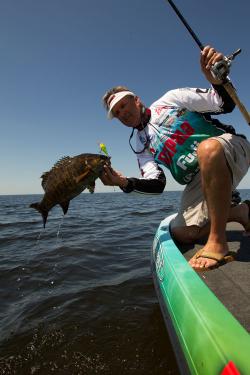
Big bass like this one have no problem eating a 10-inch worm, or even larger.
The Yamaha Pro also likes to fish big worms in current, always casting upstream above his target and slightly across the current so the water can wash the lure down naturally. What’s important here is keeping a semi-tight line to maintain better control over the lure.
In standing timber, Scroggins will start his retrieve before the worm falls completely to the bottom, slowly swimming the lure through the trees. When the worm hits a tree limb, he lets it sink several feet in hopes of generating a reflex strike before resuming his retrieve.

“Most of the time, I actually use a Carolina rig with a shorter six-inch plastic worm to find bass,” continues the Yamaha Pro, “because I can fish it so much faster and cover more water. If I get two or three strikes with it, then I’ll start using the larger worm and slow down.

“There is a lot of difference between a six-inch worm and a 10-inch worm. The larger worm naturally has a larger profile in the water, and when it is standing up on the bottom with its tail waving in the current, it certainly is much more attractive to bass, especially bigger fish.

“I’ve been fishing these 10-inch worms for more than a decade now, and I don’t hesitate to throw them in the spring, summer, and autumn. Honestly, I’ve never been to a largemouth bass lake where they didn’t catch fish.”

Bassmaster Elite Series Anglers Unveil Secrets For Spring Bass Success

Bassmaster Elite Series Anglers Secrets For Spring Success

Rapala® Pro-staffers Share Tips On Go-to Baits, Tactics And More
from The Fishing Wire

MINNETONKA, Minn.- Anyone serious about fishing knows each season brings unique challenges. But only the best will take advantage of new opportunities this spring as waters warm and the spawning season kicks into high gear.

As mainstays of the Bassmaster Elite Series tournament circuit, Rapala® pro-staffers Ott DeFoe, Bernie Schultz and Mike “Ike” Iaconelli know what it takes to land monster fish year-round.

Now, DeFoe, Schultz and Ike have joined forces to unveil their tips to help anglers make the most out of the spring fishing season and catch more bass than ever before.

Ott DeFoe’s Go-to Spring Bait

Ott DeFoe

Ott DeFoe

Elite Pro Ott DeFoe likes a Terminator T-1 Original Titanium spinnerbait slow-rolled in early spring.

For Ott DeFoe, 2011 Bassmaster Rookie of the Year, spring means you’ll find him fishing the shallows, throwing Terminator® T-1 Original Titanium Spinnerbaits, a bait that helped him catch his biggest five-bass tournament limit to date – 30 pounds, 15 ounces – on Texas’ Lake Falcon in 2013.

“This time of year fish are more than likely going to be moving into the shallows near some type of cover off of points, and there’s no better tool for targeting these areas than spinnerbaits,” says DeFoe. “I almost always have a T-1 tied on during the spring. The key is to make sure you fish them at the right pace.”

Coming out of the colder months, a fish’s metabolism will still be slow, which means a moderate pace is best for triggering strikes, explains DeFoe.

“If you’re working spinners, take your time and don’t burn them,” advises DeFoe. “Try slowly rolling the bait around trees and rocks, making light contact. Keep it moving steady and don’t linger in one area too long. I usually make one or two casts to a piece of cover then go on to the next one to cover more water.”

In terms of presentation, he recommends a 1/2-ounce Terminator T-1 Spinnerbait with a small silver Colorado blade to add a little extra thump to the bait. Choose a skirt in a color pattern that matches the local hatch and the hawgs won’t know what hit ’em.

Schultz’s Secret for Fishing the Grass

Bernie Schutz

Bernie Schutz

Florida pro Bernie Schultz shows he knows how to catch ’em up north, too, with this whopper smallmouth.

All the greats know that when it comes to spring fishing, location is everything. In fact, it’s often the difference between a successful day on the water and going home empty handed.

Bernie Schultz, an eight-time Bassmaster Classic participant, honed his skills fishing the grass-heavy lakes in his home state of Florida. However, he’s a firm believer that the Sunshine State isn’t the only place where anglers can find monster fish lurking in the green stuff.

“If you’re looking for the perfect spring Bass spot, it doesn’t get much better than finding a thick grass bed near a busy spawning area,” says Schultz. “You can typically find fish gathered in shallow pockets with easy access to sunlight where they’ll stage in or above the vegetation.”

Schultz recommends casting lipless crankbaits like the Rapala Rippin’ Rap® or Clackin’ Rap® into the grass and ripping them out to trigger reactive bites.

“The key with these lures is to make irregular contact with strands of grass and then rip the bait free,” Schultz explains. “When you snag a strand for just a moment, that slight pause, combined with the lures’ loud rattle are sure to grab fish’s attention.”

Practice Patience in Cold Waters

Although novice anglers may look for the hot new spring fishing tactic each year, the best strategy is to not overthink things. By the peak of the season, the urge for fish to spawn will be irresistible, meaning anglers can usually turn to a tried-and-true approach that has produced for them in the past.

However, according to Schultz, in rare cases when the water is still very cold following a harsh winter – like the most recent one – anglers need to adjust their mind-set more than their bait selection to find elusive lunkers.

“Patience is absolutely a virtue with cold-water fishing. To have success you need to work slow and take time to detail where fish are settling in. Non-reflective jerkbaits will be some of the best tools in your tacklebox,” says Schultz. “The Rapala X-Rap® or new Scattter Rap® Minnow are two of my favorite lures for frigid days on the water. No matter which technique you use, you’ve got to be thorough and deliberate. The fish are there – you just need to make them bite!”

How Ike Finds Finicky Fish

Mike “Ike” Iaconelli, 2006 Bass Angler of the Year and 2003 Bassmaster Classic Champion, also says spring is one of his favorite seasons for catching trophy Bass. But as anglers look to spend more time outdoors after a long winter, the season can also bring the year’s most crowded waters.

According to Ike, anglers can set themselves apart from the crowd by targeting fish located on cover and structure that is not visible to the naked eye. Using a depth finder, Ike locates hard-to-find cover and subtle depth changes, then ties on baits that he can use to feel along the bottom, like the quick-diving cranks from the Rapala DT® (Dives-To) Series.

“I also like to use more finesse presentations in the springtime,” Ike says. “Sometimes baits with an in-your-face action don’t do the trick. If the fish just don’t seem to be interested, it’s time for a change. That’s when I switch to a silent, tight-crankin’ lure like the Rapala Shad Rap® to offer up what looks like an easier meal for finicky fish.”

With these tips from some of the world’s most successful Pro Bass Anglers, even the most inexperienced anglers can fish like the pros this spring. For more helpful tips for on-the-water success, connect with Rapala online at www.Facebook.com/RapalaUSA.

About Rapala – The Most Trusted Name in Fishing

Rapala was unofficially founded in 1936 when Lauri Rapala invented the Rapala fishing lure. Rapala has grown from humble beginnings to become a market leader in the fishing tackle industry. The brand’s functionality and high quality are known by fishermen worldwide. Rapala maintains its strict standards of craftsmanship while delivering its fishing products to anglers in more than 130 countries. For more information on Rapala, please visit www.rapala.com